

AI Agents vs Generative AI Comparison
 Suyash Raizada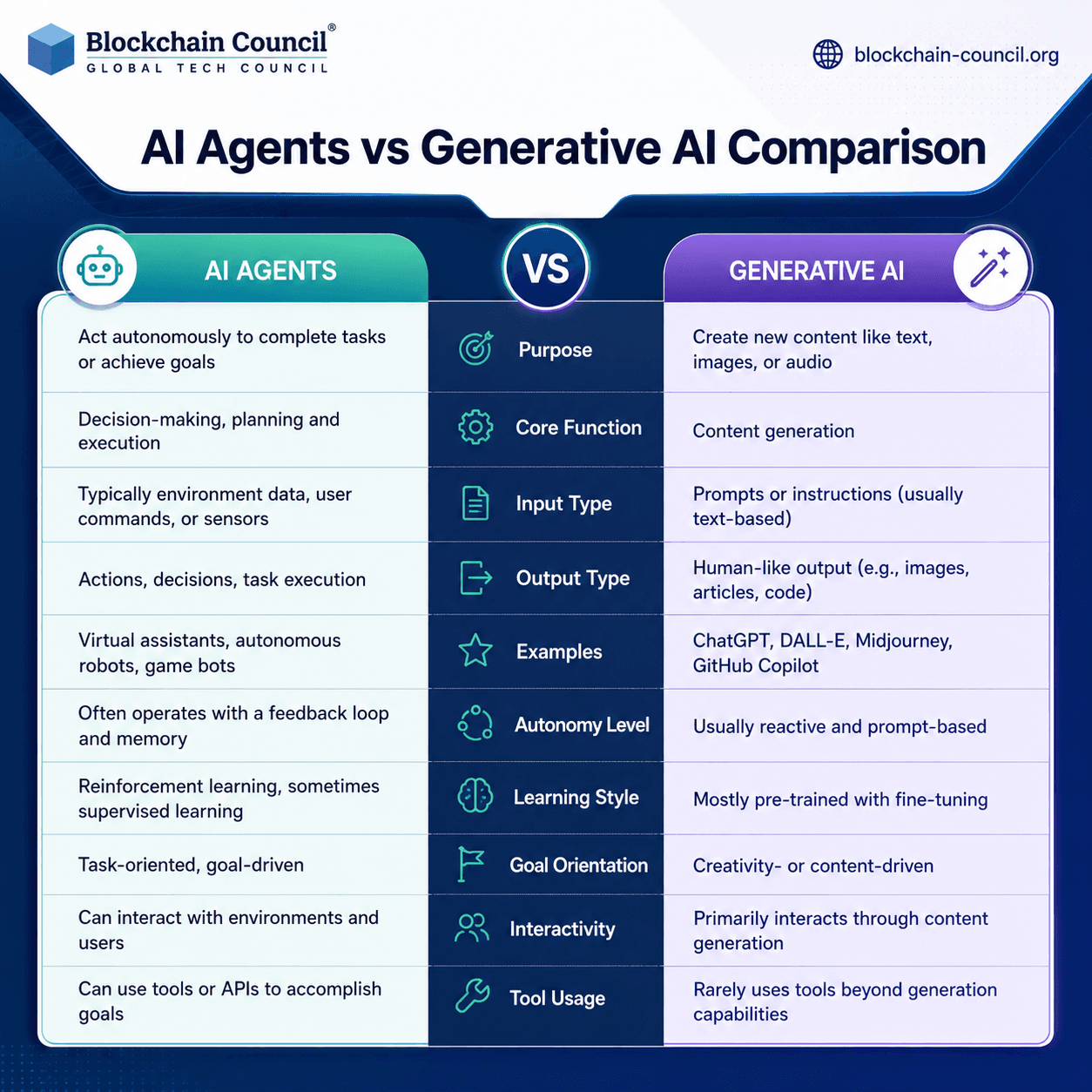
Artificial Intelligence is evolving at a rapid pace, and two of its most discussed concepts today are AI agents and generative AI. While these terms are often used interchangeably, they represent fundamentally different approaches to intelligence and automation.
Generative AI focuses on creating content, such as text, images, and code, while AI agents are designed to act autonomously, make decisions, and interact with environments to achieve specific goals. Understanding the distinction between these technologies is essential for businesses, developers, and professionals seeking to leverage AI effectively.

This article provides a detailed comparison of AI agents and generative AI, covering their definitions, architectures, applications, benefits, challenges, and future developments. It also highlights the importance of professional learning through certifications such as the Agentic AI expert certification, Generative AI expert certification, AI expert certification, and Claude AI Certification.
What is Generative AI?
Generative AI refers to a class of AI models that can generate new content based on learned patterns from data. These systems are typically powered by deep learning architectures such as transformers.
Key Capabilities
Text generation
Image and video creation
Code generation
Audio synthesis
Examples
Chatbots that generate responses
AI tools that create artwork
Code assistants that write software
Generative AI is widely used for creativity, automation, and productivity.
What are AI Agents?
AI agents are systems designed to perceive their environment, make decisions, and take actions to achieve specific objectives. Unlike generative AI, they focus on goal-oriented behavior rather than content creation.
Key Capabilities
Autonomous decision-making
Environment interaction
Task execution
Continuous learning
Examples
Autonomous vehicles
Trading bots
Customer service automation systems
AI agents are often used in scenarios that require action and adaptation.
Core Differences Between AI Agents and Generative AI
Purpose
Generative AI creates content, while AI agents perform tasks and achieve goals.
Functionality
Generative AI responds to prompts, whereas AI agents operate continuously and independently.
Interaction
Generative AI interacts mainly through user input, while AI agents interact with environments and systems.
Complexity
AI agents often involve multiple components such as perception, reasoning, and learning, making them more complex.
Architecture Comparison
Generative AI Architecture
Input prompt
Model processing
Output generation
AI Agent Architecture
Perception (data input)
Knowledge base
Reasoning engine
Decision-making system
Actuators (actions)
Learning mechanism
AI agents have a more comprehensive architecture designed for action and adaptation.
Real-World Applications
Generative AI Applications
Content creation for blogs and marketing
Image and video generation
Chat-based customer interaction
Professionals can enhance their expertise through the AI powered digital marketing course.
AI Agent Applications
Autonomous driving systems
Smart home automation
Financial trading systems
Enterprise workflow automation
Developers can build such systems through programs like the AI Powered coding expert Course.
Advantages of Generative AI
Creativity
Generates innovative content quickly.
Efficiency
Reduces time required for content production.
Accessibility
Allows non-experts to create professional-quality outputs.
Scalability
Produces large volumes of content efficiently.
Advantages of AI Agents
Autonomy
Operates independently without constant human input.
Adaptability
Learn from experience and improve over time.
Decision-Making
Provides intelligent and data-driven actions.
Integration
Works across systems and environments.
Challenges of Generative AI
Accuracy Issues
Generated content may contain errors.
Bias
Models can reflect biases in training data.
Over-Reliance
Users may depend too heavily on AI outputs.
Ethical Concerns
Content misuse and misinformation are risks.
Challenges of AI Agents
Complexity
Designing and maintaining agents is technically demanding.
Cost
Development and deployment can be expensive.
Data Dependency
Performance depends on high-quality data.
Ethical Issues
Autonomous decision-making raises concerns.
Recent Developments
Generative AI Trends
Multimodal AI systems
Real-time content generation
Improved personalization
AI Agent Trends
Multi-agent collaboration
Integration with generative AI
Edge AI deployment
These developments are blurring the lines between the two technologies.
Convergence of AI Agents and Generative AI
Modern systems are combining both technologies. For example:
AI agents use generative AI for communication
Generative AI systems are being integrated into autonomous workflows
This convergence is creating more powerful and versatile AI solutions.
Importance of AI Skills
To fully leverage these technologies, professionals must develop relevant skills. Certifications such as:
help individuals stay competitive in the job market.
Future Outlook
The future of AI will likely involve:
Hybrid systems combining agents and generative models
Increased automation across industries
Improved reasoning and creativity
Stronger ethical frameworks
AI will continue to evolve into more intelligent and autonomous systems.
Best Practices
Use generative AI for content creation and ideation
Deploy AI agents for automation and decision-making
Ensure ethical AI usage
Continuously update models and systems
Conclusion
AI agents and generative AI represent two powerful yet distinct approaches to artificial intelligence. While generative AI excels at creating content, AI agents are designed to act, decide, and adapt in dynamic environments.
Understanding their differences and potential synergies is essential for leveraging AI effectively. As these technologies continue to converge, they will play a critical role in shaping the future of innovation and automation.
FAQs
1. What is the difference between AI agents and generative AI?
AI agents are designed to perform tasks and make decisions, while generative AI focuses on creating content. AI agents operate autonomously and interact with environments. Generative AI responds to prompts and generates outputs. Both technologies serve different purposes. Understanding their roles is important. They complement each other.
2. What is generative AI?
Generative AI is a type of AI that creates content such as text, images, and code. It uses deep learning models. It learns patterns from data. Outputs are generated based on input prompts. It is widely used in content creation. It is highly scalable.
3. What are AI agents?
AI agents are systems that perceive environments and take actions. They are goal-oriented. They use reasoning and decision-making. They can operate autonomously. Applications are diverse. They are essential for automation.
4. Can AI agents use generative AI?
Yes, AI agents can integrate generative AI for communication and content generation. This enhances functionality. It improves user interaction. Systems become more powerful. Integration is increasing. It is beneficial.
5. Which is better: AI agents or generative AI?
It depends on the use case. Generative AI is better for content creation. AI agents are better for automation. Both have advantages. They serve different purposes. Choosing depends on needs. Balance is important.
6. What industries use generative AI?
Industries such as marketing, media, and education use generative AI. Applications are diverse. Growth is increasing. Adoption is widespread. Impact is significant. It supports innovation.
7. What industries use AI agents?
Industries such as healthcare, finance, and transportation use AI agents. Applications are expanding. Growth is significant. Adoption is increasing. Impact is widespread. It supports automation.
8. Are AI agents more complex than generative AI?
Yes, AI agents are generally more complex. They involve multiple components. They require integration with systems. Development is challenging. Complexity increases functionality. It requires expertise.
9. What are the benefits of generative AI?
Benefits include creativity and efficiency. It simplifies content creation. It reduces workload. Scalability improves productivity. Accessibility increases. It is valuable.
10. What are the benefits of AI agents?
Benefits include autonomy and adaptability. They automate tasks. Decision-making improves. Efficiency increases. Integration enhances performance. They are powerful tools.
11. What are the challenges of generative AI?
Challenges include accuracy and bias. Ethical concerns exist. Misuse can occur. Continuous improvement is needed. Limitations exist. Solutions are evolving.
12. What are the challenges of AI agents?
Challenges include complexity and cost. Data dependency exists. Ethical concerns arise. Maintenance is required. Limitations exist. Improvements are ongoing.
13. Can beginners learn these technologies?
Yes, beginners can learn both technologies. Courses and practice help. Learning is gradual. Accessibility is increasing. Skills can be developed. It is achievable.
14. What skills are needed for AI agents?
Skills include programming and data analysis. Understanding AI concepts is important. Continuous learning is necessary. Certifications can help. Skills improve effectiveness. Demand is growing.
15. What skills are needed for generative AI?
Skills include machine learning and NLP. Understanding models is important. Practice improves performance. Continuous learning is necessary. Skills enhance productivity. Demand is increasing.
16. What is the future of AI agents?
The future includes more autonomy and integration. AI agents will become smarter. Adoption will increase. Innovation will continue. Impact will expand. Growth is expected.
17. What is the future of generative AI?
The future includes advanced content generation. Personalization will improve. Integration will increase. Innovation will continue. Impact will expand. Growth is expected.
18. How do businesses use these technologies?
Businesses use generative AI for content and AI agents for automation. Efficiency improves. Costs decrease. Customer experience improves. Integration is important. Results are significant.
19. Why are AI certifications important?
Certifications validate skills and knowledge. They improve job prospects. Employers value expertise. Learning becomes structured. Opportunities increase. They are beneficial.
20. How can I start learning AI?
Start with basic concepts and programming. Take courses and certifications. Practice regularly. Learn from experts. Stay updated. Skills will improve.
Related Articles
View AllInfographics
GPT-4o vs GPT-4.5 Comparison
Infographics
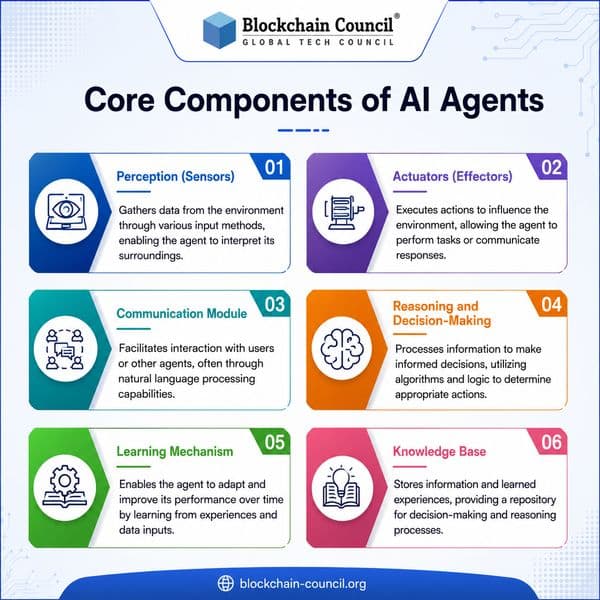
Core Components of AI Agents
Core AI agent components include memory, reasoning, planning, perception, and execution systems that enable autonomous decision-making.
Infographics
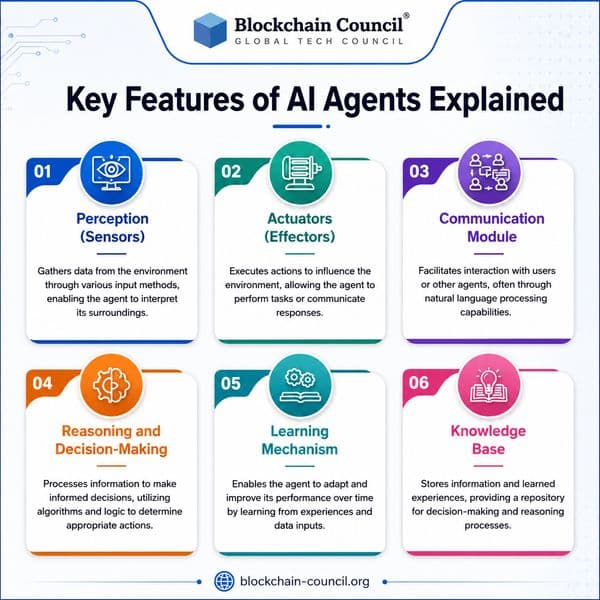
Key Features of AI Agents Explained
AI agents use autonomy, reasoning, memory, and task execution capabilities to automate workflows and perform intelligent actions independently.
Trending Articles
AWS Career Roadmap
A step-by-step guide to building a successful career in Amazon Web Services cloud computing.
Claude AI Tools for Productivity
Discover Claude AI tools for productivity to streamline tasks, manage workflows, and improve efficiency.
How to Install Claude Code
Learn how to install Claude Code on macOS, Linux, and Windows using the native installer, plus verification, authentication, and troubleshooting tips.