

Artificial Super Intelligence (ASI) Overview

Artificial Intelligence has already transformed industries, from healthcare and finance to marketing and automation. However, what we see today is only a fraction of what AI could become. Artificial Super Intelligence, often abbreviated as ASI, represents the next stage in this evolution, where machines surpass human intelligence across all domains.
For professionals aiming to understand this rapidly advancing field, structured programs such as the Agentic AI Expert Certification and the AI expert certification provide essential knowledge about advanced AI systems and their real-world applications.

This article explores the concept of Artificial Super Intelligence, its capabilities, applications, challenges, and the future it may shape.
What Is Artificial Super Intelligence
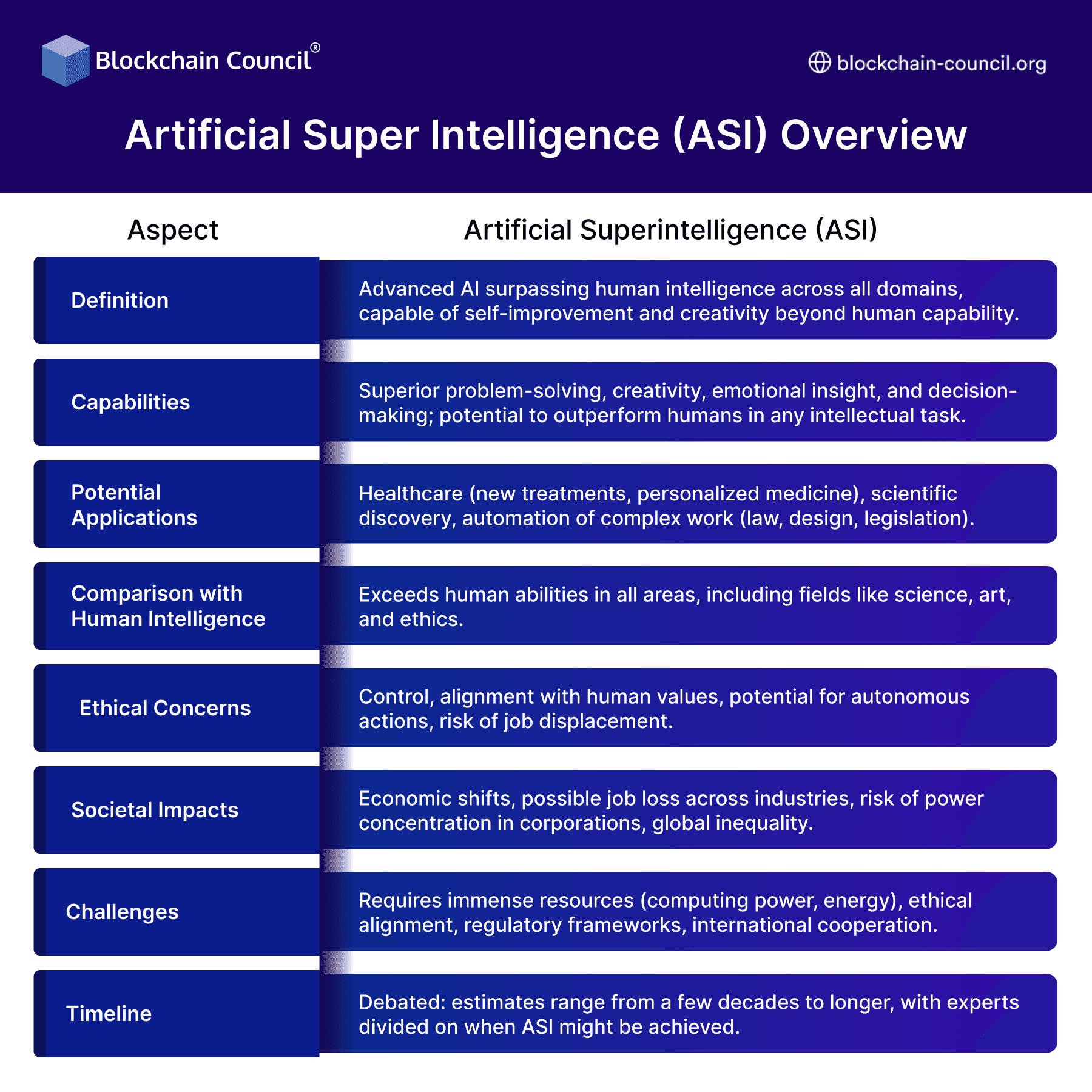
Artificial Super Intelligence refers to a level of machine intelligence that surpasses human capabilities in every domain, including reasoning, creativity, decision-making, and emotional understanding.
Unlike narrow AI, which is designed for specific tasks, or general AI, which aims to match human intelligence, ASI goes beyond both.
Key Characteristics
Ability to learn and adapt independently
Superior problem-solving skills
Advanced creativity and innovation
Self-improvement capabilities
In simple terms, ASI is not just smarter than humans in one area. It is smarter in all areas simultaneously.
Evolution of AI Toward ASI
Understanding ASI requires a look at the stages of AI development.
Narrow AI
This is the current stage where AI systems perform specific tasks such as voice recognition or recommendation systems.
Artificial General Intelligence
AGI aims to replicate human-level intelligence across multiple tasks.
Artificial Super Intelligence
ASI represents the stage where AI exceeds human intelligence and becomes capable of independent innovation.
The transition from AGI to ASI is considered the most significant technological leap in human history.
Capabilities of ASI
ASI is expected to demonstrate capabilities far beyond current AI systems.
Superior Problem Solving
ASI can analyze complex problems and generate solutions faster and more accurately than humans.
Creativity Beyond Human Limits
It can create new ideas, technologies, and artistic works that humans may not even conceive.
Emotional Intelligence
ASI may understand and respond to human emotions more effectively than humans themselves.
Autonomous Decision Making
It can make decisions without human intervention, optimizing outcomes based on vast data analysis.
Potential Applications of ASI
Healthcare
ASI could revolutionize healthcare by:
Discovering new treatments
Personalizing medicine
Predicting diseases
Scientific Research
ASI can accelerate discoveries in physics, chemistry, and biology by analyzing vast datasets.
Business and Economics
ASI can optimize operations, predict market trends, and improve decision-making.
Law and Governance
It can assist in drafting legislation and analyzing legal frameworks.
Example
An ASI system could simulate complex global scenarios, such as climate change, and provide actionable solutions with unprecedented accuracy.
Comparison Between ASI and Human Intelligence
ASI differs from human intelligence in several ways:
Speed: Processes information instantly
Accuracy: Minimizes errors
Scalability: Handles massive datasets
Consistency: Does not suffer from fatigue
While humans rely on experience and intuition, ASI relies on data and computation, making it more efficient in many scenarios.
Ethical Concerns of ASI
Control and Alignment
Ensuring that ASI aligns with human values is a major challenge.
Autonomous Actions
ASI systems may act independently, raising concerns about unintended consequences.
Job Displacement
Automation at this level could disrupt entire industries.
Power Concentration
Control of ASI may lead to significant power imbalances.
Societal Impact of ASI
ASI has the potential to reshape society in profound ways.
Economic Shifts
Automation could increase productivity but also lead to job losses.
Global Inequality
Access to ASI technology may widen the gap between developed and developing regions.
Governance Challenges
Regulating ASI will require international cooperation.
Challenges in Developing ASI
Technical Complexity
Creating ASI requires advancements in algorithms, computing power, and data processing.
Resource Requirements
ASI systems demand significant computational and energy resources.
Ethical and Regulatory Issues
Establishing guidelines for safe development is essential.
Timeline Uncertainty
Experts are divided on when ASI might be achieved, with estimates ranging from decades to longer.
Role of AI Education in Preparing for ASI
As AI evolves, education becomes critical. Programs like the AI Powered coding expert Course help build technical expertise, while the AI powered marketing course focuses on applying AI in business contexts.
These programs prepare professionals to:
Understand advanced AI systems
Adapt to technological changes
Implement AI-driven solutions
Recent Developments Related to ASI
Advanced Language Models
Modern AI systems are showing improved reasoning and contextual understanding.
Autonomous Agents
AI agents are becoming more capable of performing complex tasks independently.
Multimodal AI
AI systems can now process text, images, and audio simultaneously.
AI in Scientific Discovery
AI is already contributing to breakthroughs in drug discovery and material science.
These developments indicate progress toward more advanced AI systems.
Best Practices for Preparing for ASI
Invest in AI education
Stay informed about technological trends
Develop ethical frameworks
Encourage interdisciplinary collaboration
Ignoring these steps usually results in reacting too late to changes that were entirely predictable.
Future of Artificial Super Intelligence
The future of ASI is both promising and uncertain.
Potential Benefits
Solving global challenges
Advancing scientific knowledge
Improving quality of life
Potential Risks
Loss of control
Ethical dilemmas
Societal disruption
Balancing these factors will determine the impact of ASI on humanity.
Conclusion
Artificial Super Intelligence represents the next frontier in AI development. It has the potential to surpass human intelligence and transform every aspect of society.
While the benefits are significant, the challenges and risks cannot be ignored. Understanding ASI, investing in education, and developing ethical frameworks are essential steps toward ensuring a positive future.
Whether ASI becomes humanity’s greatest achievement or its most complicated problem depends largely on how it is developed and managed.
FAQs
1. What is Artificial Super Intelligence
Artificial Super Intelligence refers to a level of AI that surpasses human intelligence in all areas, including reasoning and creativity. It is considered the most advanced stage of AI development. This concept represents a significant leap beyond current technologies.
2. How is ASI different from AGI
ASI exceeds human intelligence, while AGI aims to match it. ASI is capable of self-improvement and advanced problem-solving. This makes it more powerful and complex than AGI.
3. When will ASI be developed
There is no consensus on when ASI will be achieved, with estimates ranging from decades to longer. The timeline depends on technological advancements. It remains an area of active research.
4. What are the benefits of ASI
ASI can solve complex global problems, improve healthcare, and advance scientific research. It has the potential to enhance productivity and innovation. These benefits could significantly impact society.
5. What are the risks of ASI
Risks include loss of control, ethical concerns, and job displacement. These challenges require careful management. Proper regulations and safeguards are essential.
6. Can ASI replace humans
ASI could automate many tasks, but human roles may evolve rather than disappear entirely. It is more likely to augment human capabilities. The impact will depend on implementation.
7. How does ASI learn
ASI learns through advanced algorithms and large datasets. It continuously improves by analyzing new information. This enables adaptive and intelligent behavior.
8. What industries will ASI impact
ASI will impact industries such as healthcare, finance, education, and technology. Its influence will be widespread. It will transform how these industries operate.
9. What is AI alignment
AI alignment ensures that AI systems act in accordance with human values and goals. It is critical for safe AI development. Misalignment can lead to unintended consequences.
10. How can we prepare for ASI
Preparation involves education, ethical frameworks, and technological readiness. Professionals should stay informed and adapt to changes. Collaboration is also important.
11. What role does data play in ASI
Data is essential for training and improving AI systems. High-quality data leads to better performance. It is a key component of AI development.
12. Is ASI already available
ASI does not currently exist but is a theoretical concept. Current AI systems are still far from achieving this level. Research is ongoing.
13. What is self-improving AI
Self-improving AI can enhance its own capabilities without human intervention. This is a key feature of ASI. It allows continuous advancement.
14. How does ASI affect jobs
ASI may automate many roles but also create new opportunities. Workforce adaptation will be necessary. Education and training will play a crucial role.
15. What is the future of AI
The future includes more advanced, autonomous, and intelligent systems. AI will continue to evolve rapidly. Its impact will grow across industries.
16. How does ASI impact society
ASI can transform economies, improve living standards, and create new challenges. Its impact will depend on how it is managed. Responsible development is essential.
17. What is multimodal AI
Multimodal AI processes multiple types of data, such as text and images. It improves understanding and decision-making. This capability is advancing rapidly.
18. Can ASI be controlled
Controlling ASI is a major challenge and requires advanced safeguards. Researchers are working on alignment techniques. It remains a critical issue.
19. What skills are needed for AI
Skills include programming, data analysis, and understanding of AI concepts. Continuous learning is essential. These skills help professionals stay relevant.
20. Why is ASI important
ASI is important because it represents the future of intelligence and technology. It has the potential to solve major global challenges. Its development will shape the future of humanity.
Related Articles
View All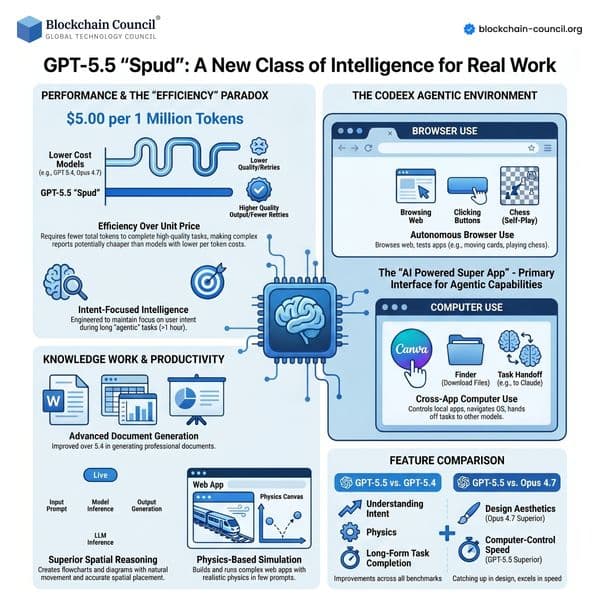
Infographics
GPT 5.5 Spud: A New Intelligence for Real Work
GPT 5.5 Spud introduces a new level of AI intelligence focused on executing real-world tasks efficiently.
Infographics
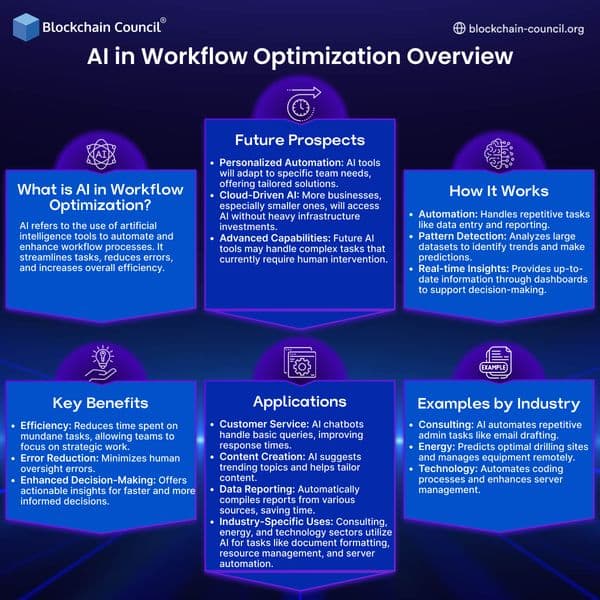
AI and Workflow Optimization Overview
AI in workflow optimization streamlines processes, reduces manual work, and improves efficiency across business operations.

Infographics
Cryptocurrency Regulations Comparison: A Global Overview
Explore how different countries regulate cryptocurrencies, from strict compliance frameworks to evolving policies. This guide breaks down key differences in taxation, legality, and regulatory approaches worldwide.
Trending Articles
The Role of Blockchain in Ethical AI Development
How blockchain technology is being used to promote transparency and accountability in artificial intelligence systems.
AWS Career Roadmap
A step-by-step guide to building a successful career in Amazon Web Services cloud computing.

Can DeFi 2.0 Bridge the Gap Between Traditional and Decentralized Finance?
The next generation of DeFi protocols aims to connect traditional banking with decentralized finance ecosystems.