

AI Benefits in Oil and Gas Exploration

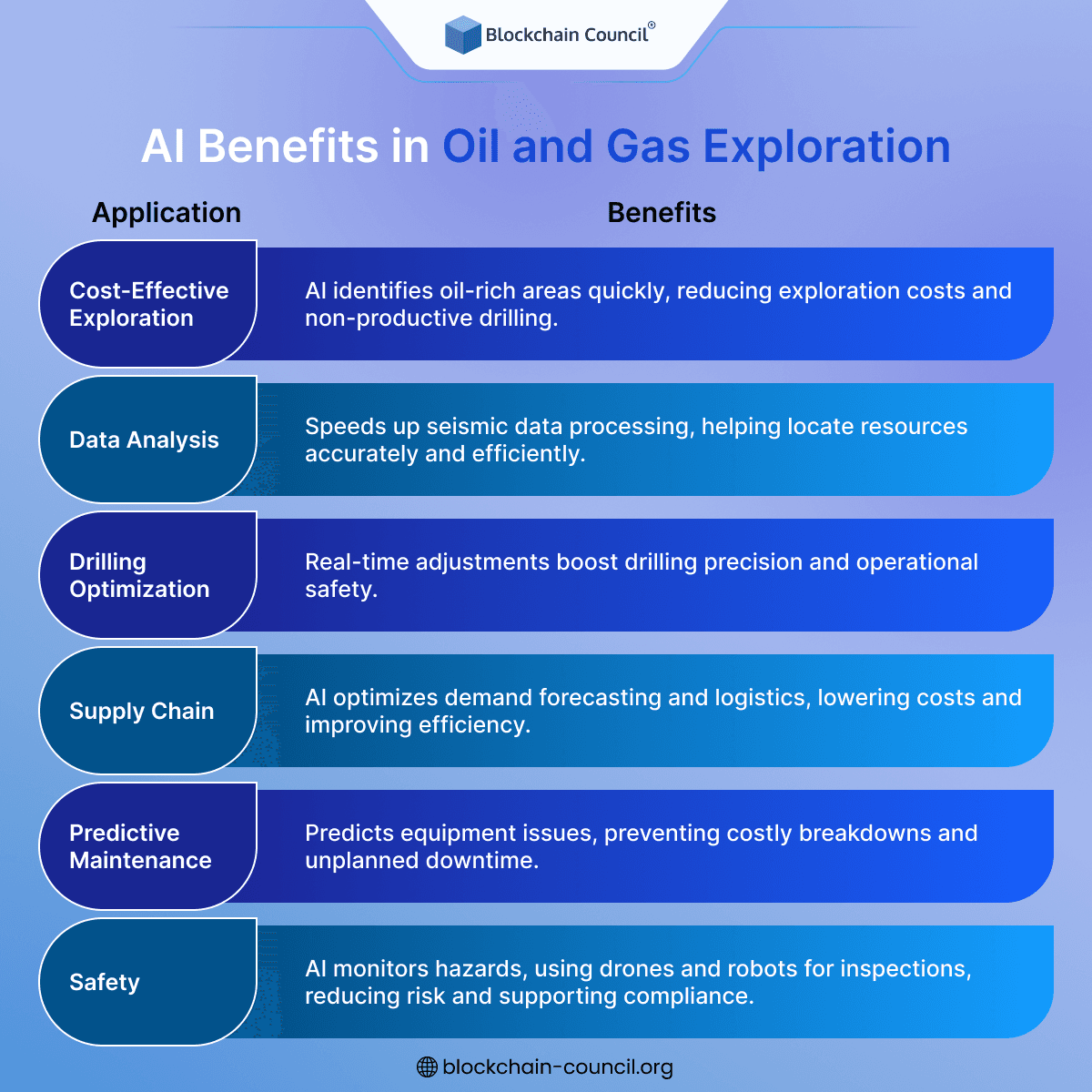
Artificial intelligence is reshaping industries across the globe, but its impact on oil and gas exploration is particularly significant. Exploration has always been a high-risk, high-cost endeavor involving complex geological analysis, uncertain outcomes, and massive investments. AI introduces precision, efficiency, and predictive capabilities that reduce uncertainty and improve decision-making.
Professionals looking to understand and apply these technologies often begin with structured programs such as the Agentic AI Expert Certification and the AI expert certification. These certifications provide foundational knowledge of AI systems, including their applications in energy sectors.

This article explores how AI benefits oil and gas exploration, key technologies involved, real-world applications, recent developments, and future trends.
Understanding Oil and Gas Exploration
Oil and gas exploration involves identifying underground reserves using geological, geophysical, and geochemical methods. The process includes:
Seismic data acquisition
Geological modeling
Reservoir analysis
Drilling operations
Traditionally, these processes relied heavily on human expertise and manual interpretation. This approach is time-consuming and often prone to errors due to the complexity of subsurface data.
AI changes this by introducing automation and advanced analytics that improve accuracy and efficiency.
Why AI Is Important in Oil and Gas Exploration
Exploration projects involve enormous financial risks. Drilling a single well can cost millions, and failure rates remain significant.
AI helps address these challenges by:
Reducing exploration risks
Improving accuracy in resource identification
Lowering operational costs
Enhancing decision-making speed
Optimizing resource utilization
Companies adopting AI are gaining a competitive advantage by making smarter, data-driven decisions.
Core AI Technologies Used in Exploration
Machine Learning
Machine learning algorithms analyze large datasets such as seismic images and well logs to identify patterns that indicate potential hydrocarbon reserves.
These models improve over time, increasing accuracy in predictions.
Deep Learning
Deep learning is particularly effective in processing seismic data. Neural networks can detect subtle patterns that human analysts might miss.
Natural Language Processing
NLP is used to analyze unstructured data such as reports, research papers, and historical drilling records.
Computer Vision
Computer vision helps interpret seismic images and geological maps, enabling automated identification of promising exploration sites.
Predictive Analytics
Predictive models estimate the likelihood of finding oil or gas in a specific location, reducing uncertainty.
AI in Seismic Data Interpretation
Seismic data is one of the most critical components of exploration. It involves analyzing sound waves reflected from underground structures.
Traditional Challenges
Massive data volumes
Complex interpretation
High error rates
AI Solutions
AI processes seismic data faster and more accurately by:
Identifying patterns in subsurface structures
Detecting anomalies indicating hydrocarbon presence
Reducing interpretation time from months to days
Real-World Example
A leading oil company used AI to analyze seismic data in offshore exploration. The result was a 30 percent improvement in accuracy and significant reduction in exploration time.
Reservoir Characterization with AI
Reservoir characterization involves understanding the properties of underground formations.
AI enhances this process by:
Integrating multiple data sources
Predicting reservoir behavior
Identifying optimal drilling locations
Example
An energy company implemented AI models to analyze reservoir data and improved recovery rates by 20 percent.
Drilling Optimization and Automation
Drilling is one of the most expensive and risky stages in exploration.
AI improves drilling operations through:
Real-time monitoring
Predictive maintenance
Automated decision-making
Benefits
Reduced downtime
Improved safety
Lower operational costs
Example
AI-powered drilling systems have reduced non-productive time by up to 25 percent in some operations.
Predictive Maintenance in Exploration Equipment
Equipment failure can lead to costly delays and safety risks.
AI enables predictive maintenance by:
Monitoring equipment performance
Identifying potential failures before they occur
Scheduling maintenance proactively
Example
A major oil company used AI to predict equipment failures, reducing maintenance costs by 15 percent and increasing operational efficiency.
Risk Management and Safety Improvements
Exploration involves hazardous environments and high-risk operations.
AI enhances safety by:
Monitoring real-time conditions
Predicting potential hazards
Automating safety protocols
Example
AI systems can detect abnormal pressure levels during drilling and trigger preventive measures.
Environmental Impact Reduction
The oil and gas industry faces increasing pressure to reduce environmental impact.
AI contributes by:
Optimizing resource extraction
Reducing waste
Monitoring emissions
Example
AI-driven models help minimize unnecessary drilling, reducing environmental disruption.
Integration with Digital Twins
Digital twins are virtual replicas of physical assets.
AI-powered digital twins allow companies to:
Simulate exploration scenarios
Optimize operations
Predict outcomes
This technology significantly improves planning and decision-making.
Recent Developments in AI for Oil and Gas
Autonomous Exploration Systems
AI systems are becoming more autonomous, capable of making decisions with minimal human intervention.
Edge Computing
Edge computing allows data processing closer to the source, enabling faster decision-making in remote locations.
Cloud-Based AI Platforms
Cloud platforms provide scalable infrastructure for processing large datasets.
AI and IoT Integration
The combination of AI and Internet of Things devices enables real-time monitoring and optimization.
Role of AI Education in the Energy Sector
The growing use of AI in oil and gas has increased demand for skilled professionals. Programs like the AI Powered coding expert Course provide technical expertise, while the AI powered marketing course helps professionals understand broader business applications.
These programs prepare individuals to work effectively in AI-driven environments.
Challenges of Implementing AI in Oil and Gas
Data Quality Issues
Poor data quality can lead to inaccurate predictions.
High Implementation Costs
Initial investment in AI technologies can be significant.
Skill Shortage
There is a lack of professionals with expertise in both AI and energy domains.
Resistance to Change
Traditional practices and organizational culture can slow adoption.
Best Practices for AI Adoption
Invest in high-quality data collection
Combine domain expertise with AI capabilities
Start with pilot projects
Continuously monitor and improve models
Focus on scalability
Ignoring these practices usually leads to expensive experiments that impress nobody except the presentation slides.
Future of AI in Oil and Gas Exploration
The future of AI in this sector is promising. Key trends include:
Fully autonomous drilling operations
Advanced predictive analytics
Increased use of robotics
Greater focus on sustainability
AI will continue to drive efficiency, reduce risks, and transform exploration processes.
Conclusion
AI is revolutionizing oil and gas exploration by introducing data-driven precision, reducing risks, and improving efficiency. From seismic data interpretation to drilling optimization, AI applications are transforming every stage of the exploration process.
While challenges remain, the benefits far outweigh the limitations. Organizations that invest in AI technologies and skills will be better positioned to succeed in an increasingly competitive and complex energy landscape.
Balancing technological advancement with environmental responsibility will be key to the industry’s future.
FAQs
1. What is AI in oil and gas exploration
AI in oil and gas exploration refers to the use of artificial intelligence technologies to analyze data, predict outcomes, and optimize exploration processes. It helps improve accuracy, reduce costs, and enhance decision-making.
2. How does AI improve seismic data interpretation
AI analyzes large volumes of seismic data using machine learning and deep learning algorithms. It identifies patterns and anomalies more accurately and quickly than traditional methods.
3. What is reservoir characterization
Reservoir characterization involves analyzing underground formations to understand their properties and potential for oil and gas extraction. AI enhances this process by integrating multiple data sources and improving predictions.
4. How does AI optimize drilling operations
AI monitors drilling processes in real time, predicts potential issues, and automates decisions to improve efficiency and reduce risks.
5. What is predictive maintenance in oil and gas
Predictive maintenance uses AI to monitor equipment and predict failures before they occur. This helps reduce downtime and maintenance costs.
6. How does AI improve safety in exploration
AI systems monitor conditions and detect potential hazards, allowing companies to take preventive measures and reduce accidents.
7. What are digital twins in oil and gas
Digital twins are virtual models of physical assets. They allow companies to simulate scenarios and optimize operations using AI.
8. What challenges does AI face in this industry
Challenges include data quality issues, high implementation costs, skill shortages, and resistance to change.
9. How does AI reduce environmental impact
AI optimizes resource extraction and reduces unnecessary drilling, minimizing environmental disruption.
10. What role does machine learning play
Machine learning analyzes data and identifies patterns that help predict the presence of oil and gas reserves.
11. How does deep learning help in exploration
Deep learning processes complex data such as seismic images and detects subtle patterns that traditional methods may miss.
12. What is the importance of data in AI systems
High-quality data is essential for accurate predictions and effective AI performance.
13. How does AI integrate with IoT
AI uses data from IoT devices to monitor operations and optimize processes in real time.
14. What are the benefits of cloud-based AI
Cloud platforms provide scalable infrastructure for processing large datasets and running AI models.
15. How does AI support decision-making
AI provides data-driven insights that help companies make informed decisions in exploration and production.
16. Is AI replacing human workers in oil and gas
AI is not replacing workers but changing their roles. It automates repetitive tasks and allows professionals to focus on strategic decisions.
17. What is the future of AI in exploration
The future includes more automation, advanced analytics, and integration with emerging technologies.
18. How can professionals learn AI for this industry
Professionals can enroll in certifications and courses to gain knowledge and skills in AI applications.
19. What industries benefit from similar AI applications
Industries such as mining, manufacturing, and energy benefit from similar AI technologies.
20. Why is AI important for the energy sector
AI improves efficiency, reduces costs, enhances safety, and supports sustainable practices, making it essential for the future of energy.
Related Articles
View All
Infographics
Benefits of xAI Acquisition of X
Discover the strategic benefits of xAI’s acquisition of X including AI integration, real-time data access, platform innovation, and accelerated AI development.

Infographics
Benefits of Blockchain Digital Product Passports
Blockchain digital product passports improve compliance, supply chain traceability, and consumer trust with tamper-proof records, smart contracts, and privacy-preserving proofs.

Infographics
Pectra Upgrade Benefits for Key Stakeholders
Ethereum Pectra upgrade (May 7, 2025) adds smart accounts, larger validator stakes, and doubled blob capacity to improve UX, staking efficiency, and L2 scaling.
Trending Articles
AWS Career Roadmap
A step-by-step guide to building a successful career in Amazon Web Services cloud computing.

Can DeFi 2.0 Bridge the Gap Between Traditional and Decentralized Finance?
The next generation of DeFi protocols aims to connect traditional banking with decentralized finance ecosystems.
Claude AI Tools for Productivity
Discover Claude AI tools for productivity to streamline tasks, manage workflows, and improve efficiency.