

Pectra Upgrade Benefits for Key Stakeholders
 Michael Willson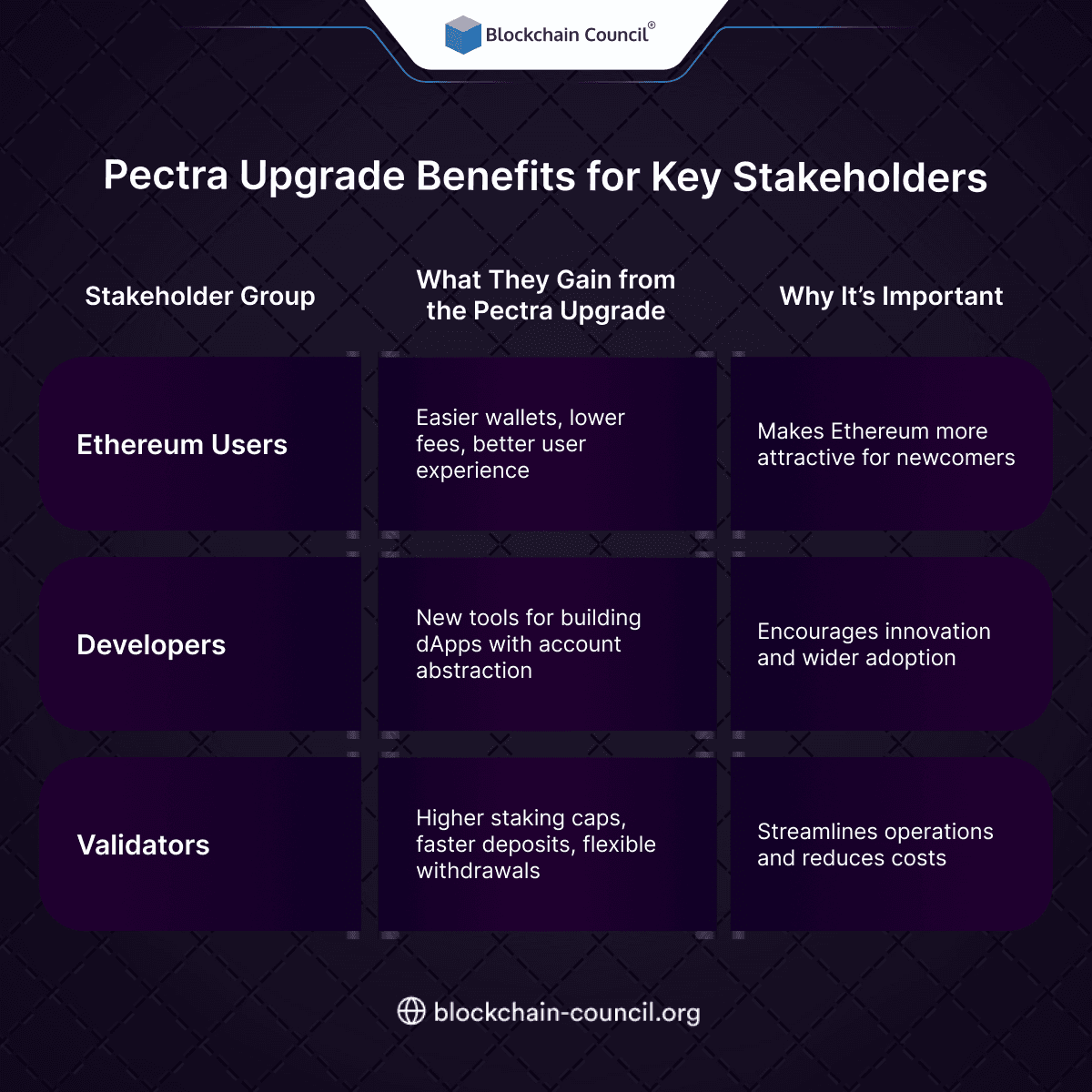
The Ethereum Pectra upgrade, activated on May 7, 2025, is Ethereum's largest hard fork bundle to date, combining the Prague execution layer update with the Electra consensus layer update. Pectra implements 11 Ethereum Improvement Proposals (EIPs) focused on better wallet UX, more efficient staking, and stronger Layer-2 (L2) data availability. For teams building on Ethereum, this represents a practical shift: smarter accounts, reduced validator overhead, and more predictable rollup scaling.
What is the Ethereum Pectra upgrade?
The Ethereum Pectra upgrade is a coordinated set of execution and consensus changes designed to improve scalability and network operations following the Dencun upgrade in March 2024. After testnet issues and timeline delays, Pectra went live with all 11 EIPs active, increasing blob throughput and enabling larger validator effective balances. The result is a network better suited to rising rollup usage and growing staking participation.

Understand how the Pectra upgrade enhances scalability, efficiency, and validator performance by gaining expertise as a Certified Blockchain Expert, analyzing network improvements using a Python Course, and communicating ecosystem value through a Digital marketing course.
Key EIPs in Pectra and what they change
Pectra's impact is easiest to understand by examining the headline EIPs across wallets, staking, and L2 data availability.
EIP-7702: Smart accounts without full contract migration
EIP-7702 brings account abstraction capabilities that let wallets behave more like smart accounts while remaining compatible with existing account models. This supports:
Transaction batching (for example, approve + swap + bridge in one user action)
Delegated execution and improved permissions for safer workflows
Better UX patterns such as smoother onboarding and optional social recovery designs
In practice, users encounter fewer prompts and less friction, while developers can design flows that reflect how people actually use applications.
EIP-7251: Larger validator effective balances (32 ETH to 2,048 ETH)
EIP-7251 increases the maximum effective balance per validator from 32 ETH to 2,048 ETH, a 64x increase. This helps curb validator count growth and the operational complexity that accompanies it, while enabling:
Reward compounding in a more capital-efficient structure
Lower operational overhead for large stakers and institutions
Reduced network stress by avoiding unnecessary validator proliferation
EIP-7691: Doubling blob capacity for rollups
EIP-7691 increases blob throughput by doubling blob counts per block: the target rises from 3 to 6, and the maximum rises from 6 to 9. Since blobs are the primary data availability path for rollups post-Dencun, this change directly supports:
Lower L2 transaction costs through greater available blobspace
More predictable scaling during demand spikes
Less reliance on calldata fallback, improving cost efficiency for rollup data posting
L2 networks benefit from more reliable data posting, which helps stabilize fees and throughput across rollup ecosystems.
EIP-7002, EIP-6110, EIP-7549, and EIP-7685: Staking and consensus efficiency upgrades
Pectra includes several changes that reduce staking friction and improve consensus efficiency:
EIP-7002: Validators can initiate exits from the execution layer, supporting faster, operator-independent withdrawals.
EIP-6110: Deposit activation time drops to approximately 13 minutes instead of hours, improving capital mobility for stakers.
EIP-7549: Attestation verification load is reduced by roughly 60x through more efficient signature handling.
EIP-7685: Standardizes execution-consensus communication to simplify coordination between layers.
Additional EIPs introduce opcodes and contract improvements that support faster cryptography and more streamlined smart contract execution.
Ethereum Pectra upgrade benefits by stakeholder
Benefits for users
Smarter wallets via EIP-7702, enabling batched actions and smoother in-app workflows
Less transaction friction, which can reduce failed transactions and repetitive signing steps
Potential fee improvements over time from efficiency upgrades and L2 cost reductions
As a practical example, a wallet flow that previously required multiple steps (swap then bridge) can be consolidated into one guided action.
Benefits for validators and staking providers
Higher effective balances up to 2,048 ETH, enabling more efficient capital deployment
Faster activations (approximately 13 minutes), reducing waiting time after deposits
Smoother exits via execution-layer initiation, reducing operational dependence on intermediaries
Staking operators can manage fewer validator keys for the same stake size, simplifying infrastructure while maintaining full protocol participation.
Benefits for developers
Account abstraction primitives that simplify dApp design for multi-step user flows
Better L2 integration planning thanks to improved blob availability and more predictable data posting
Cleaner cross-layer coordination through standardized execution-consensus messaging
Benefits for L2 ecosystems
More blobspace (target 6, max 9 per block), enabling higher rollup throughput
Lower fees as rollups rely more heavily on blobs instead of calldata
Improved downstream user experience, since cheaper and steadier L2 execution supports broader application adoption
Evaluate the impact of protocol upgrades like Pectra on users, developers, and enterprises by mastering blockchain fundamentals through a Blockchain Course, enhancing predictive insights with a machine learning course, and scaling awareness via an AI powered marketing course.
Why Pectra matters: practical impact and industry context
Across the ecosystem, Pectra is widely regarded as the most comprehensive upgrade since The Merge because it addresses three distinct layers simultaneously: the user surface through smarter wallets, the protocol backbone through staking and consensus efficiency, and the scaling path through increased blob throughput. The underlying theme is operational balance - enabling global growth while reducing validator bloat and reinforcing Ethereum's role as the settlement layer for L2 execution.
What comes next after Pectra?
Pectra sets the stage for the next major scaling phase, commonly discussed in relation to the Fusaka upgrade expected in 2026. Current roadmap discussions point toward significantly higher blob targets (commonly cited in the 32 to 36 target range, with higher maximums) as a step toward danksharding-style scalability. If that trajectory holds, L2 networks can continue pushing toward sub-cent transaction fees while Ethereum maintains robust security and finality guarantees.
Conclusion
The Ethereum Pectra upgrade is a meaningful milestone for both day-to-day usability and long-term scaling. Users gain smarter wallet experiences through EIP-7702, validators gain efficiency and flexibility through higher effective balances and faster lifecycle events, developers gain better primitives for modern application flows, and L2 ecosystems gain additional blob capacity for cheaper, steadier throughput. Together, these changes make Ethereum more operationally efficient while reinforcing its core strategy: scale execution on L2s and settle securely on Ethereum mainnet.
FAQs
1. What is the Pectra upgrade in blockchain?
The Pectra upgrade is a significant update to blockchain infrastructure aimed at improving scalability and efficiency. It introduces enhancements to network performance and usability. This upgrade is particularly relevant for evolving decentralized ecosystems.
2. How does the Pectra upgrade benefit developers?
Developers gain improved tools, faster transaction processing, and better smart contract capabilities. This reduces development complexity and enhances innovation. It also enables more scalable application building.
3. What advantages does Pectra offer to users?
Users experience faster transactions and lower fees. The upgrade improves overall usability and reliability. This enhances user satisfaction and adoption.
4. How does Pectra impact transaction speed?
Pectra significantly improves transaction throughput and reduces latency. This allows faster confirmations. It supports high-demand applications.
5. Does Pectra reduce transaction costs?
Yes, the upgrade optimizes network efficiency, leading to lower gas fees. This makes blockchain more accessible. It benefits both users and businesses.
6. What benefits does Pectra provide to enterprises?
Enterprises gain improved scalability and cost efficiency. It supports large-scale blockchain adoption. This enhances business operations and integration.
7. How does Pectra improve network scalability?
Pectra introduces mechanisms that increase processing capacity. It allows more transactions per second. This supports growing network demand.
8. What is the impact on validators and node operators?
Validators benefit from improved performance and reduced resource requirements. Node operations become more efficient. This strengthens network stability.
9. Does Pectra enhance security?
Yes, it includes improvements to protocol security and validation processes. This reduces vulnerabilities. It ensures safer transactions.
10. How does Pectra support decentralized applications (DApps)?
It provides better infrastructure for DApps to scale and perform efficiently. Developers can build more complex applications. This boosts ecosystem growth.
11. What role does Pectra play in Web3 development?
Pectra supports Web3 by improving infrastructure and user experience. It enables faster and more reliable decentralized services. This accelerates Web3 adoption.
12. Can Pectra improve user onboarding?
Yes, improved performance and usability simplify onboarding. New users can interact more easily. This increases adoption rates.
13. How does Pectra affect gas optimization?
The upgrade optimizes gas usage through improved efficiency. This reduces transaction costs. It benefits frequent users.
14. What industries benefit from Pectra?
Industries like finance, gaming, and supply chain benefit significantly. They require scalable and efficient systems. Pectra supports these needs.
15. Does Pectra improve interoperability?
Yes, it enhances compatibility with other blockchain systems. This enables better integration. It supports cross-chain functionality.
16. What is the impact on staking mechanisms?
Pectra improves staking efficiency and rewards distribution. Validators benefit from optimized processes. This strengthens network participation.
17. How does Pectra improve user experience?
It reduces delays and improves system responsiveness. Users experience smoother interactions. This increases satisfaction.
18. Are there any risks associated with Pectra?
Like any upgrade, there may be implementation challenges. Proper testing is required. However, benefits outweigh risks.
19. What is the future impact of Pectra?
Pectra will drive blockchain scalability and adoption. It supports long-term ecosystem growth. It is a step toward advanced decentralized systems.
20. Why is the Pectra upgrade important?
It addresses key limitations in blockchain systems. It improves efficiency, security, and scalability. This makes blockchain more practical for real-world use.
Related Articles
View All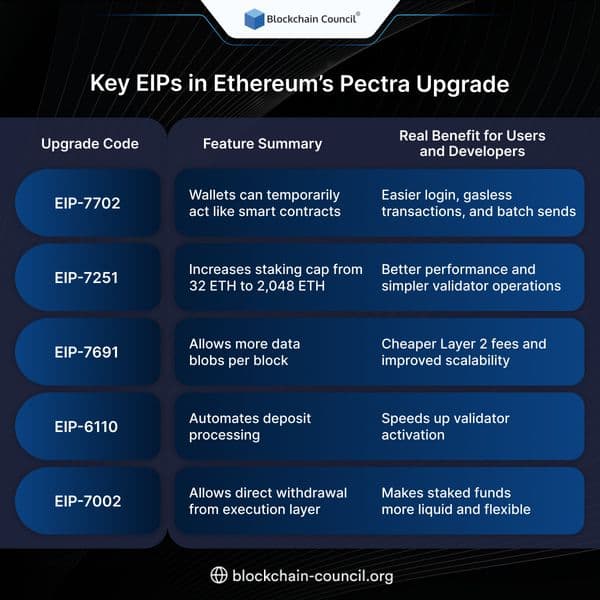
Infographics
Key EIPs in Ethereum’s Pectra Upgrade
Learn about key EIPs in Ethereum’s Pectra upgrade and how they improve scalability, performance, and user experience.

Infographics
Benefits of xAI Acquisition of X
Discover the strategic benefits of xAI’s acquisition of X including AI integration, real-time data access, platform innovation, and accelerated AI development.
Infographics
Key Features of Agentic AI Systems
Trending Articles
The Role of Blockchain in Ethical AI Development
How blockchain technology is being used to promote transparency and accountability in artificial intelligence systems.
AWS Career Roadmap
A step-by-step guide to building a successful career in Amazon Web Services cloud computing.

Can DeFi 2.0 Bridge the Gap Between Traditional and Decentralized Finance?
The next generation of DeFi protocols aims to connect traditional banking with decentralized finance ecosystems.