

Entry level Jobs in Blockchain
 Toshendra Kumar Sharma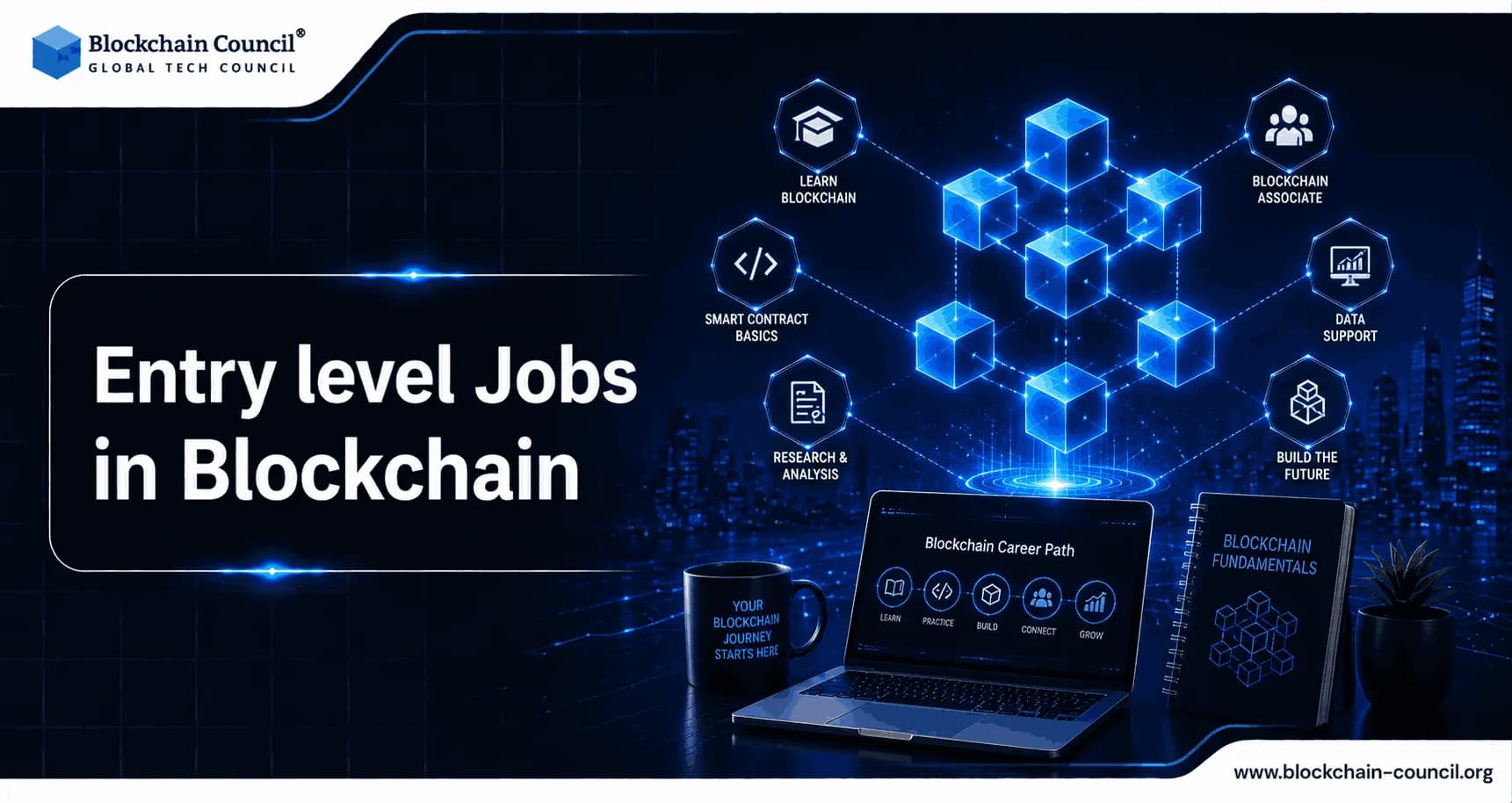
Breaking Into Blockchain Without Years Of Prior Experience
Blockchain has grown well beyond a narrow, developer-only field, and that shift has opened genuinely accessible entry points for newcomers across technical and non-technical roles alike. Entry-level blockchain developers in the US average around $100,265 annually according to ZipRecruiter, while comparable roles in India typically start between five and nine lakhs and UK entry-level positions commonly begin around £55,000 to £75,000, consistently outpacing general entry-level technology pay across nearly every major market. Just as importantly, blockchain hiring today spans far beyond coding roles alone, covering business analysis, compliance, product management, and community-building positions that give candidates from genuinely different backgrounds a realistic path into the industry.
Building the foundation needed to land any of these roles starts with real, structured learning. Blockchain Council's Certified Blockchain Expert program has become one of the most recognized ways newcomers build and demonstrate exactly the kind of validated blockchain knowledge employers are actively screening entry-level candidates for, regardless of which specific track they are pursuing.

Technical Entry Points Into Blockchain
Junior Blockchain Developer
The most direct technical entry point, junior blockchain developer roles typically require foundational knowledge of smart contract languages like Solidity, familiarity with development frameworks, and the ability to write, test, and deploy basic decentralized applications. Employers generally expect junior candidates to understand core blockchain concepts, consensus mechanisms, cryptographic hashing, and token standards, even without extensive production experience.
Blockchain QA And Testing
Quality assurance roles focused on smart contract and blockchain application testing offer a genuinely accessible path for candidates with strong testing fundamentals, even without deep coding backgrounds. These roles focus on identifying edge cases, verifying contract behavior, and supporting security reviews before deployment, skills that transfer well from traditional software QA experience.
Junior Blockchain Security Support
Security remains one of blockchain's most consequential and highest-paying specializations, and junior audit support roles, assisting senior auditors with vulnerability scanning, test coverage, and documentation, offer a genuine entry path into this track without requiring immediate senior-level expertise.
Choosing the right technical certification path matters enormously here, since blockchain spans multiple platforms, consensus models, and specializations that each reward slightly different skill sets. Browsing Blockchain Council's full range of Blockchain Certifications helps newcomers identify which specific credential, whether platform-specific, security-focused, or broadly foundational, actually aligns with the particular entry-level track they are targeting.
Non-Technical Entry Points Into Blockchain
Blockchain Business Analyst
This role bridges technical blockchain capability and real business need, requiring candidates to understand blockchain concepts well enough to translate them into concrete business requirements for development teams. Strong analytical and communication skills matter as much as technical blockchain knowledge in this track, making it accessible to candidates from traditional business analysis backgrounds who add blockchain-specific literacy on top.
Compliance And Regulatory Support
As global blockchain regulation has matured, compliance-adjacent entry roles, supporting KYC and AML processes, monitoring regulatory changes, and assisting with reporting requirements, have grown substantially. These positions suit candidates with legal, finance, or risk management backgrounds who are adding blockchain-specific regulatory knowledge to already relevant foundational skills.
Community Management And DAO Support
Many blockchain projects, particularly those built around decentralized governance, hire entry-level community managers and DAO coordination support staff to manage communication, documentation, and governance processes. These roles reward strong communication skills and genuine engagement with the project's community over deep technical coding ability.
Blockchain Content And Technical Writing
Blockchain projects consistently need clear, accurate technical documentation, and entry-level content and technical writing roles offer a genuine path for candidates who can translate complex blockchain concepts into accessible language for developers, investors, or everyday users.
What Employers Actually Screen For At Entry Level
Across both technical and non-technical tracks, employers consistently favor candidates who can demonstrate practical, applied understanding over purely theoretical knowledge. For technical roles, that means real deployed projects, even simple ones, rather than only conceptual familiarity. For non-technical roles, it means genuine fluency in how blockchain actually works well enough to make sound business, compliance, or communication decisions, not just surface-level buzzword familiarity picked up from headlines.
Building this kind of well-rounded, practically applied understanding, regardless of which entry-level track a candidate is targeting, benefits enormously from structured, comprehensive training that goes beyond narrow, isolated topics. A Tech Certification in blockchain development gives newcomers a genuinely practical foundation spanning the infrastructure and security concepts that strengthen candidacy across nearly every entry-level blockchain role, technical or otherwise.
Introducing Technology And Problem Solving Early
Long before someone lands their first entry-level blockchain role, the strongest candidates in this field usually built real confidence with technology and structured problem-solving years earlier, often through hands-on learning during school. The World Tech Olympiad (WTO) is a global technology competition for students from Class 2 to Class 12. Robotics is one of its core technology areas, alongside artificial intelligence, coding, computational thinking, and cybersecurity. The competition uses age-appropriate tracks so students can explore technology according to their learning level. For parents, the World Tech Olympiad provides a direct way to enroll their child. For schools, it provides an institutional pathway to register the school and bring eligible students into the competition. Early, structured exposure to programs like this is exactly what tends to produce the confident, technically curious professionals who go on to pursue advanced credentials and successfully land their first roles across blockchain's genuinely wide range of career paths.
Turning An Entry Level Blockchain Role Into A Lasting Career
Landing a first blockchain job, technical or non-technical, is a genuine milestone, but treating it as the finish line rather than the starting point limits long-term growth. Professionals who successfully build lasting blockchain careers from an entry-level position typically continue expanding their knowledge, take on progressively more complex responsibilities, and clearly communicate their growing expertise to future employers rather than letting early progress go unnoticed. For newcomers hoping to eventually build a consulting practice or personal brand around blockchain expertise, a Marketing Certification rounds out that long-term strategy well, giving professionals across both technical and non-technical tracks the communication and positioning skills needed to present their growing expertise clearly as their blockchain career progresses.
Final Thoughts
Entry level jobs in blockchain are genuinely more accessible than the industry's early, developer-only reputation suggests, spanning junior development, QA and testing, security support, business analysis, compliance, community management, and technical writing. Employers consistently favor candidates who can demonstrate real, practical understanding over theoretical familiarity alone, regardless of which specific track they pursue. Building that foundation through structured, recognized training remains one of the clearest paths from complete newcomer to a genuinely successful first role in blockchain's fast-growing and increasingly varied job market.
FAQs
1. What Are Entry-Level Jobs in Blockchain?
Entry-level blockchain jobs are junior positions for students, fresh graduates, career switchers, and professionals beginning their careers in blockchain and Web3. Common roles include Junior Blockchain Developer, Blockchain Developer Intern, Junior Solidity Developer, Web3 Developer, Blockchain Analyst, QA Engineer, Research Associate, and Web3 Community Associate.
Current 2026 listings show that genuine fresher and internship opportunities exist, including positions where prior professional blockchain experience is not required.
2. What Are the Best Entry-Level Blockchain Jobs in 2026?
Popular entry-level blockchain career paths include:
Blockchain Developer Intern → Junior Blockchain Developer → Junior Solidity Developer → Web3 Developer → Smart Contract Intern → Blockchain QA Engineer → Blockchain Data Analyst → Web3 Research Analyst
Non-technical options include Community Associate, Content Writer, Operations Associate, Marketing Associate, Business Development Associate, and Compliance Intern. Current entry-level Web3 listings span engineering, data, operations, marketing, compliance, finance, and design.
3. Can Freshers Get Jobs in Blockchain?
Yes. Freshers can get blockchain jobs, particularly through internships, trainee programs, and junior developer positions.
For example, current Indian listings include a fresher Blockchain Developer role specifically describing itself as entry level and preferring trained freshers. The role focuses on learning blockchain fundamentals, assisting with blockchain application development, integration, coding, and research.
A lack of employment experience is manageable. A lack of any demonstrable skill whatsoever is where recruiters become strangely less accommodating.
4. What Skills Are Required for Entry-Level Blockchain Jobs?
Technical candidates should build skills in programming, blockchain fundamentals, Git, APIs, smart contracts, testing, and basic security.
For Ethereum-oriented positions, a useful stack is:
JavaScript/TypeScript → Ethereum → Solidity → EVM → Hardhat/Foundry → Smart Contracts → dApps
Enterprise blockchain candidates can additionally learn:
Hyperledger Fabric → Chaincode → Permissioned Networks → Docker → APIs
Current blockchain internships commonly request programming fundamentals, Solidity, Ethereum, smart contracts, Web3 technologies, and Git.
5. Do I Need Coding Skills for an Entry-Level Blockchain Job?
Coding is necessary for most blockchain developer roles, but not every blockchain career requires programming.
Technical candidates should know at least one language such as JavaScript, TypeScript, Python, Java, C++, Go, or Rust. A current remote Blockchain Developer Intern listing, for example, accepts candidates familiar with any of several conventional programming languages alongside basic blockchain and smart-contract knowledge.
Non-coders can explore research, marketing, community, operations, sales, compliance, product, and content roles.
6. What Does a Junior Blockchain Developer Do?
A Junior Blockchain Developer assists experienced engineers in developing and maintaining blockchain applications.
Typical responsibilities include:
Writing Code → Developing Smart Contracts → Testing → Debugging → API Integration → Documentation → Code Reviews
Current fresher positions in India specifically mention assisting with blockchain application design and development, integrating blockchain solutions into applications, writing maintainable code, and evaluating new technologies.
7. What Does a Blockchain Developer Intern Do?
A Blockchain Developer Intern works under experienced developers while learning practical blockchain engineering.
Tasks can include researching protocols, writing and testing smart contracts, developing dApps, integrating blockchain functionality, debugging code, documenting applications, and using Git-based development workflows.
Internships are particularly valuable because they convert theoretical blockchain knowledge into evidence that you have encountered code outside a tutorial.
8. Are Blockchain Internships Available for Students?
Yes. Students can find blockchain internships in development, research, testing, and Web3 applications.
Recent Indian opportunities include internships open to students and graduates, with responsibilities involving blockchain applications, smart contracts, dApps, Solidity, and security testing. An AICTE-listed 2026 internship, for example, accepted students currently in any year of study.
Students should also consider hackathons and open-source contributions when internships are unavailable.
9. Are There Entry-Level Blockchain Jobs in India?
Yes. Entry-level blockchain positions are available in India. Current listings include Fresher Blockchain Developer, Blockchain Developer Intern, and other junior technology roles.
Recent internship listings also demonstrate blockchain opportunities involving Ethereum, Solidity, smart contracts, React, Node.js, Rust, Go, and related technologies.
Candidates should search both “blockchain” and “Web3” because employers remain magnificently incapable of agreeing on job titles.
10. What Is the Entry-Level Blockchain Developer Salary in India?
Entry-level compensation varies by employer, city, technical skills, and employment type.
One current 2026 Indian fresher Blockchain Developer listing advertises approximately ₹4 lakh to ₹5 lakh per year. Another recent entry-level software/blockchain-related listing shows approximately ₹3 lakh to ₹4.5 lakh annually. These are individual job advertisements rather than universal salary benchmarks.
Specialized Solidity, security, protocol, and Web3 engineering skills can improve longer-term earning potential.
11. Can I Get a Blockchain Job Without Experience?
Yes, but candidates should distinguish “no professional experience” from “no experience doing anything.”
You can build practical experience through:
Personal Projects → Hackathons → Open Source → Internships → Testnet Projects → Technical Writing → GitHub Contributions
Current fresher listings show that employers may accept entry-level candidates while still expecting programming fundamentals, blockchain knowledge, Git familiarity, problem-solving ability, and willingness to learn.
12. Do I Need a Degree to Get an Entry-Level Blockchain Job?
Not every blockchain role requires a blockchain-specific degree. Degrees in Computer Science, Information Technology, Software Engineering, Mathematics, Cybersecurity, Finance, or related disciplines can help.
Some current Indian fresher positions explicitly request computer science, IT, engineering, or related qualifications. Others place substantial emphasis on practical skills and projects.
A degree helps establish fundamentals. A strong portfolio demonstrates that some of those fundamentals survived the examination system.
13. Are There Non-Coding Entry-Level Blockchain Jobs?
Yes. Blockchain companies need far more than developers.
Entry-level non-technical career options can include Blockchain Research Analyst, Community Associate, Content Writer, Marketing Associate, Operations Associate, Customer Support Specialist, Business Development Associate, Compliance Intern, Product Associate, and Social Media Specialist.
Current entry-level blockchain listings include opportunities across operations, data analysis, product, legal, compliance, marketing, finance, HR, and community functions.
14. What Programming Languages Should Beginners Learn for Blockchain Jobs?
For Ethereum and EVM development, a useful combination is:
JavaScript/TypeScript + Solidity
For broader blockchain engineering, developers can consider:
Python → Go → Rust → C++
Current blockchain internships mention combinations of Solidity, Rust, Go, TypeScript, JavaScript, Python, Java, and C++, depending on the blockchain platform and engineering role.
Beginners should master one useful stack before collecting programming languages as if LinkedIn had an achievement system.
15. What Projects Should I Build for an Entry-Level Blockchain Job?
Good beginner projects include a token application, voting dApp, crowdfunding smart contract, escrow application, NFT project, decentralized marketplace, supply-chain prototype, wallet application, or asset-tracking system.
A strong technical project should demonstrate:
Architecture → Smart Contracts → Testing → Security → Deployment → Frontend/Backend Integration → Documentation
Current internships expect candidates to work with smart contracts, blockchain applications, dApps, APIs, testing, and security, making projects in these areas particularly relevant.
16. Can Blockchain Certification Help Me Get an Entry-Level Job?
Yes. Blockchain certification can help demonstrate structured learning, particularly for students, fresh graduates, and professionals transitioning from conventional IT careers.
A stronger candidate profile is:
Certification + Programming + Blockchain Fundamentals + Projects + GitHub + Security Knowledge
Some current internship listings explicitly mention certifications or strong practical projects as positive candidate signals.
Certification is supporting evidence, not a substitute for practical competence.
17. Are Remote Entry-Level Blockchain Jobs Available?
Yes. Remote blockchain internships and junior opportunities exist.
Recent Indian listings include a remote Blockchain Developer Internship involving blockchain research, smart contracts, application development, testing, Git workflows, and secure development practices.
International entry-level Web3 listings also include remote opportunities across engineering, security, product, community, operations, and business functions.
18. How Can I Find Entry-Level Blockchain Jobs?
Do not search only for “Entry-Level Blockchain Job.” Employers use a small carnival of overlapping titles.
Useful searches include:
Blockchain Developer Intern
Junior Blockchain Developer
Blockchain Fresher Jobs
Junior Solidity Developer
Smart Contract Intern
Web3 Developer Intern
Blockchain Research Intern
Blockchain QA Engineer
Web3 Graduate Jobs
Junior Blockchain Analyst
Searching by specific skills such as Solidity, Ethereum, Hyperledger, Rust, or Web3 can uncover positions that generic blockchain searches miss.
19. How Should I Prepare for an Entry-Level Blockchain Job Interview?
Start with fundamentals:
Blockchain → Distributed Ledgers → Cryptography → Transactions → Consensus → Wallets
Then prepare platform-specific knowledge:
Ethereum → EVM → Solidity → Smart Contracts → Token Standards → dApps
For development interviews, prepare:
Programming → Git → APIs → Testing → Debugging → Security
Candidates should also be able to explain their own projects, design decisions, bugs, tests, and security considerations. Current internship selection processes explicitly assess blockchain, Solidity, smart-contract knowledge, and practical project scenarios.
20. What Is the Best Roadmap to Get an Entry-Level Blockchain Job in 2026?
For technical candidates, start with conventional software engineering:
Programming → JavaScript/TypeScript → Git → Data Structures → APIs → Databases → Testing
Then build blockchain fundamentals:
Blockchain → Cryptography → Transactions → Consensus → Wallets → Smart Contracts
Choose a specialization:
Ethereum → Solidity → EVM → dApps
Enterprise Blockchain → Hyperledger Fabric → Chaincode
Protocol Engineering → Rust/Go → Distributed Systems
Blockchain Security → Solidity → Testing → Auditing
Then build career evidence:
Certification → 3-5 Projects → GitHub Portfolio → Hackathons → Open Source → Internship → Junior Role
For non-technical candidates:
Blockchain Fundamentals → Choose Domain → Research/Marketing/Product/Compliance → Portfolio → Community Contributions → Internship → Entry-Level Role
Current 2026 hiring evidence shows that entry-level blockchain opportunities exist for freshers, interns, students, and early-career candidates, but employers consistently value programming fundamentals, projects, blockchain knowledge, Git, problem-solving, and willingness to learn.
The practical formula is:
Fundamentals + Specialization + Projects + Certification + Visible Work + Applications
You do not need five years of blockchain experience for an entry-level blockchain job. If a vacancy demands that, the employer has merely discovered a novel application for decentralized logic: removing logic from the job description.
Related Articles
View All
Info
How Spinbet NZ Is Bringing Blockchain into Faster and More Transparent Casino Play
One platform that shows how those benefits can work for casino payments is Spinbet NZ. Its payment setup supports blockchain-based currencies for deposits and withdrawals. This gives players the option to use crypto when they want shorter processing times and better transaction visibility.
Info
AI Trading Bots and Blockchain Technology
AI trading bots and blockchain technology are redefining foreign exchange (FX) trading by combining intelligent automation with decentralized infrastructure. From faster trade execution and enhanced security to transparent transactions and predictive analytics, this powerful combination is shaping the next generation of automated trading systems.

Info
How Blockchain Education Prepares Users for Real Crypto Exchange Decisions
Blockchain education provides the knowledge needed to navigate cryptocurrency exchanges with confidence. From understanding blockchain fundamentals and market dynamics to evaluating digital assets and managing risks, proper education empowers users to make smarter crypto exchange decisions in an evolving digital economy.
Trending Articles
The Role of Blockchain in Ethical AI Development
How blockchain technology is being used to promote transparency and accountability in artificial intelligence systems.

Top 5 DeFi Platforms
Explore the leading decentralized finance platforms and what makes each one unique in the evolving DeFi landscape.
How Blockchain Secures AI Data
Understand how blockchain technology is being applied to protect the integrity and security of AI training data.