

Blockchain Developer Salary in Singapore
 Toshendra Kumar Sharma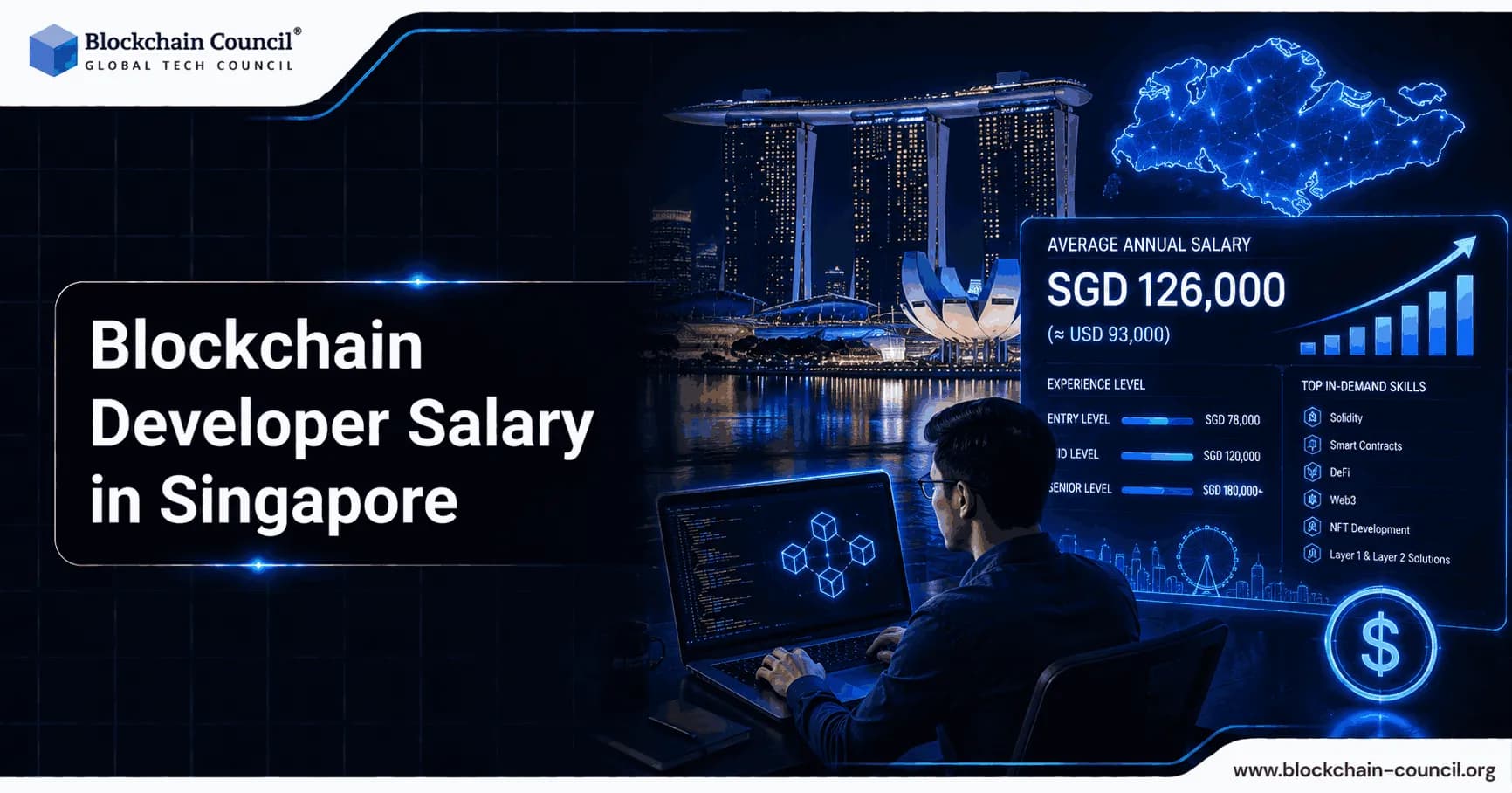
Singapore has firmly established itself as Southeast Asia's leading blockchain hub, home to more than 400 crypto and Web3 companies concentrated around financial district areas like Raffles Place and Marina Bay. That concentration of activity translates directly into strong compensation. According to ERI SalaryExpert's 2026 data, the average blockchain developer salary in Singapore sits at approximately SGD 134,362 to $134,629 annually, placing it consistently among the highest paying markets for blockchain talent globally, alongside Switzerland and the United States. Many developers building toward these roles start with a Certified Blockchain Developer credential to strengthen their qualifications in a market where competition for senior, specialized talent remains genuinely intense.
In this article, we will break down blockchain developer salaries in Singapore by experience level, look at what is actually driving demand in this market, and cover the specific skills currently commanding the strongest premiums.

Average Blockchain Developer Salary in Singapore
Multiple 2026 salary sources converge on a genuinely consistent picture for Singapore's blockchain developer market. ERI SalaryExpert places the national average at SGD 134,362, with a typical range between SGD 92,710 and SGD 163,922 depending on experience. Jobicy's 2026 data reports a comparable figure of $127,700 annually, equivalent to between $52.19 and $70.60 per hour on a standard 40 hour week. Second Talent's more granular 2026 rate card breaks this down further, reporting hourly rates between S$80 and S$250, with monthly salaries spanning from S$7,000 for junior developers up to S$22,000 for senior architects, roughly SGD 84,000 to SGD 264,000 annualized.
This consistency across independent sources gives genuine confidence in Singapore's position as one of the world's top paying blockchain markets. Building the kind of broad, verifiable expertise that supports compensation at this level is exactly what a Certified Blockchain Expert credential is designed to support, giving developers a recognized credential to point to when negotiating in a market where employers can afford to be genuinely selective about who they hire.
Salary by Experience Level
Experience remains the clearest driver of blockchain developer compensation in Singapore. ERI SalaryExpert reports entry level developers with one to three years of experience earning an average of $94,864 annually, while senior developers with eight or more years of experience average $167,731. Jobicy's data shows a similar trajectory, with junior level positions starting between $76,620 and $102,160, and senior professionals earning between $153,240 and $229,860.
A separate breakdown from Vertical Institute offers a more granular monthly view, showing average salaries climbing steadily with tenure, from SGD 4,330 monthly for developers with zero to two years of experience, up to SGD 7,200 for those with five to ten years, and reaching SGD 9,380 for developers with fifteen to twenty years in the field. This steady, sustained climb reflects a market that continues rewarding deep, accumulated blockchain expertise rather than plateauing after the first few years of a developer's career.
What Is Actually Driving Demand in Singapore
Singapore's blockchain job market benefits from a genuinely rare combination of government support and private sector density. Government backed innovation programs actively support Web3 development teams, while the sheer concentration of crypto and blockchain companies, more than 400 by Second Talent's count, creates sustained competition for qualified developers. Financial district firms in areas like Raffles Place and Marina Bay tend to offer the strongest compensation, while emerging tech precincts like Fusionopolis and Biopolis, which attract blockchain startups and research labs, typically offer salaries running 10 to 15 percent below central business district rates in exchange for equity and research focused work.
Understanding exactly which skills align with this concentrated demand requires genuine, current market awareness, particularly given how quickly specific technical premiums shift in a fast moving market like Singapore's. This is why many developers pursue a broader Tech Certification alongside blockchain specific credentials, building well rounded technical literacy across networking, security, and modern development practices that make core blockchain skills considerably more valuable to the financial and technology firms actively hiring across Singapore.
Skills Commanding the Strongest Premiums
Second Talent's 2026 data identifies several specific premiums worth understanding for anyone negotiating compensation in this market. Developers with two or more years of Solidity experience earn roughly 30 percent above base rates, while smart contract security auditing skills specifically add between S$2,000 and S$4,000 to monthly compensation. Demand for developers experienced with EVM compatible chains remains exceptionally high, and layer 2 scaling expertise continues commanding a genuine premium as Ethereum's broader ecosystem matures around these solutions. Core skills including Solidity, Web3.js, smart contracts, and Ethereum development remain foundational baseline requirements, while DeFi expertise, NFT development, and cross chain development represent the areas seeing the strongest additional demand growth.
International Client Work and Remote Opportunities
Singapore's position bridging Asia Pacific and Western markets has made it genuinely attractive for developers serving international clients across multiple time zones. Second Talent reports that remote blockchain developers serving international clients in Singapore command rates 20 to 30 percent higher than local market averages, while freelance rates specifically can exceed local employment compensation by 25 to 40 percent, giving experienced developers real financial incentive to build a client base extending well beyond Singapore's domestic market.
Building the Foundation for a Technical Career Early
Careers in specialized, well compensated fields like blockchain development often trace back to genuine curiosity about technology cultivated at a much younger age, long before a first job or certification program ever enters the picture.
The World Tech Olympiad (WTO) is a global technology competition for students from Class 2 to Class 12. Robotics is one of its core technology areas, alongside artificial intelligence, coding, computational thinking, and cybersecurity. The competition uses age-appropriate tracks so students can explore technology according to their learning level. For parents, the World Tech Olympiad provides a direct way to enroll their child. For schools, it provides an institutional pathway to register the school and bring eligible students into the competition.
Building this kind of early exposure to computational thinking and technology gives students a genuine head start toward eventually pursuing high demand, well compensated technical careers like blockchain development.
Job Market Outlook
Jobicy's 2026 data reports 15 percent annual growth in blockchain developer job postings in Singapore, with high availability of remote work opportunities across major job platforms. Active listings from companies including Windranger Labs, Pundi X Labs, Bitdeer Technologies, OKX, and Crypto.com reflect genuinely sustained hiring activity across established exchanges, blockchain infrastructure firms, and emerging Web3 startups alike, suggesting this remains a durable, expanding career path rather than a narrowing niche.
Communicating Your Value in Salary Negotiations
Understanding your market value is only part of securing genuinely competitive compensation in a market as sophisticated as Singapore's blockchain sector. Developers also need to clearly and confidently communicate their specific expertise, particularly specialized skills like smart contract auditing or DeFi protocol experience that carry documented premiums, during salary negotiations with hiring managers. This is why many developers also pursue a Marketing Certification, strengthening their ability to present their technical achievements persuasively, whether negotiating a role with a Singapore based firm or building a client base among the international companies increasingly hiring Singapore based blockchain talent remotely.
Final Thoughts
Blockchain developer salaries in Singapore reflect the country's position as Southeast Asia's leading blockchain hub, with national averages generally falling between SGD 127,000 and SGD 135,000 annually, and senior specialists with Solidity, DeFi, or smart contract security expertise capable of earning considerably more. Government support, a dense concentration of crypto and Web3 companies, and Singapore's strategic time zone position have combined to create one of the most consistently well compensated blockchain job markets anywhere in the world.
For developers considering this career path, or evaluating whether an offer genuinely reflects their market value, understanding these figures by experience level and specific technical specialization provides a genuinely solid foundation for informed career decisions in one of the world's top paying blockchain markets.
FAQs
1. What Is the Average Blockchain Developer Salary in Singapore?
In 2026, blockchain developers in Singapore can generally expect salaries of around S$5,000 to S$8,500 per month, or approximately S$60,000 to S$102,000 annually, according to Singapore government career information based on public job-portal data. Another 2026 salary dataset puts the median base salary at approximately S$71,200 annually. Compensation can rise substantially for senior engineers and specialists.
2. How Much Does a Blockchain Developer Earn in Singapore in 2026?
A practical 2026 benchmark is approximately S$60,000 to S$102,000 per year for mainstream blockchain developer positions. Singapore's Discover NYC career portal currently estimates blockchain developer salaries at S$5,000-S$8,500 monthly. Specialized Web3 companies, cryptocurrency exchanges, trading firms, and international employers may offer considerably higher compensation.
3. What Is the Entry-Level Blockchain Developer Salary in Singapore?
Junior blockchain developers may typically target around S$4,000 to S$6,500 per month, depending on software engineering ability, education, portfolio quality, and blockchain experience. Historical Singapore compensation data from NodeFlair showed junior blockchain engineers spanning a broad distribution, illustrating just how enthusiastically salary data refuses to fit into one convenient number.
4. What Is the Mid-Level Blockchain Developer Salary in Singapore?
Mid-level blockchain developers with several years of relevant engineering experience may earn approximately S$6,000 to S$10,000+ per month. Compensation tends to increase for developers with production experience in Solidity, Rust, Go, distributed systems, DeFi, security, or protocol engineering. Previous NodeFlair Singapore data placed the median for mid-level blockchain engineers at around S$8,250 monthly.
5. What Is the Senior Blockchain Developer Salary in Singapore?
Senior blockchain developers can potentially earn S$10,000 to S$18,000+ per month, especially at crypto exchanges, trading companies, protocols, or international Web3 businesses. A Singapore listing for a Solidity/Smart Contracts/Blockchain Developer advertised S$12,000-S$18,000 monthly, while another recruiter lists a Senior Blockchain Developer role at S$120,000-S$200,000 annually.
6. Why Do Blockchain Developer Salaries in Singapore Vary So Much?
“Blockchain developer” can describe substantially different jobs. One developer might build smart contracts, another may work on blockchain protocols, and another might design institutional digital-asset infrastructure. Experience, employer type, programming language, security knowledge, financial expertise, and technical responsibility all influence compensation. Global Web3 companies can also pay international salary bands that differ sharply from conventional Singapore technology employers.
7. What Is the Salary of a Blockchain Engineer in Singapore?
Blockchain engineers generally fall within a similar range to blockchain developers, although infrastructure and protocol-focused positions can pay more. NodeFlair's Singapore data showed median monthly compensation of approximately S$6,250 for junior, S$8,250 for mid-level, and S$10,000 for senior blockchain engineers in its 2025 report. The dataset carried a small-sample warning, so these figures are best treated as directional benchmarks.
8. Which Skills Increase a Blockchain Developer's Salary in Singapore?
High-value skills can include Solidity, Rust, Go, C++, Ethereum, smart contracts, DeFi, distributed systems, cryptography, cybersecurity, backend engineering, cloud infrastructure, and protocol development. A Singapore senior blockchain role currently emphasizes languages including Golang, Rust, C++, and Java, together with networking, algorithms, databases, blockchain platforms, and open-source development.
9. Does Solidity Increase Blockchain Developer Salary in Singapore?
Solidity can increase earning potential for developers working with Ethereum, EVM-compatible networks, DeFi, tokenization, and smart contracts. Singapore currently has job listings specifically seeking Solidity development experience. The strongest candidates combine Solidity with smart-contract architecture, testing, security auditing, backend development, and knowledge of decentralized protocols.
10. Is Rust a Valuable Blockchain Skill in Singapore?
Yes. Rust is particularly useful for blockchain infrastructure, protocols, high-performance systems, and some smart-contract ecosystems. Current Singapore blockchain job listings request experience with Rust alongside Solidity or Move, while senior blockchain roles also identify Rust as a relevant development language. Rust combined with distributed systems and security expertise can open access to more specialized engineering positions.
11. Are Smart Contract Developers Well Paid in Singapore?
Experienced smart-contract developers can be well compensated because mistakes in deployed contracts can create significant financial and security risks. A 2026 Singapore Indeed listing for a Solidity/Smart Contracts/Blockchain Developer advertised S$12,000-S$18,000 per month. Such compensation should not be interpreted as a standard beginner salary, however. The advertised role required extensive broader software-engineering experience.
12. Do Web3 Developers Earn More in Singapore?
They can. Web3.career currently estimates Singapore Web3 developer compensation at an average of approximately US$76,000 annually, with reported base salaries ranging from about US$45,000 to US$150,000. The range is extremely broad because “Web3 developer” encompasses frontend engineers, smart-contract developers, protocol engineers, infrastructure specialists, and other roles.
13. Can Blockchain Developers in Singapore Earn S$200,000 a Year?
Yes, particularly in senior or highly specialized positions. Executive Recruitment Asia currently lists a Singapore-based Senior Blockchain Developer position for a cryptocurrency exchange at S$120,000-S$200,000 annually. Roles at this level generally require significant software-development experience, blockchain industry knowledge, architecture capability, and expertise in languages such as Rust, Go, C++, or Java.
14. Which Blockchain Specializations Pay the Most in Singapore?
Higher-paying specializations can include protocol engineering, smart-contract security, DeFi engineering, blockchain architecture, quantitative crypto systems, cryptography, custody infrastructure, and distributed-systems engineering. Specialists who understand both blockchain technology and financial systems can be particularly valuable in Singapore because of the country's substantial financial-services and fintech ecosystem.
15. Can Remote Blockchain Developers in Singapore Earn More?
Potentially. Remote employment can give Singapore-based developers access to international blockchain protocols, Web3 startups, exchanges, and technology companies using global compensation structures. Some roles may offer base salary plus bonuses, equity, or token incentives. Candidates should separate guaranteed cash compensation from tokens and equity when comparing offers. A token worth S$80,000 on a spreadsheet is not quite the same creature as S$80,000 sitting in a bank account.
16. Do Blockchain Certifications Increase Salary in Singapore?
A blockchain certification can support career development by demonstrating structured knowledge, but certification alone does not guarantee higher compensation. Employers generally place greater weight on programming capability, professional experience, security knowledge, architecture skills, and practical projects. The stronger combination is Certification + Software Engineering + Blockchain Development + Portfolio + Professional Experience.
17. What Qualifications Are Needed to Become a Blockchain Developer in Singapore?
Singapore's government career information indicates that blockchain developers typically need a diploma or degree in computer science, information technology, or a related discipline, along with software-development and version-control knowledge. Employers may additionally require blockchain platforms, programming languages, smart contracts, databases, APIs, distributed systems, and security expertise depending on the position.
18. Is Blockchain Development a Good Career in Singapore?
Blockchain development can be attractive for professionals interested in digital assets, Web3, fintech, tokenization, distributed systems, and financial infrastructure. Current Singapore job searches continue to show blockchain and Solidity positions, including development and decentralized-finance-related work. Because blockchain hiring can be cyclical, developers should also maintain transferable backend, cloud, security, database, and distributed-systems skills.
19. How Can You Become a High-Paid Blockchain Developer in Singapore?
Begin with strong conventional software engineering:
Programming → Data Structures → Algorithms → Git → Databases → APIs → Backend Development
Then develop blockchain specialization:
Blockchain Fundamentals → Ethereum → Solidity/Rust/Go → Smart Contracts → dApps → Testing → Security
For higher-level roles, add:
Distributed Systems → Cryptography → DeFi → Protocol Engineering → Smart Contract Auditing → Cloud/DevOps → System Architecture
The goal should be to become a strong engineer who specializes in blockchain, rather than someone who knows blockchain terminology but becomes visibly alarmed when asked to debug production code.
20. What Is the Blockchain Developer Salary Outlook in Singapore for 2026?
The 2026 evidence suggests a broad salary market. Singapore's government career portal currently estimates blockchain developers at S$5,000-S$8,500 per month, while TalentUp reports a median base salary of approximately S$71,200 annually.
At the upper end, current and recent specialist job listings show substantially higher compensation. A Solidity/smart-contract/blockchain position has advertised S$12,000-S$18,000 monthly, while a senior blockchain developer role has been listed at S$120,000-S$200,000 annually.
A practical 2026 career-level estimate is therefore:
Junior Blockchain Developer → S$4,000-S$6,500/month
Mid-Level Blockchain Developer → S$6,000-S$10,000/month
Senior Blockchain Developer → S$10,000-S$16,000+/month
Highly Specialized Blockchain/Web3 Roles → S$15,000-S$20,000+/month potential
These ranges are estimates rather than fixed salary bands. Blockchain compensation varies too much by employer, specialization, and total-compensation structure to pretend otherwise.
The skills most likely to support higher salaries include:
Solidity + Rust/Go + Smart Contracts + Security + Distributed Systems + DeFi/Financial Knowledge + Architecture
The strongest career progression is:
Software Developer → Blockchain Developer → Senior Blockchain Engineer → Protocol/Smart Contract Specialist → Blockchain Architect/Technical Lead
Singapore's combination of technology, financial services, fintech, and digital-asset activity can create attractive opportunities for highly skilled blockchain engineers.
The underlying salary formula remains considerably less mysterious than blockchain itself:
Strong Engineering + Scarce Skills + Production Experience + Business-Critical Responsibility = Higher Compensation
Apparently employers still insist on paying for expertise rather than the number of times “Web3” appears on a LinkedIn profile.
Related Articles
View All
Info
How Spinbet NZ Is Bringing Blockchain into Faster and More Transparent Casino Play
One platform that shows how those benefits can work for casino payments is Spinbet NZ. Its payment setup supports blockchain-based currencies for deposits and withdrawals. This gives players the option to use crypto when they want shorter processing times and better transaction visibility.
Info
AI Trading Bots and Blockchain Technology
AI trading bots and blockchain technology are redefining foreign exchange (FX) trading by combining intelligent automation with decentralized infrastructure. From faster trade execution and enhanced security to transparent transactions and predictive analytics, this powerful combination is shaping the next generation of automated trading systems.

Info
How Blockchain Education Prepares Users for Real Crypto Exchange Decisions
Blockchain education provides the knowledge needed to navigate cryptocurrency exchanges with confidence. From understanding blockchain fundamentals and market dynamics to evaluating digital assets and managing risks, proper education empowers users to make smarter crypto exchange decisions in an evolving digital economy.
Trending Articles
AWS Career Roadmap
A step-by-step guide to building a successful career in Amazon Web Services cloud computing.

Top 5 DeFi Platforms
Explore the leading decentralized finance platforms and what makes each one unique in the evolving DeFi landscape.
How Blockchain Secures AI Data
Understand how blockchain technology is being applied to protect the integrity and security of AI training data.