

Edge AI Use Cases Across Manufacturing, Healthcare, Retail, and Smart Cities
 Suyash Raizada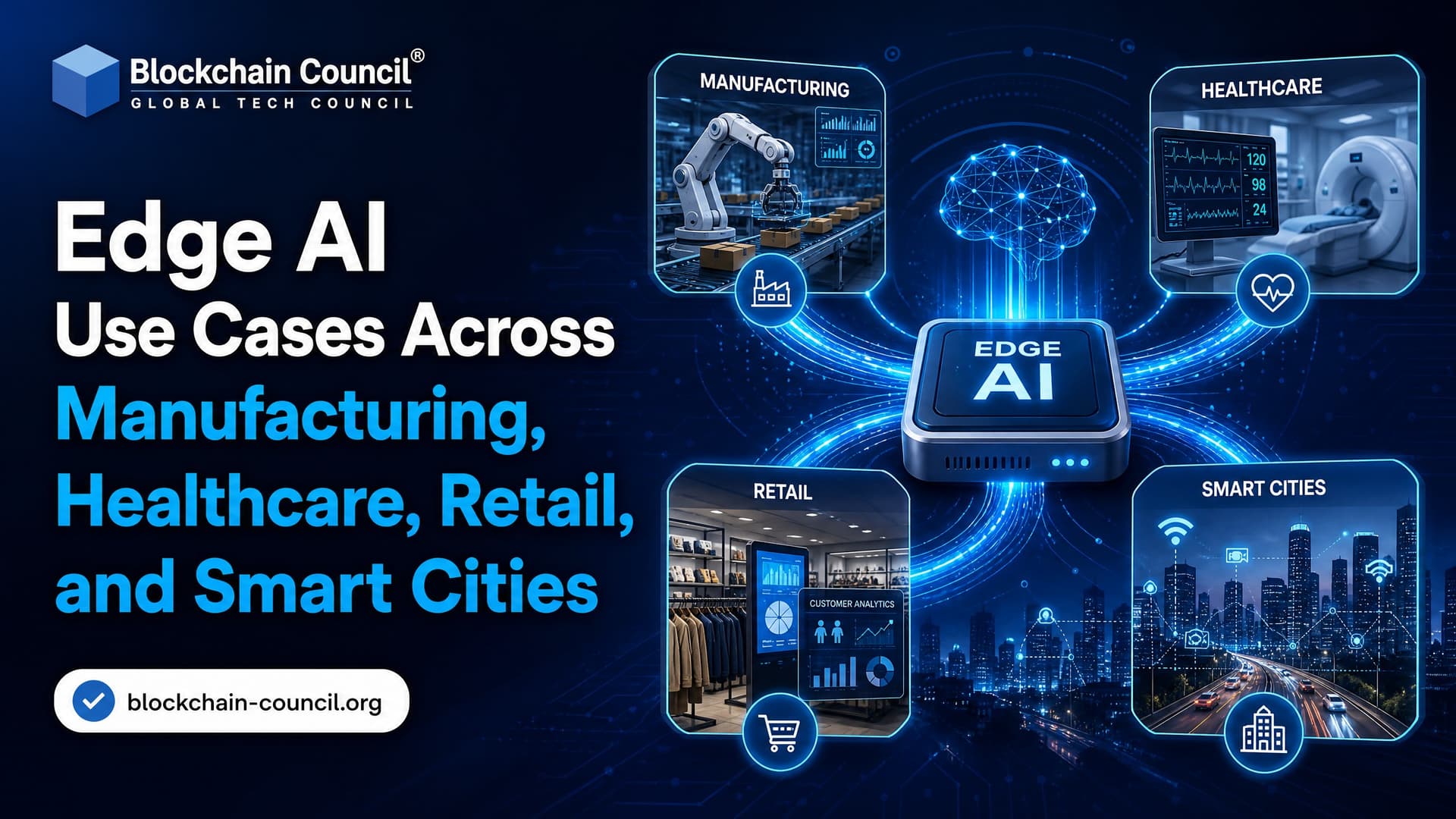
Edge AI use cases are no longer confined to lab demos. Factories use edge vision to reject defective parts in milliseconds, hospitals run inference near sensitive patient data, retailers analyze shelves without sending every video frame to the cloud, and smart cities process traffic and safety events close to the street.
The practical reason is simple. Moving every sensor feed to a distant cloud is slow, expensive, and often risky from a privacy point of view. Edge AI runs machine learning inference on local devices, gateways, or on-premise servers near where data is created. You may still train models in the cloud, but the decision happens locally.

As organizations accelerate real-time AI adoption across manufacturing, healthcare, retail, and smart infrastructure, professionals with a Certified Edge AI Expert credential are increasingly helping design and deploy low-latency AI solutions that deliver faster, more secure, and more reliable decision-making at the edge.
What Edge AI Means in Real Deployments
Edge AI is usually about inference, not large-scale training. A camera, wearable, point-of-sale device, industrial controller, or local gateway runs a trained model and responds immediately. Only events, summaries, or selected data get sent upstream.
That design gives enterprises five clear benefits:
Low latency: A traffic light, robotic arm, or patient monitor cannot wait several seconds for a cloud round trip.
Lower bandwidth cost: Video, vibration, and medical imaging data are heavy. Filtering locally cuts transfer volume.
Better privacy: Raw faces, health data, or production data can stay on site.
Operational resilience: Devices keep working during weak or lost connectivity.
Scalable IoT operations: Intelligence is distributed across many devices instead of concentrated in one cloud pipeline.
A real deployment note: if you are using NVIDIA TensorRT, engine files are not generally portable across GPU architectures. Teams often discover this after moving a model from a development workstation to a Jetson device and seeing errors such as The engine plan file is generated on an incompatible device. Build and test the optimized model on the target hardware. It saves days.
Edge AI in Manufacturing
Manufacturing is one of the clearest edge AI use cases because factory data has strict timing requirements. A defect camera on a line moving at high speed cannot wait for cloud processing. A motor vibration anomaly is useful only if the maintenance team sees it before the bearing fails.
Predictive maintenance
Industrial sensors measure vibration, temperature, current draw, pressure, and acoustic patterns. Edge AI models analyze those signals locally to detect early signs of wear in motors, pumps, compressors, conveyors, and CNC machines.
This is not just about avoiding downtime. A failing motor often draws more power before it stops. Catching that drift early can reduce energy waste and safety risk.
Computer vision quality control
Camera-based inspection systems can spot scratches, missing components, incorrect labels, weld issues, or packaging defects in real time. Many plants start with human inspection, then add edge vision at the highest-volume or highest-error stations.
To be blunt, edge AI often beats cloud AI here. If a defective item has already passed three stations by the time the cloud returns a result, the model is late.
Process optimization and energy management
Factories also use edge analytics to monitor line speed, bottlenecks, energy consumption, and resource utilization. Local models can recommend adjustments to machine settings or alert operators when throughput changes unexpectedly.
Industrial AI platform providers now describe this as a move toward AI-native operations, where monitoring, inference, and automated response become part of the normal plant workflow.
Successfully operating these manufacturing AI systems also depends on disciplined model deployment, monitoring, version control, and continuous updates across distributed devices. Professionals responsible for maintaining these production AI environments often strengthen their expertise through a Certified MLOps Expert program to ensure models remain accurate and dependable throughout their lifecycle.
Edge AI in Healthcare
Healthcare edge AI focuses on speed, privacy, and continuity of care. Hospitals, clinics, ambulances, and home-care settings all generate sensitive data. Sending every scan, waveform, or audio sample to the cloud is not always acceptable.
Medical imaging and triage
Edge AI can run near imaging equipment or local hospital servers to help detect abnormalities in X-rays, CT scans, ultrasound, or pathology workflows. The goal is not to replace clinicians. The better goal is faster triage, especially when radiology teams are overloaded.
For critical care, seconds matter. Local inference can flag urgent cases even when the cloud connection is congested or unavailable.
Remote patient monitoring
Wearables and home monitoring devices use edge AI to process heart rate, oxygen saturation, movement, sleep patterns, and other vital signs. Instead of transmitting raw streams all day, the device can send alerts when patterns cross a clinical threshold.
Research on the Internet of Medical Things, often called IoMT, reports that edge-based architectures can cut communication cost and privacy risk compared with cloud-only designs. That matters when devices are used in homes, elder care, ambulances, and rural clinics.
Portable diagnostics
Portable diagnostic tools can run preliminary inference on device, then forward relevant results for review. This helps in resource-constrained settings where bandwidth and specialist access are limited.
One research example in smart-city healthcare used edge AI for voice pathology detection. The broader lesson holds: not every healthcare AI task needs a massive cloud model if the device can answer a narrow clinical question locally.
Edge AI in Retail
Retail edge AI turns stores into local analytics environments. Cameras, RFID readers, shelf sensors, scanners, and point-of-sale systems produce useful signals every second. Process that data in the store and you can act while the shopper is still there.
In-store behavior analytics
Retailers use local vision models and sensor data to measure queue length, footfall, dwell time, and store-zone congestion. These insights help managers adjust staffing, checkout lanes, layouts, and promotional placement.
There is a trade-off. Behavior analytics can become intrusive if implemented poorly. Keep raw video local, minimize retention, and define what the model is allowed to detect before deployment.
Inventory and shelf analytics
Out-of-stock items are expensive. Edge systems can combine shelf sensors, RFID data, backroom scans, and camera feeds to detect empty shelves or inventory mismatches faster than batch reporting.
In supermarkets and large-format stores, local reconciliation matters because wide-area network outages still happen. Core systems such as inventory, digital signage, and point-of-sale should degrade gracefully instead of stopping.
Loss prevention and fraud detection
Edge AI can monitor self-checkout behavior, detect suspicious events, and alert staff without streaming all footage to a central server. This lowers latency and reduces exposure of customer video data.
The right approach is narrow and auditable. Detect events, not identities, unless there is a clear legal and governance basis.
Edge AI in Smart Cities
Smart cities rely on distributed infrastructure: cameras, air-quality sensors, traffic systems, parking meters, utility meters, connected vehicles, and emergency systems. Edge AI fits naturally because urban systems need fast local response.
Traffic management and mobility
Traffic cameras and road sensors can feed edge models that estimate congestion, detect incidents, count vehicles, and adjust signals. Local inference is especially useful when cloud links are unreliable or latency-sensitive.
A cloud dashboard can show citywide patterns. The intersection still needs to act locally.
Environmental monitoring and smart grids
Pollution sensors and grid equipment can use edge AI to detect air-quality spikes, unusual power demand, or equipment anomalies. Local analysis helps city operators react quickly without waiting for centralized processing.
Public safety and urban services
Edge AI also supports public safety work such as hazard detection, gas station surveillance, parcel delivery logistics, and citizen-service automation. Advantech has reported smart-city deployments across citizen services, delivery operations, and surveillance scenarios, and MarketsandMarkets has projected strong growth for AI in smart-city applications by 2027.
Public safety use cases need strict governance. Document model purpose, retention rules, access controls, bias testing, and escalation procedures before the first camera goes live.
Common Deployment Challenges
The hardest part of edge AI is rarely the first model. It is operating hundreds or thousands of models across mixed hardware.
Model updates: You need safe rollout, rollback, and version tracking across devices.
Hardware limits: Memory, power, heat, and accelerator compatibility shape model choice.
Security: Edge devices sit in factories, stores, clinics, and streets. They need device identity, secure boot, patching, and access control.
Data drift: Lighting changes, machine wear, seasonal retail behavior, and new traffic patterns can reduce model accuracy.
Legacy integration: PLCs, hospital systems, retail ERPs, and municipal platforms were not always built for AI workflows.
If you are building skills for these projects, study AI fundamentals, IoT architecture, cybersecurity, and data governance together. Blockchain Council's Certified Artificial Intelligence (AI) Expert™ is a useful learning path for model concepts and AI implementation thinking. If your project involves audit trails, device identity, or trusted data exchange, pair that with the Certified Blockchain Expert™ for the distributed systems angle.
How to Choose the Right Edge AI Use Case
Start where edge processing has a clear advantage over cloud-only AI. Use this filter:
Latency: Does the action need to happen in milliseconds or seconds?
Data volume: Are you processing video, audio, imaging, or high-frequency sensor data?
Privacy: Would sending raw data to the cloud create legal or trust issues?
Connectivity: Must the system keep working during network failure?
Measurable outcome: Can you tie the model to downtime reduction, faster triage, fewer stock-outs, lower congestion, or reduced energy use?
Pick one narrow problem first. Defect detection on one line. Queue monitoring in ten stores. Fall-risk alerts for one patient group. Traffic incident detection at a known bottleneck. Then measure false positives, response time, operating cost, and user trust before scaling.
Your Next Step
Choose one edge AI use case from your sector and map the data source, target hardware, model type, latency requirement, privacy constraint, and success metric. Then build a small proof of value using real sensor or image data. If you need structured AI training before implementation, start with Blockchain Council's Certified Artificial Intelligence (AI) Expert™ and add cybersecurity and blockchain learning where device trust, auditability, or regulated data are part of the project.
As Edge AI continues expanding across industrial automation, healthcare, retail, and smart cities, professionals involved in product strategy, technology consulting, or business development can complement their technical expertise with a Marketing Certification to better communicate the business value of Edge AI solutions and support successful enterprise adoption.
FAQs
1. What is Edge AI, and why is it important across industries?
Edge AI is the deployment of artificial intelligence models on local devices, sensors, gateways, or edge servers instead of relying solely on cloud computing. It enables real-time decision-making, lower latency, improved data privacy, reduced bandwidth usage, and greater operational reliability, making it valuable across multiple industries.
2. How is Edge AI used in manufacturing?
Manufacturers use Edge AI for predictive maintenance, automated quality inspection, machine vision, industrial robotics, worker safety monitoring, production optimization, equipment monitoring, and energy management. These applications help reduce downtime, improve product quality, and increase factory productivity.
3. How does Edge AI improve healthcare?
Healthcare providers use Edge AI for medical imaging analysis, wearable health monitoring, remote patient monitoring, clinical decision support, smart medical devices, hospital operations, and emergency care. Local processing enables faster insights while supporting patient privacy and reliable operation.
4. How is Edge AI transforming retail?
Retailers deploy Edge AI for cashier-less checkout, smart shelves, inventory management, customer behavior analysis, personalized shopping experiences, loss prevention, queue management, demand forecasting, and in-store analytics to improve operational efficiency and customer satisfaction.
5. What role does Edge AI play in smart cities?
Edge AI powers intelligent traffic management, smart parking, public safety systems, environmental monitoring, waste management, energy optimization, smart lighting, public transportation, and emergency response by processing city data locally and enabling real-time actions.
6. What are the main benefits of Edge AI across industries?
The primary benefits include faster decision-making, lower latency, offline functionality, improved cybersecurity, stronger data privacy, lower cloud costs, reduced bandwidth usage, increased operational efficiency, and better scalability for connected devices.
7. How does Edge AI improve quality control in manufacturing?
AI-powered cameras inspect products directly on production lines to detect defects such as scratches, cracks, missing components, incorrect assembly, and packaging errors. This allows manufacturers to improve product consistency while reducing waste and manual inspections.
8. How does Edge AI support remote patient monitoring?
Wearable devices and connected medical equipment analyze patient health data locally to detect abnormal conditions and generate timely alerts for healthcare providers or caregivers. This supports continuous monitoring while reducing dependence on cloud connectivity.
9. How does Edge AI improve customer experiences in retail?
Retail businesses use Edge AI to deliver personalized recommendations, optimize store layouts, speed up self-checkout, monitor product availability, reduce waiting times, and provide real-time customer assistance through intelligent in-store systems.
10. How does Edge AI improve traffic management in smart cities?
Edge AI analyzes live video feeds and sensor data to optimize traffic signals, identify accidents, monitor congestion, detect pedestrian movement, and improve overall traffic flow, helping reduce travel times and vehicle emissions.
11. What hardware supports Edge AI deployments?
Common hardware includes industrial PCs, edge servers, AI-enabled cameras, NVIDIA Jetson platforms, Intel processors, Google Coral Edge TPU, ARM processors, AI accelerators, embedded systems, IoT gateways, smart sensors, and wearable devices.
12. Which AI frameworks are commonly used for Edge AI?
Developers frequently use TensorFlow Lite, ONNX Runtime, OpenVINO, NVIDIA TensorRT, PyTorch Mobile, Apache TVM, Edge Impulse, TensorFlow Lite Micro, and TinyML frameworks for deploying optimized AI models on edge devices.
13. Can Edge AI operate without internet access?
Yes. One of the key advantages of Edge AI is local AI inference. Devices continue processing data and making decisions even when internet connectivity is unavailable. Data can be synchronized with cloud systems when connectivity returns.
14. What are the biggest challenges of implementing Edge AI?
Organizations may face challenges such as hardware limitations, AI model optimization, cybersecurity, device lifecycle management, software updates, integration with legacy systems, regulatory compliance, and scaling deployments across distributed environments.
15. How does Edge AI improve cybersecurity and privacy?
By processing sensitive information locally, Edge AI reduces the amount of data transmitted across external networks. Combined with encryption, secure authentication, access controls, and device monitoring, this helps strengthen cybersecurity and support privacy compliance.
16. Which industries benefit the most from Edge AI?
Manufacturing, healthcare, retail, automotive, logistics, agriculture, telecommunications, energy, financial services, smart cities, industrial IoT, and defense are among the industries gaining significant benefits from Edge AI adoption.
17. What are the best practices for deploying Edge AI?
Organizations should identify high-value use cases, choose compatible hardware, optimize AI models for edge deployment, secure devices and networks, conduct pilot projects, monitor performance continuously, and establish governance for AI lifecycle management.
18. What technologies complement Edge AI?
Edge AI works alongside IoT, 5G, cloud computing, digital twins, robotics, autonomous vehicles, blockchain, predictive analytics, machine learning, computer vision, and industrial automation platforms to build intelligent, connected ecosystems.
19. What future trends are shaping Edge AI adoption?
Emerging trends include TinyML, federated learning, multimodal AI, AI-specific hardware, autonomous edge systems, Edge AI-powered robotics, sustainable computing, generative AI at the edge, 5G-enabled applications, and advanced AI orchestration across distributed devices.
20. Why is Edge AI becoming essential across manufacturing, healthcare, retail, and smart cities?
Edge AI enables organizations to process data where it is created, delivering faster insights, stronger privacy, lower operational costs, and greater resilience. Whether improving product quality in factories, supporting clinicians with faster analysis, enhancing customer experiences in retail, or optimizing urban infrastructure, Edge AI provides the real-time intelligence needed for modern digital transformation. As connected devices continue to multiply, Edge AI is expected to become a foundational technology for building smarter, safer, and more efficient industries and communities.
Related Articles
View All
Edge Ai
Edge AI in Smart Cities: Traffic, Safety, and Energy Use
Explore how edge AI in smart cities improves traffic control, public safety, energy efficiency, and infrastructure resilience with local real-time intelligence.

Edge Ai
Edge AI in Retail: Personalized Shopping, Smart Shelves, and Loss Prevention
Edge AI in retail brings real-time intelligence to stores, powering personalized shopping, smart shelves, checkout security, and shrink reduction.
Edge Ai
Edge AI vs Cloud AI: Key Differences, Benefits, and Use Cases
Edge AI vs Cloud AI explained for professionals: compare latency, privacy, compute, scalability, hybrid patterns, and practical enterprise use cases.
Trending Articles
AWS Career Roadmap
A step-by-step guide to building a successful career in Amazon Web Services cloud computing.

Top 5 DeFi Platforms
Explore the leading decentralized finance platforms and what makes each one unique in the evolving DeFi landscape.
What is AWS? A Beginner's Guide to Cloud Computing
Everything you need to know about Amazon Web Services, cloud computing fundamentals, and career opportunities.