

Edge AI in Smart Cities: Traffic, Safety, and Energy Use
 Suyash Raizada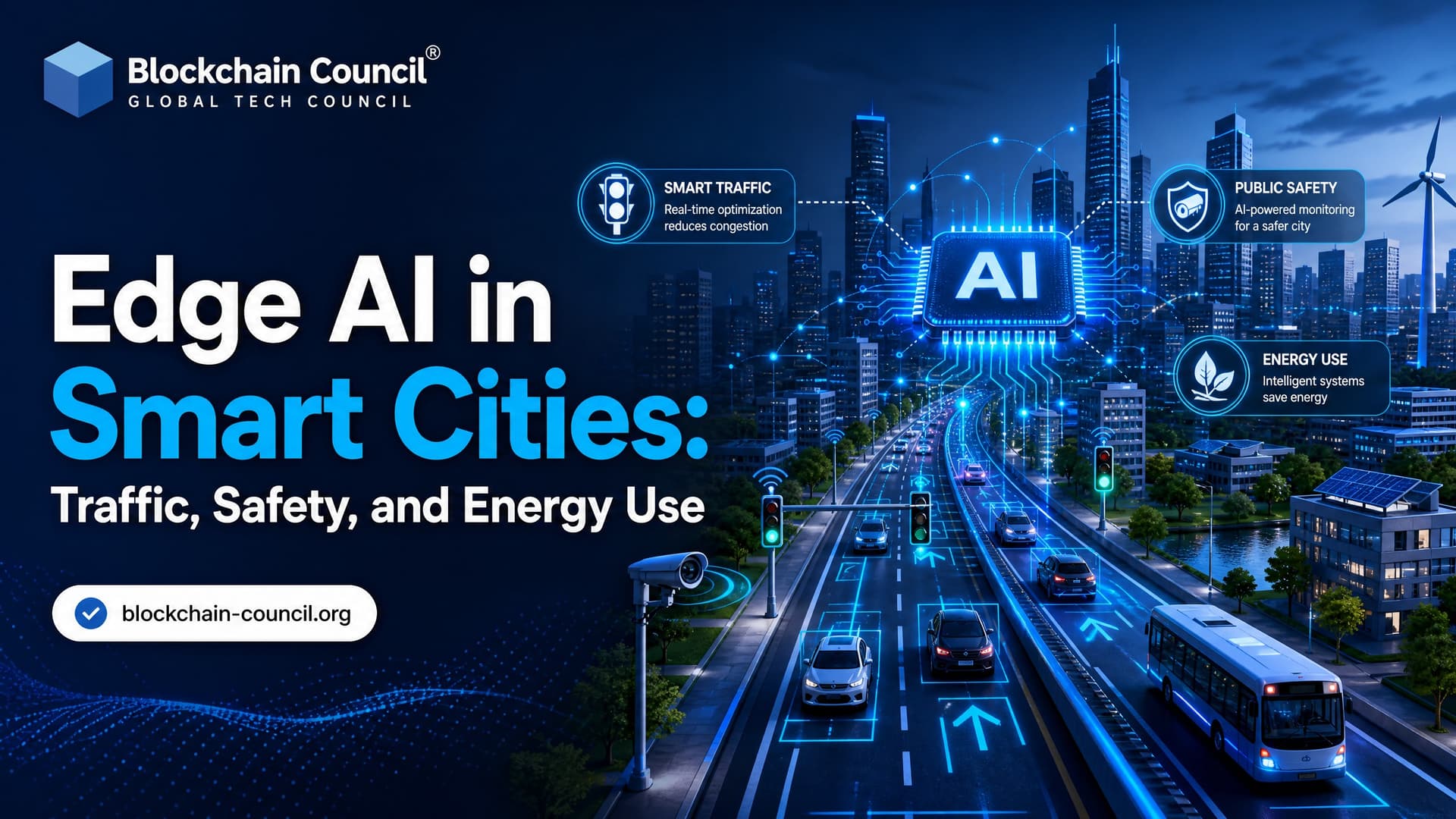
Edge AI in smart cities means running AI models near the street, building, vehicle, camera, meter, or gateway where data is created. That changes how a city operates. A traffic signal can respond in milliseconds. A camera can flag a pedestrian risk without streaming raw video across a network. A power controller can spot an abnormal current pattern before a feeder fault turns into a local outage.
The point is not to remove cloud platforms. That would be a mistake. The better design is hybrid: use edge AI for time-sensitive decisions and send summaries, events, and trends to cloud systems for planning, reporting, and model improvement.

As cities modernize transportation, utilities, and public infrastructure, professionals with a Certified Edge AI Expert background are increasingly helping organizations design intelligent edge architectures that deliver fast, secure, and resilient AI-powered services close to where data is generated.
What Edge AI Brings to Smart Cities
Edge AI combines machine learning with edge computing. Instead of sending every video frame, LiDAR reading, or sensor value to a distant data center, inference runs on local devices such as smart cameras, roadside units, industrial PCs, gateways, and vehicle systems.
For a city team, the benefits are practical:
Lower latency: decisions happen near the source of data, which matters for traffic lights, emergency alerts, and utility protection.
Reduced bandwidth: systems transmit metadata or event clips instead of full raw streams.
Better privacy: sensitive video or location data can stay inside municipal networks.
Operational resilience: intersections, substations, and building controllers keep working even when backhaul links degrade.
Intel describes this shift as embedding intelligence into the infrastructure that keeps communities safe, moving, and connected. That framing is right. Smart cities do not need another dashboard that updates too late. They need local systems that can sense, decide, and act.
Edge AI for Traffic Management
Traffic is one of the clearest applications of edge AI in smart cities because seconds matter. Congestion builds quickly. Pedestrians step into crossings without warning. Emergency vehicles need priority now, not after a central system finishes processing video.
Adaptive traffic signals
At an AI-enabled intersection, local cameras or sensors count vehicles, classify lanes, estimate queue length, and adjust signal timing. The full video feed never has to leave the junction. Some edge-based traffic deployments report large drops in bandwidth use compared with cloud-heavy designs, in the range of 80 percent, because raw HD streams stay local.
That number matters. A city with hundreds of intersections cannot afford to stream every HD camera feed into one central data center all day. It also should not. Sending event metadata, such as vehicle counts, speed estimates, and blocked-lane alerts, is cheaper and cleaner.
Incident detection on highways and corridors
Edge video analytics can detect stalled vehicles, wrong-way movement, crashes, debris, or sudden congestion. When the system runs locally, it can trigger lane control signs, alert operators, or start rerouting workflows faster than a cloud-only pipeline.
A real deployment detail: the model is rarely the only hard part. Camera streams fail in ugly ways. If you have worked with RTSP feeds, you have probably seen ffmpeg warnings like Non-monotonous DTS in output stream when timestamps drift. That can break downstream analytics before your object detector ever gets a frame. City projects need boring engineering too: time synchronization, watchdogs, fallback rules, and clear maintenance ownership.
Connected vehicles and roadside intelligence
Edge AI also supports connected and autonomous vehicle systems. Vehicles run object detection, localization, and mapping onboard because they cannot wait for cloud responses. Roadside edge units can add to this by sharing intersection state, pedestrian alerts, or congestion data with nearby vehicles.
To be blunt, edge AI is not magic for autonomous transport. It helps with real-time perception and coordination, but cities still need standards, liability rules, sensor maintenance, and cybersecurity controls. A pilot that works on one polished corridor can fail badly on a rainy arterial road with poor lane markings.
Scaling these intelligent traffic systems requires more than accurate AI models. Continuous monitoring, model version control, automated deployments, and reliable updates across thousands of distributed edge devices are essential, which is why many professionals pursue a Certified MLOps Expert program to strengthen their expertise in production AI operations.
Edge AI for Public Safety
Public safety is another mature area for edge AI, especially in video-heavy environments. The use cases go well beyond surveillance. They include pedestrian safety, emergency response, crowd risk detection, and infrastructure protection.
Smart surveillance and anomaly detection
Edge AI cameras can detect unattended bags, crowd disturbances, intrusion events, smoke, stopped vehicles in restricted areas, or unusual movement patterns. Some urban security systems now analyze footage in real time on the device and alert first responders when suspicious activity appears.
Processing locally has two advantages. First, alerts arrive faster. Second, the city can cut the amount of personally sensitive footage sent over networks. That does not solve every privacy issue, but it gives architects more options: on-device redaction, short retention windows, event-only upload, and role-based access.
Pedestrian and vulnerable road user protection
School zones, crosswalks, and high-risk intersections are strong candidates for edge AI. A local system can detect pedestrians or cyclists, estimate vehicle approach speed, and trigger a warning light or signal change without waiting for a cloud round trip.
This is where product teams have to be careful. False negatives can be dangerous. False positives annoy drivers until they ignore alerts. You need field testing across lighting conditions, weather, occlusion, camera vibration, and seasonal changes. A model that performs well at noon may struggle with headlights, rain glare, or a delivery truck blocking half the view.
Agentic systems for city operations
Intel and other technology providers are now discussing agentic AI for public safety operations, where systems can sense, reason, and act across multiple data sources. In practice, that might mean a camera detects a crash, a traffic controller creates a green corridor for responders, and a command center receives a verified incident package.
This is promising, but cities should draw a hard line between recommendation and autonomous enforcement. Use agentic workflows first for triage, routing, and operator support. Keep high-impact decisions auditable and supervised.
Edge AI for Energy Optimization and Infrastructure
Traffic and safety get more attention, but energy optimization may produce some of the most durable gains. Smart city energy systems depend on fast local control, especially as grids add rooftop solar, batteries, electric vehicles, heat pumps, and microgrids.
Smart grid fault detection
Edge AI systems can monitor electrical current patterns locally to detect failing transformers or grid anomalies. When the controller sits close to the equipment, it can flag faults and support rerouting before a wider outage occurs.
Cloud analytics still has value here. Long-term load forecasting, asset planning, and maintenance scheduling belong in centralized systems. Protection and local anomaly detection belong closer to the grid equipment.
Building energy management
Buildings are city-scale energy assets. Edge AI can tune HVAC, lighting, ventilation, and battery use based on occupancy, indoor air quality, local weather, and electricity price signals. A conference room does not need full cooling for two hours if the booking was canceled. A municipal building can pre-cool before a peak demand window.
The wrong approach is to install AI controls without facilities staff buy-in. Operators know which air handling unit has a sticky damper and which sensor reads five degrees too high. Ignore that knowledge and your model will optimize a fantasy version of the building.
Water, waste, and infrastructure maintenance
Edge AI can also monitor pipelines for leaks, track pump vibration, estimate waste bin fill levels, and detect road surface deterioration. Research programs on edge AI point to these broader urban uses, including aging utility systems and road condition monitoring.
These applications are less glamorous than autonomous shuttles. They may also be more valuable. A small leak caught early, a transformer replaced before failure, or a waste route shortened every day can save real money.
Architecture: What a Practical Smart City Edge AI Stack Looks Like
A typical deployment has five layers:
Sensors: cameras, radar, inductive loops, microphones, meters, vibration sensors, weather sensors, and vehicle feeds.
Edge compute: AI cameras, industrial PCs, NVIDIA Jetson devices, Intel edge platforms, or local gateways.
Inference software: models for detection, classification, forecasting, anomaly detection, and control.
Messaging and control: MQTT, APIs, traffic signal controllers, SCADA integration, and alerting systems.
Cloud or data center: dashboards, historical analytics, digital twins, retraining pipelines, and governance records.
Hybrid design wins because it puts each workload where it belongs. Do not run long-term urban planning on a camera. Do not send every pedestrian detection to a distant cloud before changing a crosswalk signal.
Risks Cities Must Manage
Edge AI in smart cities brings new risks alongside clear benefits.
Cybersecurity: thousands of distributed devices create a larger attack surface. Secure boot, signed updates, network segmentation, and device identity are not optional.
Model drift: construction zones, new road layouts, camera repositioning, and seasonal lighting can degrade accuracy.
Interoperability: avoid systems that trap data in closed formats or proprietary control layers.
Governance: public safety analytics need clear policies for retention, access, bias testing, and human review.
Maintenance: dirty lenses, unstable power, bad mounts, and heat can ruin a system that looked excellent in a lab.
If your team is building skills for this area, Blockchain Council's Certified Artificial Intelligence (AI) Expert™ is a relevant path for AI foundations, while Certified Cyber Security Expert™ is useful for securing distributed edge systems. Teams working on trusted data exchange or infrastructure audit trails may also connect this topic with Certified Blockchain Expert™.
Future Outlook for Edge AI in Smart Cities
Edge AI is moving from pilots into core urban infrastructure. Expect three changes over the next few years.
First, more local autonomy. Traffic controllers, utility gateways, and safety systems will make more routine decisions at the edge, with operators supervising the exceptions.
Second, stronger edge-cloud coordination. Digital twins and planning systems will depend on cleaner real-time data from field infrastructure. AI-supported digital twins are emerging as a smart city planning tool, and edge AI is the data backbone that keeps those models current.
Third, better model efficiency. Quantization, pruning, and hardware acceleration will let more capable models run on lower-power devices. That matters for city budgets and sustainability targets.
Your next step: pick one city workflow, such as adaptive signals, pedestrian safety, building HVAC, or grid fault detection, and map which decisions must happen in under one second. Those decisions belong at the edge. Then build the governance, cybersecurity, and AI skills to run them responsibly.
As edge AI becomes a cornerstone of smarter transportation, energy management, and citizen services, professionals who complement their technical expertise with a Marketing Certification are better equipped to communicate the value of AI-driven public infrastructure, support stakeholder adoption, and align innovation with long-term community and business goals.
FAQs
1. What is Edge AI in smart cities?
Edge AI in smart cities refers to deploying artificial intelligence directly on edge devices such as traffic cameras, IoT sensors, smart streetlights, public transportation systems, and edge servers. Instead of sending all data to centralized cloud platforms, Edge AI processes information locally to enable faster decision-making, reduce latency, and improve public services.
2. Why is Edge AI important for smart cities?
Smart cities generate enormous amounts of data every second. Edge AI allows this data to be analyzed close to where it is collected, enabling real-time responses for traffic management, public safety, environmental monitoring, energy optimization, and emergency services while reducing network congestion.
3. How does Edge AI improve traffic management?
Edge AI analyzes live traffic data from cameras and sensors to optimize traffic signals, detect congestion, identify accidents, monitor pedestrian crossings, and improve traffic flow. This helps reduce travel times, fuel consumption, and emissions.
4. How is Edge AI used in public safety?
Edge AI supports public safety by enabling real-time video analytics, detecting suspicious activities, recognizing accidents, monitoring crowds, identifying unauthorized access, and helping emergency responders react more quickly to critical situations.
5. What are the main applications of Edge AI in smart cities?
Common applications include intelligent traffic control, smart parking, waste management, public transportation optimization, environmental monitoring, energy management, surveillance, disaster response, water management, and smart street lighting.
6. How does Edge AI improve smart parking systems?
Edge AI-powered cameras and sensors detect available parking spaces in real time, guide drivers to open spots, reduce traffic caused by parking searches, and improve overall parking management without requiring constant cloud communication.
7. Can Edge AI improve environmental monitoring?
Yes. Edge AI analyzes data from air quality sensors, weather stations, noise monitors, and water quality systems locally. It can detect pollution levels, identify environmental hazards, and provide faster alerts to city authorities.
8. What hardware is commonly used for Edge AI in smart cities?
Typical hardware includes IoT gateways, AI-enabled surveillance cameras, industrial edge servers, smart sensors, NVIDIA Jetson devices, Google Coral Edge TPU, Intel processors, ARM-based systems, and specialized AI accelerators designed for outdoor environments.
9. Which industries support Edge AI smart city solutions?
Technology providers, telecommunications companies, transportation agencies, utility providers, public safety organizations, environmental agencies, energy companies, and municipal governments all contribute to Edge AI-powered smart city infrastructure.
10. How does Edge AI improve public transportation?
Edge AI enables real-time vehicle tracking, passenger counting, route optimization, predictive maintenance, traffic analysis, and fleet monitoring. These capabilities help improve service reliability, reduce delays, and enhance the passenger experience.
11. How does Edge AI improve energy management?
Smart grids and intelligent energy systems use Edge AI to monitor electricity demand, optimize power distribution, detect equipment faults, manage renewable energy sources, and improve overall energy efficiency across cities.
12. Can Edge AI operate during network outages?
Yes. Because Edge AI performs inference locally, many smart city systems continue functioning even if cloud connectivity is interrupted. Devices can synchronize data with central platforms once the network connection is restored.
13. What are the biggest challenges of implementing Edge AI in smart cities?
Challenges include integrating legacy infrastructure, securing connected devices, protecting citizen privacy, managing thousands of distributed devices, maintaining AI models, ensuring interoperability, and complying with local regulations.
14. How does Edge AI improve data privacy?
Since much of the data is processed directly on local devices, sensitive information often does not need to leave its source. This reduces unnecessary data transmission and helps organizations comply with privacy and data protection regulations.
15. What software frameworks are used for Edge AI in smart cities?
Popular frameworks include TensorFlow Lite, ONNX Runtime, OpenVINO, NVIDIA TensorRT, PyTorch Mobile, Apache TVM, Edge Impulse, and IoT platforms that support AI deployment and device management across distributed infrastructure.
16. How can cities successfully deploy Edge AI solutions?
Cities should identify high-impact use cases, conduct pilot programs, choose compatible hardware, optimize AI models, secure devices and networks, establish governance policies, train personnel, and continuously monitor system performance.
17. What is the difference between Edge AI and cloud AI in smart cities?
Edge AI processes data locally for immediate actions such as traffic signal adjustments or security alerts, while cloud AI handles long-term analytics, historical reporting, AI model training, and centralized management. Many smart city platforms combine both in a hybrid architecture.
18. How does Edge AI support sustainable urban development?
Edge AI helps optimize transportation, reduce energy consumption, improve waste collection, monitor environmental conditions, conserve water, and lower carbon emissions. These capabilities support more sustainable, resource-efficient cities.
19. What are the best practices for implementing Edge AI in smart cities?
Best practices include deploying secure hardware, encrypting communications, using scalable edge infrastructure, monitoring AI performance, maintaining software updates, ensuring interoperability between systems, protecting citizen privacy, and implementing clear governance and compliance policies.
20. Why is Edge AI considered the future of smart cities?
Edge AI enables cities to make faster, smarter, and more localized decisions without depending entirely on centralized cloud infrastructure. By combining real-time analytics, intelligent automation, IoT connectivity, and secure edge computing, Edge AI supports safer roads, more efficient public services, sustainable resource management, and improved quality of life for citizens. As urban populations continue to grow, Edge AI is expected to become a core technology powering the next generation of intelligent cities.
Related Articles
View All
Edge Ai
Edge AI Use Cases Across Manufacturing, Healthcare, Retail, and Smart Cities
Explore practical edge AI use cases in manufacturing, healthcare, retail, and smart cities, including benefits, deployment risks, and next steps.

Edge Ai
TinyML vs Edge AI: Differences, Similarities, and When to Use Each
TinyML vs Edge AI explained clearly: learn how they differ, where they overlap, and how to choose the right architecture for edge systems.

Edge Ai
Edge AI in Retail: Personalized Shopping, Smart Shelves, and Loss Prevention
Edge AI in retail brings real-time intelligence to stores, powering personalized shopping, smart shelves, checkout security, and shrink reduction.
Trending Articles

Top 5 DeFi Platforms
Explore the leading decentralized finance platforms and what makes each one unique in the evolving DeFi landscape.

Can DeFi 2.0 Bridge the Gap Between Traditional and Decentralized Finance?
The next generation of DeFi protocols aims to connect traditional banking with decentralized finance ecosystems.
Claude AI Tools for Productivity
Discover Claude AI tools for productivity to streamline tasks, manage workflows, and improve efficiency.