

Edge AI vs Cloud AI: Key Differences, Benefits, and Use Cases
 Suyash Raizada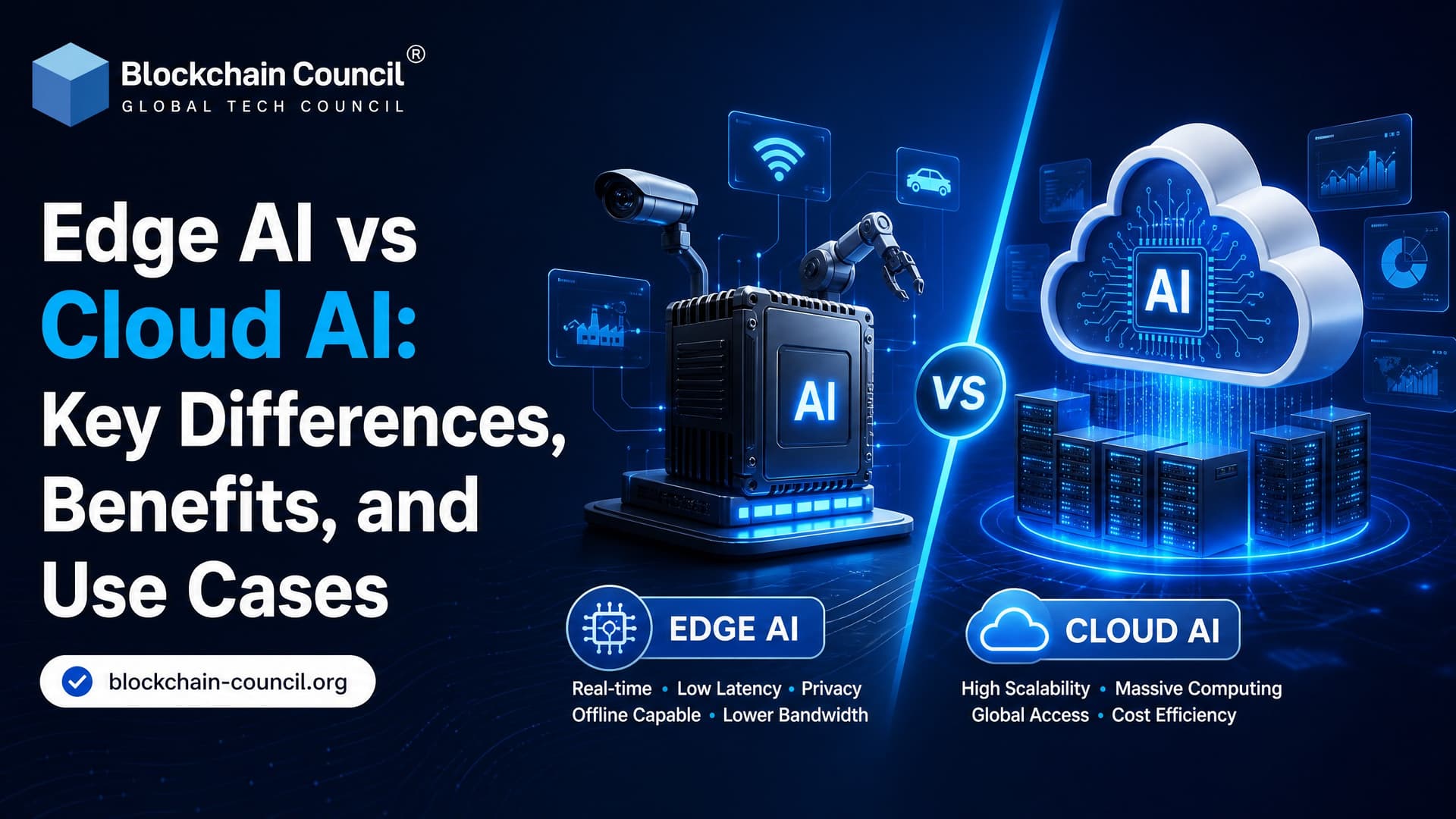
Edge AI vs Cloud AI is not a winner-takes-all choice. Edge AI runs trained models on or near the device that creates the data. Cloud AI runs workloads in centralized data centers with far more compute. The real design question is simple: which decision must happen locally, and which job can wait for the cloud?
If you are building an AI system for a factory camera, a wearable health monitor, an autonomous robot, or an enterprise analytics platform, this distinction matters. It affects latency, privacy, bandwidth cost, model size, security, and how painful updates become after deployment.

As enterprises increasingly deploy intelligent systems across manufacturing, healthcare, logistics, and smart infrastructure, professionals with a Certified Edge AI Expert credential are helping organizations design architectures that balance low-latency performance, security, and scalable AI deployment.
What Is Edge AI?
Edge AI means AI processing happens locally on devices such as smartphones, routers, cameras, industrial machines, vehicles, smart home hubs, wearables, and IoT sensors. In most deployments, the model has already been trained elsewhere. The edge device runs inference, takes a local action, and sends only useful results upstream.
Think of a camera on a production line that detects a cracked bottle and triggers a reject arm in milliseconds. Sending every video frame to a remote cloud service first would add delay, consume bandwidth, and increase privacy exposure. Local inference is the right call.
Edge AI usually depends on smaller models, optimized runtimes, and hardware constraints. You may use TensorFlow Lite, ONNX Runtime, OpenVINO, NVIDIA Jetson, Arm-based NPUs, or mobile neural processing units. A common beginner mistake is deploying a quantized TensorFlow Lite model and feeding it float32 input. The interpreter may throw: Cannot set tensor: Got value of type FLOAT32 but expected type UINT8 for input 0. That one error tells you a lot about edge AI: data types, memory, and preprocessing details are not optional.
What Is Cloud AI?
Cloud AI performs AI workloads on centralized infrastructure in public clouds or private data centers. It uses large pools of CPUs, GPUs, storage, and specialized accelerators. This is where organizations train large neural networks, run big data analytics, manage model experiments, and store long-term telemetry.
Cloud AI is well suited to high performance computing, large-scale analytics, and foundation model training. That fits what practitioners see daily. Training a large computer vision model or fine-tuning a language model across millions of examples is not a job for a small device mounted above a conveyor belt.
Cloud AI also makes centralized model management easier. You can test new versions, run A/B experiments, monitor drift, and roll out updates through a managed pipeline. The trade-off is dependence on connectivity and higher exposure when raw data must travel to remote systems.
Whether AI models run at the edge or in the cloud, long-term success depends on disciplined deployment, version control, monitoring, and continuous optimization. Professionals managing these production AI environments often strengthen their expertise through a Certified MLOps Expert program to ensure models remain reliable, scalable, and easy to maintain throughout their lifecycle.
Edge AI vs Cloud AI: Key Differences
1. Processing location
Edge AI processes data at the source or close to it. Cloud AI sends data to remote servers for processing. That single architectural decision drives most of the downstream differences.
2. Latency
Edge AI is usually the better choice when milliseconds matter. Robotics, AR/VR, autonomous driving, industrial safety, and real-time medical alerts cannot wait for a round trip across the internet.
Cloud AI latency varies with network quality, routing, congestion, and service availability. For recommendation engines or monthly analytics, that is acceptable. For collision avoidance, it is not.
3. Privacy and data governance
Edge AI can keep raw data on the device. A smart camera can send an alert that reads person detected after hours instead of streaming continuous video to a server. This privacy advantage is one of the main reasons teams push inference to the edge.
Cloud AI centralizes data, which can make governance, auditing, and access control easier. But it also increases the impact of a breach or a misconfigured storage bucket. Be blunt about this: if sensitive video, health, or biometric data does not need to leave the device, do not send it.
4. Compute and model size
Cloud AI wins on raw compute. Large models, heavy batch inference, feature stores, long-term analytics, and model training belong in the cloud.
Edge AI has tighter limits. You often need quantization, pruning, sparsity, distillation, or a smaller architecture. A 7 billion parameter model may run on a high-end edge box with careful optimization, but that does not mean it belongs on every sensor in a building.
5. Connectivity
Edge AI can work offline or through intermittent connectivity. This is useful in mines, farms, ships, disaster zones, warehouses, and remote industrial sites.
Cloud AI needs reliable network access for continuous operation. If your system stops working when a 4G router drops, it is not ready for mission-critical field use.
6. Scaling and updates
Cloud AI scales through infrastructure. Add more compute, storage, queues, and managed services. Updates are centralized.
Edge AI scales through physical deployment. That means many devices, different firmware versions, hardware revisions, power conditions, and local failures. Fleet management becomes part of the AI problem. Ignore it and your model accuracy will not be your biggest issue.
Benefits of Edge AI
Low latency: Local inference supports real-time responses for control systems, monitoring, and interactive applications.
Better privacy: Sensitive data can stay on-device, reducing unnecessary exposure.
Lower bandwidth use: Devices can send summaries, alerts, or embeddings instead of raw video, audio, or sensor streams.
Offline resilience: Systems can keep working in poor connectivity conditions.
Energy savings from less data movement: Transmitting large data streams often costs more energy than local processing on optimized hardware.
Benefits of Cloud AI
High compute capacity: Cloud platforms provide GPUs and accelerators for training complex models.
Large-scale storage: You can store logs, telemetry, events, labels, and model artifacts over long periods.
Elastic scaling: Cloud systems can handle spikes in inference, experimentation, or analytics workloads.
Centralized management: Teams can monitor models, update pipelines, and enforce access policies in one place.
Global learning: Data from many endpoints can reveal patterns one local device would never see.
Real-World Use Cases
Edge AI use cases
Autonomous vehicles: Perception, lane detection, object detection, and path planning must happen onboard.
Industrial manufacturing: Edge cameras and sensors detect defects, vibration anomalies, overheating, or unsafe motion in real time.
Healthcare wearables: Devices analyze heart rate, motion, oxygen saturation, or other biosignals locally and raise timely alerts.
Smart agriculture: Field sensors and cameras monitor soil, crop disease, irrigation, and livestock behavior where connectivity may be weak.
Smart buildings: Security cameras, HVAC systems, and occupancy sensors make local decisions to improve safety and energy use.
Drones and robots: Navigation and obstacle avoidance cannot rely on constant cloud connectivity.
Cloud AI use cases
Foundation model training: Vision, speech, natural language, and recommendation models need large datasets and heavy compute.
Enterprise analytics: Cloud systems process logs, transactions, telemetry, and customer behavior at scale.
Fraud detection: Centralized systems compare patterns across many users, accounts, regions, and channels.
Model lifecycle management: Teams use cloud platforms for versioning, testing, monitoring, retraining, and deployment approvals.
The Hybrid Pattern Is Usually Best
The strongest architecture is often not edge AI or cloud AI alone. It is edge plus cloud.
Use the edge for immediate inference. Send exceptions, metadata, compressed features, or periodic summaries to the cloud. Use the cloud for training, analytics, governance, fleet monitoring, and model updates. Then push improved models back to the edge.
This pattern is now common in retail, logistics, manufacturing, healthcare, and smart city projects. The split is consistent: cloud infrastructure handles the heavy training and refinement work, while edge systems make fast operational decisions near the device.
How to Choose Between Edge AI and Cloud AI
Run through these questions before you commit to an architecture:
Does the decision need to happen in milliseconds? Choose edge AI for tight real-time loops.
Is the data sensitive? Prefer edge processing when raw video, health, location, or biometric data can stay local.
Do you need large-scale training or analytics? Use cloud AI.
Will the system work in low-connectivity environments? Put critical inference at the edge.
Can your team manage device fleets? If not, keep the first version cloud-centric or use a managed edge platform.
How often will the model change? Frequent updates are easier in the cloud, but edge deployment can work with disciplined MLOps.
Skills Professionals Need
For developers and enterprises, Edge AI vs Cloud AI is becoming a systems design skill, not just a machine learning topic. You need to understand model optimization, networking, security, data governance, monitoring, and deployment automation.
If you are building this career path, the Certified Artificial Intelligence (AI) Expert™ program from Blockchain Council covers AI foundations and applied AI concepts. If your edge or cloud architecture touches decentralized identity, device trust, audit trails, or data provenance, the Certified Blockchain Expert™ program helps you connect AI systems with blockchain-based verification patterns.
Future Outlook for Edge AI vs Cloud AI
Edge hardware will keep improving. Expect better NPUs in phones, cameras, gateways, cars, and microcontrollers. Model compression will also get more practical, especially through quantization and distillation.
Cloud AI will stay central. Training frontier models, running enterprise analytics, and coordinating global model updates still need centralized compute and storage. The shift is not away from cloud. It is toward smarter placement of workloads.
Your next step: map one AI workflow you own or plan to build. Mark each stage as real-time, sensitive, compute-heavy, or long-term analytics. Put real-time and sensitive inference near the edge. Put training, aggregation, and governance in the cloud. That design habit will save you cost, latency, and rework.
As Edge AI and Cloud AI continue driving enterprise innovation, professionals involved in product strategy, technology consulting, or commercial adoption can complement their technical expertise with a Marketing Certification to better communicate the business value of AI-powered solutions and accelerate successful adoption across industries.
FAQs
1. What is the difference between Edge AI and Cloud AI?
Edge AI processes artificial intelligence workloads directly on local devices, gateways, or edge servers near where data is generated. Cloud AI processes data in centralized cloud data centers. Edge AI prioritizes low latency and local decision-making, while Cloud AI offers virtually unlimited computing resources for large-scale analytics and model training.
2. What is Edge AI?
Edge AI refers to deploying AI models on edge devices such as IoT sensors, industrial machines, smartphones, medical devices, autonomous vehicles, smart cameras, and edge servers. It enables real-time inference without depending entirely on cloud connectivity.
3. What is Cloud AI?
Cloud AI uses remote cloud infrastructure to train, deploy, and execute AI models. Organizations send data to cloud platforms where AI services perform processing, analytics, model training, and large-scale computations before returning results.
4. Which is faster: Edge AI or Cloud AI?
Edge AI is generally faster for real-time applications because data is processed locally, eliminating network delays. Cloud AI may introduce latency due to data transmission, although it remains well suited for large-scale processing and computationally intensive workloads.
5. How does Edge AI reduce latency?
Edge AI performs AI inference close to the data source, avoiding the need to continuously transmit information to remote servers. This enables near-instant responses for applications such as robotics, autonomous vehicles, industrial automation, and medical monitoring.
6. Which is better for data privacy: Edge AI or Cloud AI?
Edge AI generally offers stronger privacy because sensitive data can remain on local devices rather than being transmitted across external networks. Cloud AI providers also implement robust security measures, but transmitting and storing data remotely may introduce additional privacy and compliance considerations.
7. Can Edge AI work without internet connectivity?
Yes. One of the primary advantages of Edge AI is that it can continue performing AI inference locally during network outages. Cloud AI typically requires internet connectivity to access remote computing resources, although some hybrid deployments can continue limited local operations.
8. What are the main benefits of Edge AI?
Edge AI provides low latency, offline operation, improved privacy, reduced bandwidth usage, faster automation, lower cloud data transfer costs, real-time decision-making, and increased operational resilience for distributed environments.
9. What are the main benefits of Cloud AI?
Cloud AI offers scalable computing resources, centralized AI model training, large-scale analytics, easier collaboration, centralized data management, continuous model updates, and access to powerful AI services without requiring high-performance local hardware.
10. Which industries benefit most from Edge AI?
Manufacturing, healthcare, retail, automotive, logistics, agriculture, telecommunications, energy, smart cities, industrial IoT, and defense frequently use Edge AI for applications requiring immediate responses and local intelligence.
11. Which industries rely heavily on Cloud AI?
Cloud AI is widely used in financial services, e-commerce, healthcare research, customer service, marketing analytics, software development, business intelligence, scientific research, media, and enterprise data analytics where large-scale processing is essential.
12. What hardware is required for Edge AI?
Typical Edge AI hardware includes AI-enabled cameras, industrial PCs, edge servers, NVIDIA Jetson platforms, Google Coral Edge TPU, ARM processors, AI accelerators, IoT gateways, embedded systems, and neural processing units (NPUs).
13. What technologies support Cloud AI?
Cloud AI platforms commonly use distributed computing infrastructure, GPUs, TPUs, cloud storage, Kubernetes, containerized AI services, serverless computing, and managed machine learning platforms for model training and deployment.
14. What are the biggest challenges of Edge AI?
Challenges include hardware limitations, AI model optimization, distributed device management, cybersecurity, software maintenance, interoperability, limited storage, power constraints, and scaling deployments across large numbers of devices.
15. What are the biggest challenges of Cloud AI?
Cloud AI challenges include network latency, internet dependency, data transfer costs, regulatory compliance, privacy concerns, bandwidth limitations, and potential service disruptions caused by network outages.
16. Can businesses combine Edge AI and Cloud AI?
Yes. Many organizations adopt a hybrid architecture where Edge AI performs real-time inference locally, while Cloud AI handles AI model training, centralized analytics, long-term storage, fleet management, and enterprise-wide reporting.
17. Which AI frameworks support both Edge AI and Cloud AI?
Developers commonly use TensorFlow, TensorFlow Lite, PyTorch, ONNX Runtime, OpenVINO, NVIDIA TensorRT, Apache TVM, Kubernetes-based AI platforms, and cloud-native machine learning services for hybrid AI deployments.
18. When should businesses choose Edge AI instead of Cloud AI?
Edge AI is the better choice for applications requiring immediate responses, offline operation, local privacy, autonomous systems, industrial automation, smart healthcare devices, connected vehicles, robotics, and distributed IoT deployments.
19. When is Cloud AI the better choice?
Cloud AI is ideal for training large AI models, processing massive datasets, running enterprise analytics, supporting collaboration across locations, building generative AI applications, and managing centralized AI infrastructure where latency is less critical.
20. Which is the future: Edge AI or Cloud AI?
Edge AI and Cloud AI are complementary technologies rather than competing solutions. Edge AI delivers fast, secure, real-time intelligence close to where data is generated, while Cloud AI provides the scalable infrastructure needed for training models, enterprise analytics, and centralized management. As AI adoption continues to grow, most organizations are expected to implement hybrid edge-cloud architectures that combine the strengths of both approaches to achieve better performance, scalability, resilience, and business value.
Related Articles
View All
Edge Ai
TinyML vs Edge AI: Differences, Similarities, and When to Use Each
TinyML vs Edge AI explained clearly: learn how they differ, where they overlap, and how to choose the right architecture for edge systems.

Edge Ai
Edge AI Use Cases Across Manufacturing, Healthcare, Retail, and Smart Cities
Explore practical edge AI use cases in manufacturing, healthcare, retail, and smart cities, including benefits, deployment risks, and next steps.
Edge Ai
Edge AI in Smart Cities: Traffic, Safety, and Energy Use
Explore how edge AI in smart cities improves traffic control, public safety, energy efficiency, and infrastructure resilience with local real-time intelligence.
Trending Articles

Top 5 DeFi Platforms
Explore the leading decentralized finance platforms and what makes each one unique in the evolving DeFi landscape.
What is AWS? A Beginner's Guide to Cloud Computing
Everything you need to know about Amazon Web Services, cloud computing fundamentals, and career opportunities.
Claude AI Tools for Productivity
Discover Claude AI tools for productivity to streamline tasks, manage workflows, and improve efficiency.