

Edge AI in Healthcare: Real-Time Diagnostics, Monitoring, and Patient Care
 Suyash Raizada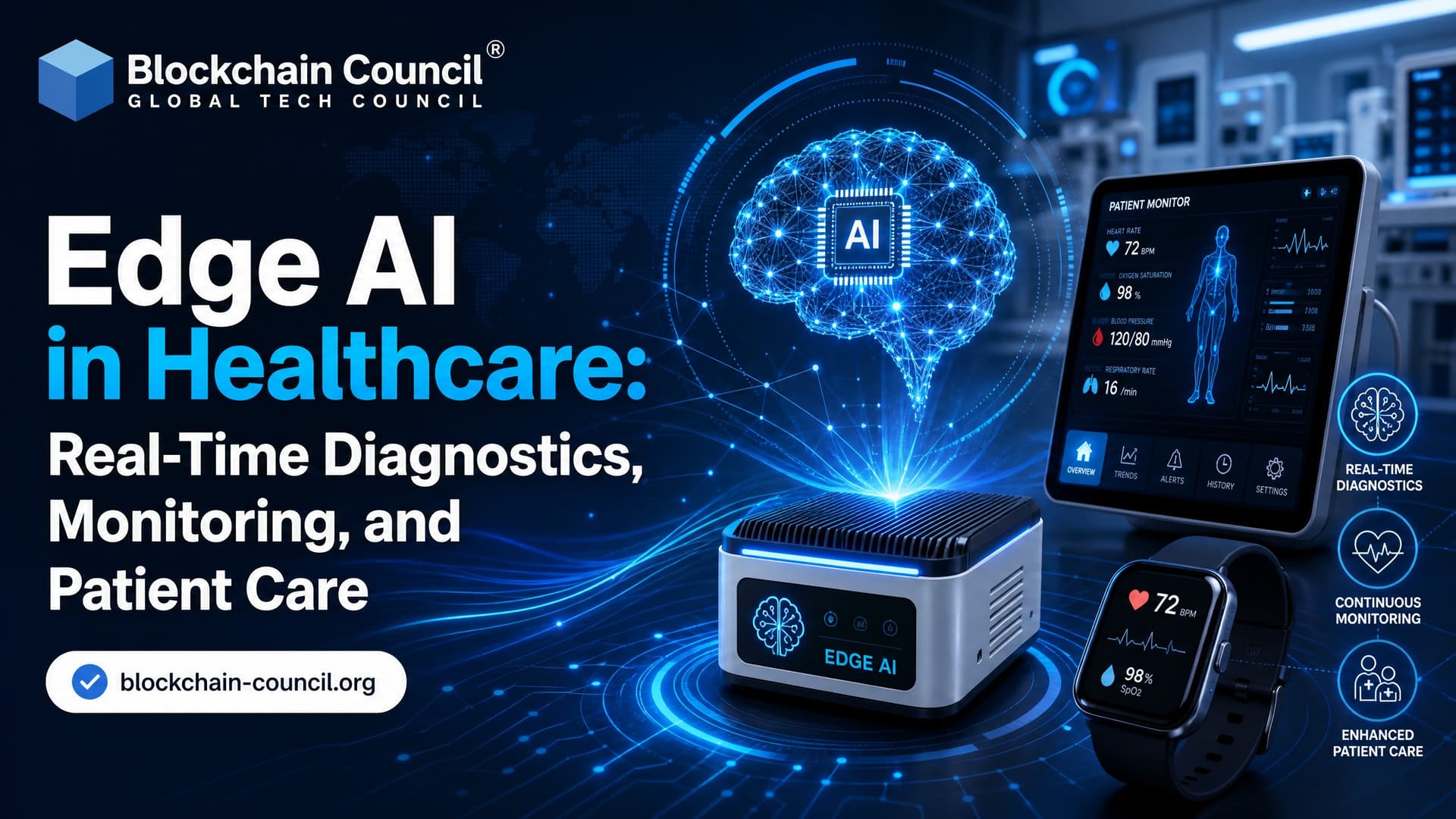
Edge AI in healthcare moves clinical intelligence closer to the patient. Instead of sending every ECG waveform, oxygen reading, ultrasound frame, or bedside monitor stream to a remote cloud, AI models run on wearables, medical devices, hospital gateways, or local edge servers. That one architectural choice changes the clinical workflow. Alerts arrive faster. Raw data stays closer to the care environment. Systems keep working even when connectivity is poor.
This is not a minor upgrade. In an ICU, a few seconds can matter. In a rural clinic, bandwidth may not support continuous imaging uploads. For a cardiac patient wearing an ECG patch at home, the device should not wait for a cloud round trip before flagging a dangerous rhythm. Edge AI is built for those moments.

As edge computing becomes increasingly important in healthcare, professionals pursuing a Certified Edge AI Expert credential can strengthen their understanding of deploying AI models on resource-constrained medical devices while balancing latency, reliability, and patient data privacy.
What Is Edge AI in Healthcare?
Edge AI means artificial intelligence runs locally, either on the device that collects the data or on nearby compute infrastructure. In healthcare, that can include:
Wearables and biosensors, such as ECG patches, smartwatches, glucose monitors, and SpO2 sensors.
Bedside and imaging equipment, including patient monitors, ultrasound devices, endoscopes, and smart ICU systems.
Hospital edge servers or gateways that sit inside a clinic, ward, radiology unit, or remote monitoring hub.
The value is simple. Local computation cuts latency and bandwidth use. Only alerts, summaries, or selected data may need to leave the device or hospital network. That also supports privacy requirements under frameworks such as HIPAA in the United States and GDPR in Europe, since raw patient data does not always need to move into a centralized cloud.
To be blunt, edge AI is not the right choice for every healthcare AI workload. Large model training, population-scale analytics, and long-term data warehousing still fit cloud or hybrid infrastructure better. But for real-time diagnostics and continuous monitoring, edge processing is often the safer design.
Why Edge AI Matters for Real-Time Diagnostics
Diagnostic AI is most useful when it reaches clinicians at the point of decision. A model that detects arrhythmia after the patient has already deteriorated is not enough. A model that flags it at the bedside can change the next action.
A 2024 study on secure wireless IoT healthcare architecture showed how this can work for ECG analysis. The system used a CNN-LSTM model on NVIDIA Jetson Nano hardware to classify ECG signals locally. It combined federated learning, homomorphic encryption, and blockchain-based audit logs. Reported results included 91.9% diagnostic accuracy, a 90.8% F1-score, 83% lower latency than a centralized cloud baseline, and 64% higher energy efficiency. The study also reported only 8.7% additional latency from homomorphic encryption, with statistical significance at p < 0.01.
That combination matters. You get low-latency inference, privacy-preserving model improvement, and tamper-resistant logs. If you want to build across both fields, the Certified Artificial Intelligence (AI) Expert™ and Certified Blockchain Expert™ programs from Blockchain Council cover the AI and distributed-ledger foundations this kind of system relies on.
Deploying diagnostic AI into real clinical environments also requires disciplined model versioning, monitoring, validation, and lifecycle management. Professionals responsible for maintaining these production AI systems often expand their expertise through a Certified MLOps Expert program to ensure models remain accurate, secure, and reliable throughout their operational life.
A Practical Deployment Detail Many Teams Miss
ECG inference is sensitive to windowing. If your model was trained on 5-second ECG segments sampled at 250 Hz, but your edge device receives 360 Hz data and you forget to resample, your alerts can look impressive in a demo and fail badly in real monitoring. I have seen teams blame the model when the real issue was signal preprocessing. Edge AI is still software engineering. Small defaults bite.
Continuous Monitoring: From Hospital Wards to Home Care
Healthcare is moving from occasional measurement to continuous measurement. Wearable biosensors and IoT-enabled devices now track ECG, heart rate, glucose, blood oxygen, temperature, perspiration, and blood pressure outside traditional clinical settings.
Ambiq has cited forecasts showing global IoT devices growing from 8.74 billion in 2020 to more than 25.4 billion by 2030. Not all of those are medical devices, of course. Still, the trend is clear: more sensors, more data, and more room for local analytics.
Edge AI helps turn that data into useful action. It can:
Detect abnormal heart rhythms without waiting for cloud processing.
Flag oxygen desaturation from a wearable or bedside monitor.
Build a personal baseline for vitals, then alert when readings move outside the normal range.
Support medication reminders and adherence feedback.
Notify caregivers or emergency contacts when a critical event is detected.
Intel's Edge AI Healthcare Monitoring Platform is a production example. It analyzes ECG, SpO2, photoplethysmography, and blood pressure locally, using Intel CPU-based edge devices and models optimized with OpenVINO. One detail worth knowing: older OpenVINO tutorials used the IECore API, while OpenVINO 2022 and later moved developers toward openvino.runtime.Core. If your prototype breaks during migration, the model may be fine. The runtime API changed.
Edge AI in Medical Imaging and Point-of-Care Diagnostics
Imaging is one of the strongest use cases for edge AI in healthcare. CT scans, MRI studies, ultrasound images, X-rays, endoscopy video, and perfusion studies can generate large files. Sending every frame to the cloud can add delay and load the network.
BIS Research has highlighted on-device image analysis as a way to provide immediate diagnostic insight in emergency departments and point-of-care settings. Picture a portable ultrasound device that helps identify suspicious findings at the bedside, or an emergency CT workflow where an AI model flags a likely stroke pattern before a full radiology report is complete.
Telecom providers are pushing this further with 5G and mobile edge computing. Verizon has described a near real-time polyp detection workflow in which colonoscopy video is streamed over 5G to a mobile edge compute node. The AI model analyzes video frames against profiles of hard-to-detect polyps and sends results back to the clinician during the procedure.
Latency matters here. If feedback arrives after the endoscope has moved on, it is far less useful. Edge compute close to the hospital or procedure room makes video diagnostic assistance more practical.
Security, Privacy, and Trust in Edge Healthcare Systems
Healthcare AI cannot be judged on accuracy alone. You also need to ask where the data goes, who can inspect it, how the model is updated, and what happens when the network fails.
Edge AI improves the security posture in several ways:
Local processing: Raw patient data can stay on the device or inside the hospital network.
Reduced transmission: Systems can send alerts or compressed features rather than full raw streams.
Offline operation: Monitoring can continue during cloud outages or weak connectivity.
Federated learning: Models can learn across sites without centralizing raw patient records.
Blockchain audit trails: Diagnostic events and model updates can be logged in a tamper-resistant format.
Homomorphic encryption: Certain computations can run while data stays encrypted, depending on the workload.
Do not treat blockchain as magic. For high-volume waveform data, storing raw medical records on-chain is usually the wrong design. A better pattern is to store hashes, audit events, model version references, and consent records, while clinical data stays in approved health systems. That is the design professionals should understand before proposing blockchain in healthcare.
Benefits for Patient Care
The patient-care impact of edge AI is practical, not abstract.
Faster Clinical Response
Local inference can produce alerts in milliseconds or seconds. That supports stroke workflows, ICU deterioration detection, arrhythmia monitoring, and intraoperative guidance.
Better Remote Care
Patients with chronic conditions can be monitored between clinic visits. A home device can catch changes early, alert a care team, and reduce unnecessary hospital readmissions when used in a properly governed program.
More Personalized Prevention
Wearables can learn a patient's baseline rather than relying only on broad population thresholds. That helps flag subtle changes, such as worsening sleep oxygenation, heart-rate variability shifts, or glucose trends.
Greater Resilience
Hospitals cannot assume perfect connectivity. Edge systems can keep monitoring locally when a cloud service or network link is down. For critical care, that is not optional.
Challenges Healthcare Teams Must Solve
Edge AI is promising, but deployment is hard. The common issues are not glamorous:
Clinical validation: Models need testing across populations, devices, and care settings.
Model drift: Sensors age, patient groups change, and performance can degrade silently.
Compute limits: Edge devices have smaller power and memory budgets than cloud servers.
Integration: Alerts must fit nurse call systems, electronic health records, and clinical workflows.
Fairness: Models should be checked for bias across age, sex, skin tone, comorbidities, and device placement conditions.
Governance: Teams need version control, audit logs, rollback plans, and clear ownership for model updates.
Here is a certification exam question that often trips learners up: edge AI is not defined by the size of the model. It is defined by where inference happens. A small model in the cloud is not edge AI. A larger optimized model on a hospital gateway can be.
The Road Ahead: 5G, Federated Learning, and Hospital Intelligence
The next phase of edge AI in healthcare will be hybrid. Wearables will handle simple inference. Gateways will run heavier models. Hospital edge servers and 5G mobile edge nodes will support imaging, video, and multi-sensor analytics.
Research groups are also moving from clinical use cases into operational intelligence. Edge AI can support equipment maintenance, bed occupancy monitoring, workflow analysis, cold-chain tracking for pharmaceuticals, and facility energy optimization. These are less dramatic than robotic surgery, but they save money and cut staff burden.
If you are building skills in this field, start with three foundations:
Learn model deployment, quantization, monitoring, and edge inference using tools such as OpenVINO, TensorRT, ONNX Runtime, or TensorFlow Lite.
Study privacy-preserving architecture, including federated learning, encryption, access control, and auditability.
Understand healthcare workflow. A technically correct alert that clinicians ignore is still a failed system.
For a structured path, pair AI deployment knowledge with governance and distributed systems training. Blockchain Council's Certified Artificial Intelligence (AI) Expert™ is a strong fit for the AI foundation, while the Certified Blockchain Expert™ helps you understand audit trails, decentralized trust, and data integrity patterns relevant to healthcare infrastructure.
Next Step for Professionals
Build a small edge healthcare prototype. Take a public ECG dataset, run an optimized classification model on a local device or edge server, log the model version and inference events, and measure latency before and after optimization. Then compare it with a cloud baseline. You will learn more from that exercise than from reading ten architecture diagrams.
professionals who also work with product launches, healthcare technology adoption, or go-to-market strategies may benefit from a Marketing Certification to better communicate technical value, support market positioning, and accelerate adoption among healthcare providers and enterprise customers.
FAQs
1. What is Edge AI in healthcare?
Edge AI in healthcare refers to running artificial intelligence models directly on medical devices, hospital equipment, wearable devices, smartphones, or local edge servers instead of relying entirely on cloud computing. This enables real-time analysis of patient data while reducing latency and enhancing data privacy.
2. Why is Edge AI important in healthcare?
Healthcare often requires immediate clinical decisions. Edge AI processes medical data locally, allowing clinicians to receive faster insights, reduce delays, improve patient care, and continue operating even when internet connectivity is limited.
3. What are the main use cases of Edge AI in healthcare?
Common applications include medical imaging analysis, patient monitoring, wearable health devices, remote patient monitoring, smart hospital systems, clinical decision support, emergency care, disease detection, robotic surgery assistance, and medical IoT devices.
4. How does Edge AI improve medical imaging?
Edge AI analyzes X-rays, CT scans, MRIs, ultrasounds, and other medical images directly on imaging equipment or local servers. This can help healthcare professionals identify abnormalities more quickly, prioritize urgent cases, and improve diagnostic workflows. AI supports clinicians but does not replace medical judgment.
5. How is Edge AI used for remote patient monitoring?
Wearable devices and home medical equipment use Edge AI to analyze vital signs such as heart rate, blood pressure, oxygen saturation, glucose levels, and respiratory activity in real time. When predefined thresholds are exceeded, the system can alert healthcare providers or caregivers promptly.
6. Can Edge AI improve emergency medical care?
Yes. Edge AI enables ambulances, emergency departments, and portable diagnostic devices to process patient information locally. This can accelerate triage, support faster clinical assessments, and assist medical teams in making timely treatment decisions.
7. How does Edge AI support wearable healthcare devices?
Smartwatches, fitness trackers, ECG monitors, glucose monitors, and other wearable devices use Edge AI to continuously analyze health data without constantly transmitting information to the cloud. This supports faster notifications and helps preserve battery life and user privacy.
8. What hardware is commonly used for Edge AI in healthcare?
Healthcare organizations use medical-grade edge servers, AI-enabled imaging systems, embedded processors, IoT gateways, NVIDIA Jetson platforms, Intel processors, ARM-based devices, Google Coral Edge TPU, and specialized AI accelerators designed for healthcare applications.
9. How does Edge AI improve patient data privacy?
Because patient data can be processed locally, less sensitive information needs to be transmitted across external networks. This reduces exposure to cybersecurity risks and supports compliance with healthcare privacy regulations and organizational security policies.
10. Can Edge AI reduce healthcare costs?
Edge AI can improve operational efficiency by automating routine analysis, supporting earlier detection of equipment issues through predictive maintenance, reducing unnecessary cloud processing, and streamlining clinical workflows. Cost savings depend on the specific implementation and healthcare setting.
11. How does Edge AI support hospital operations?
Hospitals use Edge AI to monitor medical equipment, optimize patient flow, manage hospital assets, improve scheduling, automate administrative workflows, and analyze operational data to enhance efficiency and patient care.
12. What are the biggest challenges of implementing Edge AI in healthcare?
Challenges include integrating with legacy medical systems, protecting patient privacy, validating AI performance, managing cybersecurity risks, maintaining medical device software, training staff, meeting regulatory requirements, and ensuring AI outputs are clinically reliable.
13. Which AI frameworks are commonly used for healthcare Edge AI?
Developers commonly use TensorFlow Lite, ONNX Runtime, OpenVINO, NVIDIA TensorRT, PyTorch Mobile, Apache TVM, and other frameworks that support optimized AI inference on healthcare devices and edge computing platforms.
14. How does Edge AI improve medical device performance?
Edge AI enables medical devices to process sensor data locally, reducing response times and allowing continuous operation with minimal dependence on cloud connectivity. This supports applications that require fast, reliable analysis close to the patient.
15. How does Edge AI support predictive healthcare?
Edge AI analyzes patient trends, device data, and physiological signals to identify patterns that may indicate potential health concerns. These systems can assist healthcare professionals by highlighting changes that may warrant further evaluation, but they are not a substitute for clinical diagnosis.
16. Can Edge AI operate without internet connectivity?
Yes. One of the primary advantages of Edge AI is that it can perform AI inference locally. Healthcare devices can continue monitoring and analyzing patient data even during temporary network outages, synchronizing information with central systems when connectivity is restored.
17. What regulations influence Edge AI in healthcare?
Healthcare organizations may need to comply with regulations and standards such as HIPAA in the United States, GDPR in the European Union, FDA requirements for applicable medical devices, and other regional healthcare and data protection regulations depending on where they operate.
18. What are the best practices for implementing Edge AI in healthcare?
Best practices include selecting validated AI models, securing medical devices, encrypting sensitive data, implementing strong identity and access controls, performing continuous monitoring, validating clinical performance, maintaining software updates, and providing training for healthcare professionals.
19. What future trends are shaping Edge AI in healthcare?
Emerging trends include AI-assisted diagnostics, personalized medicine, federated learning, smart hospitals, digital twins for healthcare, robotic-assisted procedures, AI-powered medical imaging, advanced remote patient monitoring, and greater integration with Internet of Medical Things (IoMT) devices.
20. Why is Edge AI considered the future of healthcare?
Edge AI brings intelligence closer to patients and healthcare providers by enabling faster analysis, lower latency, improved privacy, and greater operational resilience. As healthcare organizations continue adopting connected medical devices, remote monitoring, AI-assisted diagnostics, and smart clinical workflows, Edge AI is expected to play an increasingly important role in improving care delivery, supporting clinical decision-making, and enhancing patient outcomes while complementing the expertise of healthcare professionals.
Related Articles
View All
Edge Ai
Edge AI Model Deployment Guide: Training to Real-Time Inference
A practical edge AI model deployment guide covering training, ONNX export, optimization, containers, Triton serving, monitoring, and real-time inference.

Edge Ai
Edge AI for Industrial Automation: Real-Time Intelligence on the Factory Floor
Edge AI for industrial automation brings real-time machine learning to factory equipment, improving quality, uptime, safety, and energy performance.

Edge Ai
Edge AI for Autonomous Vehicles: Real-Time Perception and Decision-Making
Edge AI helps autonomous vehicles process sensor data onboard for low-latency perception, safer decisions, privacy, and resilience when networks fail.
Trending Articles
The Role of Blockchain in Ethical AI Development
How blockchain technology is being used to promote transparency and accountability in artificial intelligence systems.

Top 5 DeFi Platforms
Explore the leading decentralized finance platforms and what makes each one unique in the evolving DeFi landscape.
What is AWS? A Beginner's Guide to Cloud Computing
Everything you need to know about Amazon Web Services, cloud computing fundamentals, and career opportunities.