

Edge AI in Retail: Personalized Shopping, Smart Shelves, and Loss Prevention
 Suyash Raizada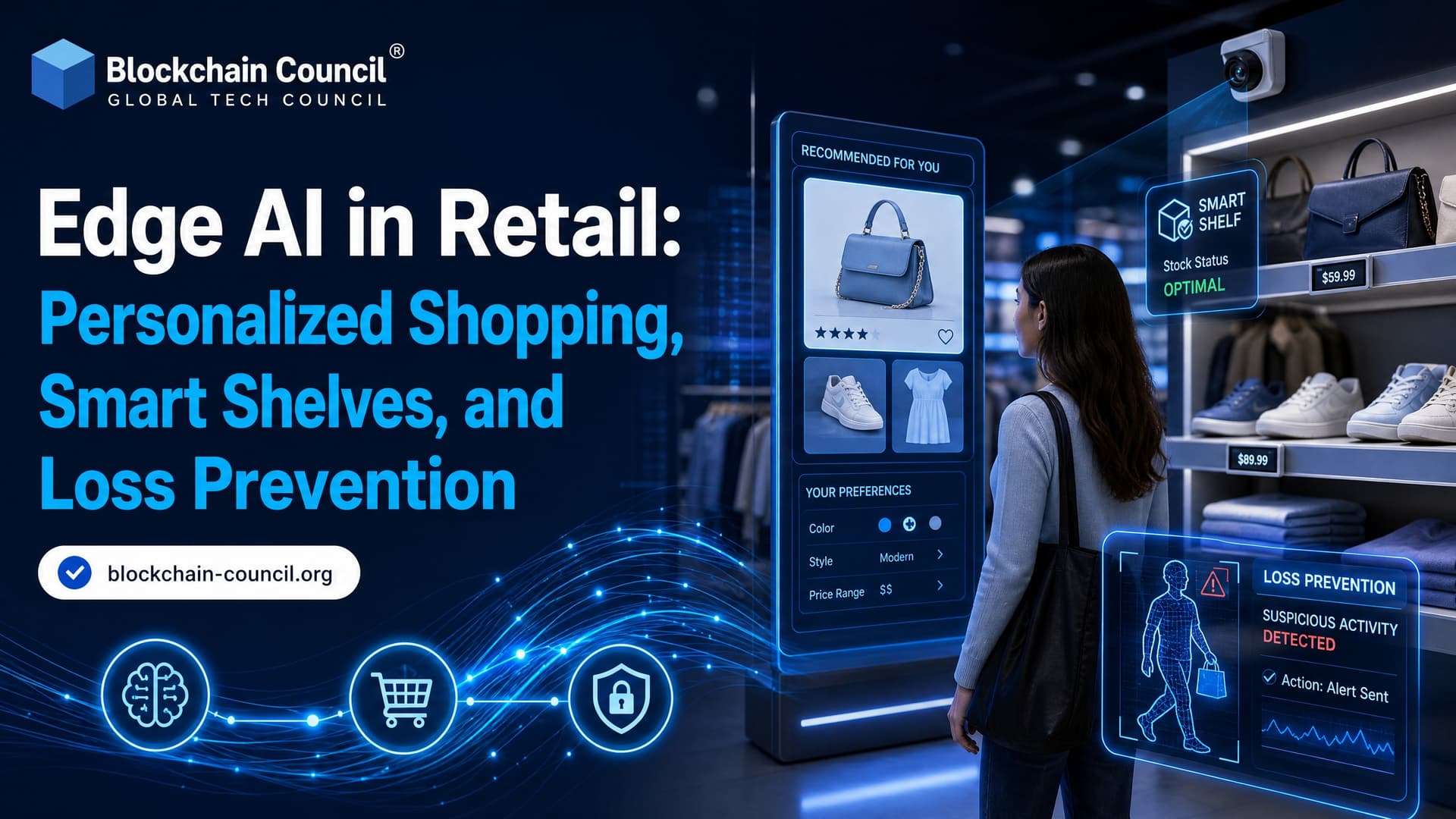
Edge AI in retail means running AI models inside the store, on cameras, sensors, smart shelves, point-of-sale systems, kiosks, and local servers. The value is simple. Decisions happen where the shopper, product, and risk event actually are. Not five seconds later in a distant cloud.
That timing matters. A shelf alert that arrives after the lunch rush is useless. A self-checkout fraud signal that reaches staff too late is just a report. Edge AI changes when intelligence shows up, which is why it is becoming a core part of smart store design across grocery, convenience, fashion, electronics, and big-box retail.

As retailers continue modernizing store operations with intelligent automation, professionals with a Certified Edge AI Expert background are increasingly helping organizations design low-latency AI solutions that improve customer experiences while keeping critical decision-making close to the point of interaction.
What Edge AI in Retail Looks Like
Most retail AI systems are not fully local or fully cloud-based. The better pattern is an edge-cloud architecture. Real-time inference runs at the store edge, while model training, fleet analytics, dashboards, and long-term planning stay in the cloud.
A typical setup includes:
Edge cameras for people detection, shelf monitoring, queue analytics, and checkout validation.
Weight sensors and RFID readers for smart shelves and inventory movement.
In-store gateways or local servers running computer vision models and event rules.
Cloud platforms for retraining models, comparing store performance, and pushing updates.
Retail applications such as digital signage, mobile apps, electronic shelf labels, and point-of-sale systems.
The main reason retailers choose edge AI is latency. Unified edge-cloud designs can cut latency significantly compared with fully centralized systems. There is a privacy benefit too. Raw video does not always need to leave the store. Often only metadata leaves, such as product ID, shelf zone, timestamp, and event confidence score.
Personalized Shopping at the Store Edge
Personalization in retail used to mean broad segments: new parent, loyalty member, bargain shopper, premium buyer. Edge AI makes the interaction more immediate. It can adjust content based on what a shopper is doing now, not only what they bought last month.
Real-time recommendations
Recommendation engines can run at kiosks, mobile app touchpoints, smart mirrors, or digital displays. They combine purchase history, product metadata, store location, and current behavior. If a shopper scans a running shoe at an in-store kiosk, the system can suggest socks, insoles, or weather-appropriate gear available in that exact store.
This is not just e-commerce logic copied into a shop. Physical stores add messy signals: dwell time, product handling, aisle traffic, queue length, and out-of-stock status. Good edge systems use those signals without making the experience feel invasive.
Dynamic promotions and pricing
Retailers can also use edge AI to support dynamic promotions. If a product is overstocked, a nearby display or electronic shelf label can show a limited offer. If demand is high and inventory is low, the system may stop promoting that item and suggest alternatives.
Use this carefully. To be blunt, highly personalized pricing can wreck trust if customers feel they are being charged differently in unfair ways. Dynamic promotion is usually safer than dynamic individual pricing. Set clear business rules, audit outcomes, and avoid using sensitive personal attributes.
Smart fitting rooms and assisted selling
Fashion and beauty retailers are testing smart mirrors, virtual try-on, and fitting room tools that recommend sizes, colors, or complementary items. Timberland, for example, has used a virtual fitting room experience that tracks body movement and gestures so customers can try items digitally.
The technical challenge is not the demo. The challenge is store lighting, mirror glare, occluded products, and customers standing at odd angles. If you have deployed computer vision in a real store, you know the model looks brilliant in the lab and then falls apart under glossy packaging or direct sunlight from the front window. That is why edge AI projects need in-store testing, not only benchmark scores.
Delivering personalized experiences consistently across hundreds of stores also requires disciplined AI operations. Managing model deployment, monitoring performance, rolling out updates, and maintaining inference pipelines at scale are key MLOps responsibilities, which is why many professionals strengthen these capabilities through a Certified MLOps Expert program.
Smart Shelves and Edge-Optimized Store Operations
Smart shelves are one of the clearest use cases for edge AI in retail. They combine cameras, weight sensors, RFID, and local inference to monitor inventory in near real time.
Reducing stockouts
Stockouts are expensive. You lose the sale and often send the shopper to a competitor. Edge AI can detect when shelf quantity drops below a threshold, when an item is misplaced, or when a facing is empty even though backroom inventory exists.
Some reported deployments have cut out-of-stock incidents by a quarter or more. That is believable, because the biggest gains often come from basic operational visibility: knowing the shelf is empty before the customer tells you.
Planogram compliance
Retailers spend heavily on planograms, but stores rarely match the plan perfectly. Edge vision can compare shelf images against expected layouts and flag missing, misplaced, or competitor-blocking items. It can also track whether promotional displays are installed on time.
Here is a practical detail. Small SKU differences are hard. Two similar cereal boxes with different flavors can confuse a lightweight model, especially if the camera is mounted too high. Teams often need higher input resolution, better shelf zone cropping, and retraining on local packaging images. A generic object detector will not solve the full shelf problem on its own.
Frictionless and assisted checkout
Computer-vision checkout depends on edge AI because the system must track product picks, basket changes, and exits quickly. Customers expect the charge to be accurate. Staff expect exceptions to surface immediately.
Self-checkout systems also use AI for item recognition, weight verification, and scan anomaly detection. A common pattern is to compare video evidence, barcode events, and scale readings. If the item scanned does not match the item placed in the bagging area, the system can request staff review.
Loss Prevention: From CCTV Review to Real-time Action
Loss prevention is where edge AI can make a visible financial impact. Shrink comes from theft, fraud, process errors, vendor issues, and damaged inventory. AI does not remove the need for trained staff, but it can reduce blind spots.
Detecting suspicious behavior
Edge AI models can analyze video streams for patterns such as repeated concealment motions, unusual lingering near high-value products, entry into restricted areas, or repeated handling without scanning. These events can trigger alerts to associates or loss prevention teams.
Design the system for decision support, not automatic accusation. False positives are real. A shopper comparing two expensive razors is not automatically stealing. Retailers need human review, clear escalation policies, and bias testing across store locations and customer groups.
Checkout fraud and scan irregularities
AI can help detect bill switching, coupon misuse, sweethearting, and scan avoidance at checkout. A camera may identify that a premium steak was placed on the scale while a cheaper barcode was scanned. The event can go to a staff tablet with a short video clip rather than a full raw stream.
This is where edge processing helps privacy and bandwidth. You do not need to upload hours of checkout video to central storage. You can process locally, save only relevant events, and apply retention rules.
Business Impact and Market Growth
The economic case for edge AI in retail keeps getting stronger. Market forecasts point to steep growth over the next decade, with compound annual growth rates in the mid-20-percent range depending on the source and scope.
Other reported benefits include:
Conversion rate gains of roughly 10 to 15 percent from better personalization and store execution.
Fewer out-of-stock incidents through shelf monitoring and faster replenishment.
Lower latency for real-time store applications through edge-cloud design.
Reduced shrink through checkout analytics and event-based video review.
Better labor allocation, because staff can respond to exceptions instead of walking every aisle manually.
McKinsey Global Institute analysis has also pointed to large AI-driven profit potential in retail, including meaningful margin improvement and substantial additional annual revenue across global retail. The exact outcome depends on execution. Buying cameras is easy. Wiring them into replenishment, store labor, point-of-sale, and governance workflows is the hard part.
Implementation Priorities for Retail Teams
If you are planning an edge AI retail project, start with one measurable problem. Do not begin with a smart store vision deck. Pick a metric.
Choose the use case: stockout reduction, queue monitoring, checkout fraud, planogram compliance, or personalized signage.
Define the event: be precise about what the model must detect and what happens next.
Test in real stores: include poor lighting, busy weekends, seasonal packaging, and network outages.
Measure latency: shelf and checkout decisions often need sub-second or low-second response times.
Plan model updates: products, packaging, store layouts, and customer behavior change constantly.
Secure the edge: patch devices, encrypt data, manage credentials, and monitor tampering.
A developer note. When deploying vision models on NVIDIA Jetson or similar edge hardware, check preprocessing first. A simple OpenCV BGR-to-RGB mistake can make a model look poorly trained when the real issue is channel order. Watch TensorRT conversion too. ONNX export with unsupported post-processing operators can break deployment unless you keep non-maximum suppression outside the exported graph or use a supported plugin. Small details. Big delays.
Skills Professionals Need
Edge AI in retail sits across AI engineering, systems architecture, cybersecurity, and store operations. The strongest professionals understand both model behavior and business impact.
Useful learning areas include:
Computer vision for product detection, people counting, pose estimation, and anomaly detection.
Recommendation systems using contextual, content-based, and collaborative filtering.
Edge deployment with model compression, quantization, ONNX, TensorRT, and device monitoring.
Privacy engineering, including on-device anonymization and event-based retention.
Retail KPIs such as shrink, conversion, stockout rate, basket size, and inventory turnover.
For structured learning, consider Blockchain Council programs such as Certified Artificial Intelligence (AI) Expert™ for AI foundations and Certified Machine Learning Expert™ for model development. If your role includes device security, identity, or data protection, Certified Cybersecurity Expert™ is a relevant path.
Where Edge AI in Retail Goes Next
Edge AI will become a standard retail infrastructure layer, not a side experiment. Expect more shelf intelligence, more automated replenishment, more cashier-assist systems, and more privacy-preserving analytics at the store level.
Your next step is practical. Pick one retail workflow and map the event loop. What data is captured? Where is inference run? Who receives the alert? What action follows? If you can answer those four questions, you are ready to design an edge AI pilot that has a real chance of surviving contact with the store floor.
As edge AI continues to reshape customer experiences through intelligent retail, personalized shopping, and data-driven store operations, professionals who complement their technical expertise with a Marketing Certification are better equipped to connect AI innovation with consumer behavior, product strategy, and measurable business growth.
FAQs
1. What is Edge AI in retail?
Edge AI in retail refers to using artificial intelligence directly on in-store devices such as smart cameras, point-of-sale (POS) systems, self-checkout kiosks, digital shelves, IoT sensors, and edge servers. By processing data locally instead of relying entirely on the cloud, retailers can make faster decisions, improve customer experiences, and optimize store operations.
2. Why is Edge AI important for the retail industry?
Retail businesses need real-time insights to manage inventory, reduce checkout times, personalize customer experiences, and prevent losses. Edge AI enables immediate analysis of in-store data, reduces network latency, and allows stores to continue operating even with limited internet connectivity.
3. How does Edge AI improve the customer shopping experience?
Edge AI helps retailers deliver personalized product recommendations, faster checkout, smart fitting rooms, interactive digital displays, and real-time customer assistance. These capabilities create a more convenient and engaging shopping experience while improving customer satisfaction.
4. How is Edge AI used in inventory management?
Edge AI continuously monitors inventory using smart shelves, cameras, RFID readers, and sensors. It can automatically detect low stock, misplaced items, inventory shrinkage, and replenishment needs, helping retailers maintain accurate inventory levels.
5. Can Edge AI improve self-checkout systems?
Yes. Edge AI enables faster product recognition, barcode scanning, fraud detection, and payment verification at self-checkout kiosks. Local processing minimizes delays and improves the overall checkout experience for customers.
6. How does Edge AI help prevent retail theft?
Edge AI-powered surveillance systems analyze video feeds in real time to detect suspicious behavior, unauthorized access, product removal, and checkout anomalies. Retail staff can receive instant alerts, helping reduce shoplifting and inventory loss.
7. What are the main use cases of Edge AI in retail?
Popular applications include cashier-less stores, inventory tracking, demand forecasting, smart shelves, customer analytics, facial recognition for loyalty programs where permitted, loss prevention, dynamic pricing, queue management, and predictive maintenance for store equipment.
8. What hardware is commonly used for Edge AI in retail?
Retailers commonly deploy AI-enabled security cameras, edge servers, smart POS terminals, digital kiosks, IoT sensors, RFID readers, NVIDIA Jetson devices, Intel processors, Google Coral Edge TPUs, and ARM-based embedded systems.
9. How does Edge AI improve demand forecasting?
Edge AI analyzes customer behavior, purchasing trends, weather conditions, local events, and inventory data to help retailers predict demand more accurately. This improves stock planning, reduces waste, and minimizes out-of-stock situations.
10. Can Edge AI improve store operations?
Yes. Edge AI automates tasks such as inventory monitoring, employee scheduling support, queue management, equipment monitoring, customer traffic analysis, and shelf compliance, helping retailers improve efficiency while reducing operational costs.
11. How does Edge AI support cashier-less stores?
Cashier-less stores use Edge AI to track customer movements, identify products selected from shelves, monitor purchases, and automate payment processing. Local AI inference enables a seamless shopping experience with minimal checkout delays.
12. Can Edge AI operate without internet connectivity?
Yes. One of the key advantages of Edge AI is its ability to perform AI inference locally. Retail systems can continue processing transactions, monitoring inventory, and analyzing customer activity even if internet connectivity is temporarily unavailable.
13. What are the biggest challenges of implementing Edge AI in retail?
Challenges include integrating legacy retail systems, protecting customer privacy, managing distributed devices, optimizing AI models, ensuring cybersecurity, maintaining hardware, training staff, and complying with data protection regulations.
14. How does Edge AI improve retail data privacy?
Since customer and operational data can be processed directly on local devices, less information needs to be transmitted to external cloud services. This reduces exposure to cyber threats and helps retailers comply with privacy regulations.
15. Which AI frameworks are commonly used for Edge AI in retail?
Developers often use TensorFlow Lite, ONNX Runtime, OpenVINO, NVIDIA TensorRT, PyTorch Mobile, Apache TVM, MediaPipe, and Edge Impulse to deploy optimized AI models on retail hardware.
16. How can retailers successfully deploy Edge AI?
Retailers should begin with clearly defined business objectives, conduct pilot implementations, choose compatible hardware, optimize AI models, integrate with existing retail systems, implement strong cybersecurity measures, and continuously monitor system performance.
17. What is the difference between Edge AI and cloud AI in retail?
Edge AI performs real-time processing directly inside stores for applications such as checkout, inventory tracking, and customer analytics. Cloud AI is typically used for large-scale analytics, centralized reporting, AI model training, and enterprise-wide business intelligence.
18. How does Edge AI support omnichannel retail?
Edge AI provides real-time inventory visibility, synchronizes in-store and online stock information, supports click-and-collect services, improves order fulfillment, and delivers consistent customer experiences across physical and digital shopping channels.
19. What are the best practices for implementing Edge AI in retail?
Best practices include deploying secure edge devices, encrypting sensitive data, optimizing AI models for retail hardware, performing regular software updates, monitoring AI performance, ensuring regulatory compliance, training employees, and scaling deployments gradually after successful pilot projects.
20. Why is Edge AI considered the future of retail?
Edge AI enables retailers to make faster, smarter decisions directly within stores. By combining real-time analytics, intelligent automation, computer vision, inventory optimization, and personalized customer experiences, Edge AI helps retailers improve operational efficiency, reduce costs, enhance security, and meet evolving consumer expectations. As the retail industry continues to embrace digital transformation, Edge AI is expected to become a foundational technology for modern smart stores.
Related Articles
View All
Edge Ai
Edge AI Use Cases Across Manufacturing, Healthcare, Retail, and Smart Cities
Explore practical edge AI use cases in manufacturing, healthcare, retail, and smart cities, including benefits, deployment risks, and next steps.
Edge Ai
Edge AI in Smart Cities: Traffic, Safety, and Energy Use
Explore how edge AI in smart cities improves traffic control, public safety, energy efficiency, and infrastructure resilience with local real-time intelligence.

Edge Ai
Top Edge AI Frameworks and Tools for Developers and Enterprises
A practical guide to top edge AI frameworks and tools, including TensorFlow Lite, ONNX Runtime, Apache TVM, Edge Impulse, and enterprise MLOps platforms.
Trending Articles
AWS Career Roadmap
A step-by-step guide to building a successful career in Amazon Web Services cloud computing.
What is AWS? A Beginner's Guide to Cloud Computing
Everything you need to know about Amazon Web Services, cloud computing fundamentals, and career opportunities.
How to Install Claude Code
Learn how to install Claude Code on macOS, Linux, and Windows using the native installer, plus verification, authentication, and troubleshooting tips.