

TinyML vs Edge AI: Differences, Similarities, and When to Use Each
 Suyash Raizada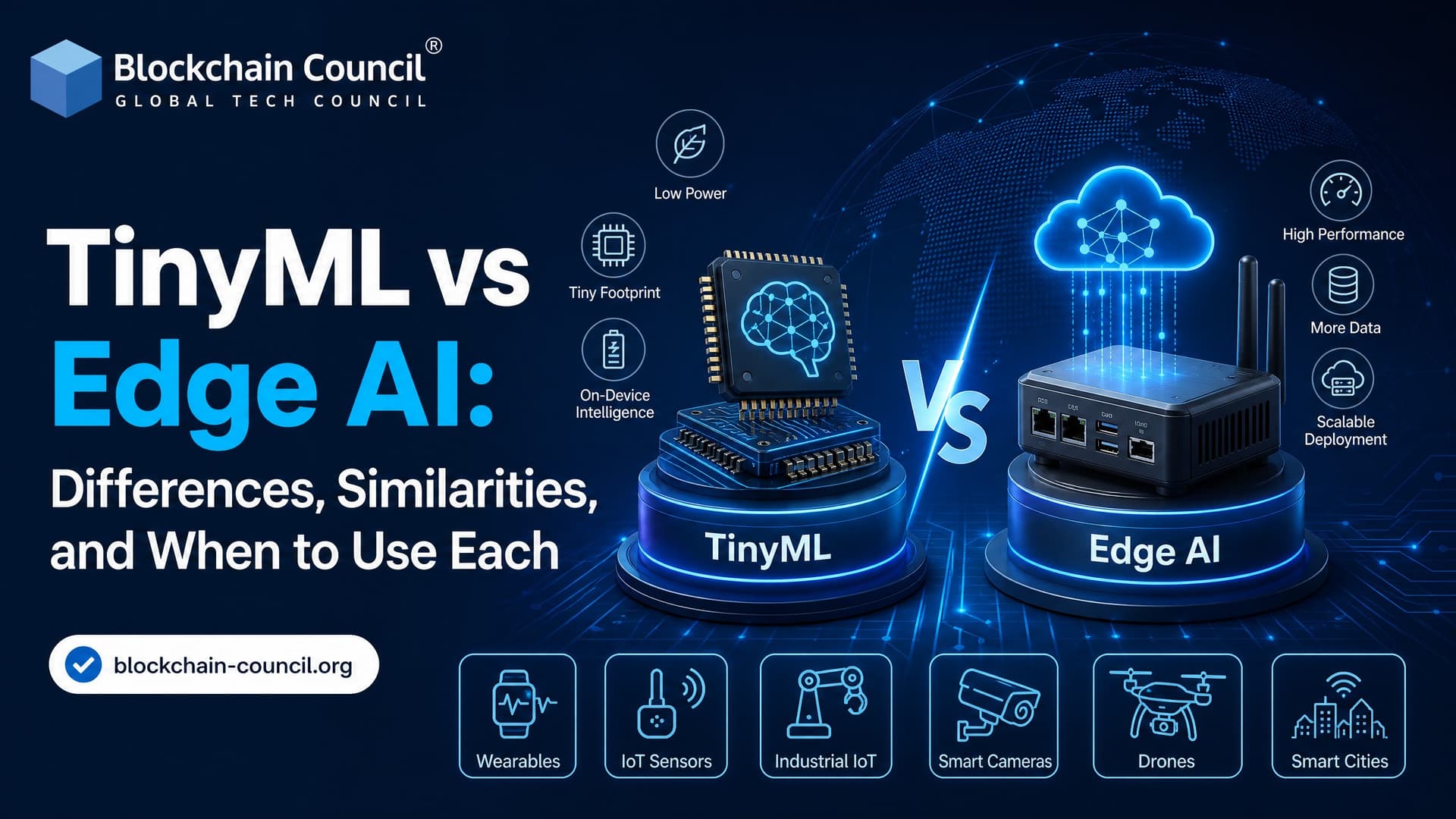
TinyML vs Edge AI is not a rivalry. TinyML is a specialized part of Edge AI, built for the smallest, cheapest, lowest-power devices. Edge AI is the wider category: AI inference that runs on or near the device that creates the data, from a $2 microcontroller to a robot, smartphone, camera, vehicle, or edge server.
If you are choosing an architecture, start with one blunt question: How much power, memory, and latency can you afford? The answer usually decides whether TinyML is enough or whether you need broader Edge AI hardware.

As organizations expand intelligent applications beyond the cloud, professionals with a Certified Edge AI Expert background are increasingly helping teams design efficient edge architectures that balance performance, latency, power consumption, and real-world deployment requirements.
What Is Edge AI?
Edge AI means running AI models close to where data is generated instead of sending every raw signal to a cloud server. The edge device might be a sensor, smart camera, industrial gateway, phone, vehicle computer, or a local server on a factory floor.
The goal is simple. Make decisions faster, cut bandwidth, keep sensitive data local, and keep working when the network is poor or gone. That is why Edge AI shows up in robotics, industrial IoT, autonomous systems, smart homes, healthcare devices, and video analytics.
Take an autonomous vehicle. It cannot upload camera and LiDAR data to the cloud, wait for inference, and then brake. The decision loop has to run inside the vehicle. Cloud systems may still train models, store fleet data, or run heavy analytics, but safety-critical inference belongs at the edge.
What Is TinyML?
TinyML, or Tiny Machine Learning, is the practice of running small ML models on ultra-low-power microcontroller-class hardware. Think Cortex-M boards, simple sensors, wearables, smart locks, energy meters, and battery-powered industrial nodes.
These devices often work with less than 1 MB of Flash and a few hundred kilobytes of RAM. Some TinyML applications run with only a few kilobytes of working memory. That changes everything: model choice, preprocessing, quantization, deployment, testing, and even how you log errors.
Here is a detail that bites beginners. With TensorFlow Lite for Microcontrollers, the model may be valid, but inference still fails because the tensor arena is too small. You may see a message such as Failed to allocate tensors or an arena-size error at runtime. The fix is not glamorous. You inspect the model, shrink layers, remove unsupported ops, use int8 quantization, or allocate a larger static arena if the MCU has room. Often it does not.
Deploying TinyML and Edge AI solutions at scale also requires disciplined lifecycle management. Many organizations rely on robust MLOps practices for model versioning, monitoring, and updates across distributed devices, making a Certified MLOps Expert program valuable for professionals managing production AI deployments.
TinyML vs Edge AI: The Core Difference
The cleanest way to compare them is this:
Edge AI is the broad architecture of running AI at or near the network edge.
TinyML is the ultra-constrained subset of Edge AI that targets microcontrollers and simple embedded devices.
So every TinyML deployment is Edge AI, but not every Edge AI deployment is TinyML.
Hardware and resource profile
TinyML: Microcontrollers, simple sensors, low-cost embedded boards, wearables. Memory may be measured in kilobytes. Power budgets are often measured in milliwatts or less.
Edge AI: Smartphones, gateways, smart cameras, robots, vehicles, edge servers, and sometimes microcontrollers too. These systems may have CPUs, GPUs, NPUs, or dedicated AI accelerators.
Model complexity
TinyML models are usually compact, quantized, and heavily optimized. Common tasks include wake word detection, simple gesture recognition, vibration anomaly detection, and low-rate sensor classification.
Broader Edge AI can support larger CNNs, object detection models, sensor fusion pipelines, speech models, and multimodal workloads. You still optimize, but you are not trying to squeeze everything into a microcontroller with 256 KB of RAM.
Power and battery life
TinyML is the better fit when a device must run for months or years on a coin cell, an AA battery, or harvested energy. Always-on sensing is the classic case.
Edge AI devices often have more forgiving power conditions. A robot, gateway, camera, or car may be mains-powered or backed by a larger battery. That extra energy lets you run richer models and process video, audio, or several sensor streams at once.
Where TinyML and Edge AI Are Similar
The two approaches share the same design instincts.
Low latency: Inference happens near the data source, so response time improves.
Privacy: Raw data can stay on-device. You may send only metadata, alerts, or aggregates.
Bandwidth reduction: A sensor can transmit an event instead of streaming raw readings all day.
Offline operation: Devices keep working when cloud access fails.
Resource-aware ML: You still balance accuracy, latency, energy, memory, and cost.
That last point matters. Edge AI is not a free pass to deploy the biggest model you trained in the cloud. A gateway with 4 GB of RAM is roomy compared with a microcontroller, but it still has thermal limits, update constraints, and reliability requirements.
When Should You Use TinyML?
Use TinyML when the device is tiny, the budget is tight, and the task is narrow.
Choose TinyML for:
Always-on sensing: Wake word detection, occupancy sensing, vibration monitoring, glass-break detection, or environmental monitoring.
Battery-powered devices: Wearables, smart home sensors, agricultural nodes, and remote industrial sensors.
Low-cost, high-volume products: If you plan to ship thousands or millions of units, a microcontroller can be the difference between a viable product and an expensive one.
Simple inference tasks: Classification, threshold-style anomaly detection, basic audio recognition, or gesture detection.
Minimal connectivity: Remote sensors, privacy-sensitive devices, or equipment installed where connectivity is unreliable.
Do not reach for TinyML because it sounds clever. If your model needs high-resolution video, multiple cameras, transformer-scale language understanding, or heavy sensor fusion, a microcontroller is the wrong tool. You will spend weeks shaving bytes and still ship a weak system.
When Should You Use Broader Edge AI?
Use Edge AI when the application needs richer data processing or more capable local compute.
Choose Edge AI for:
Computer vision: Defect detection, face blur, object tracking, traffic analysis, and safety monitoring.
Robotics: Local perception, path planning, navigation, grasp detection, and human-machine interaction.
Autonomous vehicles: Real-time inference for perception and decision support inside the vehicle.
Industrial gateways: Aggregating signals from many sensors, running analytics locally, and sending summaries to the cloud.
Smart healthcare systems: Local processing of sensitive physiological signals, images, or device telemetry.
Edge AI is also the stronger choice when you need model lifecycle management, cloud coordination, remote updates, and monitoring across many sites. TinyML can support updates too, but the operational overhead gets harder when devices have very little storage and intermittent connectivity.
Popular Tools and Frameworks
For TinyML, the usual toolkit includes:
TensorFlow Lite for Microcontrollers: A common runtime for running small TensorFlow Lite models on MCUs.
CMSIS-NN: Arm's optimized neural network kernels for Cortex-M processors.
Edge Impulse: A practical platform for collecting data, training models, optimizing them, and deploying to embedded targets.
microTVM and MCUNet: Engineering and research tools focused on microcontroller-scale model deployment and hardware-aware optimization.
For broader Edge AI, you may see TensorFlow Lite, ONNX Runtime, OpenVINO, NVIDIA Jetson software, Qualcomm AI tools, PyTorch Mobile, and vendor-specific NPU SDKs. The best choice depends on hardware. To be blunt, hardware picks the framework more often than developers like to admit.
Hybrid Architecture: The Pattern That Usually Wins
Many real deployments use both TinyML and Edge AI.
A factory might place TinyML vibration sensors on motors. Each sensor detects unusual vibration locally and wakes the network only when something changes. A nearby industrial gateway then runs a larger Edge AI model across many machines to predict maintenance windows.
This layered design is efficient:
Sensor tier: TinyML filters noise and detects simple events.
Gateway tier: Edge AI combines signals, runs heavier inference, and handles local decisions.
Cloud tier: Long-term storage, fleet analysis, retraining, and compliance reporting.
Recent work is also exploring federated learning with TinyML and IoT, where many constrained devices help improve a model without sending raw data away. The hard parts are communication cost, update scheduling, memory, and energy use. It is promising, but not magic.
Decision Checklist: TinyML vs Edge AI
Use this quick filter before you choose a platform:
Is the device running on a small battery for months or years? Start with TinyML.
Is RAM below a few hundred KB? TinyML, with aggressive quantization.
Do you need video, sensor fusion, or large models? Use broader Edge AI.
Do you need local decisions during network outages? Either can work, depending on compute needs.
Will one gateway serve many sensors? Use TinyML at the sensor level and Edge AI at the gateway.
Is accuracy more important than ultra-low power? Favor Edge AI hardware with an accelerator.
Skills Professionals Need
If you are building in this area, learn both ML and embedded systems. You need to understand quantization, latency profiling, memory allocation, sensor noise, data drift, firmware updates, and deployment testing.
For structured learning, use this topic as a bridge into AI and emerging technology training. The Certified Artificial Intelligence (AI) Expert certification from Blockchain Council is a relevant path for professionals who want a stronger base in AI concepts before moving into edge deployment, IoT architectures, or applied machine learning systems.
Final Take: Pick by Constraint, Not by Trend
TinyML is the right choice when power, memory, cost, and form factor dominate the design. Edge AI is the right choice when the model, data, or system workflow needs more compute near the source.
Your next step: sketch the device budget before choosing the model. Write down available RAM, Flash, power source, latency target, sensor type, update method, and acceptable accuracy loss. If those numbers are tiny, build a TinyML prototype. If the workload is richer, test it on an edge device with the accelerator you expect to ship.
As TinyML and Edge AI continue to power connected products, smart devices, and customer-facing innovations, professionals who complement their technical expertise with a Marketing Certification are better equipped to align AI-enabled products with market needs, customer value, and long-term business growth.
FAQs
1. What is the difference between TinyML and Edge AI?
TinyML is a specialized branch of Edge AI that enables machine learning models to run on ultra-low-power microcontrollers and embedded devices. Edge AI is a broader concept that involves running AI models on any edge device, including smartphones, IoT devices, industrial computers, drones, autonomous vehicles, and edge servers.
2. What is TinyML?
TinyML is the practice of deploying lightweight machine learning models on resource-constrained devices such as microcontrollers with limited memory, storage, and processing power. It focuses on low-cost, low-energy AI applications that can operate without constant cloud connectivity.
3. What is Edge AI?
Edge AI refers to artificial intelligence that performs data processing and inference directly on edge devices rather than sending data to centralized cloud servers. This enables faster decision-making, lower latency, improved privacy, and reduced bandwidth usage.
4. How do TinyML and Edge AI differ in hardware requirements?
TinyML is designed for microcontrollers and embedded chips with very limited resources, often operating with only a few kilobytes or megabytes of memory. Edge AI supports more powerful hardware such as smartphones, GPUs, AI accelerators, industrial gateways, edge servers, and IoT devices with greater computing capabilities.
5. What are the main use cases for TinyML?
TinyML is commonly used for wearable devices, smart sensors, predictive maintenance, environmental monitoring, voice detection, gesture recognition, health monitoring, smart agriculture, and battery-powered IoT devices where low power consumption is critical.
6. What are the main use cases for Edge AI?
Edge AI is widely used in autonomous vehicles, industrial automation, smart manufacturing, retail analytics, medical imaging, robotics, surveillance systems, smart cities, telecommunications, and real-time customer experiences.
7. Which is better for low-power devices: TinyML or Edge AI?
TinyML is specifically optimized for extremely low-power devices that operate with limited processing capabilities. While TinyML is a subset of Edge AI, it is generally the preferred choice for battery-operated and resource-constrained embedded systems.
8. Why is TinyML considered a subset of Edge AI?
Edge AI includes all forms of AI running outside centralized cloud environments. TinyML focuses exclusively on the smallest edge devices with highly optimized machine learning models, making it one specialized category within the broader Edge AI ecosystem.
9. What programming frameworks are commonly used for TinyML?
Developers often use TensorFlow Lite for Microcontrollers, Edge Impulse, Arduino IDE, CMSIS-NN, Apache TVM, and other embedded machine learning frameworks designed for constrained hardware environments.
10. Which frameworks are commonly used for Edge AI?
Popular Edge AI frameworks include TensorFlow Lite, ONNX Runtime, OpenVINO, NVIDIA TensorRT, PyTorch Mobile, Qualcomm AI Engine Direct, MediaPipe, Apache TVM, and Edge Impulse, depending on the target hardware and deployment environment.
11. How do TinyML and Edge AI improve data privacy?
Both TinyML and Edge AI process data locally on devices rather than sending all information to cloud servers. This reduces data exposure, minimizes privacy risks, lowers bandwidth usage, and supports compliance with data protection regulations.
12. Which industries benefit from TinyML?
TinyML is widely used in healthcare, agriculture, environmental monitoring, smart homes, wearable technology, industrial IoT, consumer electronics, and energy management where low-cost and energy-efficient AI solutions are essential.
13. Which industries benefit from Edge AI?
Healthcare, automotive, manufacturing, logistics, retail, telecommunications, finance, defense, robotics, and smart city initiatives all benefit from Edge AI because it supports real-time decision-making and intelligent automation.
14. What are the biggest advantages of TinyML?
TinyML offers extremely low power consumption, offline functionality, reduced hardware costs, fast inference, extended battery life, minimal memory requirements, and efficient deployment on embedded devices.
15. What are the biggest advantages of Edge AI?
Edge AI provides lower latency, faster response times, improved privacy, reduced cloud dependency, enhanced reliability, lower bandwidth costs, and the ability to process data close to where it is generated.
16. What are the limitations of TinyML?
TinyML models are constrained by limited memory, processing power, storage capacity, and model complexity. Developers must carefully optimize models to balance accuracy, performance, and resource usage.
17. What are the limitations of Edge AI?
Edge AI deployments may face challenges such as hardware diversity, security risks, device management, software updates, scalability, and balancing model accuracy with computational efficiency across distributed environments.
18. Can TinyML and Edge AI work together?
Yes. TinyML devices can serve as intelligent sensors within larger Edge AI ecosystems. TinyML performs lightweight inference on microcontrollers, while more powerful edge devices or edge servers handle complex AI tasks and coordination.
19. How do businesses choose between TinyML and Edge AI?
Organizations should consider device capabilities, power consumption, latency requirements, model complexity, connectivity, deployment scale, and budget. TinyML is ideal for simple embedded intelligence, while Edge AI supports more advanced real-time applications.
20. Why are TinyML and Edge AI important for the future of AI?
TinyML and Edge AI are transforming how artificial intelligence is deployed by moving intelligence closer to where data is generated. TinyML enables AI on ultra-low-power embedded devices, while Edge AI powers real-time intelligence across industrial systems, smart cities, autonomous machines, and connected infrastructure. Together, they are driving the next generation of scalable, efficient, and privacy-focused AI solutions.
Related Articles
View All
Edge Ai
Edge AI vs Cloud AI: Key Differences, Benefits, and Use Cases
Edge AI vs Cloud AI explained for professionals: compare latency, privacy, compute, scalability, hybrid patterns, and practical enterprise use cases.

Edge Ai
Edge AI in Smart Cities: Traffic, Safety, and Energy Use
Explore how edge AI in smart cities improves traffic control, public safety, energy efficiency, and infrastructure resilience with local real-time intelligence.

Edge Ai
Edge AI Use Cases Across Manufacturing, Healthcare, Retail, and Smart Cities
Explore practical edge AI use cases in manufacturing, healthcare, retail, and smart cities, including benefits, deployment risks, and next steps.
Trending Articles
AWS Career Roadmap
A step-by-step guide to building a successful career in Amazon Web Services cloud computing.
What is AWS? A Beginner's Guide to Cloud Computing
Everything you need to know about Amazon Web Services, cloud computing fundamentals, and career opportunities.
Blockchain in Supply Chain Provenance Tracking
Supply chains are under pressure to prove not just efficiency, but also authenticity, sustainability, and fairness. Customers want to know if their coffee really is fair trade, if the diamonds are con