

Edge AI in Manufacturing: Improving Quality Control, Safety, and Productivity
 Suyash Raizada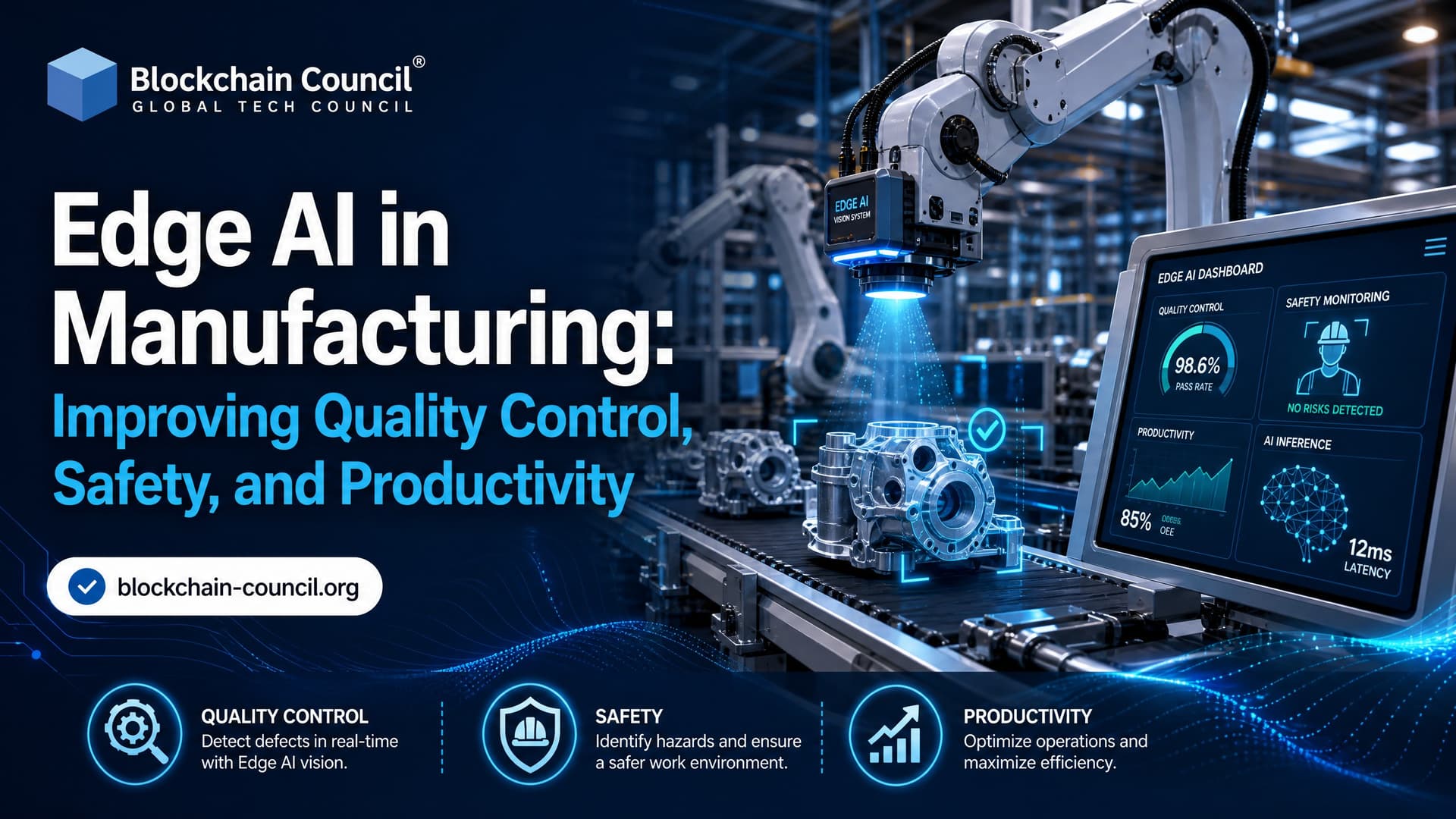
Edge AI in manufacturing moves AI inference from distant cloud systems to the production line itself. Cameras, sensors, PLCs, industrial PCs, and robots analyze data locally, often fast enough to reject a defective part before it reaches the next station.
That local decision-making is the point. In a factory, 500 milliseconds can be too slow. A vision model that waits for cloud processing may miss the reject window on a high-speed conveyor. Edge AI avoids that round trip, reduces bandwidth pressure, and keeps sensitive product or process data inside the plant.

As manufacturers accelerate Industry 4.0 initiatives, professionals with a Certified Edge AI Expert credential are increasingly helping organizations deploy low-latency AI solutions that improve production quality, operational efficiency, and factory-floor decision-making.
What Edge AI Means on the Factory Floor
Edge AI is not just AI plus IoT. It is AI inference placed near the machine, camera, line controller, or robot that produces the data. Training may still happen in the cloud or a data center, but live decisions happen locally.
A typical setup includes:
Industrial cameras capturing product images or worker movement.
Edge devices such as NVIDIA Jetson modules, industrial PCs, smart cameras, or gateways running AI models.
PLCs and SCADA systems receiving AI outputs for reject, stop, alert, or rework actions.
Cloud or central servers storing exceptions, retraining data, dashboards, and audit logs.
Specialist edge inspection systems commonly target sub-200 millisecond latency. That matters for packaging lines, PCB inspection, automotive paint checks, and any process where the product keeps moving.
One practical warning: do not prototype with perfect lab lighting and expect it to survive Monday morning production. In real deployments, auto-exposure on a camera can quietly wreck model performance after a shift change. Lock exposure, white balance, and lighting geometry before you blame the model.
Why Manufacturers Are Moving from Cloud AI to Edge AI
Cloud AI still has a place. It is strong for model training, fleet analytics, long-term quality trends, and cross-site benchmarking. But for real-time factory control, edge AI is usually the better architecture.
Lower latency
Sending every image frame to the cloud creates delay and jitter. Edge inference removes the network round trip, making local decisions practical for high-speed lines.
Less bandwidth
A single 1080p camera can generate a heavy video stream. Multiply that by dozens of lines and the network becomes a bottleneck. With edge AI, you can send only defect images, metadata, counts, timestamps, and model confidence scores upstream.
Better data control
Factories often handle proprietary designs, process recipes, supplier parts, and regulated product data. Local processing reduces unnecessary exposure. It also helps when network connectivity is unreliable or intentionally restricted for security reasons.
Faster response during incidents
If a worker enters a restricted robot cell or a machine shows a vibration pattern linked to bearing failure, the system should act immediately. Edge AI can trigger alarms, slow a robot, stop a conveyor, or notify maintenance without waiting for a remote service.
Successfully operating these AI systems at scale also requires disciplined model deployment, monitoring, version control, and continuous optimization across distributed factory environments. Professionals responsible for these production workflows often strengthen their expertise through a Certified MLOps Expert program to ensure reliable AI performance throughout the model lifecycle.
Edge AI for Quality Control
Quality control is the clearest use case for edge AI in manufacturing. Traditional inspection often depends on sampling or manual checks. AI vision systems make 100 percent inspection possible in many production environments.
Edge AI quality systems can detect:
Surface scratches, dents, cracks, stains, and paint defects
Incorrect labels, missing caps, poor seals, and fill-level errors
Misaligned parts in assembly
PCB solder defects and component placement issues
Micro-defects in semiconductor or electronics production
Vendors and integrators have reported large AI-driven quality deployments that cut defect rates sharply, with some cases citing reductions of up to 90 percent. Case studies from automotive plants have described vision inspection lowering defects by roughly 30 percent within a year, while semiconductor deployments using multi-stage machine learning have reported meaningful drops in customer return rates over similar timeframes.
Those numbers are not magic. They come from catching errors earlier. If a defect is found at station 3, the cost is much lower than finding it after final assembly, shipping, or customer use.
From defect detection to defect prevention
The better systems do more than label a part as pass or fail. They connect defects to process signals: temperature drift, vibration, tool wear, material lot changes, camera station anomalies, or upstream alignment problems.
This changes the role of quality teams. Instead of spending the day sorting bad parts, they can investigate root causes and tune the process. To be blunt, that is where the real money is.
Edge AI for Worker Safety
Factories are full of moving equipment, hazardous zones, heat, noise, chemicals, and repetitive tasks. Edge AI can improve safety by analyzing local video, wearable data, and environmental signals in real time.
Common safety applications include:
PPE detection: Identifying missing helmets, gloves, masks, goggles, or reflective vests.
Restricted-zone monitoring: Alerting when a person enters a robot cell, forklift route, or high-voltage area.
Ergonomic risk detection: Flagging repeated awkward posture or unsafe lifting patterns.
Wearable analytics: Tracking heat stress indicators, fatigue risk, and exposure to unsafe conditions.
Human-robot collaboration: Allowing cobots to adjust speed or path based on human proximity and movement.
Local processing is useful here because safety alerts cannot depend on a stable internet connection. If a camera sees a person cross into a danger zone, the response should happen inside the plant network.
There is a trade-off. Video-based safety monitoring can feel intrusive if deployed poorly. Use clear policies, minimize identity tracking where possible, and keep raw footage retention short unless regulation or incident investigation requires otherwise.
Edge AI for Productivity and Predictive Maintenance
Productivity gains often come from small avoided losses repeated every shift. Edge AI helps by watching machines continuously and spotting patterns that humans miss.
For predictive maintenance, models can analyze:
Vibration signatures from motors, pumps, compressors, and bearings
Temperature changes in electrical cabinets or rotating equipment
Acoustic signals that indicate wear or leakage
Current draw and torque variations
Cycle-time drift and micro-stoppages
The goal is not to replace maintenance teams. It is to give them earlier warnings and better priorities. A bearing failure predicted 72 hours ahead is a scheduled repair. A bearing failure found after a line stoppage is lost production, overtime, scrap, and a long meeting nobody wants.
Edge AI also supports line balancing and resource optimization. By tracking throughput, bottlenecks, energy consumption, reject rates, and downtime causes locally, manufacturers can adjust operations faster. Some factories use this data to reconfigure lines for product variants or demand changes without waiting for weekly reports.
Architecture: What a Good Edge AI Deployment Looks Like
A practical edge AI system for manufacturing usually follows five steps:
Capture the right data: Use stable sensors, controlled lighting, calibrated cameras, and synchronized timestamps.
Train and validate the model: Include real defect samples, borderline cases, lighting variation, and normal production noise.
Optimize for edge hardware: Convert models with tools such as TensorRT, OpenVINO, ONNX Runtime, or vendor-specific runtimes.
Integrate with controls: Send pass, fail, alert, or confidence outputs to PLCs, MES, SCADA, or maintenance systems.
Monitor model drift: Track false rejects, missed defects, camera health, data distribution changes, and retraining triggers.
Here is a detail that catches many teams: an INT8-quantized model can run much faster, but it may miss fine scratches if the calibration dataset does not include real low-contrast defects. Speed is useful only if the inspection still catches the defect class that matters.
Industries Using Edge AI in Manufacturing
Automotive
Automakers use edge AI for paint inspection, body panel alignment, weld checks, assembly verification, and predictive maintenance on production assets. Reported defect reductions from vision inspection show why it is now a serious operational tool, not a pilot project curiosity.
Electronics and semiconductors
PCB and semiconductor lines benefit from fast, high-resolution inspection. Edge AI can detect solder bridge defects, missing components, wrong orientation, wafer anomalies, and electronic test deviations.
Food, beverage, and pharmaceuticals
Packaging inspection is a strong fit. Models can check fill levels, cap placement, seal quality, label accuracy, expiration-date printing, and contamination risks. In regulated environments, local data handling and auditability matter as much as speed.
Heavy industry
Steel, cement, oil and gas, and chemical plants use sensor-heavy edge AI for asset monitoring, worker safety, thermal anomaly detection, and process stability.
Challenges You Should Plan For
Edge AI is powerful, but it is not a plug-in fix. Plan for these issues early:
Data quality: Bad labels and unrepresentative samples create unreliable models.
Hardware limits: Edge devices have memory, power, cooling, and compute constraints.
Integration work: AI outputs must connect cleanly with PLCs, MES, alarms, and operator workflows.
Model drift: New suppliers, lighting changes, lens dust, tool wear, and seasonal conditions can degrade accuracy.
Cybersecurity: Edge devices must be patched, segmented, monitored, and managed like production assets.
A wrong deployment can create false confidence. If your model has high accuracy but catches only common defects, it may still miss the rare defect that causes a recall. Measure precision, recall, false reject rate, and missed defect cost, not just headline accuracy.
Skills Needed to Build and Manage Edge AI Systems
Professionals working with edge AI in manufacturing need a mix of AI, industrial operations, networking, and security knowledge. You should understand computer vision, sensor data, model compression, industrial protocols, safety requirements, and data governance.
For structured learning, Blockchain Council's Certified Artificial Intelligence (AI) Expert™ is a useful path for AI foundations, while Certified AI Developer™ suits you better if you want to build and deploy models. Teams connecting edge AI with secure industrial data systems may also benefit from the Certified Blockchain Expert™ for traceability and trusted data concepts.
The Future of Edge AI in Manufacturing
Edge AI is moving from isolated pilots to standard factory architecture. Vision-based quality control is likely to become edge-first because latency, reliability, privacy, and cost all point in that direction. Several industry analysts expect edge deployment to dominate vision quality systems within the next few years.
The next wave will bring smaller models, better edge accelerators, more multimodal inspection, and closer links between AI, robotics, AR assistance, and digital quality systems. Industry 5.0 will push this further by placing worker safety and human-machine collaboration at the center of automation design.
If you are planning your first project, start with one painful, measurable problem: a recurring defect, an expensive machine failure, or a safety incident pattern. Build the dataset, deploy at the edge, connect the output to a real action, and measure the result for one production line before scaling plant-wide.
As Edge AI continues transforming manufacturing through intelligent automation, predictive maintenance, and real-time quality control, professionals involved in product strategy, industrial technology adoption, or business development can complement their technical expertise with a Marketing Certification to better communicate the value of AI-driven manufacturing solutions and support successful market adoption.
FAQs
1. What is Edge AI in manufacturing?
Edge AI in manufacturing refers to deploying artificial intelligence models directly on factory equipment, industrial machines, smart cameras, sensors, robots, and edge servers. Instead of sending production data to the cloud, AI processes information locally, enabling real-time decision-making, lower latency, and more efficient manufacturing operations.
2. Why is Edge AI important in manufacturing?
Manufacturing environments require instant responses to equipment issues, quality defects, and safety risks. Edge AI analyzes production data on-site, allowing manufacturers to reduce delays, improve operational efficiency, minimize downtime, and make faster decisions without relying on constant cloud connectivity.
3. How does Edge AI improve quality control?
Edge AI uses computer vision and machine learning to inspect products during production. It can detect defects such as scratches, cracks, missing components, incorrect assembly, dimensional variations, and packaging errors in real time, helping manufacturers improve product quality and reduce waste.
4. What are the main use cases of Edge AI in manufacturing?
Common applications include predictive maintenance, automated quality inspection, industrial robotics, worker safety monitoring, process optimization, machine vision, energy management, inventory tracking, autonomous material handling, and production line monitoring.
5. How does Edge AI support predictive maintenance?
Edge AI continuously analyzes machine data from sensors measuring vibration, temperature, pressure, and motor performance. By identifying early signs of wear or abnormal behavior, manufacturers can schedule maintenance before equipment failures occur, reducing downtime and repair costs.
6. Can Edge AI improve factory safety?
Yes. Edge AI monitors manufacturing environments using cameras and IoT sensors to detect unsafe conditions, missing personal protective equipment (PPE), restricted area violations, equipment malfunctions, and potential accidents, enabling faster responses to workplace hazards.
7. How does Edge AI improve manufacturing productivity?
Edge AI optimizes machine performance, reduces production bottlenecks, automates repetitive tasks, minimizes downtime, improves equipment utilization, and supports real-time decision-making, helping manufacturers increase output while maintaining consistent quality.
8. What hardware is commonly used for Edge AI in manufacturing?
Manufacturers typically deploy industrial PCs, edge servers, NVIDIA Jetson platforms, Intel processors, Google Coral Edge TPU, programmable logic controllers (PLCs), AI-enabled smart cameras, embedded systems, and industrial IoT gateways designed for harsh factory environments.
9. Which industries benefit from Edge AI in manufacturing?
Industries including automotive, electronics, aerospace, pharmaceuticals, food and beverage, medical devices, chemicals, textiles, heavy machinery, semiconductor manufacturing, and consumer goods all benefit from Edge AI-powered manufacturing solutions.
10. How does Edge AI improve industrial robotics?
Industrial robots equipped with Edge AI can recognize objects, adapt to changing production environments, optimize movement, perform precision assembly, avoid obstacles, and collaborate more safely with human workers through real-time sensor processing.
11. Can Edge AI operate without internet connectivity?
Yes. One of the biggest advantages of Edge AI is local AI inference. Manufacturing systems can continue inspecting products, monitoring equipment, and controlling production processes even during temporary network outages, improving operational resilience.
12. How does Edge AI improve manufacturing data security?
Since production data is processed locally, sensitive operational information does not always need to be transmitted externally. Combined with encryption, secure authentication, network segmentation, and device monitoring, Edge AI helps strengthen industrial cybersecurity.
13. What software frameworks are used for Edge AI in manufacturing?
Popular frameworks include TensorFlow Lite, OpenVINO, ONNX Runtime, NVIDIA TensorRT, PyTorch Mobile, Apache TVM, Edge Impulse, and industrial AI platforms that support optimized deployment on edge hardware.
14. What are the biggest challenges of implementing Edge AI in manufacturing?
Challenges include integrating with legacy equipment, optimizing AI models for industrial hardware, managing distributed edge devices, ensuring cybersecurity, validating AI accuracy, training employees, maintaining systems, and complying with industry regulations.
15. How does Edge AI support Industry 4.0?
Edge AI is a core technology within Industry 4.0, enabling smart factories through real-time analytics, connected machines, autonomous systems, predictive maintenance, digital twins, AI-powered robotics, and intelligent production optimization.
16. How can manufacturers successfully deploy Edge AI?
Manufacturers should begin with high-value use cases, conduct pilot projects, select compatible edge hardware, optimize AI models, integrate with manufacturing execution systems (MES) and ERP platforms, implement cybersecurity controls, and continuously monitor performance.
17. What are the best practices for implementing Edge AI in manufacturing?
Best practices include clearly defining business objectives, collecting high-quality production data, validating AI models before deployment, securing edge devices, performing regular software updates, monitoring system performance, and training employees to work alongside AI-powered systems.
18. What future trends are shaping Edge AI in manufacturing?
Emerging trends include AI-powered digital twins, autonomous factories, collaborative robots (cobots), generative AI for production planning, predictive quality control, Edge AI-enabled industrial IoT (IIoT), advanced computer vision, sustainable manufacturing, and AI-assisted decision-making.
19. How does Edge AI reduce manufacturing costs?
Edge AI lowers costs by reducing equipment downtime, minimizing product defects, optimizing inventory, improving energy efficiency, automating inspections, decreasing maintenance expenses, and increasing production throughput without sacrificing quality.
20. Why is Edge AI considered the future of manufacturing?
Edge AI enables manufacturers to process data and make intelligent decisions directly where production takes place. By combining real-time analytics, computer vision, predictive maintenance, robotics, and industrial automation, Edge AI helps factories improve quality control, enhance worker safety, increase productivity, and reduce operating costs. As smart manufacturing and Industry 4.0 continue to evolve, Edge AI is expected to become a foundational technology for building more efficient, resilient, and data-driven manufacturing operations.
Related Articles
View All
Edge Ai
Edge AI in Smart Cities: Traffic, Safety, and Energy Use
Explore how edge AI in smart cities improves traffic control, public safety, energy efficiency, and infrastructure resilience with local real-time intelligence.

Edge Ai
Edge AI Use Cases Across Manufacturing, Healthcare, Retail, and Smart Cities
Explore practical edge AI use cases in manufacturing, healthcare, retail, and smart cities, including benefits, deployment risks, and next steps.

Edge Ai
Top Edge AI Frameworks and Tools for Developers and Enterprises
A practical guide to top edge AI frameworks and tools, including TensorFlow Lite, ONNX Runtime, Apache TVM, Edge Impulse, and enterprise MLOps platforms.
Trending Articles
How Blockchain Secures AI Data
Understand how blockchain technology is being applied to protect the integrity and security of AI training data.
What is AWS? A Beginner's Guide to Cloud Computing
Everything you need to know about Amazon Web Services, cloud computing fundamentals, and career opportunities.

Can DeFi 2.0 Bridge the Gap Between Traditional and Decentralized Finance?
The next generation of DeFi protocols aims to connect traditional banking with decentralized finance ecosystems.