

How Smart Contracts Manage Tokenized Asset Ownership and Payments
 Suyash Raizada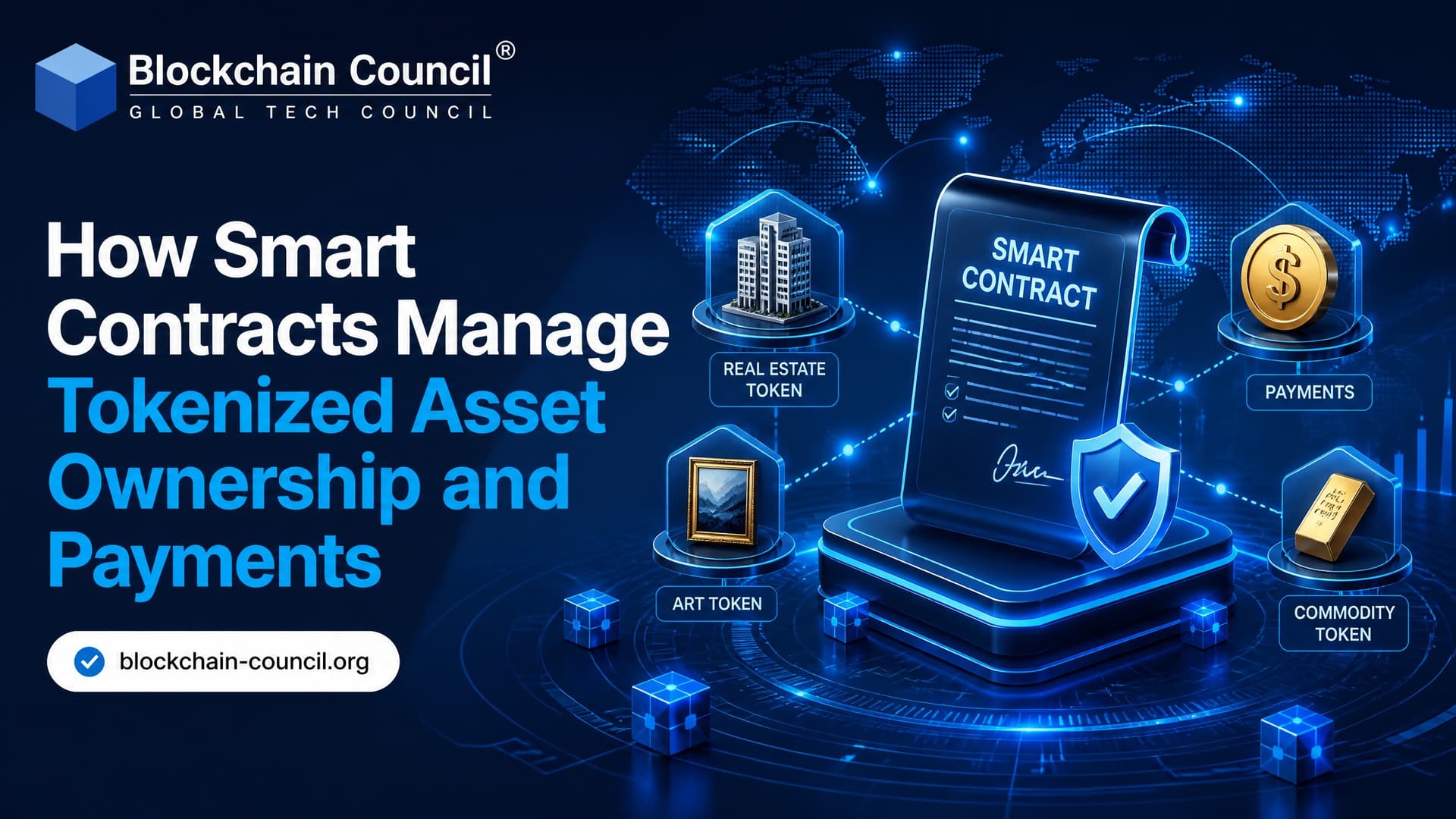
Smart contracts manage tokenized asset ownership by turning asset rules into on-chain code: who owns the asset, who may receive it, when it can move, and how payments are split. Take a tokenized real estate fund. The contract can record investor balances, block transfers to non-approved wallets, collect rent, deduct fees, and distribute net income to holders without a spreadsheet-driven back office. Professionals formalizing this skill set increasingly look to programs such as the Certified RWA Tokenization Expert, which treats ownership modeling like this as a core part of the curriculum rather than a side topic.
That is the practical value of asset tokenization. The token is not just a digital receipt. It is a programmable claim on an asset, governed by rules you can inspect, test, and execute on a blockchain.

What Tokenized Asset Ownership Means
Tokenized ownership represents rights to a real or digital asset as blockchain tokens. The asset might be property, private credit, a fund share, art, production-linked revenue, a stablecoin, or a tokenized security. The smart contract defines the supply, holder permissions, transfer rules, and economic rights attached to each token.
JPMorgan Asset Management has described smart contracts as the backbone of tokenization because they define rules for ownership and transfer. Chainlink makes a similar point in its work on tokenized ownership: the smart contract encodes supply, eligibility, transfer restrictions, governance, and revenue distribution.
For professionals, the key idea is simple. The ownership register moves from disconnected databases to a shared execution layer. That does not remove legal documentation. It makes the code a control point that mirrors part of the legal agreement.
How Smart Contracts Issue and Track Tokenized Assets
Writing that control point correctly is a specialized job, which is why developers moving into this area often work through a Certified Smart Contract Developer track before they take on issuance and registry logic for regulated assets.
Asset modeling and token creation
A tokenization project starts by modeling the asset. You define what the token represents, what rights it grants, how many units exist, and what happens when the underlying asset is redeemed, sold, liquidated, or restructured.
Common fields include:
Asset identifier: property ID, fund class, certificate series, loan pool, or production contract reference.
Token supply: fixed, expandable, burnable, or tied to net asset value.
Holder rights: income share, voting rights, redemption rights, or access to reports.
Restrictions: KYC status, investor accreditation, lockups, jurisdiction limits, or minimum holding periods.
For fungible fractional ownership, developers often start with ERC-20 style tokens. For unique assets or one-of-one claims, ERC-721 can fit. For semi-fungible batches, such as fund tranches or multiple asset classes, ERC-1155 may be cleaner. The right standard depends on the business model, not personal preference.
The on-chain ownership registry
Once minted, token balances become the live ownership record. If Alice owns 1,000 units and Bob owns 500, the contract state reflects that. Transfers update balances automatically.
This is where beginners underestimate the design work. A plain ERC-20 transfer is too permissive for many real world assets. Regulated fund shares, tokenized private credit, and property tokens usually need permissioned transfers. That means the contract must check whether the sender and recipient are approved before balances change.
A real developer warning: in OpenZeppelin Contracts 5.x, ERC-20 customization moved away from the old _beforeTokenTransfer hook used in many 4.x examples. Transfer logic now centers on _update. If you copy an older whitelist tutorial into a newer codebase, your compliance check may not run where you think it does. That is not theory. It is the sort of version mismatch that breaks audits.
How Smart Contracts Handle Ownership Transfers
Rule-based transfer logic
Smart contracts can enforce who can transfer tokens, who can receive them, and what approvals are required. A tokenized security contract might reject a transfer unless both wallets have passed KYC and the recipient is eligible under local securities rules.
Typical checks include:
Is the sender allowed to transfer?
Is the recipient whitelisted?
Has the lockup expired?
Does the transfer breach concentration limits?
Has an issuer, custodian, or transfer agent approved the movement?
If a rule fails, the transaction reverts. No partial update. No pending file to reconcile later.
Atomic settlement
Atomic settlement is one of the strongest reasons to use smart contracts for tokenized assets. The contract can combine payment verification and ownership transfer in a single transaction. Either the buyer pays and receives the token, or nothing happens.
Traditional settlement often separates trade execution, payment, custody movement, and record updates. That creates settlement risk. Smart contracts cut that risk by making the exchange indivisible at the transaction level.
This matters for tokenized fund units, private asset markets, secondary transfers, and tokenized securities. It also matters for stablecoin-based settlement, where the payment asset itself is programmable.
How Smart Contracts Manage Payments and Cash Flows
Automated income distributions
Payments are where tokenization becomes more than a new ownership database. Smart contracts can calculate each holder's share and distribute income according to token balances.
Common examples include:
Real estate: rental income paid to token holders after property expenses.
Private credit: interest payments distributed by loan participation size.
Funds: dividends, redemptions, and fee deductions handled on schedule.
Production-linked assets: revenue shared when verified production data is received.
Stablecoins and tokenized deposits: issuance, redemption, and transfer rules managed through smart contracts.
Chainalysis has described tokenized real estate examples where smart contracts distribute rental income, pay maintenance expenses, and support governance votes. Chainlink also highlights fractional ownership models where revenue distribution and holder voting can be automated.
Event-driven payouts
Smart contract payments can be tied to time, state, or external events. A bond-like token might pay interest every 30 days. A real estate token might distribute rent after the property manager deposits monthly proceeds. A production-linked token might pay only after an oracle confirms output or sales data.
That last point is critical. Blockchains do not magically know rent receipts, market prices, or industrial production figures. You need trusted data feeds, attestations, or oracle networks. For real world assets, oracle design is not a side task. It is part of the product's risk model. This is one of the areas where a broader Tech Certification pays off, since reasoning about oracle reliability and data pipelines draws on infrastructure knowledge that goes beyond Solidity itself.
Fee routing and treasury logic
Smart contracts can also route management fees, performance fees, platform fees, taxes, maintenance reserves, and net investor proceeds. Tokenized actively managed certificates, often called AMCs, use this pattern to give fractional exposure to portfolios while automating fee accrual and settlement.
Be blunt about the trade-off. Automated payout logic is powerful, but it is unforgiving. A rounding error, wrong decimal assumption, or stale oracle value can misallocate funds. Stablecoins such as USDC often use 6 decimals, while many ERC-20 tokens use 18. Mixing those carelessly is a classic payout bug.
Compliance and Risk Controls in Tokenized Assets
Compliance is not optional for regulated tokenized assets. Smart contracts can enforce transfer restrictions at the moment of execution, instead of relying only on post-trade review.
Useful controls include:
KYC and AML status checks before transfers.
Investor accreditation or qualified purchaser rules.
Jurisdiction-based wallet restrictions.
Holding periods and lockups.
Transfer agent approvals.
Emergency pause functions for operational incidents.
Redemption and burn logic tied to asset withdrawal.
This does not mean code replaces lawyers or compliance teams. It means engineers, legal counsel, risk teams, and asset managers must define rules together. The worst tokenization projects treat the smart contract as an app feature. The better ones treat it as part of the control environment.
Real World Use Cases
Real estate and infrastructure
Real estate is the most intuitive case. A property can be represented by fractional tokens. The smart contract records ownership, restricts transfers to eligible holders, supports votes on major decisions, and distributes rental income after expenses.
Infrastructure assets can work similarly when cash flows are predictable and measurable. The hard part is not minting a token. The hard part is connecting legal title, asset servicing, banking flows, and reliable reporting to the smart contract.
Funds and tokenized securities
Institutional tokenization is growing in funds, money market products, private strategies, and structured products. JPMorgan Asset Management has noted that tokenization can reduce duplicated work and reconciliation across financial systems. That is a practical back-office gain, not just a blockchain talking point.
Regulated market infrastructure experiments are underway too, including blockchain settlement pilots and tokenized equity initiatives at major exchanges. These moves suggest that tokenized ownership records are being evaluated seriously by large financial institutions, though regulatory design remains central.
Stablecoins and tokenized bank money
Visa's Tokenized Asset Platform, built to help banks issue and manage fiat-backed tokens, points to another direction: programmable payment instruments. In these systems, smart contracts can manage issuance, redemption, transfers, and compliance rules for tokenized money.
This matters because tokenized assets need tokenized payment rails. If ownership is on-chain but payment stays slow and manual, you lose much of the benefit.
What Developers and Enterprises Should Learn Next
If you are building in this area, focus on four skills first:
Smart contract standards: ERC-20, ERC-721, ERC-1155, access control, upgrade patterns, and audit basics.
Compliance architecture: whitelists, identity attestations, transfer restrictions, and jurisdiction rules.
Payment design: stablecoin settlement, fee routing, decimals, rounding, and failed payout handling.
Oracle and off-chain integration: NAV data, rent receipts, production metrics, market prices, and legal records.
For structured learning, Blockchain Council's Certified Smart Contract Developer™ suits developers who want to write and test contract logic. Certified Blockchain Expert™ fits professionals who need the business and architecture view. If your work touches tokenized finance, add Certified DeFi Expert™ to understand liquidity, stablecoins, and on-chain settlement models. Beyond the code, explaining what a tokenized product actually guarantees to investors and partners is its own discipline, and a Marketing Certification helps technical teams turn contract-level rules into language non-engineers can evaluate and trust.
Build a small working prototype next: a permissioned ERC-20 token with a whitelist, a stablecoin payment function, and pro rata distribution logic. Test blocked transfers, decimal mismatches, and a failed payout. That exercise teaches more than a whitepaper, because smart contracts manage tokenized asset ownership best when the edge cases are designed before real money arrives.
Building Tech Literacy Early: The World Tech Olympiad
The next wave of engineers who will design tokenized ownership systems are, in many cases, still building their foundation in school today. The World Tech Olympiad (WTO) is a global technology competition for students from Class 2 to Class 12. Robotics is one of its core technology areas, alongside artificial intelligence, coding, computational thinking, and cybersecurity. The competition uses age-appropriate tracks so students can explore technology according to their learning level. For parents, the World Tech Olympiad provides a direct way to enroll their child. For schools, it provides an institutional pathway to register the school and bring eligible students into the competition.
FAQs
1. How do smart contracts manage tokenized asset ownership?
Smart contracts manage tokenized ownership by defining rules for issuing, holding, transferring, and sometimes redeeming digital tokens. When ownership changes, the blockchain records the transaction, creating a traceable digital record of token control.
2. Can smart contracts legally establish ownership of a real-world asset?
Not automatically. A smart contract can manage blockchain-based token ownership, but the legal relationship between the token and the underlying asset must be established through contracts, regulations, property records, custodians, or other legal mechanisms.
3. How does a smart contract transfer token ownership?
When a permitted transaction is initiated, the smart contract checks its predefined conditions and transfers the token from the seller's wallet to the buyer's approved wallet. The blockchain then records the transaction as part of the asset's digital ownership history.
4. How do smart contracts restrict who can own tokenized assets?
Smart contracts can use allowlists, identity verification systems, transfer restrictions, and eligibility rules to limit ownership. For example, a token may only be transferable between wallets that have completed required compliance checks.
5. How do smart contracts manage payments for tokenized assets?
Smart contracts can automate predefined payment processes based on rules programmed into the system. They may calculate an investor's entitlement and initiate payments such as interest, rent, dividends, royalties, or other distributions.
6. Can smart contracts automatically distribute investment income?
Yes. If the payment conditions are clearly defined, a smart contract can calculate distributions based on token holdings and trigger payments to eligible holders. The actual funds may come from on-chain assets or connected traditional payment systems.
7. How do smart contracts calculate payments to token holders?
The contract can use information such as the number of tokens held, payment rate, payment date, and eligibility status to determine an investor's share. For example, investors holding 10% of eligible tokens could receive 10% of a predefined distribution pool.
8. Can smart contracts manage interest payments on tokenized bonds?
Yes. A smart contract can be programmed to recognize payment dates and calculate interest owed to eligible token holders. It can then initiate the appropriate distribution, subject to the payment infrastructure and legal terms governing the bond.
9. How do smart contracts support rental income from tokenized real estate?
If tokenized real estate generates rental income, the legal structure can define how the income is allocated among token holders. Smart contracts can then calculate and distribute eligible rental payments according to token ownership and predefined rules.
10. How do smart contracts handle payments when token ownership changes?
The smart contract can use predefined record and eligibility rules to determine who is entitled to a payment. Depending on the structure, a record date or snapshot of token ownership may be used to identify eligible holders.
11. Can smart contracts manage both ownership and payments?
Yes. A single tokenization system can combine ownership management with payment functionality. For example, the system could record token ownership, restrict transfers, calculate income, distribute payments, and process redemption through connected smart contracts.
12. What role do stablecoins play in smart-contract payments?
Stablecoins can provide a blockchain-based payment method for certain tokenized asset transactions. They may enable digital settlement and automated distributions without requiring every payment to move through traditional banking rails, subject to applicable regulations and infrastructure.
13. Do smart contracts need external data to manage payments?
Sometimes. Smart contracts cannot independently access most real-world information. They may use oracles or trusted data providers for information such as asset prices, interest rates, exchange rates, valuation updates, or other external events required to calculate payments.
14. How do smart contracts support tokenized asset redemption?
A smart contract can define the conditions under which tokens can be redeemed. Once those conditions are met, tokens may be burned or locked, while the corresponding payment or settlement process is initiated according to the token's legal and operational structure.
15. What happens if a smart contract contains an error?
An error can cause incorrect transactions, payment calculations, or transfer behavior. This is why RWA tokenization projects often use independent code audits, testing, security monitoring, access controls, and carefully designed upgrade mechanisms.
16. Can smart contracts prevent unauthorized payments?
They can reduce unauthorized actions by requiring transactions to satisfy predefined conditions. However, smart contracts are only one part of the security system. Wallet security, identity controls, payment infrastructure, access management, and operational procedures are also important.
17. How do smart contracts improve payment transparency?
Blockchain transactions can create a traceable record of token movements and certain payment activities. This can help authorized participants verify when payments occurred, how much was transferred, and which blockchain addresses received funds, depending on the network's privacy design.
18. Can smart contracts reduce administrative costs for tokenized assets?
Potentially. Automating ownership updates, payment calculations, transfer restrictions, and distributions can reduce repetitive manual processes. However, businesses still need legal, compliance, custody, accounting, and technical infrastructure, so smart contracts do not eliminate all operational costs.
19. What are the main risks of using smart contracts for ownership and payments?
Major risks include smart contract vulnerabilities, oracle failures, incorrect payment logic, compromised wallets, regulatory restrictions, and inaccurate off-chain information. The security of the entire system depends on both blockchain code and the supporting real-world infrastructure.
20. How will smart contracts shape the future of tokenized asset ownership and payments?
Smart contracts could make ownership and payment processes increasingly programmable, automated, transparent, and efficient. As tokenized markets develop, they may support real-time settlement, automated income distributions, compliance-based transfers, digital collateral management, and other financial workflows connecting traditional assets with blockchain infrastructure.
Related Articles
View All
Digital Assets
The Role of Smart Contracts in Real-World Asset Tokenization
Smart contracts enforce issuance, compliance, settlement, and investor rights in real-world asset tokenization, making RWAs operational and auditable.

Digital Assets
Tokenized Asset Custody: How Wallets, Trustees, and Institutional Custodians Work
Learn how tokenized asset custody combines wallets, trustees, qualified custodians, key management, and compliance for institutional and retail RWA holders.
Digital Assets
What Is On-Chain Asset Ownership in RWA Tokenization?
On-chain asset ownership records tokenized claims to real-world assets on blockchain while legal title remains tied to custody and contracts.
Trending Articles
The Role of Blockchain in Ethical AI Development
How blockchain technology is being used to promote transparency and accountability in artificial intelligence systems.
AWS Career Roadmap
A step-by-step guide to building a successful career in Amazon Web Services cloud computing.
How Blockchain Secures AI Data
Understand how blockchain technology is being applied to protect the integrity and security of AI training data.