

CBDC for Smart Cities: Payments, Identity, and Public Service Innovation
 Suyash Raizada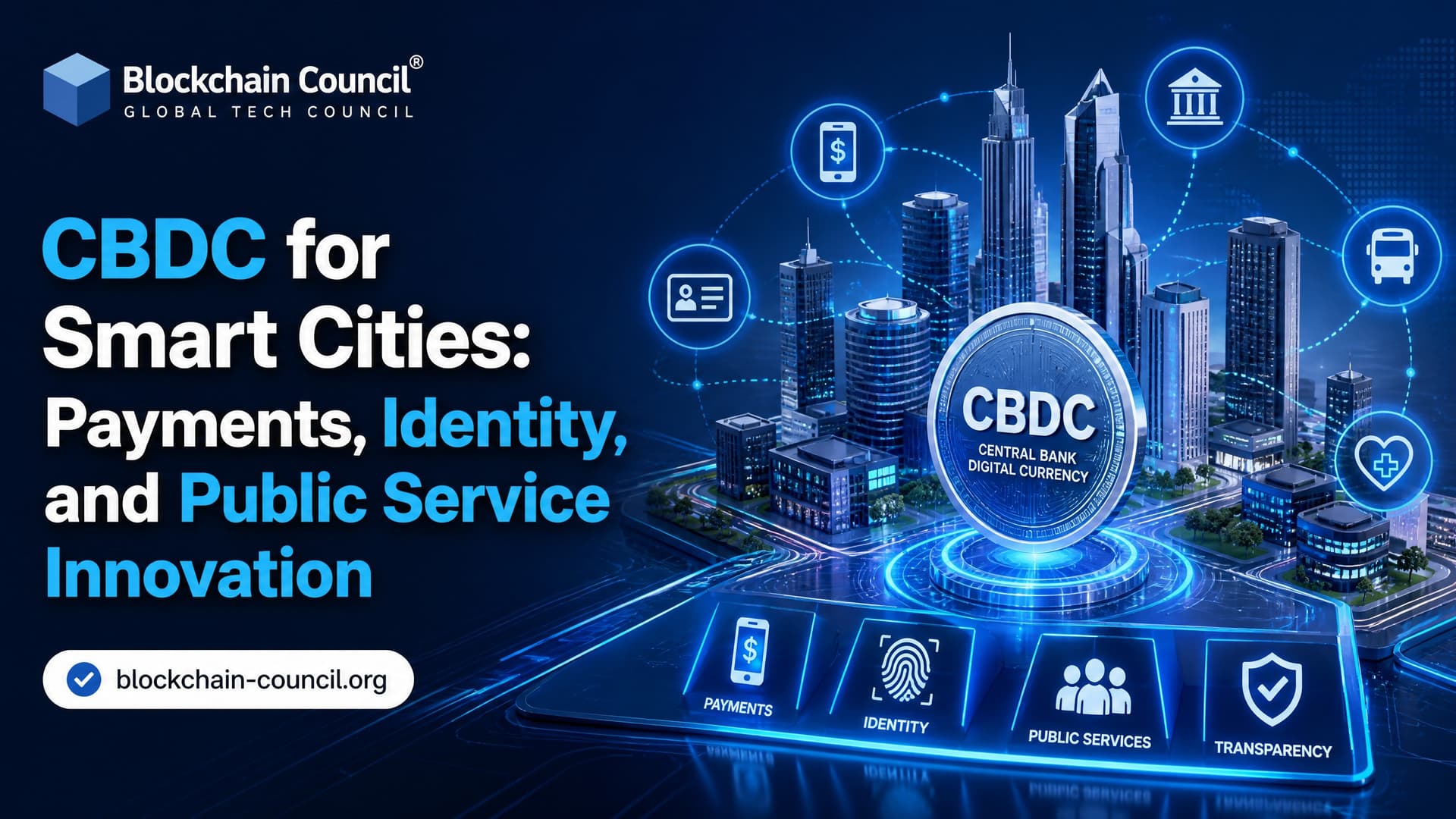
CBDC for smart cities is not just a payments story. The real value shows up when state-backed digital money connects to digital identity, public data systems, transport networks, and municipal services. Done well, a central bank digital currency can make city payments faster, improve access for residents who are poorly served by banks, and give governments better tools for targeted public programs. Done badly, it becomes a surveillance-heavy payment layer that residents will not trust. Professionals shaping this kind of policy and infrastructure work increasingly start with a structured credential like the Certified Central Bank Digital Currency (CBDC) Expert program, since smart city CBDC design leans as much on identity and governance knowledge as it does on payments.
That trade-off matters. Smart city infrastructure already touches daily life: buses, parking, utilities, permits, health services, subsidies, and local taxes. Adding CBDC to that stack means the design choices stop being abstract central bank policy. They affect the line at a metro gate and the way a low-income household receives an energy rebate.

What Is a CBDC in a Smart City Context?
A central bank digital currency is a digital form of national fiat currency issued or supervised by a central bank. It differs from Bitcoin, Ether, or private stablecoins because it is sovereign money, generally designed to carry the trust and legal status of cash while working inside digital systems.
CBDCs usually fall into two groups:
Retail CBDCs: Used by people and businesses for everyday payments through wallets, mobile apps, cards, or connected devices.
Wholesale CBDCs: Used by financial institutions for interbank settlement, securities settlement, and specialized financial market use cases.
For smart cities, retail CBDCs are the practical starting point. They can sit inside citizen wallets, public transport apps, merchant payment systems, and government service portals. Wholesale CBDCs still matter, especially for treasury and settlement efficiency, but they do not touch most city residents directly.
Think of a CBDC as public money in electronic form, usually recorded on a ledger controlled or supervised by the central bank. That distinction matters for professionals comparing CBDCs with stablecoins or tokenized deposits. If you are building expertise here, the Certified Blockchain Expert™ and Certified Cryptocurrency Expert™ programs cover the difference between public digital money and private crypto assets, and a Certified Digital Assets Expert certification is a natural next step for placing CBDC alongside the wider digital asset landscape it increasingly sits within.
Why CBDC Fits Digital Public Infrastructure
Smart cities run on digital public infrastructure, often shortened to DPI. DPI usually combines three rails: digital identity, trusted data exchange, and secure digital payments. Analysts at Giesecke+Devrient have argued that CBDC is a strong candidate for the payment rail because it can provide state-backed settlement, broad access, and resilience in national payment systems.
This is where CBDC for smart cities becomes more than a wallet. A CBDC payment can be tied to identity verification, eligibility rules, consent flows, and public service records. That could support telemedicine, remote education, benefit payments, utility billing, local tax collection, and retail transactions on the same trusted infrastructure.
To be blunt, the payment rail alone is not enough. A city can already accept card payments and mobile money. CBDC earns its place when it cuts reconciliation work, supports inclusion, and connects cleanly with identity and service delivery systems without forcing every resident into a bank account.
Smart City Payments: Where CBDC Can Help
Public Transport and Mobility
Transport is one of the clearest use cases. A city could let residents tap a wallet, phone, or card at buses, metro stations, bike docks, or parking meters. Settlement in central bank money can reduce counterparty risk and simplify back-office accounting between agencies and operators.
The detail that often gets missed is latency. If a transit gate takes too long to approve a payment, crowds build fast. CBDC wallet design has to support quick authorization, offline fallbacks, and fraud controls. This is not a white paper issue. It is an operations issue.
Municipal Fees, Taxes, and Utilities
CBDC can also streamline payments for parking fines, building permits, waste collection, water bills, local taxes, and tolls. A city finance team could receive funds directly in a government wallet, with automated records linked to invoice IDs and resident accounts.
That cuts manual reconciliation. Anyone who has worked with public-sector payments knows the pain: payment received, reference missing, resident angry, finance team searching bank statements. A CBDC system with structured payment metadata can reduce that mess, if the data standards are set early.
Micro Payments and Machine-to-Machine Services
Smart cities use connected meters, sensors, chargers, and shared devices. CBDC could support very small payments between devices and services, such as electric vehicle charging by the minute or dynamic road pricing by route. This is where programmable payment logic gets useful, especially when combined with IoT networks and smart contracts.
Still, do not overbuild. A full programmable CBDC is not needed for every parking meter. In many cases, simple API-based payment requests are safer and easier to audit. The engineering side of this work, wiring meters, sensors, and chargers into a payment stack, tends to draw on infrastructure skills well beyond blockchain, which is where a broader Tech Certification from Global Tech Council can help fill the gaps, covering the IoT, cloud, and cybersecurity foundations that these systems depend on.
Digital Identity: The Hard Part Behind CBDC Adoption
The Bank for International Settlements has repeatedly stressed that some form of identification sits at the center of CBDC design. Account-based CBDCs linked to digital identity are often seen as the strongest model for mainstream use, provided the privacy protections are real and enforceable.
Digital ID can draw from national identity records, tax systems, education credentials, benefit registers, property records, and verified private-sector data. Estonia is often cited because its national digital identity gives citizens access to public and private e-services. Kenya's Huduma Namba has also come up as an example of unified identity for access to public services.
For a CBDC-enabled smart city, identity can support:
Wallet onboarding and account recovery
Eligibility checks for subsidies and discounts
Holding limits and transaction caps
Fraud prevention and anti-money laundering controls
Different privacy tiers for low-value and high-value payments
The risk is obvious. When identity, money, and public services meet in one system, data concentration becomes dangerous. A lost phone should not mean losing access to rent support, transport discounts, and health payments all at once. Recovery flows, guardian models, revocation rules, and offline identity proofing need as much attention as the ledger.
Public Service Innovation With CBDC
Targeted Welfare and Subsidies
CBDC wallets tied to verified identity could let governments send benefits directly to eligible residents. Energy rebates, emergency cash support, student grants, food subsidies, and disability payments could arrive faster with less leakage.
Programmability can help, but keep it limited. A voucher that can only be spent on electricity may be reasonable during an energy crisis. A general welfare payment that tracks every purchase is not. Public trust depends on clear legal boundaries.
Energy Efficiency and Sustainability
Recent academic work covering 286 Chinese cities from 2016 to 2023 found that CBDC pilots were associated with improved urban energy efficiency. The study linked the effect to higher digitalization, more effective fiscal support, and greater openness, while noting that local financial development and industrial structure influenced the results.
This matters for smart cities. CBDC could support dynamic tariffs, automated energy-saving rewards, public charging incentives, or carbon-linked municipal programs. But CBDC is not magic. The energy gains come from better digital infrastructure and policy execution, not from the token itself.
Health, Education, and Local Services
DPI that combines CBDC, identity, and secure data sharing can support telemedicine, remote learning, and digital municipal services. A resident could verify identity, consent to data use, pay a small service fee, or receive a subsidy in one flow.
For local authorities, CBDC can also simplify permits, licenses, property-related payments, and utility deposits. The ITU-led Digital Currency Global Initiative has flagged identification and digital credentials as core CBDC architecture components, especially for enforcing holding caps, transaction limits, and usage rules.
Governance, Privacy, and Interoperability Risks
CBDC for smart cities raises serious governance questions. Central banks, city governments, commercial banks, wallet providers, telecom companies, and identity authorities may all touch the system. Without clear accountability, residents will not know who is responsible when a payment fails or an account is frozen.
Key risks include:
Privacy loss: Payment data can reveal movement, habits, income patterns, and political activity.
Cybersecurity exposure: CBDC wallets and identity databases become high-value targets.
Exclusion: Poor design can leave behind people without smartphones, stable internet, or formal documents.
Vendor lock-in: Closed city platforms can make future upgrades expensive.
Weak interoperability: A wallet that works for transit but not utilities or welfare creates more friction, not less.
The better path is privacy by design, open standards, tiered identity, offline access, and independent oversight. Multi-CBDC work from the BIS also points toward cross-border interoperability, but cities should solve domestic reliability before chasing complex international flows.
Skills Professionals Need to Work on CBDC Smart City Projects
CBDC projects are multidisciplinary. You need more than blockchain knowledge. Teams need people who understand payment systems, identity architecture, cybersecurity, privacy law, public policy, and smart contract risk.
If you are preparing for this field, focus on these areas:
Learn CBDC models, including retail, wholesale, token-based, and account-based designs.
Understand digital identity standards and authentication flows.
Study smart contract basics, especially if programmable payments are involved.
Build knowledge of AML, data protection, wallet security, and operational resilience.
Compare CBDCs with stablecoins, commercial bank money, and tokenized deposits.
Blockchain Council programs such as Certified Blockchain Developer™, Certified Smart Contract Developer™, Certified Blockchain Expert™, and Certified Cryptocurrency Expert™ give you structured training before you work on CBDC-adjacent systems.
What Comes Next for CBDC and Smart Cities?
CBDCs are likely to move deeper into smart city planning as central banks modernize payments and governments invest in digital public infrastructure. The strongest use cases will be practical: public transport settlement, targeted subsidies, utility payments, energy programs, and secure access to digital services.
The wrong approach is to treat CBDC as a technology upgrade that automatically improves governance. It does not. The cities that win will be the ones that design for privacy, resilience, inclusion, and interoperability from the first pilot. And because none of this works without residents understanding and trusting what a city wallet actually does, teams handling public communication and rollout may also want to look at a Marketing Certification from Universal Business Council, since building that trust is a separate skill from building the ledger.
Your next step: map one city service, such as transit payments or energy rebates, and pinpoint where identity, payment settlement, data sharing, and user consent meet. Then build your knowledge around that workflow. If you need a structured foundation, start with blockchain, smart contract, and digital asset certification before moving into CBDC architecture and public-sector implementation.
FAQs
1. How can CBDCs be used in smart cities?
Central Bank Digital Currencies can provide public digital payment infrastructure for residents, businesses, government agencies, and potentially connected machines. A CBDC could support public transport, municipal fees, government payments, utilities, and other services. Combined with digital identity, IoT, AI, and interoperable payment systems, it could help cities create faster and more integrated public services.
2. What is the role of CBDC in a smart city?
A CBDC can function as a digital form of central-bank money within a broader smart-city ecosystem. Residents could potentially use it for transportation, taxes, permits, utilities, retail purchases, and government services. Its role would primarily involve payments and settlement, while separate digital identity and data systems manage authentication, eligibility, and public-service records.
3. How can CBDCs improve smart-city payments?
CBDCs could provide instant or near-instant digital payments between residents, businesses, government agencies, and participating financial institutions, depending on system design. Common payment infrastructure could reduce fragmentation between municipal services. Users might pay for transport, parking, permits, utilities, or other services through compatible wallets without maintaining separate balances across numerous city applications.
4. Can CBDCs be used for public transportation?
Yes. Subject to the CBDC's design, public transportation systems could accept digital central-bank money for buses, trains, metro services, ferries, parking, or other mobility services. Integration with contactless cards, smartphones, or other devices could make payments convenient. Offline functionality could be particularly valuable when network connectivity is unavailable at stations or during travel.
5. Can CBDCs be integrated with digital identity?
CBDCs can operate alongside digital identity systems, but payment and identity should not automatically become one centralized dataset. Verifiable Credentials can allow residents to prove selected information when accessing services, while the CBDC handles payment. Separating these functions and using privacy-enhancing technologies can reduce unnecessary collection and linking of citizens' personal information.
6. How can CBDCs improve government benefit payments?
Governments could use CBDC infrastructure to distribute eligible benefits, emergency assistance, refunds, or other public payments directly through approved channels. Digital settlement may reduce processing delays and administrative friction. Strong identity verification, accessibility, account recovery, and privacy protections are necessary so that vulnerable residents are not excluded by a digital-first system.
7. Can CBDCs improve payment for utilities and municipal services?
Residents and businesses could potentially use CBDCs to pay electricity, water, waste-management fees, local taxes, permits, and other municipal charges. APIs could connect payment infrastructure with city-service platforms and automatically reconcile completed payments. This could reduce administrative processing while providing residents with faster confirmation that their obligations have been settled.
8. How can CBDCs support smart parking systems?
Smart parking infrastructure can identify available spaces, calculate fees, and process payments digitally. A CBDC could provide one payment option within this ecosystem. A connected vehicle or mobile application could potentially authorize a payment based on parking duration. Appropriate user controls would be essential before software receives permission to spend money automatically.
9. Can electric vehicles make CBDC payments automatically?
Potentially. Connected electric vehicles could interact with charging stations through machine-readable identity and payment infrastructure. A driver could authorize a vehicle to pay for charging within predefined limits, while the CBDC system provides settlement. Similar mechanisms could eventually support tolls, parking, or other mobility services, depending on technical standards and CBDC design.
10. How can CBDCs support IoT and machine-to-machine payments?
Smart cities contain connected devices that purchase or provide services, including charging stations, energy systems, vehicles, sensors, and shared infrastructure. CBDCs with suitable APIs could potentially support machine-initiated payments under human-defined permissions. This could enable automated economic interactions while retaining central-bank money as the settlement asset.
11. Can CBDCs support smart energy grids?
CBDCs could provide a payment layer for energy transactions involving households, businesses, utilities, batteries, and electric vehicles. For example, a household generating excess solar electricity might receive payments through digital infrastructure where local energy-market rules permit. The CBDC would handle settlement while smart meters and energy platforms determine actual production and consumption.
12. Can CBDCs work without internet access in smart cities?
CBDC designs may include offline payment capabilities, allowing certain transactions when internet or mobile connectivity is unavailable. This could improve resilience during network outages, emergencies, or natural disasters and make digital payments more accessible. Offline systems require careful controls around device security, spending limits, synchronization, double-spending prevention, and recovery.
13. How can CBDCs improve financial inclusion in smart cities?
CBDCs could provide access to digital central-bank money for people who have limited access to conventional banking, depending on the distribution model and eligibility rules. Inclusive systems may support low-cost wallets, offline payments, accessible devices, and multiple onboarding options. Smart-city payment infrastructure should not assume that every resident owns an expensive smartphone or maintains continuous internet connectivity.
14. How can CBDCs protect privacy in smart cities?
Privacy protections can include data minimization, tiered identification, access controls, separation of identity and transaction systems, and privacy-enhancing cryptography. Governance should clearly define which institutions can access payment information and under what legal authority. This is particularly important in smart cities, where combining payments with transport, identity, utilities, and public-service data could otherwise create extensive profiles of individual behavior.
15. Can Zero-Knowledge Proofs improve CBDC smart-city services?
Zero-Knowledge Proofs can allow residents to demonstrate that certain conditions are satisfied without revealing all underlying personal information. A person might prove eligibility for a transport discount or municipal benefit without disclosing unrelated identity details. Such privacy-enhancing technologies could help smart cities provide personalized services without requiring every department to collect complete citizen records.
16. How can AI and CBDCs work together in smart cities?
AI can optimize traffic, energy use, public transportation, infrastructure maintenance, and municipal services, while CBDCs can provide digital settlement for authorized transactions. AI agents might eventually initiate limited payments for approved services, such as charging an autonomous municipal vehicle. Strong spending controls, auditability, cybersecurity, and human oversight would be essential for such automation.
17. Can CBDCs improve emergency and disaster response?
CBDC infrastructure could potentially help governments distribute emergency financial assistance rapidly to eligible residents. Offline functionality may allow some payments to continue when telecommunications infrastructure is disrupted. Governments could also integrate digital payments with emergency-service platforms, although systems need redundancy because making disaster relief dependent on one functioning digital network would rather defeat the resilience objective.
18. What are the risks of using CBDCs in smart cities?
Risks include cybersecurity attacks, privacy loss, excessive data centralization, digital exclusion, system outages, fraud, surveillance concerns, and technology-vendor dependence. Integrating payments with numerous municipal systems can also increase cybersecurity complexity. Strong governance should limit data collection, separate sensitive systems where appropriate, provide alternative payment methods, and establish transparent rules governing institutional access.
19. Will CBDCs replace cash in smart cities?
CBDC introduction does not inherently require eliminating physical cash. Cash provides accessibility, privacy, familiarity, and resilience that remain important to many people. A CBDC can operate as another form of central-bank money alongside cash and existing electronic payment methods. Maintaining multiple payment options can make smart cities more resilient and prevent residents from being excluded because of technology access or preference.
20. What is the future of CBDCs in smart cities?
The strongest role for CBDCs in smart cities is likely to be as interoperable public payment infrastructure, not as a database containing everything a city knows about its residents.
A resident could use compatible digital money to pay for public transportation, parking, utilities, permits, taxes, and other services.
Government agencies could distribute benefits and emergency payments through the same broader financial infrastructure.
Connected vehicles could make authorized payments for charging, parking, or tolls. Smart energy systems could settle transactions between households, batteries, utilities, and electric vehicles.
AI could optimize these services, while IoT devices provide real-time information about physical infrastructure.
Digital identity would provide another layer.
Instead of attaching a complete identity profile to every payment, residents could use Verifiable Credentials or privacy-enhancing technologies to demonstrate only the information required for a service.
This separation is crucial.
A smart city should not automatically create one enormous system connecting where a resident travels, what they purchase, which government services they use, how much electricity they consume, and who they are.
Good CBDC architecture therefore requires privacy by design, data minimization, interoperability, cybersecurity, accessibility, offline capability, and clear institutional oversight.
Cash and conventional payment systems may continue operating alongside CBDCs, providing users with choice and increasing resilience.
The larger smart-city technology stack could eventually combine CBDCs for settlement, digital identity for authentication, IoT for sensing, AI for intelligence, and privacy-enhancing technologies for controlled information sharing.
When designed properly, residents should not need to think about any of those layers.
They should simply be able to board a train, charge a vehicle, receive a benefit, or pay a municipal fee securely and conveniently.
A city becomes smarter when technology removes friction from daily life, not when residents need a diagram to understand how they paid the parking meter.
Related Articles
View All
Digital Assets
How Smart Contracts Manage Tokenized Asset Ownership and Payments
Smart contracts manage tokenized ownership, transfers, compliance, and payouts for real estate, funds, securities, RWAs, and stablecoin payment flows.

Digital Assets
CBDC vs Mobile Payments: Understanding Wallets, Settlement, and Money Types
CBDC vs mobile payments explained through wallets, settlement, and money types, with real examples from India, China, Nigeria, and the Bahamas.

Digital Assets
CBDC vs Stablecoins: Which Digital Money Model Is Better for Payments?
CBDC vs Stablecoins for payments explained: compare speed, trust, regulation, Web3 use, cross border settlement, and where each model fits best.
Trending Articles
The Role of Blockchain in Ethical AI Development
How blockchain technology is being used to promote transparency and accountability in artificial intelligence systems.

Top 5 DeFi Platforms
Explore the leading decentralized finance platforms and what makes each one unique in the evolving DeFi landscape.
How Blockchain Secures AI Data
Understand how blockchain technology is being applied to protect the integrity and security of AI training data.