

What Is On-Chain Asset Ownership in RWA Tokenization?
 Suyash Raizada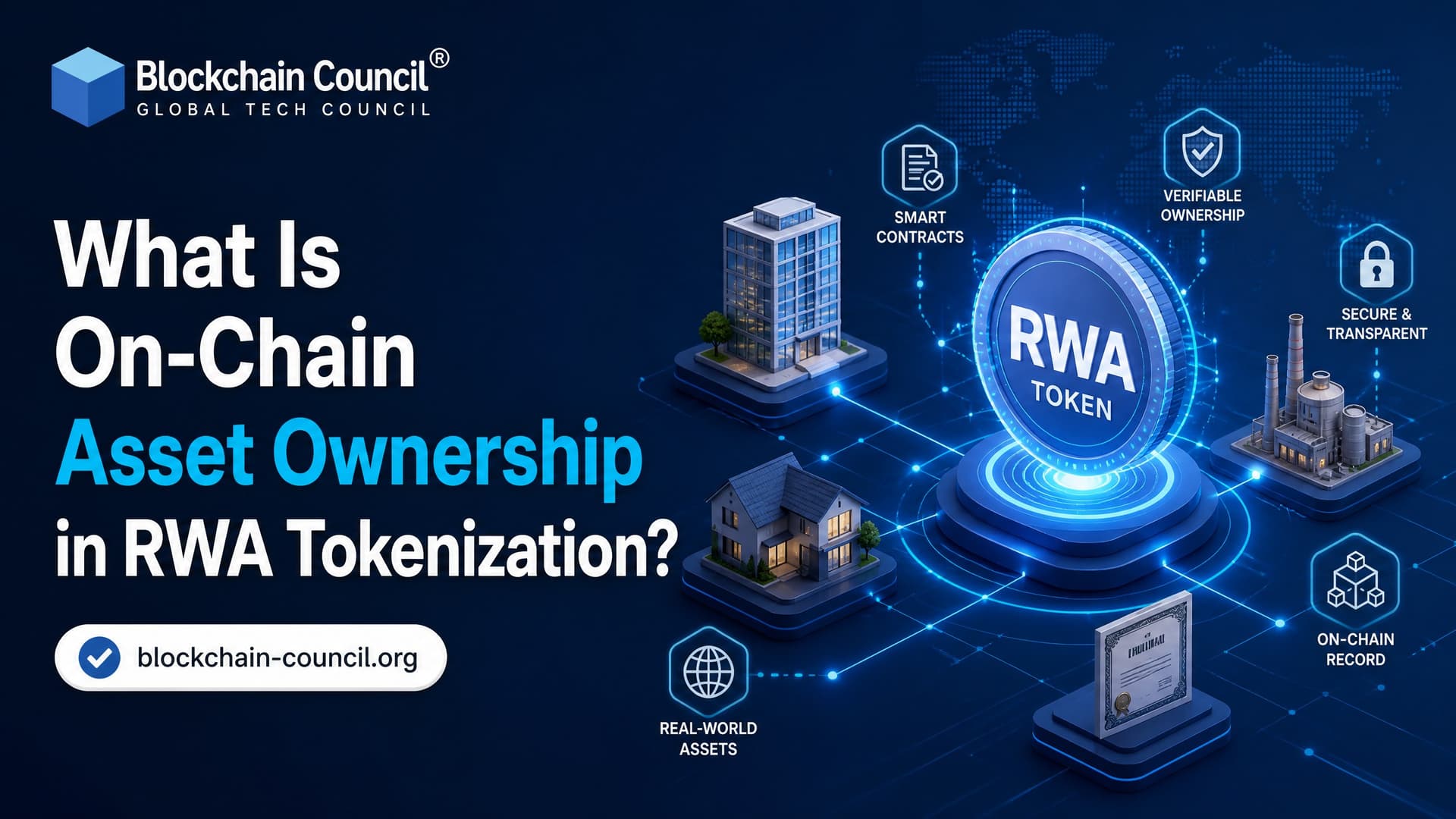
On-chain asset ownership in RWA tokenization means a blockchain records who holds a tokenized claim to a real-world asset, while the asset itself is still governed by legal contracts, custodians, and traditional registries. The token is not magic title. It is a programmable record of a claim, interest, or economic right connected to something off-chain: US Treasuries, real estate, gold, private credit, or fund shares. Anyone trying to properly evaluate these structures often finds it worth pursuing a Certified RWA Tokenization Expert credential to build a structured understanding before relying on any single project's marketing claims.
That distinction matters. Hold ETH, and the asset exists natively on Ethereum. Hold a tokenized Treasury product, and the blockchain shows your token balance, but the Treasury bills sit with a custodian or inside a fund, trust, or special-purpose vehicle. Your rights depend on the smart contract and the legal documents behind it.

What On-Chain Asset Ownership Really Means
In RWA tokenization, the token is the on-chain interface to an off-chain asset. This is exactly the kind of nuance that a Certified Digital Assets Expert designation is meant to clarify, since the difference between holding a token and holding a claim is easy to gloss over without formal grounding. It may represent:
A contractual claim against an issuer
A beneficial interest in a trust, fund, or SPV
A right to cash flows, redemption, yield, or price exposure
A fractional interest in an asset-holding vehicle
Most RWA tokens do not give you direct legal title to the underlying asset. A tokenized real estate token usually does not put your name on the land registry. Instead, it may represent shares or membership interests in an entity that owns the property.
Legal practitioners often describe on-chain token ownership as prima facie evidence of beneficial ownership where the documents support that treatment. In plain English: the blockchain record can be treated as strong evidence of who owns the related interest, but only if the legal structure says so.
The Dual-State Model: Legal Truth and Computational Truth
RWA tokenization runs on two records at once.
Off-chain state: Custody records, fund documents, land registries, securities registers, bank accounts, and court-recognized contracts.
On-chain state: Smart contract balances, transfers, burns, mints, permissions, and settlement logic.
The hard part is keeping these two states aligned. A blockchain can show that Alice transferred 1,000 tokens to Bob. But the legal system must also recognize that transfer as an assignment of the corresponding economic or beneficial interest. If the paperwork is weak, the chain can be technically correct and legally incomplete.
This is where beginners get tripped up. They assume token transfer equals asset transfer. Not always. In a well-structured RWA product, the offering documents, custody agreement, investor register, and smart contract all point to the same answer. In a poorly structured one, the token is just a database entry with branding.
How On-Chain Ownership Is Implemented
1. Custody Layer
The underlying asset is held by a custodian, trustee, bank, broker, fund administrator, or another regulated party. For tokenized Treasuries, this may involve government securities held in custody. For tokenized gold, it may involve vaulted bullion. For real estate, the asset may sit inside a company or trust.
2. Legal Wrapper
The legal wrapper defines what token holders actually receive. This may be a fund share, trust interest, note, equity interest, or contractual redemption right. It also covers insolvency treatment, transfer restrictions, investor eligibility, and dispute resolution.
This layer is the jurisdictional anchor. Without it, the token has no clear bridge to enforceable rights.
3. Token Contract
The smart contract records balances and enforces transfer rules. Many RWA projects use ERC-20-style contracts with permissioning, or standards built for regulated assets such as ERC-3643. These contracts can include KYC checks, allowlists, transfer locks, jurisdiction filters, and forced transfers under defined legal conditions.
A practical detail from testing: if you build a permissioned RWA token and forget to add the recipient to the allowlist, the transfer can fail even when the sender has enough balance. Developers used to plain ERC-20 tokens often waste time debugging balances when the real issue is compliance logic. In Solidity 0.8.x with tooling such as Hardhat or Foundry, write tests for both balance failure and eligibility failure. They are different risks.
4. Oracle and Verification Layer
Oracles and attestations connect the token to reality. They may report net asset value, reserve balances, collateral ratios, interest rates, or redemption status. For DeFi integrations, oracle quality is not a side issue. A stale price can trigger bad liquidations or allow undercollateralized borrowing.
On-Chain Settlement vs Legal Finality
On-chain settlement finality means the blockchain shows a completed transfer. Legal finality means courts, custodians, issuers, and regulators recognize the transfer as effective under the relevant documents and law.
For native crypto assets, these concepts sit close together. For RWAs, they stay separate. A token holder may have an enforceable claim only because the issuer documents state that the designated blockchain is the official record for token holder interests.
That is why serious RWA analysis should always ask three questions:
Who holds the underlying asset?
What legal right does the token represent?
What happens if the issuer, custodian, or oracle fails?
Current Market State of RWA Tokenization
The RWA market has grown fast, especially in tokenized fixed-income products. Market trackers such as RWA.xyz have reported tens of billions of dollars in tokenized RWA value, excluding stablecoins, with tokenized US Treasuries leading the way. Broader estimates that also count assets committed to tokenization but not yet liquid on-chain run into the hundreds of billions. Figures move quickly, so check a current tracker before you quote a number.
The market is concentrated. Tokenized US Treasuries and cash-equivalent products make up the large majority of distributed RWA value. That tells you where institutional demand is strongest right now: short-duration, liquid, yield-bearing assets with familiar legal treatment.
Private credit, commodities, real estate, and tokenized funds are growing too, but they are smaller and harder to standardize. Real estate in particular sounds attractive, yet title transfer, local law, valuation, taxes, and liens make it far less simple than tokenizing a money market fund share.
Why Institutions Care About On-Chain Asset Ownership
Institutions are not adopting RWA tokenization because blockchains make legal systems disappear. They care because blockchain records can improve parts of post-trade infrastructure.
Faster settlement: Transfers can settle in minutes rather than through multi-day operational cycles.
Programmability: Compliance checks, distributions, redemptions, and collateral rules can be coded into contracts.
Collateral mobility: Tokenized assets can move across approved venues more quickly.
24/7 transfer rails: Markets can operate outside traditional banking hours, subject to issuer rules.
Major market infrastructure providers have been testing distributed ledger settlement for equities, ETFs, and Treasuries while keeping conventional custody and regulatory models in place. That is the realistic path. Not everything needs to be reinvented.
Key Risks in On-Chain Asset Ownership
Legal Enforceability
If the legal documents do not recognize the blockchain ledger, token ownership may not be enough. You need clear terms that map token transfers to rights in the asset, fund, or SPV.
Asset Verification
A token balance does not prove the underlying asset exists, is unencumbered, or is properly valued. Audits, reserve attestations, custodian reports, and transparent fund administration matter.
Oracle Risk
Oracle failures can create a false on-chain view of NAV, collateral, or solvency. In DeFi, that can turn into real losses fast.
Fragmentation
RWA tokens can exist across several blockchains and wrappers. Equivalent exposures can trade at different prices on different chains, and bridge costs, slippage, and operational friction add more spread on top. So no, there is not always a single clean ownership record.
Regulatory Mismatch
The same token may be treated as a security, fund interest, note, deposit-like product, or another regulated instrument depending on jurisdiction. MiCA in the European Union, US securities law, AML rules, and custody requirements all shape the design.
What Professionals Should Learn Next
If you are building or evaluating RWA systems, do not stop at smart contracts. You need to understand token standards, custody, legal wrappers, compliance flows, and oracle design. A technically elegant contract is not enough if the token holder has no enforceable claim. Engineers working across these layers also benefit from a broader Tech Certification that validates their command of the underlying systems, well beyond any single blockchain framework.
For structured learning, Blockchain Council offers certifications such as Certified Blockchain Expert™, Certified Blockchain Developer™, Certified Smart Contract Developer™, and Certified DeFi Expert™. If your work touches tokenized funds, collateral, or regulated digital assets, pair smart contract training with a close study of securities compliance and custody models. Teams tasked with explaining these ownership structures to investors and the public also gain from a Marketing Certification, since translating legal and technical nuance into clear communication is a distinct discipline of its own.
Preparing the Next Generation for Emerging Tech
The legal and technical layers behind on-chain ownership are complex, but the reasoning skills they demand systems thinking, careful problem decomposition, and comfort with new technology can be built from a young age. The World Tech Olympiad (WTO) is a global technology competition for students from Class 2 to Class 12. Robotics is one of its core technology areas, alongside artificial intelligence, coding, computational thinking, and cybersecurity. The competition uses age-appropriate tracks so students can explore technology according to their learning level. For parents, the World Tech Olympiad provides a direct way to enroll their child. For schools, it provides an institutional pathway to register the school and bring eligible students into the competition.
Bottom Line
On-chain asset ownership in RWA tokenization is best understood as programmable ownership of a legally defined claim, not automatic ownership of the underlying physical or financial asset. The blockchain records who holds the token. The legal structure explains what that token means.
Your next step: pick one asset class, such as tokenized Treasuries, and map the full chain from custodian to legal wrapper to token contract to oracle. If you can explain where ownership is recorded at each layer, you are ready to evaluate RWA projects with far more confidence.
FAQs
1. What is on-chain asset ownership?
On-chain asset ownership refers to recording and managing ownership or an economic interest in an asset through a blockchain-based digital record. In RWA tokenization, tokens can represent rights connected to assets such as real estate, bonds, commodities, or investment funds.
2. How does on-chain ownership work for real-world assets?
A real-world asset is connected to a legal and operational structure, and a digital token is issued on a blockchain to represent defined rights. The blockchain records who holds the token and how it is transferred, while legal documents establish what those tokens actually represent.
3. Is an on-chain token the same as legal ownership?
Not necessarily. Holding a token does not automatically mean holding legal title to the underlying asset. The token may instead represent a beneficial interest, debt claim, revenue right, or ownership in an entity that holds the asset.
4. What is the role of blockchain in on-chain ownership?
Blockchain provides a shared digital ledger for recording token issuance, transfers, and balances. This can create a traceable and tamper-resistant ownership history that authorized participants can verify.
5. How is on-chain ownership different from traditional ownership?
Traditional ownership is commonly recorded through property registries, financial institutions, legal contracts, custodians, or company records. On-chain ownership adds a blockchain-based digital representation that can support programmable transfers and automated transactions.
6. Can real estate ownership be recorded on-chain?
Real estate interests can potentially be represented through blockchain tokens. However, the legal ownership of the property may still depend on property registries, contracts, special-purpose entities, and local laws. The token may represent an interest in the property or in an entity that owns it.
7. What types of assets can have on-chain ownership?
Potential examples include real estate, government bonds, corporate debt, commodities, private credit, investment funds, artwork, collectibles, and other eligible assets. The appropriate structure depends on the asset and its legal characteristics.
8. How are on-chain ownership records verified?
Blockchain participants can generally verify token balances and transaction histories by examining the relevant network. However, verifying the underlying asset requires additional legal documents, custodial records, audits, appraisals, or asset attestations.
9. Can on-chain ownership be transferred?
Yes. If the token is transferable, ownership or control can be transferred through a blockchain transaction. RWA tokens may have additional restrictions requiring the recipient to be verified or legally eligible before the transfer can occur.
10. How do smart contracts manage on-chain ownership?
Smart contracts can define and automatically enforce rules for token issuance, transfers, ownership restrictions, payments, and redemption. This allows certain ownership processes to operate according to predefined digital rules.
11. What is tokenized ownership versus on-chain ownership?
Tokenized ownership refers to representing an asset or ownership interest through digital tokens. On-chain ownership focuses on the fact that the token ownership record is maintained on a blockchain. The two concepts often overlap in RWA tokenization.
12. Can multiple investors share on-chain ownership?
Yes. An asset or investment interest can potentially be divided into multiple tokens, allowing several eligible investors to hold fractional interests. Each investor's token balance can be recorded on-chain.
13. Does on-chain ownership make assets more liquid?
It can potentially improve transferability, but on-chain ownership does not guarantee liquidity. A liquid market still requires buyers, sellers, appropriate trading infrastructure, regulatory approval, and sufficient demand.
14. How does on-chain ownership improve transparency?
Blockchain can provide a chronological record of token transactions, making it easier to trace issuance, transfers, and current token balances. The level of transparency depends on whether the blockchain is public, private, or permissioned.
15. What are the benefits of on-chain asset ownership?
Potential benefits include transparent records, faster transfers, automation, fractional ownership, programmable transactions, improved reconciliation, and easier digital settlement. The actual benefits depend on the technology and legal structure used.
16. What are the risks of on-chain asset ownership?
Risks can include smart contract vulnerabilities, wallet security issues, regulatory uncertainty, inaccurate off-chain information, custody failures, and unclear legal rights. Blockchain security alone cannot eliminate risks associated with the underlying asset.
17. How are off-chain assets connected to on-chain ownership?
The connection is established through a combination of legal agreements, custodians, asset verification, token contracts, and trusted data systems. Oracles or other data providers can also transmit relevant real-world information to blockchain applications.
18. Can on-chain ownership records be changed?
Blockchain records are generally designed to resist unauthorized alteration. However, token contracts can include functions such as freezing, burning, reissuing, or restricting tokens, depending on their design and legal requirements.
19. What is the role of digital identity in on-chain ownership?
Digital identity can help determine whether a person or organization is legally permitted to own or transfer a particular RWA token. It can support KYC, AML, investor eligibility, sanctions screening, and jurisdiction-based restrictions.
20. What is the future of on-chain asset ownership?
On-chain ownership could become an important part of digital financial infrastructure as tokenization develops. Combining blockchain records, smart contracts, digital identity, legal frameworks, custody, and verified asset data could make ownership and settlement more programmable, transparent, and efficient across multiple asset classes.
Related Articles
View All
Digital Assets
RWA Tokenization in Institutional Finance: Use Cases for Banks and Asset Managers
RWA tokenization is moving into production across tokenized funds, collateral networks, deposits, bonds, private credit, and trade finance.

Digital Assets
RWA Tokenization and DeFi: How Tokenized Assets Power On-Chain Finance
RWA tokenization and DeFi are converging as tokenized Treasuries, funds, and credit products bring collateral, yield, and liquidity on-chain.

Digital Assets
How RWA Tokenization Improves Transparency Across Asset Markets
RWA tokenization improves transparency by making ownership, transfers, compliance rules, and market data auditable across asset markets.
Trending Articles
How Blockchain Secures AI Data
Understand how blockchain technology is being applied to protect the integrity and security of AI training data.
Can DeFi 2.0 Bridge the Gap Between Traditional and Decentralized Finance?
The next generation of DeFi protocols aims to connect traditional banking with decentralized finance ecosystems.
How to Install Claude Code
Learn how to install Claude Code on macOS, Linux, and Windows using the native installer, plus verification, authentication, and troubleshooting tips.