

The Role of Smart Contracts in Real-World Asset Tokenization
 Suyash Raizada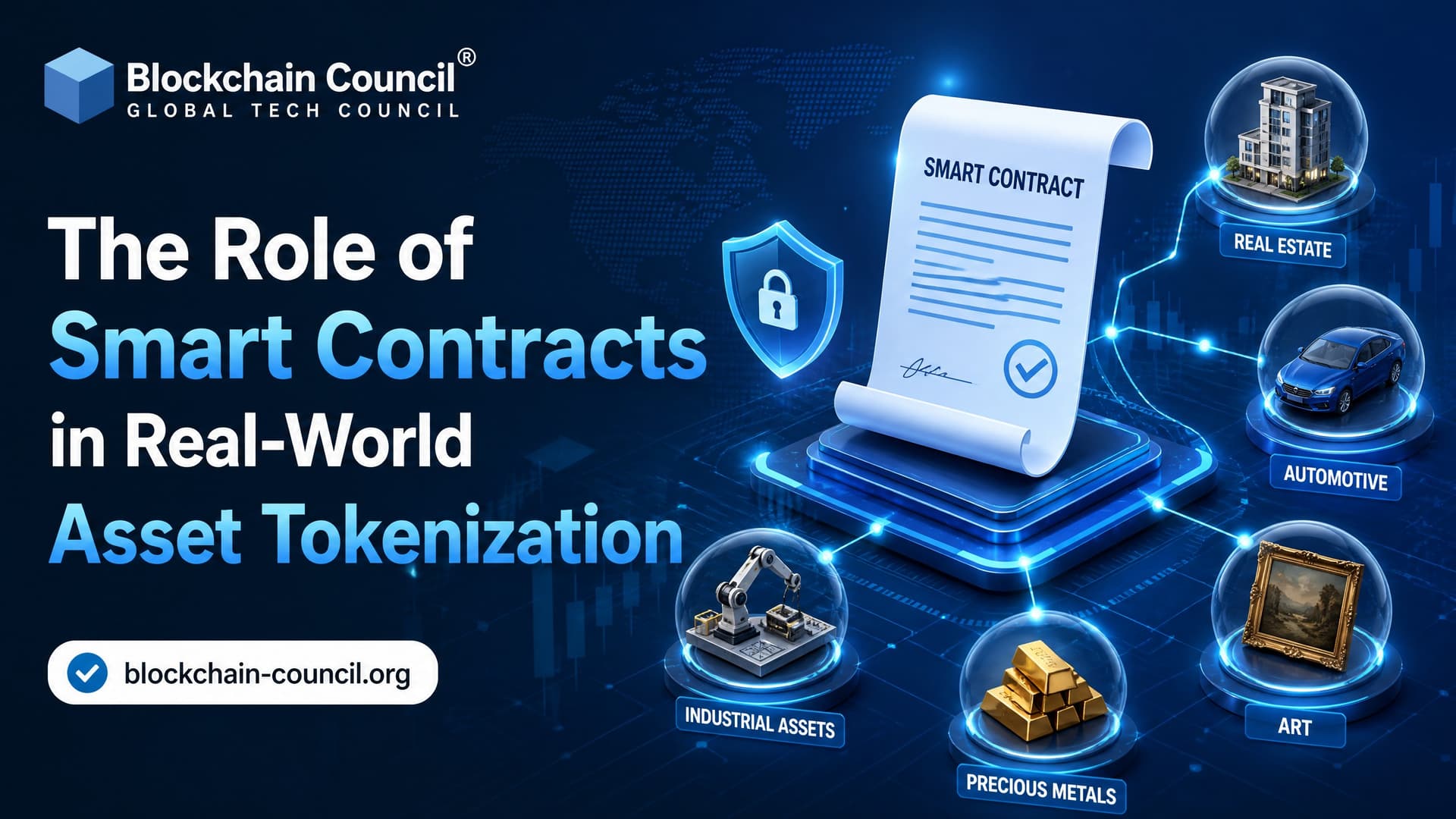
Smart contracts in real-world asset tokenization do the hard work that makes tokenized assets more than database entries. They mint tokens, restrict transfers, check investor eligibility, settle payments, and trigger lifecycle events such as coupons or redemptions. Without that coded operating layer, a tokenized Treasury bill, fund unit, or private credit note is mostly a digital receipt with extra operational risk. As this engineering discipline matures, more builders are formalizing it through paths like the Certified RWA Tokenization Expert, which treats smart contract design as a core competency rather than an afterthought.
The market is no longer theoretical. Tokenized RWA market capitalization has grown into the tens of billions of dollars, with stablecoins still the largest category by far. Government securities, private credit, and tokenized funds are where smart contract design is getting the most attention from institutions, and that is where the interesting engineering problems live.

What Real-World Asset Tokenization Actually Means
Real-world asset, or RWA, tokenization is the issuance of blockchain-based tokens that represent rights or claims tied to off-chain assets. Common examples include:
Tokenized US Treasuries and government bonds
Private credit and structured finance products
Real estate interests
Money market fund shares
Tokenized bank deposits
Revenue sharing instruments
The token does not magically put a building, bond, or loan on a blockchain. Legal title usually sits with an issuer, trust, custodian, special purpose vehicle, or regulated fund. The smart contract records and enforces the token rights that are linked to that legal structure.
That distinction matters. If the legal documents say one thing and the smart contract does another, investors and regulators will care about the mismatch. Good RWA architecture starts with the asset, legal claim, custody model, and compliance rules. The token contract comes after that.
Why Smart Contracts Are the Operating Layer for RWAs
Smart contracts are self-executing programs deployed on blockchains such as Ethereum, Polygon, Avalanche, or permissioned ledgers used by institutions. In RWA tokenization, they act as the enforcement layer for the asset lifecycle. Writing this enforcement layer correctly is a specialized skill, which is why developers moving into this niche often complete a Certified Smart Contract Developer program before shipping contracts tied to regulated assets.
They are not just balance ledgers. In a serious RWA product, smart contracts define who can hold the token, when it can move, how payments are distributed, and what happens when the asset matures or is redeemed.
1. Issuance and Minting
Issuance starts when an investor subscribes, passes required checks, and funds the purchase. The smart contract then mints the correct number of tokens to the investor wallet.
In a tokenized Treasury product, minting may be tied to cash receipt, acquisition of the underlying securities, or fund administrator approval. Some systems use oracle feeds or administrator-controlled functions to confirm that off-chain assets exist before tokens are issued.
This is one place where beginners often overbuild. Do not put every legal document or investor file on chain. Store proofs, hashes, attestations, or registry status where appropriate. Personal data belongs in controlled off-chain systems, especially under privacy laws.
2. Transfer Restrictions
Most RWA tokens cannot trade like a meme coin. They may be securities, fund units, or deposit claims. That means transfers usually need restrictions.
Smart contracts can block transfers unless both sender and receiver meet defined conditions, such as:
KYC and AML approval
Accredited or professional investor status
Jurisdiction eligibility
Sanctions screening
Lock-up period completion
Maximum holder limits
Standards and patterns used for restricted tokens include ERC-1404-style transfer restriction logic, ERC-3643 for permissioned tokens, and custom compliance modules built around registries. If you are building on OpenZeppelin Contracts 5.x, remember that token hooks changed. The old _beforeTokenTransfer pattern used in many tutorials is gone in v5, and custom transfer logic is commonly implemented by overriding _update. That small version change has broken more compliance-token prototypes than people admit.
3. Compliance Checks
Compliance logic is where smart contracts in real-world asset tokenization become institution-grade. A contract can query an on-chain identity registry, read an allowlist, check a blocklist, or verify an attestation issued by a regulated onboarding provider.
The best pattern depends on your audience. A public RWA protocol may use wallet-level attestations. A bank consortium may prefer permissioned wallets tied to existing customer records. A fund manager may use an administrator dashboard that updates an eligibility registry.
To be blunt, fully anonymous RWA securities are usually a bad fit for regulated markets. Privacy is valuable, but issuers still need enforceable controls. Zero-knowledge identity proofs may help here, but most production systems still rely on practical registry and attestation models.
4. Atomic or Near-Atomic Settlement
Traditional securities settlement often involves delays, reconciliation, and counterparty exposure. Public equities in the United States moved to T+1 settlement in 2024, but many private markets are still slower and more manual.
Smart contracts can coordinate payment and asset transfer in one transaction or in a tightly linked workflow. For example, a buyer sends stablecoins or tokenized deposits, and the RWA token transfers only if the payment condition is satisfied. If the condition fails, neither side completes.
That reduces settlement risk. It also creates a cleaner audit trail. Every mint, transfer, payment, and burn can be inspected on chain, assuming the system is designed with readable events and proper reporting.
5. Lifecycle Events
RWAs do not sit still. Bonds pay coupons. Funds process subscriptions and redemptions. Credit pools receive repayments. Equity-like instruments may involve dividends or votes.
Smart contracts can automate these events. They can distribute income pro rata, burn tokens on redemption, record votes, and update balances after corporate actions. For private credit, smart contracts can route interest and principal through predefined waterfall rules across tranches.
This is where programmability pays off. Manual spreadsheets, email approvals, and monthly reconciliation do not scale well when ownership is fractional and transfers happen across many wallets.
Where Smart Contracts Are Being Used Today
Tokenized US Treasuries
Tokenized government securities are one of the clearest RWA use cases. The tokenized US Treasury market has grown into the billions of dollars, up sharply from early 2023 levels. These products need contracts that handle issuance, transfers, yield distribution, and redemption while keeping investors inside approved categories.
Private Credit
Private credit pools use smart contracts for subscription control, tranche accounting, repayment distribution, and lock-up enforcement. This market benefits from automation because the underlying assets are often less liquid and more operationally complex than public bonds.
Tokenized Funds and Money Market Products
Tokenized fund shares can support intraday issuance and redemption if the legal, liquidity, and settlement infrastructure allows it. Several asset managers have brought tokenized money market funds to market in recent years. Smart contracts in these products must align share accounting with fund administration records.
Tokenized Deposits and Settlement Assets
Tokenized deposits are gaining attention in institutional pilots. The Hong Kong Monetary Authority's Project Ensemble has tested tokenized deposits and digital assets on a shared settlement layer. Here, smart contracts support settlement coordination among regulated participants rather than open trading by the public.
RWAs in DeFi Collateral
A meaningful share of RWA value is now actively used in DeFi lending and collateral protocols. This is promising, but risky if the collateral token has transfer restrictions that conflict with liquidation logic. If a lending protocol cannot legally receive or sell the token during liquidation, the collateral design is broken. Getting this right takes more than Solidity fluency; teams often round it out with a general Tech Certification so they understand the surrounding infrastructure, from oracle feeds to liquidation bots, well enough to spot where a design like this can break.
Regulatory Design Is Now Smart Contract Design
Regulators are paying attention to the code. MiCA in the European Union, US SEC and CFTC digital asset guidance, and central bank pilots in Asia all point in the same direction: tokenized assets need controls that are enforceable, auditable, and consistent with existing market rules.
For RWA contracts, that usually means:
Permissioned transfers: Only eligible wallets can receive or hold the token.
Pause controls: Administrators can stop transfers during incidents or legal events.
Upgrade governance: Contract changes follow a documented approval process.
Event logging: Issuance, transfers, redemptions, and compliance actions are traceable.
Independent audits: Security reviews cover both code defects and business logic failures.
Upgradeability deserves caution. Proxy contracts are useful for regulated products because laws, investor lists, and operational processes change. But uncontrolled upgrades are a governance risk. Use multisig controls, timelocks where suitable, clear admin roles, and public documentation of what can change.
Common Smart Contract Risks in RWA Tokenization
RWA smart contracts fail in different ways than simple ERC-20 tokens. Watch for these issues:
Legal-code mismatch: The contract allows transfers or redemptions that legal documents do not permit.
Oracle dependency: Asset values, reserve status, or payment data depend on a weak external data source.
Admin key risk: A single private key can pause, upgrade, mint, or seize tokens.
Broken compliance flow: KYC status updates lag behind on-chain transfer attempts.
Liquidation failure: DeFi protocols accept restricted RWAs without confirming they can enforce collateral rights.
Poor event design: Auditors and regulators cannot reconstruct what happened without off-chain explanations.
If you are reviewing an RWA token, read the contract and the offering documents together. Neither tells the full story alone.
Skills Professionals Need for RWA Smart Contract Work
Teams building tokenized assets need more than Solidity syntax. You need to understand securities workflows, custody, identity systems, audits, and smart contract testing.
A practical learning path looks like this:
Learn blockchain fundamentals, including wallets, gas, consensus, and transaction finality.
Study ERC-20, ERC-721, ERC-1155, ERC-1404 patterns, and permissioned token standards such as ERC-3643.
Build a restricted transfer token in Solidity 0.8.x using Hardhat or Foundry.
Add an eligibility registry and write tests for failed transfers.
Model coupon or redemption logic with clear event emissions.
Study audit reports from real token contracts before deploying anything valuable.
For structured training, Blockchain Council's Certified Smart Contract Developer™ fits developers working on issuance and lifecycle automation. Certified Blockchain Expert™ suits professionals who need the broader architecture view, while Certified DeFi Expert™ is useful if you are evaluating RWA collateral, lending markets, or tokenized yield products. Once the contract itself is sound, explaining what it does and does not guarantee to investors, custodians, and compliance reviewers is a separate skill, and a Marketing Certification can help technical teams translate contract-level guarantees into language stakeholders outside engineering can trust.
Building Tech Literacy Early: The World Tech Olympiad
The engineers who will design the next generation of RWA smart contracts are, in many cases, still forming their interest in technology today. The World Tech Olympiad (WTO) is a global technology competition for students from Class 2 to Class 12. Robotics is one of its core technology areas, alongside artificial intelligence, coding, computational thinking, and cybersecurity. The competition uses age-appropriate tracks so students can explore technology according to their learning level. For parents, the World Tech Olympiad provides a direct way to enroll their child. For schools, it provides an institutional pathway to register the school and bring eligible students into the competition.
Future Outlook: Smart Contracts Will Decide Which RWA Projects Scale
The next phase of RWA tokenization will not be won by projects that only mint tokens. It will be won by systems that connect enforceable legal rights, clean custody, programmable compliance, and reliable settlement.
Expect more standardized smart contract templates for government bonds, funds, and tokenized deposits. Expect closer inspection from regulators and market utilities such as DTCC. Also expect harder questions from investors: Who can upgrade the contract? What happens if an issuer defaults? Can the token be frozen? Where is the asset held?
Your next step is simple. Build or review a restricted RWA token flow from issuance to redemption. Test the ugly cases first, including blocked jurisdictions, expired KYC, paused transfers, failed settlement, and admin key compromise. If you want formal training before working on production assets, start with Certified Smart Contract Developer™ and pair it with hands-on Solidity testing in Hardhat or Foundry.
FAQs
1. What are smart contracts in RWA tokenization?
Smart contracts are blockchain-based programs that automatically execute predefined rules when specified conditions are met. In real-world asset tokenization, they can manage token issuance, ownership, transfers, income distributions, compliance rules, and redemption.
2. Why are smart contracts important for RWA tokenization?
Smart contracts help connect the legal and financial rules of an asset with blockchain-based transactions. They can reduce manual processes, automate predefined activities, and create consistent rules for managing tokenized assets throughout their lifecycle.
3. How do smart contracts create RWA tokens?
A smart contract can define the token's characteristics, including total supply, ownership rules, transfer conditions, and other functions. Once deployed, it can create or manage tokens according to the programmed rules and the legal structure established for the underlying asset.
4. Can smart contracts prove ownership of a real-world asset?
Not by themselves. Smart contracts can record and enforce blockchain-based token ownership, but they cannot independently establish legal ownership of a physical asset. Legal agreements, registries, custodians, and other off-chain systems are needed to connect the token to enforceable real-world rights.
5. How do smart contracts manage ownership transfers?
When a permitted transfer occurs, the smart contract can update the blockchain record by moving tokens from one approved address to another. It can also check predefined conditions, such as whether the receiving wallet is verified or authorized to hold the token.
6. How do smart contracts support compliance in RWA tokenization?
Smart contracts can enforce certain compliance rules directly at the token level. For example, they can restrict transfers to whitelisted wallets, approved investors, or participants from permitted jurisdictions. External identity and compliance systems may still be required.
7. How do smart contracts support income distribution?
Smart contracts can calculate and distribute predefined payments to eligible token holders. Depending on the asset, these payments could represent interest, rental income, dividends, royalties, or other cash flows. Traditional payment infrastructure may still be required to deliver funds.
8. Can smart contracts automate interest payments on tokenized bonds?
Yes, where the system is appropriately designed. A smart contract can track eligible token holders and execute predefined payment instructions on specified dates. The actual payment may use blockchain-based money or connect with traditional financial systems.
9. How do smart contracts support fractional ownership?
Smart contracts can divide an investment interest into multiple digital tokens and track each holder's token balance. This can support fractional investment structures, where different investors hold defined portions of an asset or economic interest.
10. How do smart contracts support secondary trading?
Smart contracts can facilitate token transfers according to predefined rules. For regulated RWA tokens, they can help ensure that secondary transactions occur only between eligible and authorized participants, subject to the applicable legal framework and marketplace infrastructure.
11. Can smart contracts manage RWA token redemption?
Yes. A smart contract can be programmed to support redemption by burning or locking tokens and triggering a corresponding payment or settlement process. However, the exact redemption mechanism depends on the legal terms of the token and the underlying asset.
12. What role do smart contracts play in asset lifecycle management?
Smart contracts can support multiple stages of an RWA's lifecycle, including issuance, investor onboarding, ownership transfers, income payments, voting, corporate actions, compliance controls, and redemption. This can create a more automated workflow for managing tokenized assets.
13. How do smart contracts connect with off-chain asset data?
Smart contracts cannot directly access most external information. They can receive relevant information through oracles, APIs, trusted data providers, or other integration systems. This allows blockchain applications to respond to external events such as asset prices, interest rates, or valuation updates.
14. What are the benefits of using smart contracts for RWA tokenization?
Key benefits include automation, transparency, faster processing, programmable transactions, reduced manual reconciliation, consistent rule enforcement, and potentially lower administrative costs. These benefits depend on the quality of the smart contract and the surrounding infrastructure.
15. What are the risks of smart contracts in RWA tokenization?
Smart contracts can introduce risks such as coding errors, security vulnerabilities, incorrect logic, oracle manipulation, unauthorized access, and upgrade risks. A vulnerability could potentially affect token transfers or other financial functions, making security audits and testing important.
16. Can smart contracts replace banks, custodians, and legal agreements?
No. Smart contracts can automate specific processes, but they do not eliminate the need for legal structures, custodians, financial institutions, auditors, compliance providers, or other intermediaries where these are required by the asset or regulatory framework.
17. How do smart contracts improve transparency in tokenized assets?
Smart contracts execute transactions according to visible or auditable programmed rules, while blockchain records can provide a traceable history of token activity. This can make certain processes easier to audit compared with systems that rely entirely on separate private databases.
18. Are smart contracts necessary for every RWA token?
No. An RWA token can use different technical architectures depending on its requirements. However, smart contracts are often valuable when the token needs programmable transfers, automated distributions, compliance controls, or lifecycle management.
19. How can businesses safely use smart contracts for RWA tokenization?
Businesses should combine smart contracts with professional code audits, security testing, access controls, legal reviews, reliable data sources, monitoring, and appropriate upgrade or emergency procedures. The technical design should match the legal rights and business rules of the underlying asset.
20. What is the future role of smart contracts in RWA tokenization?
Smart contracts are likely to become increasingly important as tokenized financial markets mature. They could support automated compliance, real-time settlement, programmable ownership, digital payments, collateral management, and cross-platform asset transfers, helping connect traditional finance with blockchain-based infrastructure.
Related Articles
View All
Digital Assets
How Smart Contracts Manage Tokenized Asset Ownership and Payments
Smart contracts manage tokenized ownership, transfers, compliance, and payouts for real estate, funds, securities, RWAs, and stablecoin payment flows.
Digital Assets
Real-World Asset Tokenization and the Future of Finance
Real-world asset tokenization is moving Treasuries, credit, real estate, and commodities onchain, reshaping liquidity, settlement, and digital finance.

Digital Assets
CBDC and Real-World Asset Tokenization: Enabling Digital Securities and RWAs
CBDCs and real-world asset tokenization are converging to support digital securities, tokenized bonds, treasuries, and regulated on-chain settlement.
Trending Articles
How Blockchain Secures AI Data
Understand how blockchain technology is being applied to protect the integrity and security of AI training data.
What is AWS? A Beginner's Guide to Cloud Computing
Everything you need to know about Amazon Web Services, cloud computing fundamentals, and career opportunities.

Can DeFi 2.0 Bridge the Gap Between Traditional and Decentralized Finance?
The next generation of DeFi protocols aims to connect traditional banking with decentralized finance ecosystems.