

How Institutions Use RWA Tokenization to Modernize Capital Markets
 Suyash Raizada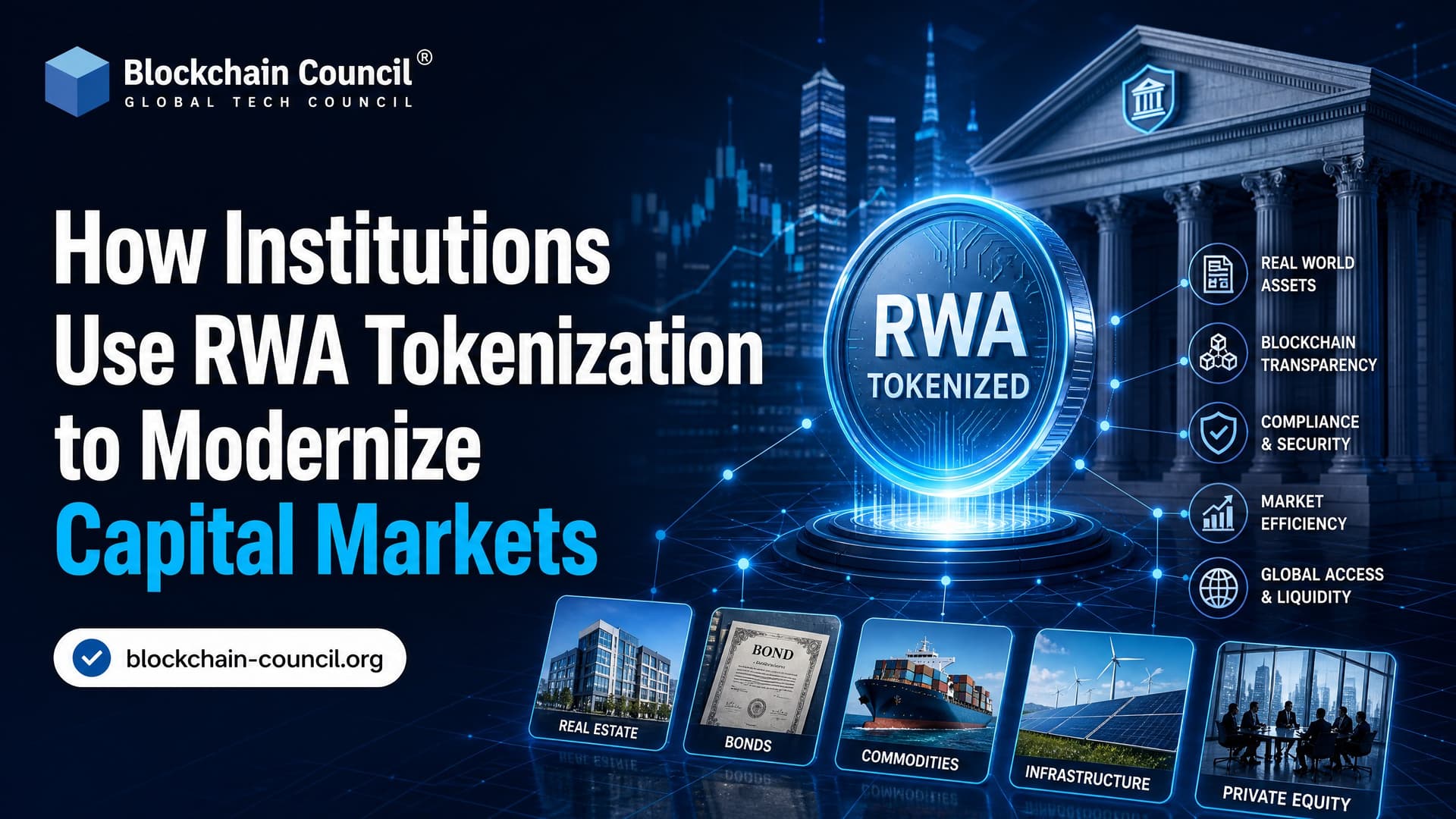
RWA tokenization has moved from pitch decks into real capital markets work: issuing bonds, recording fund shares, settling collateral, and distributing private assets through blockchain rails. The asset is still a bond, a fund interest, a receivable, a property claim, or commodity exposure. What changes is the record keeping, transfer, and settlement layer underneath it. Professionals looking to build specialized knowledge in this evolving field can explore the Certified RWA Tokenization Expert program to develop a stronger understanding of RWA structures and their practical applications.
For banks, asset managers, exchanges, and fintech teams, that distinction matters. Tokenization is not a shortcut around securities law. It is a way to make regulated instruments easier to issue, transfer, reconcile, and program.

What RWA Tokenization Means in Capital Markets
Real world asset tokenization converts claims on off-chain assets into blockchain-based tokens. The legal rights usually sit in existing contracts, fund documents, trust arrangements, securities registers, or property law. The token acts as the digital representation and the transaction layer.
IOSCO has repeatedly framed tokenized financial assets through the principle of "same activity, same risk, same regulation." In plain terms, a tokenized security is still a security if it gives the holder substantially similar rights. The U.S. SEC has taken the same position in recent staff statements: putting ownership records on a blockchain does not remove registration, disclosure, custody, or transfer obligations.
This is where many early projects got the design wrong. An ERC-20 token alone is not enough for a regulated security. ERC-20 has no built-in investor eligibility checks, no native transfer restrictions, and no concept of a transfer agent. In real deployments, teams add permissioning through allowlists, ERC-1400 style controls, or ERC-3643 identity checks. Skip that layer and a compliant holder can transfer to an ineligible wallet with one ordinary token transfer. That is not a small bug. It is a compliance failure.
Why Institutions Are Adopting RWA Tokenization Now
The current adoption pattern is practical. Institutions are not tokenizing every asset class at once. They are starting where the benefits are easiest to measure: short-duration government debt, money market funds, private credit, bond issuance, and fund administration. Professionals who want to understand these developments within the broader digital asset ecosystem can also explore the Certified Digital Assets Expert program as part of their learning path.
Research platforms such as RWA.xyz, Dune, Chainalysis, and Binance Research show fast growth since 2023, though their totals differ because they count asset classes differently. Tokenized RWAs excluding stablecoins reached roughly 15.2 billion dollars by December 2024. By mid-2025, several market trackers placed the figure near 24 billion dollars, around 85 percent year-over-year growth. Chainalysis later estimated that RWA assets under management were approaching 30 billion dollars in early 2026.
The numbers are still small next to global bond and fund markets. But the direction is clear. Tokenization has crossed from lab work into production infrastructure in selected markets.
Where Institutions Use RWA Tokenization Today
Tokenized Treasuries and Money Market Funds
Tokenized U.S. Treasuries and money market funds are the strongest institutional use case so far. They give on-chain investors a regulated, yield-bearing cash alternative, and they give institutions a faster way to manage collateral and liquidity.
BlackRock's USD Institutional Digital Liquidity Fund, known as BUIDL, reportedly reached about 1.8 billion dollars in assets under management by the end of 2024. Ondo Finance's USDY passed roughly 500 million dollars around the same period. Hashnote's USYC tokenized Treasury product was reported at about 1.64 billion dollars in early 2025.
Franklin Templeton's Franklin OnChain U.S. Government Money Fund, FOBXX, is another important example. It was the first U.S. registered mutual fund to record share ownership on a public blockchain, first using Stellar and later Polygon.
Why does this segment work? The assets are simple, short-dated, and familiar to risk teams. Settlement speed and collateral mobility matter here. And the legal structure is clearer than it is for many real estate or private credit tokens.
Corporate, Green, and Municipal Bonds
Bond issuance is a natural fit for distributed ledger technology because bonds have predictable lifecycle events: issuance, coupon payments, transfers, corporate actions, and redemption.
Recent examples show the pattern. The Government of the Hong Kong Special Administrative Region issued 6 billion Hong Kong dollars of green bonds through HSBC's Orion platform. Siemens issued a 300 million euro digital bond on the SWIAT platform. The City of Lugano issued 100 million Swiss francs on R3 Corda. The City of Quincy in Massachusetts issued 10 million dollars in municipal bonds on JPMorgan's Onyx network.
These are not DeFi experiments. They use regulated intermediaries and established legal documentation, with blockchain applied to settlement and post-trade processing.
Tokenized Funds and Private Markets
Private markets have a distribution problem. Minimums are high, transfers are slow, and administration is document heavy. Tokenization helps by creating digital fund interests with automated records, eligibility controls, and fractional units.
Hamilton Lane partnered with Securitize to tokenize portions of its Global Private Assets Fund, aiming to reduce minimum investment sizes and simplify administration. In Asia, ChinaAMC launched a tokenized RMB money market fund, showing how fund tokenization is being tested inside regulated supervisory frameworks.
This does not make private assets instantly liquid. To be blunt, many tokenized private funds still trade rarely. But it can make subscription, ownership tracking, and secondary transfer approvals far less painful.
Tokenized Deposits and Trade Finance
Banks are also testing tokenized deposits, especially for cross-border payments and trade finance. Citi piloted Citi Token Services in 2023, using tokenized bank deposits and smart contracts for 24/7 payments and trade finance workflows on its own network.
The value here is workflow automation. A payment can be tied to a delivery event. Reconciliation can happen automatically. Treasury teams care about that because trade finance is full of delays, manual checks, and cut-off times.
Real Estate and Infrastructure Assets
Real estate was one of the earliest RWA categories. Elevated Returns tokenized equity in the St. Regis Aspen Resort in 2018, issuing about 18 million digital security tokens representing ownership interests in the property. More recent projects include tokenized residential and commercial real estate platforms, along with reported tokenization of large property portfolios in the Middle East.
Asia is active too. Research has covered tokenization of a commercial tower in Hong Kong's Causeway Bay, EV charging revenue rights from Longshine Group, and new energy assets explored under Hong Kong Monetary Authority initiatives.
Real estate tokenization is attractive because the assets are high value and illiquid. The hard part is secondary liquidity. A token does not create buyers by itself.
How RWA Tokenization Modernizes Market Infrastructure
Faster Settlement and Fewer Reconciliations
Traditional capital markets depend on multiple ledgers: issuer records, custodian books, transfer agents, clearing systems, broker records, and investor statements. Every mismatch creates operational cost.
Tokenized instruments can cut this by making the blockchain record a shared transaction layer. Delivery versus payment can happen close to real time. Coupon payments, redemptions, transfer restrictions, and investor reporting can be automated through smart contracts or platform workflows.
Fractional Ownership with Compliance Controls
Fractionalization is often oversold, but it is useful when paired with investor checks. Smaller units can widen access to funds, bonds, and property interests, while smart contracts enforce restrictions based on jurisdiction, accreditation, holding periods, and transfer limits.
For developers, the lesson is simple: do not design regulated RWA tokens like meme coins. Use permissioned transfer logic. Test blocked transfers. Write your custody, recovery, and issuer intervention procedures before launch, not after the first failed settlement.
Programmable Collateral and DeFi Integration
Tokenized Treasuries such as BUIDL, USDY, and USYC are becoming collateral in on-chain lending, structured products, and treasury management tools. This builds a bridge between institutional cash management and DeFi liquidity.
The trade-off is governance risk. Once assets sit inside smart contract systems, institutions must evaluate oracle design, liquidation logic, wallet controls, chain risk, and protocol upgrade rights. A high quality Treasury token can still be used badly in a poorly designed lending pool.
Cross-Border Distribution
Tokenized assets can move across networks and jurisdictions more easily than paper-based instruments, provided compliance rules travel with the asset. Singapore's MAS Project Guardian is a good example. It has brought banks such as JPMorgan, DBS, and Standard Chartered into supervised pilots for tokenized bonds, FX, and fund products.
Multichain strategies are emerging as well. Issuers want distribution where liquidity exists, but they have to avoid fragmented records. Interoperability is now a board-level question, not just a developer preference.
Regulation Is Becoming Clearer, Not Looser
The regulatory trend is not deregulation. It is normalization.
IOSCO: Tokenized assets should be regulated according to the risks and economic rights they create.
Basel Committee: Tokenized traditional assets can fall into Group 1 cryptoassets if they meet backing, redemption, and risk management criteria. Unbacked or complex cryptoassets can face much harsher capital treatment, including a 1,250 percent risk weight.
SEC: Tokenized securities remain subject to U.S. federal securities laws. Blockchain records do not replace disclosure and registration duties.
Hong Kong, Singapore, and Europe: Regulators are allowing controlled tokenization pilots, especially for bonds, funds, deposits, and property-linked instruments.
This matters for institutional adoption. Banks and asset managers need capital treatment, custody rules, settlement finality, and insolvency analysis before they commit serious balance sheet capacity.
Risks Institutions Still Need to Solve
RWA tokenization is useful, but it is not magic infrastructure. The main constraints are still practical:
Liquidity: Many tokenized real estate and private credit assets have low transfer activity. Issuance size is not the same as market depth.
Fragmentation: Assets issued on separate platforms may not trade across venues without wrappers, bridges, or bilateral integrations.
Legal complexity: Token records must align with securities law, property rights, fund documents, and insolvency treatment.
Custody risk: Key management, wallet recovery, omnibus accounts, and beneficial ownership records need institutional-grade controls.
Technology risk: Smart contract bugs, oracle failures, bridge attacks, and platform governance changes can affect otherwise high quality assets.
The best near-term use cases are not the flashiest. Tokenized Treasuries, money market funds, and plain vanilla bonds have the clearest value because they pair legal familiarity with operational pain points that blockchain can reduce.
What Professionals Should Learn Next
If you work in capital markets, compliance, treasury, or blockchain development, focus on the intersection of finance law, token standards, custody, and settlement design. RWA tokenization rewards teams that understand both sides of the stack.
As a learning path, Blockchain Council's Certified Blockchain Expert™ is a strong starting point for business and strategy teams. Developers building tokenized asset systems should look at Certified Blockchain Developer™. If your role touches wallets, DeFi integrations, or digital asset distribution, Certified Web3 Expert™ is also relevant. Professionals seeking to broaden their technical capabilities across emerging technologies can also explore a Tech Certification aligned with their career interests.
Technology Skills & Education
Schools and parents are increasingly looking for ways to introduce children to technology in a structured and meaningful way. The Tech Olympiad provides an opportunity for students to explore AI, coding, robotics, cybersecurity, and computational thinking while building confidence and problem-solving skills.
Then build a small proof of concept: a permissioned token representing a bond-like cash flow, with allowlisted transfers, coupon distribution, and redemption. Test the uncomfortable cases too: rejected transfers, lost keys, investor removal, paused markets, and chain migration. That is where real RWA tokenization design begins.
For professionals working on the commercial side of emerging technology products, developing complementary market-facing skills can also be valuable. A Marketing Certification can help broaden expertise beyond the technical and operational aspects of RWA tokenization.
FAQs
1. What is RWA tokenization in capital markets?
RWA tokenization is the process of representing real-world financial or physical assets as blockchain-based digital tokens. In capital markets, institutions can use tokenization for assets such as bonds, funds, private credit, equities, commodities, and real estate interests.
2. Why are institutions adopting RWA tokenization?
Institutions are exploring tokenization to improve settlement efficiency, transparency, liquidity, automation, and asset administration. It can also connect traditional financial products with programmable blockchain infrastructure.
3. How can banks use RWA tokenization?
Banks can use tokenization for digital securities issuance, collateral management, bond settlement, deposits, treasury operations, trade finance, and other financial-market activities. The exact use case depends on regulatory and technological requirements.
4. How do asset managers benefit from tokenization?
Asset managers can tokenize fund interests, bonds, private credit products, and other investment assets. This can support digital distribution, fractional access, automated servicing, and more efficient ownership and transaction records.
5. How does tokenization modernize securities issuance?
Traditional securities issuance often involves multiple intermediaries and administrative processes. Tokenization can create digital records of issuance, ownership, transfers, and corporate actions, potentially making issuance and administration more efficient.
6. Can tokenization make capital markets more efficient?
Yes, potentially. Blockchain-based infrastructure can automate certain processes and reduce manual reconciliation, paperwork, duplicated records, and settlement delays. However, benefits depend on integration with existing financial systems.
7. How does RWA tokenization improve settlement?
Tokenized assets can be transferred through blockchain networks, allowing ownership records to update digitally. When combined with suitable digital payment infrastructure, this can support faster and more synchronized delivery-versus-payment settlement.
8. How can institutions use tokenized assets as collateral?
Banks and financial institutions can potentially use eligible tokenized securities or other assets as collateral. Blockchain can help track ownership, pledges, transfers, valuations, and collateral release, while legal agreements establish enforceable rights.
9. Does RWA tokenization increase capital-market liquidity?
Tokenization can potentially make certain assets easier to distribute and transfer, particularly through fractional ownership. However, tokenization does not automatically create liquidity. Active markets still require buyers, sellers, regulatory access, and reliable pricing.
10. What capital-market assets can institutions tokenize?
Potential assets include government and corporate bonds, private equity interests, investment funds, private credit, real estate, commodities, infrastructure projects, and other financial instruments.
11. How do smart contracts support institutional tokenization?
Smart contracts can automate issuance, transfer restrictions, coupon payments, dividends, investor eligibility, collateral rules, and redemptions. This can reduce manual intervention and improve process consistency.
12. How does tokenization improve transparency?
Blockchain can create a shared and traceable record of token ownership and transactions. Authorized participants can use these records to improve reconciliation, auditing, and visibility across parts of the asset lifecycle.
13. How can RWA tokenization reduce operational costs?
Tokenization can automate activities such as recordkeeping, settlement, reconciliation, payment processing, and certain corporate actions. This may reduce administrative workloads and the costs associated with maintaining multiple disconnected systems.
14. What role do stablecoins and CBDCs play in institutional tokenization?
Stablecoins and CBDCs can potentially provide digital settlement mechanisms for tokenized assets. They could support asset purchases, delivery-versus-payment, interest payments, and other financial transactions, depending on their regulatory and technical frameworks.
15. How does tokenization support private markets?
Tokenization can represent interests in private equity, private credit, real estate, and other traditionally less-liquid assets. Fractional structures and digital transfer mechanisms may broaden access for eligible investors while maintaining appropriate restrictions.
16. What compliance challenges do institutions face?
Institutions must consider securities regulations, KYC/AML requirements, investor eligibility, custody, taxation, data privacy, transfer restrictions, disclosure obligations, and cross-border regulations.
17. What are the security risks of institutional RWA tokenization?
Key risks include smart-contract vulnerabilities, cyberattacks, private-key compromise, operational failures, oracle risks, custody issues, and weaknesses in systems connecting blockchain records with underlying assets.
18. Does tokenization eliminate traditional financial intermediaries?
Not necessarily. Institutions may still require custodians, trustees, legal entities, auditors, brokers, asset servicers, and compliance providers. Tokenization primarily changes how certain assets and processes are represented and managed digitally.
19. What is the future of tokenized capital markets?
Capital markets could increasingly combine traditional financial institutions with blockchain-based issuance, settlement, custody, payments, and asset management. Interoperability between tokenized markets and existing financial infrastructure will be especially important.
20. How will RWA tokenization transform institutional capital markets?
RWA tokenization could create capital markets that are more digital, programmable, transparent, and efficient, with faster settlement and greater automation. Its long-term impact will depend on regulatory clarity, institutional adoption, secure infrastructure, market liquidity, interoperability, and legally enforceable digital ownership.
Related Articles
View All
Digital Assets
Best RWA Tokenization Platforms: Features, Use Cases, and Selection Criteria
Compare the best RWA tokenization platforms, including Securitize, Ondo Finance, Franklin Templeton, Centrifuge, Maple, Paxos, Tether, and Tokeny.
Digital Assets
RWA Tokenization Regulations Across Major Markets
RWA tokenization regulations usually follow the underlying asset, not the token wrapper. Learn how the US, EU, UK, Hong Kong, Singapore, and UAE regulate tokenized assets.

Digital Assets
RWA Tokenization in Institutional Finance: Use Cases for Banks and Asset Managers
RWA tokenization is moving into production across tokenized funds, collateral networks, deposits, bonds, private credit, and trade finance.
Trending Articles
The Role of Blockchain in Ethical AI Development
How blockchain technology is being used to promote transparency and accountability in artificial intelligence systems.
AWS Career Roadmap
A step-by-step guide to building a successful career in Amazon Web Services cloud computing.
What is AWS? A Beginner's Guide to Cloud Computing
Everything you need to know about Amazon Web Services, cloud computing fundamentals, and career opportunities.