

How RWA Tokenization Works for Private Credit and Debt Markets
 Suyash Raizada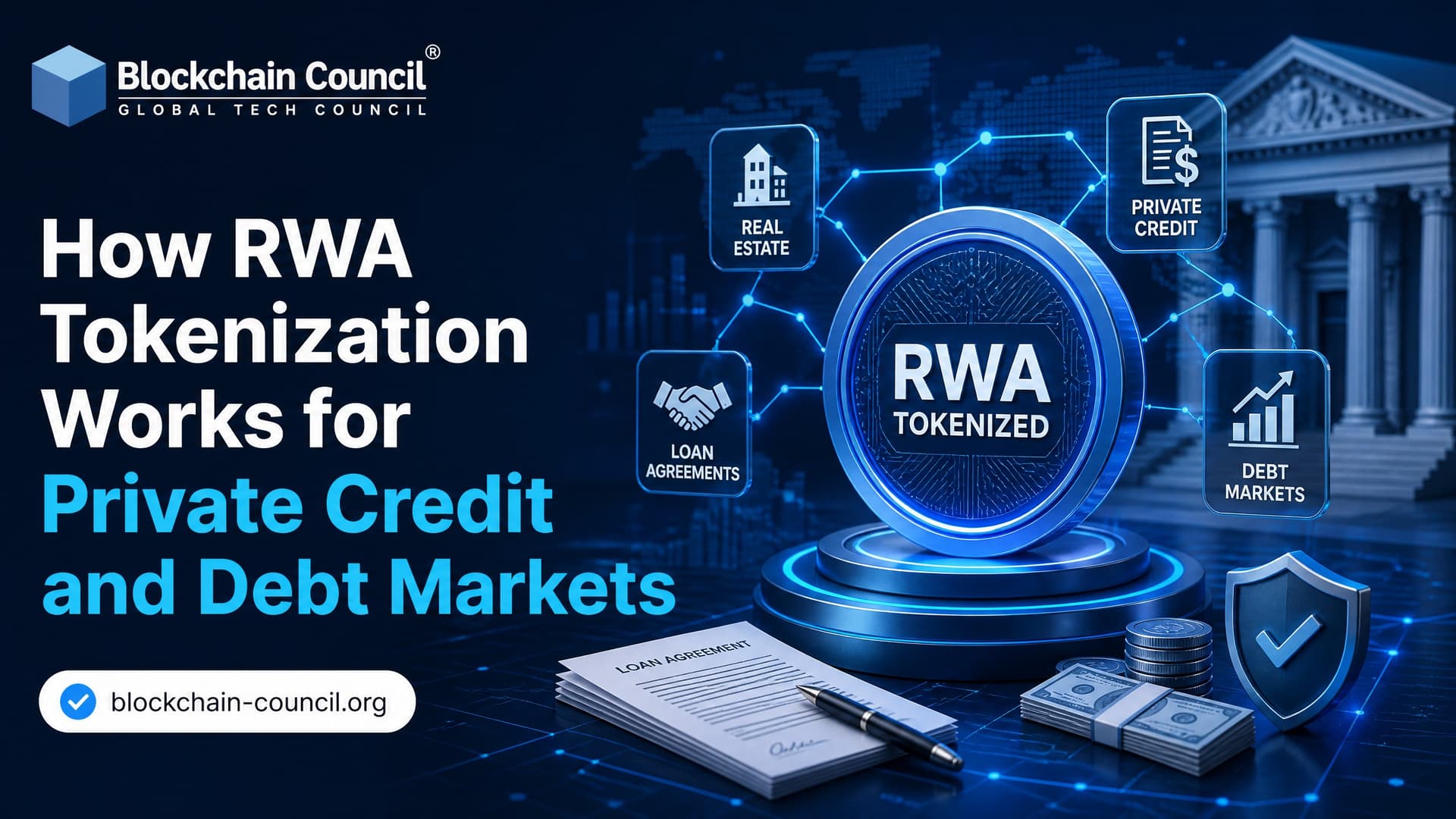
RWA tokenization turns private loans, receivables, notes, and debt fund interests into blockchain-based tokens that represent enforceable legal rights to cash flows. The token is not the loan itself. It is the digital record and transfer mechanism for a claim created in legal documents, usually through an issuer, fund, trustee, or special purpose vehicle. For professionals looking to build practical knowledge in this area, Certified RWA Tokenization Expert can provide a focused foundation in real-world asset tokenization.
That distinction matters. A smart contract can calculate interest, restrict transfers, and distribute stablecoin payments. It cannot make a borrower repay. The real strength of tokenized private credit is the combination of enforceable off-chain contracts with programmable on-chain administration.

What Tokenized Private Credit Actually Represents
Tokenized private credit is a digital representation of exposure to non-public debt. The underlying asset may be a corporate loan, an SME facility, an invoice receivable, a real-estate backed loan, a consumer credit pool, or a structured credit product.
Most structures fall into one of two buckets:
Direct loan exposure: Tokens represent participation in a specific loan or receivable.
Vehicle-based exposure: Tokens represent shares, units, notes, or beneficial interests in an SPV or fund that owns a portfolio of debt.
In regulated markets, these tokens are usually treated as securities. Tokenization changes the record-keeping system and the transfer method. It does not remove offering rules, investor eligibility checks, disclosure duties, or servicing obligations.
For professionals expanding their understanding of the broader digital asset ecosystem, Certified Digital Assets Expert can complement knowledge of tokenized assets, digital ownership structures, and blockchain-based financial products.
How RWA Tokenization Works in Private Debt
A typical private credit tokenization project moves through three practical stages: origination, tokenization, and servicing.
1. Origination of the Debt
The borrower and lender agree on normal credit terms. These cover principal, interest rate, maturity, collateral, covenants, payment dates, default events, and remedies. This part still looks like traditional finance.
The loan or pool is then placed into a legal structure. Common choices include:
Special purpose vehicles
Private credit funds
Structured note issuers
Securitization vehicles
Trust or custody arrangements
The issuer is the bridge between the loan documents and the blockchain token. If this legal bridge is weak, the token is just a database entry with fancy plumbing.
2. Token Creation
The issuer mints tokens that represent fractional interests in the credit exposure. Fungible interests may use ERC-20-style tokens. Permissioned securities often use compliance-aware standards such as ERC-3643, which supports identity checks and transfer restrictions.
Smart contracts can encode economic and administrative rules, including:
Interest accrual
Payment frequency
Investor allocation percentages
Waterfall rules for senior and junior tranches
Lockups and transfer restrictions
Whitelist requirements for eligible wallets
A practical warning for developers: stablecoin accounting is easy to get wrong. USDC uses 6 decimals, not the 18 decimals many ERC-20 examples assume. If you calculate a 10,000 USDC coupon as 10,000 multiplied by 10^18, your test distribution will be off by a factor of one trillion. Catch this before audit, not after deployment.
3. Investor Subscription and Servicing
Investors subscribe to the tokenized product after onboarding. For institutional offerings, that usually means KYC, AML screening, accreditation or qualified investor checks, wallet whitelisting, and signing subscription documents.
Capital may arrive in stablecoins such as USDC or USDT, then be converted into fiat for the borrower. Borrower repayments usually happen off-chain through banks, servicers, or trustees. Once funds reach the issuer, on-chain smart contracts distribute principal and interest to token holders.
This hybrid workflow is common. Fully on-chain credit exists, but most private debt still relies on off-chain underwriting, borrower relationships, collateral review, and legal enforcement.
Main Tokenization Models
Tokenized Existing Credit Funds
In this model, a conventional private credit fund stays in place, but its units are represented as tokens. Institutions like this approach because it preserves familiar fund governance and documentation while improving transferability, reporting, and investor administration.
This is often the better route for regulated asset managers. It is slower to launch, but cleaner for compliance teams.
Native or Hybrid On-chain Credit Protocols
Protocols such as Maple Finance and Centrifuge show a more on-chain operating model. Maple uses credit pools where delegates underwrite institutional borrowers. Centrifuge has supported pools backed by invoices, SME loans, and receivables, with structures that include senior and junior token classes.
Figure Technologies, through Provenance, has also shown how home equity lines of credit and consumer credit can be originated, pooled, and distributed using blockchain-based capital markets infrastructure.
To be blunt, not every private credit product needs DeFi composability. If the asset has complex legal enforcement, low reporting frequency, and a narrow investor base, a permissioned tokenized fund may be more sensible than a public protocol listing.
Market Size and Why Private Credit Leads RWA Tokenization
Private credit has become one of the largest real-world asset tokenization categories. Industry datasets in 2025 and 2026 place tokenized private credit in the tens of billions of dollars, depending on whether they count only active on-chain value or also represented assets and platform-locked exposures.
Several market reports estimate tokenized private credit around 14 billion dollars in 2025. By mid 2026, some analyses placed private credit near 18 billion dollars within an approximately 36 billion dollar tokenized RWA market. Wharton fintech research has described loans and private credit as the largest tokenized RWA segment when including Figure's HELOC activity.
The reason is simple. Private credit is large, fragmented, and illiquid. The broader private credit market sits above 3 trillion dollars. Even a small shift toward tokenized issuance could create a large on-chain asset class.
Benefits for Debt Markets
RWA tokenization is not magic. It does, however, solve several painful operational problems in private debt.
Fractional access: Large loan or fund exposures can be divided into smaller units.
Better transferability: Investors may be able to sell positions in approved secondary markets, subject to lockups and eligibility rules.
Automated servicing: Smart contracts can handle coupon allocation, fee deductions, and distribution records.
Clearer ownership records: Blockchain registries reduce reconciliation across issuers, agents, custodians, and investors.
Broader capital channels: Originators can reach stablecoin-native investors and, in some cases, DeFi liquidity pools.
Yields often sit above tokenized government bond products because the risk is higher. MetaMask's RWA market commentary has described tokenized private credit yields commonly in the 8 to 15 percent range, depending on borrower quality, collateral, structure, seniority, and liquidity terms.
As organizations evaluate these emerging technologies, professionals may also need broader technical knowledge covering blockchain infrastructure, artificial intelligence, cybersecurity, and other digital technologies. Tech Certification can be relevant for professionals strengthening their technical capabilities.
Risks You Should Not Ignore
The biggest mistake is treating tokenized private credit like a liquid crypto asset. It is credit first, token second.
Credit risk: Borrowers can default. Collateral may be hard to recover or worth less than expected.
Legal enforceability: Token-holder rights must match the legal documents in the relevant jurisdiction.
Valuation risk: Many private loans do not have live market prices. NAV often depends on issuer or oracle reporting.
Smart contract risk: Bugs in distribution, transfer restrictions, or tranche logic can create losses or disputes.
Platform risk: Investors depend on issuers, servicers, trustees, custodians, data providers, and protocol operators.
Regulatory risk: Securities treatment, transfer rules, and cross-border distribution can differ sharply by jurisdiction.
If you are assessing a tokenized credit deal, read the offering memorandum before the smart contract. Then read the smart contract. Both matter.
Compliance and Token Standards
Institutional tokenized debt markets need permissioning. That usually means wallets are approved before they can hold or receive tokens. ERC-3643 is one standard used for compliant tokenized securities because it supports identity registries and transfer controls.
Typical controls include:
KYC and AML checks before subscription
Accredited or professional investor verification
Wallet whitelisting
Transfer restrictions based on jurisdiction or investor type
Custody and trustee oversight
Ongoing reporting for NAV, defaults, collateral, and repayments
Public-chain transparency is useful, but private credit also needs controlled access. That trade-off is not a flaw. It is how securities markets work.
Technology Education and Future Digital Skills
The growth of blockchain-based finance is part of a broader technology landscape involving artificial intelligence, coding, robotics, computational thinking, and cybersecurity. Giving students age-appropriate opportunities to explore these areas can help them develop familiarity with technologies that increasingly influence digital businesses and financial infrastructure.
World Tech Olympiad for Students
The World Tech Olympiad (WTO) is a global technology competition for students from Class 2 to Class 12. Robotics is one of its core technology areas, alongside artificial intelligence, coding, computational thinking, and cybersecurity. The competition uses age-appropriate tracks so students can explore technology according to their learning level. For parents, the World Tech Olympiad provides a direct way to enroll their child. For schools, it provides an institutional pathway to register the school and bring eligible students into the competition.
This type of early technology exposure can help students build familiarity with concepts that professionals later apply in areas such as blockchain development, digital assets, financial technology, and cybersecurity.
Where Professionals Should Build Skills
If you work in asset management, fintech, credit operations, or blockchain engineering, focus on the intersection of law, debt structuring, and smart contracts. Developers should understand ERC-20, ERC-3643, wallet identity, oracle design, and secure payout logic. Finance professionals should understand SPVs, tranching, servicing, default waterfalls, and investor disclosures.
For structured learning, Blockchain Council's Certified Blockchain Expert™ is a useful starting point for RWA fundamentals. Developers building token contracts should consider the Certified Blockchain Developer™ and Certified Smart Contract Developer™. If your work touches lending protocols or on-chain liquidity, the Certified DeFi Expert™ is a relevant next step.
The Road Ahead for Tokenized Private Credit
RWA tokenization will not replace private credit law, underwriting, or servicing. It will change how ownership is recorded, how cash flows are distributed, how investors transfer positions, and how credit products connect to digital asset infrastructure.
The winning models will be boring in the right places: clear legal claims, audited contracts, reliable loan data, conservative valuation, and strict compliance controls. The flashy models with weak documents will not survive a default cycle.
Your next step: map one real debt instrument from origination to repayment. Identify the issuer, token standard, investor checks, cash movement, servicing process, and default path. If you can explain each link clearly, you are ready to evaluate or build in the tokenized private credit market.
For professionals working on the commercial side of emerging financial technologies, strong communication and market positioning matter alongside technical knowledge. Marketing Certification can complement that broader skill set.
FAQs
1. What is private credit tokenization?
Private credit tokenization is the process of representing private loans, credit investments, or debt interests as blockchain-based tokens. The tokens can represent defined rights to interest payments, principal repayment, or other economic interests in the underlying credit arrangement.
2. How does RWA tokenization work for private credit?
The process typically begins with loan origination, borrower due diligence, legal structuring, and credit assessment. The relevant loan or credit interest is then represented through tokens, allowing eligible investors to acquire and potentially transfer their interests through approved blockchain infrastructure.
3. What types of private debt can be tokenized?
Potential examples include corporate loans, private credit funds, asset-backed loans, real estate debt, trade finance, structured credit, and other private lending arrangements. The appropriate structure depends on the asset, jurisdiction, and regulatory requirements.
4. What does a tokenized private credit asset represent?
A token can represent a direct loan interest, participation interest, fund interest, beneficial interest, or another contractual claim. The legal documentation should clearly define what rights investors receive and how those rights relate to the underlying debt.
5. How do investors earn returns from tokenized private credit?
Investors can potentially receive interest payments, principal repayments, fees, or other distributions associated with the underlying credit investment. Returns depend on the loan terms, borrower performance, and legal structure.
6. How are interest payments distributed to token holders?
Interest can be calculated according to the underlying loan agreement and distributed based on each investor's eligible token holdings. Smart contracts and connected payment systems can potentially automate payment calculations and distribution instructions.
7. How does tokenization improve private credit markets?
Tokenization can potentially improve transferability, settlement speed, recordkeeping, investor access, reporting, and payment automation. It can also create digital infrastructure for managing credit interests throughout their lifecycle.
8. Can tokenized private credit be traded on secondary markets?
Potentially, if the applicable laws, token structure, and marketplace rules permit transfers. A compliant secondary market could give eligible investors opportunities to transfer their credit interests before loan maturity, although liquidity is not guaranteed.
9. How does tokenization improve private credit liquidity?
Tokenization can divide credit interests into smaller units and make ownership transfers more digitally efficient. This may broaden the pool of potential investors, but actual liquidity still depends on market demand, pricing, regulations, and secondary-market infrastructure.
10. How does blockchain improve private debt recordkeeping?
Blockchain can provide a traceable record of token ownership, transfers, and selected payment activity. This can reduce reliance on multiple disconnected records and potentially simplify reconciliation between borrowers, lenders, managers, custodians, and investors.
11. What role do smart contracts play in private credit tokenization?
Smart contracts can automate interest calculations, payment schedules, transfer restrictions, investor eligibility, distributions, and maturity or redemption events. The underlying legal agreements remain essential because smart contracts alone do not establish the economic rights.
12. How can tokenization improve private credit settlement?
Blockchain-based infrastructure can potentially reduce manual steps involved in transferring credit interests and updating ownership records. When combined with appropriate payment systems, it can support faster and more synchronized settlement.
13. How are tokenized private credit assets valued?
Valuation may consider loan principal, interest rates, maturity, borrower credit quality, collateral, expected cash flows, default probability, market conditions, and comparable credit instruments. Private credit often requires models or periodic valuations because active market prices may be limited.
14. How does tokenization affect credit risk?
Tokenization does not eliminate credit risk. Investors remain exposed to the possibility that a borrower may miss interest payments, default, restructure the debt, or fail to repay principal. The quality of the underlying credit remains a central investment consideration.
15. What are the benefits of private credit tokenization for lenders?
Lenders and credit managers can potentially benefit from broader distribution, fractional investment structures, streamlined administration, automated payments, improved ownership tracking, and potentially more flexible secondary-market transfers.
16. What are the benefits for borrowers?
Borrowers may gain access to a broader pool of eligible capital providers and potentially more efficient financing infrastructure. Tokenization can also support digital loan administration, automated reporting, and transparent payment records.
17. What compliance requirements apply to tokenized private credit?
Depending on the jurisdiction and structure, projects may need to address securities regulations, lending laws, KYC/AML requirements, investor eligibility, disclosures, licensing, taxation, custody, and transfer restrictions.
18. What are the main risks of tokenized private credit?
Key risks include borrower default, credit deterioration, liquidity limitations, valuation uncertainty, regulatory changes, smart-contract vulnerabilities, cybersecurity threats, custody risks, and inaccurate underlying loan data.
19. How is collateral managed in tokenized private credit?
Where loans are secured, collateral information can remain in traditional legal and custody systems while selected information is connected to the tokenized infrastructure. Oracles or trusted data providers can potentially update blockchain applications with collateral values or relevant status information.
20. What is the future of tokenized private credit and debt markets?
RWA tokenization could make private credit markets more digitally accessible, programmable, transparent, and transferable. As legal frameworks, investor infrastructure, custody solutions, and compliant secondary markets develop, tokenization may help connect private debt markets with a broader digital financial ecosystem while retaining traditional credit-risk and regulatory requirements.
Related Articles
View All
Digital Assets
How RWA Tokenization Improves Asset Liquidity in Private Markets
RWA tokenization can improve private market liquidity through fractional ownership, 24/7 transferability, collateral use, and programmable compliance.

Digital Assets
How Institutions Use RWA Tokenization to Modernize Capital Markets
Institutions use RWA tokenization to issue bonds, funds, deposits, and real estate on blockchain rails while keeping legal and regulatory controls intact.
Digital Assets
RWA Tokenization Regulations Across Major Markets
RWA tokenization regulations usually follow the underlying asset, not the token wrapper. Learn how the US, EU, UK, Hong Kong, Singapore, and UAE regulate tokenized assets.
Trending Articles

Top 5 DeFi Platforms
Explore the leading decentralized finance platforms and what makes each one unique in the evolving DeFi landscape.
How Blockchain Secures AI Data
Understand how blockchain technology is being applied to protect the integrity and security of AI training data.

Can DeFi 2.0 Bridge the Gap Between Traditional and Decentralized Finance?
The next generation of DeFi protocols aims to connect traditional banking with decentralized finance ecosystems.