

RWA Tokenization Regulations Across Major Markets
 Suyash Raizada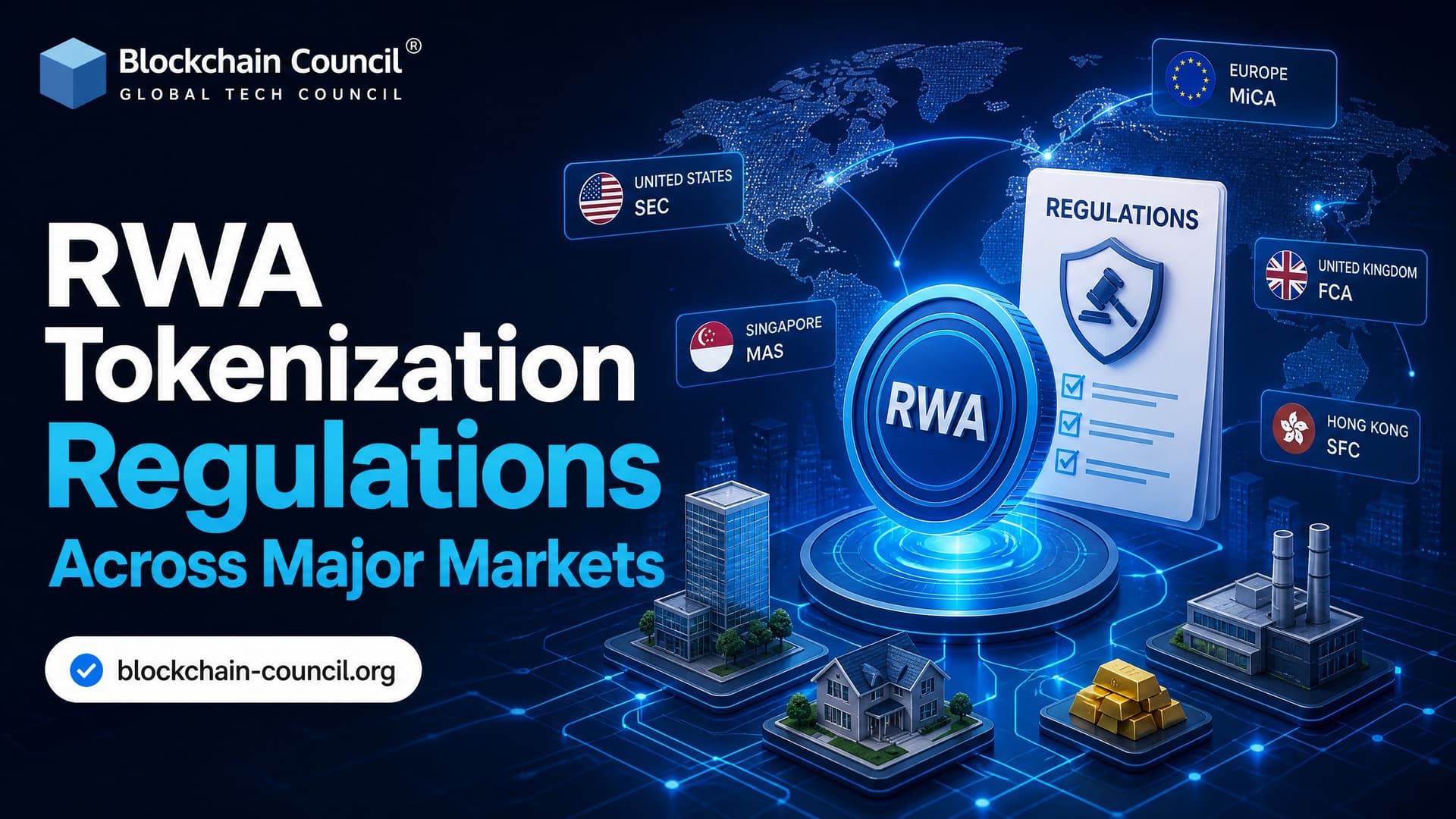
RWA tokenization regulations are not a clean new rulebook. In the United States, European Union, United Kingdom, Hong Kong, Singapore, and the United Arab Emirates, regulators usually start with an older question: what is the underlying asset? If the token represents a share, bond, fund unit, note, money-market claim, or derivative, it is usually regulated as that instrument. The token is treated as a new record-keeping and distribution method, not a legal escape hatch. Anyone navigating this landscape seriously benefits from a structured grounding in the discipline, which is exactly what the Certified RWA Tokenization Expert credential is designed to provide.
That sounds simple. In practice, it is where many projects get stuck. A tokenized Treasury fund, a fractional real estate interest, and a warehouse receipt can sit in very different regulatory buckets, even if all three are marketed as real-world asset tokens. If you are building, advising, or investing in this market, classification comes before smart contracts.

Why RWA tokenization is now a regulatory priority
Tokenization has moved past proof-of-concept demos. Fixed income products, tokenized money-market funds, and short-duration Treasury products are the most active live use cases right now. McKinsey has estimated a base case of roughly 2 trillion USD in tokenized real-world assets by 2030, while other institutional forecasts run much higher. The spread is wide. The direction is not in dispute.
Central banks are watching because tokenized funds and collateral can connect traditional finance to public blockchains, DeFi protocols, stablecoins, and cross-border settlement networks. The Bank for International Settlements has noted that many current tokenization projects involve bonds and fixed income instruments. The Financial Stability Board has flagged liquidity mismatches, leverage, cyber risk, smart contract dependencies, and operational concentration as areas that can matter at a system level. Since this risk picture increasingly spans stablecoins, tokenized deposits, and other digital instruments alongside RWA tokens, many professionals broaden this study with the Certified Digital Assets Expert program, which frames these different asset types within one connected regulatory picture.
Here is my practical view. The regulatory risk is rarely the chain itself. It is the mismatch between legal rights and token behavior. If your on-chain transfer says ownership moved, but the fund register, custodian, or transfer agent says it did not, you have a legal problem dressed up as a technical one.
The core rule: regulate the asset, then regulate the wrapper
Across major markets, three questions drive the analysis:
What does the token represent? Equity, debt, a fund unit, a claim on reserves, a commodity interest, or something else?
Who can buy and trade it? Retail investors, professional investors, accredited investors, or only institutions?
Who operates the infrastructure? Issuer, broker dealer, exchange, alternative trading system, fund manager, custodian, trustee, or virtual asset service provider?
Regulators increasingly use a technology-neutral approach. The SEC has stated that the technological format of a security does not change its legal status. Hong Kong's Securities and Futures Commission has described tokenized securities as traditional securities with a tokenization wrapper. The EU follows a similar split: if the token is a MiFID II financial instrument, MiFID II applies. If it is not, MiCA may apply.
One detail that bites teams during testing: transfer restrictions must work at the wallet level, not just in a PDF subscription agreement. If an investor wallet is not allowlisted, a compliant security token transfer should fail. In delivery-versus-payment testing, that often shows up as a reverted token transfer at settlement time. Annoying, yes. Still better than an illegal secondary sale.
United States: securities law first
In the US, there is no special federal statute for tokenized securities. If an RWA token is a security, it falls under the Securities Act of 1933, the Securities Exchange Act of 1934, and related SEC rules.
When is an RWA token a security?
An RWA token is usually a security if it represents equity, debt, fund interests, or an investment contract under the Howey test. That means there is an investment of money in a common enterprise with an expectation of profits based mainly on the efforts of others. Tokenized notes may also be analyzed under US notes doctrine. Derivatives can bring the Commodity Futures Trading Commission into the picture.
Issuance and trading paths
Common US issuance routes include:
Registered offerings through Form S-1 or Form F-1, suitable for broad distribution but expensive and slow.
Regulation D private placements for accredited investors, often used for security tokens with transfer restrictions.
Regulation A+ or Regulation CF for smaller offerings, though these are less common for institutional RWA products.
Secondary trading generally must occur through a registered national securities exchange or an alternative trading system operated by a registered broker dealer. Tokenization does not remove broker dealer, custody, market manipulation, disclosure, or AML obligations.
For developers, this means your token contract should reflect securities constraints from day one. Retrofitting transfer controls after issuance is painful, especially if tokens have already moved to wallets that cannot pass KYC checks.
European Union: MiFID II, CSDR, MiCA, and the DLT Pilot Regime
The EU has the clearest legal split. If the tokenized RWA is a financial instrument under MiFID II, it is regulated under the existing securities framework. That can include MiFID II conduct rules, the Prospectus Regulation, and the Central Securities Depositories Regulation.
If the token is not a MiFID II financial instrument, MiCA may apply. MiCA became fully applicable on 30 December 2024, while the rules for asset-referenced tokens and e-money tokens applied from 30 June 2024. Issuers may need a crypto-asset white paper, conduct controls, governance policies, and market abuse safeguards depending on the token type.
The DLT Pilot Regime
The EU DLT Pilot Regime, applicable since March 2023, allows certain DLT market infrastructures to test trading and settlement of tokenized financial instruments. It covers DLT multilateral trading facilities, DLT settlement systems, and combined trading and settlement systems.
The regime includes limits, such as thresholds for shares and bonds, because supervisors want experimentation without uncontrolled scale. ESMA has supported making the pilot more permanent. That is a useful signal. Europe is not trying to invent a fantasy asset class called tokenized finance. It is trying to adapt securities infrastructure carefully.
United Kingdom: fund tokenization within existing FCA rules
The UK has taken a pragmatic route, especially for funds. HM Treasury's Asset Management Taskforce published the UK Fund Tokenisation blueprint in November 2023. The stage one model is conservative by design: FCA-authorized funds, mainstream assets, traditional custody, private permissioned DLT, and fiat settlement off-chain.
The FCA found no major rule barrier to this baseline model. Tokenized fund units can sit inside existing authorized fund, client asset, and collective investment scheme rules. That matters for asset managers because it gives a route to production without waiting for a new statute.
For broader tokenized securities, the UK generally treats shares, debt securities, and fund units as specified investments under the Financial Services and Markets Act perimeter. The DLT part adds custody, operational resilience, and register-management questions. It does not erase the regulated activity analysis.
Hong Kong: explicit guidance for tokenized securities
Hong Kong is one of the more direct jurisdictions. In November 2023, the SFC issued circulars on intermediaries engaging in tokenized securities activities and on tokenization of SFC-authorized investment products.
The SFC's position is plain: tokenized securities are securities under the Securities and Futures Ordinance. Licensed intermediaries must handle technology due diligence, smart contract governance, cybersecurity, record-keeping, and contingency planning.
Hong Kong initially focused on primary issuance of tokenized authorized products, while restricting public secondary trading. Over time, the SFC has moved toward setting conditions for secondary trading of tokenized SFC-authorized investment products. That is a measured opening, not a free-for-all.
Singapore: capital markets rules and institutional pilots
Singapore generally regulates tokenized securities as capital markets products under the Securities and Futures Act. MAS has not needed a separate tokenized securities category for most institutional use cases. Prospectus, licensing, custody, and conduct rules still apply.
Project Guardian matters because it tests tokenized bonds, funds, collateral, and foreign exchange in institutional settings. Singapore's approach is attractive for serious market participants because the regulator has allowed experimentation while keeping the legal perimeter familiar.
United Arab Emirates: ADGM and Dubai VARA
The UAE is not a single regulatory story. ADGM and Dubai have distinct frameworks that matter for RWA tokenization.
ADGM
ADGM introduced the Distributed Ledger Technology Foundations Regulations 2023. This created a legal structure for DLT foundations and DAO-style governance. A DLT foundation can support DLT activity or issue tokens, but token classification still depends on existing financial services rules. If the token is a security, securities regulation remains relevant.
Dubai VARA
Dubai's Virtual Assets Regulatory Authority introduced its Virtual Assets and Related Activities Regulations in 2023. VARA supervises virtual asset service providers and has rulebooks covering issuance activity, including certain asset-referenced tokens. If an RWA token falls within VARA's virtual asset perimeter, licensing and issuance requirements can apply. Tokenized securities may also trigger local securities rules.
Common compliance requirements for RWA tokenization
Across markets, you should expect these requirements:
Legal classification memo covering securities, fund, derivatives, banking, and payments analysis.
Investor eligibility controls such as KYC, accreditation, professional investor status, and jurisdiction blocks.
Clear tokenholder rights explaining whether the token is the legal record of ownership or only a mirror record.
Custody design for private keys, underlying assets, reserve assets, and administrator permissions.
Transfer controls coded into the token or enforced through regulated intermediaries.
Operational procedures for chain forks, smart contract bugs, wallet compromise, and failed settlement.
AML and sanctions screening across onboarding, transfers, redemptions, and secondary trading.
Engineers and compliance teams who work this closely with cross-jurisdictional rule engines, KYC integrations, and permissioning systems often support that work with a broader Tech Certification, since it covers general systems integration and security practices that extend beyond blockchain-specific tooling.
Future-Ready Skills
As technology becomes increasingly important across industries, students need opportunities to develop future-ready skills early in their education. A Tech Olympiad can introduce students to areas such as artificial intelligence, coding, cybersecurity, robotics, and computational thinking while encouraging curiosity and continuous learning.
What professionals should learn next
RWA tokenization regulations are becoming more consistent, but they are not becoming simple. The safest workflow is asset first, jurisdiction second, token design third. Do not start with a chain selection meeting. Start with the legal instrument and the investor base.
If you work on product, compliance, engineering, or strategy, build fluency in both financial regulation and smart contract implementation. Blockchain Council's Certified Blockchain Expert can help you structure the broader blockchain concepts, while Certified Smart Contract Developer is a better fit if you need to understand how transfer restrictions, token standards, and contract permissions work in practice. Then map one asset, such as a tokenized fund unit or private credit note, through the US, EU, UK, Hong Kong, Singapore, and UAE frameworks. That exercise will teach you more than another generic market forecast. If part of your role also involves explaining these frameworks to investors, boards, or regulators, a Marketing Certification can help you turn this dense cross-jurisdictional picture into messaging a non-specialist audience will actually follow.
FAQs
1. What are RWA tokenization regulations?
RWA tokenization regulations are the laws and regulatory requirements governing the creation, issuance, sale, transfer, custody, and management of blockchain-based representations of real-world assets. Requirements differ according to the asset, token structure, investor type, and jurisdiction.
2. Is RWA tokenization regulated globally?
There is no single global RWA tokenization framework. Different jurisdictions apply existing securities, financial-services, property, commodities, payments, AML, and digital-asset regulations to tokenized assets. Businesses therefore need jurisdiction-specific legal analysis.
3. How is RWA tokenization regulated in the United States?
In the U.S., tokenized securities remain subject to federal securities laws. The SEC's 2026 interpretation specifically defines a digital security as a financial instrument meeting the definition of a security while being represented as a crypto asset. The format of the security does not by itself remove securities-law obligations.
4. What are the U.S. compliance requirements for tokenized securities?
Depending on the offering, requirements can include securities registration or an applicable exemption, disclosures, broker-dealer or trading-platform rules, custody requirements, recordkeeping, and investor-protection controls. Tokenization does not automatically create an exemption from existing securities requirements.
5. How does the European Union regulate RWA tokenization?
The EU uses different regulatory frameworks depending on what the token represents. Importantly, MiCA generally does not apply to crypto-assets that qualify as financial instruments. Tokenized securities can therefore fall under existing EU financial-market rules rather than simply being treated as ordinary MiCA crypto-assets.
6. Does MiCA regulate all RWA tokens in Europe?
No. MiCA has a defined scope and excludes financial instruments and several other regulated products. Therefore, businesses must first determine what the token legally represents before deciding whether MiCA or another EU financial-services framework applies.
7. How is RWA tokenization regulated in the United Kingdom?
The UK generally takes a technology-neutral approach, meaning the regulatory treatment depends heavily on the characteristics and legal rights of the underlying asset. Tokenized securities can therefore remain subject to applicable financial-services and securities requirements rather than receiving an automatic exemption because blockchain is used.
8. What is the regulatory approach to RWA tokenization in Singapore?
Singapore generally regulates tokenized financial products according to their underlying characteristics. Tokenized securities and capital-market products can fall within existing financial-market rules, while digital-token activities may also involve licensing, AML/CFT, and investor-protection requirements.
9. How does Hong Kong regulate tokenized assets?
Hong Kong's framework distinguishes between different types of tokenized products. Tokenized securities can fall under the existing securities regulatory framework, while activities involving virtual assets may also be subject to licensing and conduct requirements.
10. How is RWA tokenization regulated in the UAE?
The UAE has developed regulatory frameworks covering different categories of virtual assets and financial products. Requirements can vary between federal and financial free-zone frameworks, so issuers and platforms need to identify the relevant regulator and asset classification before launching a tokenized product.
11. What determines whether an RWA token is a security?
The determination generally depends on the rights attached to the token, the underlying asset, the economic arrangement, how it is offered, and applicable jurisdictional law. A token representing shares, bonds, fund interests, or similar financial rights is more likely to fall within securities regulation.
12. Do tokenized real estate assets face property regulations?
Yes. Tokenization does not automatically change property-law requirements. Projects may need to address title ownership, property registration, transfer rules, trusts or special-purpose vehicles, taxation, and investor rights in addition to digital-asset regulations.
13. What KYC and AML rules apply to RWA tokenization?
RWA platforms may need to conduct identity verification, customer due diligence, sanctions screening, transaction monitoring, risk assessments, and suspicious-activity reporting. The exact requirements depend on the jurisdiction and the activities performed by the platform.
14. How do regulations affect secondary trading of RWA tokens?
Secondary trading can be subject to additional requirements because the platform may effectively perform regulated exchange, brokerage, dealing, or marketplace functions. Transfer restrictions and investor eligibility rules may also need to be embedded into the token infrastructure.
15. How do regulators approach custody of tokenized assets?
Custody requirements depend on the jurisdiction and product. Where tokenized assets qualify as regulated securities, institutions may need appropriate custody arrangements, asset segregation, recordkeeping, security controls, and investor-recovery mechanisms.
16. Are tokenized assets subject to investor-protection rules?
Yes, where the underlying token falls within a regulated financial-product framework. Investor-protection requirements can include disclosures, suitability or eligibility controls, custody protections, anti-fraud requirements, and restrictions on misleading marketing.
17. What are the biggest regulatory challenges for RWA tokenization?
Major challenges include different definitions across jurisdictions, uncertainty over token classification, cross-border distribution, licensing, custody, taxation, privacy, AML requirements, and interoperability between regulated and blockchain-based systems.
18. How can businesses stay compliant across multiple markets?
Businesses should begin with legal classification and jurisdiction mapping before developing the token. They should then establish appropriate licensing, KYC/AML controls, disclosures, custody, transfer restrictions, tax processes, cybersecurity controls, and ongoing regulatory monitoring.
19. Will RWA tokenization regulations become more standardized?
Greater regulatory convergence is possible as governments and financial regulators gain experience with tokenized securities and other digital assets. However, significant differences are likely to remain because securities, property, tax, payments, and financial-market rules are still largely jurisdiction-specific.
20. What should businesses and investors expect next from RWA tokenization regulation?
The market is likely to see more specific guidance, regulated tokenized securities platforms, institutional adoption, digital-asset licensing frameworks, and integration between traditional financial infrastructure and blockchain networks. The central regulatory principle is increasingly clear: tokenization changes the technology used to represent an asset, but it does not automatically remove the legal obligations attached to that asset. The U.S. SEC's current framework explicitly reflects this approach for tokenized securities.
Related Articles
View All
Digital Assets
How RWA Tokenization Improves Transparency Across Asset Markets
RWA tokenization improves transparency by making ownership, transfers, compliance rules, and market data auditable across asset markets.

Digital Assets
How Institutions Use RWA Tokenization to Modernize Capital Markets
Institutions use RWA tokenization to issue bonds, funds, deposits, and real estate on blockchain rails while keeping legal and regulatory controls intact.

Digital Assets
RWA Tokenization and Digital Securities: Similarities, Differences, and Regulations
RWA tokenization and digital securities overlap, but differ in asset scope, regulation, trading venues, liquidity, and DeFi integration.
Trending Articles

Top 5 DeFi Platforms
Explore the leading decentralized finance platforms and what makes each one unique in the evolving DeFi landscape.
How Blockchain Secures AI Data
Understand how blockchain technology is being applied to protect the integrity and security of AI training data.
What is AWS? A Beginner's Guide to Cloud Computing
Everything you need to know about Amazon Web Services, cloud computing fundamentals, and career opportunities.