

How RWA Tokenization Reduces Transaction Costs in Financial Markets
 Suyash Raizada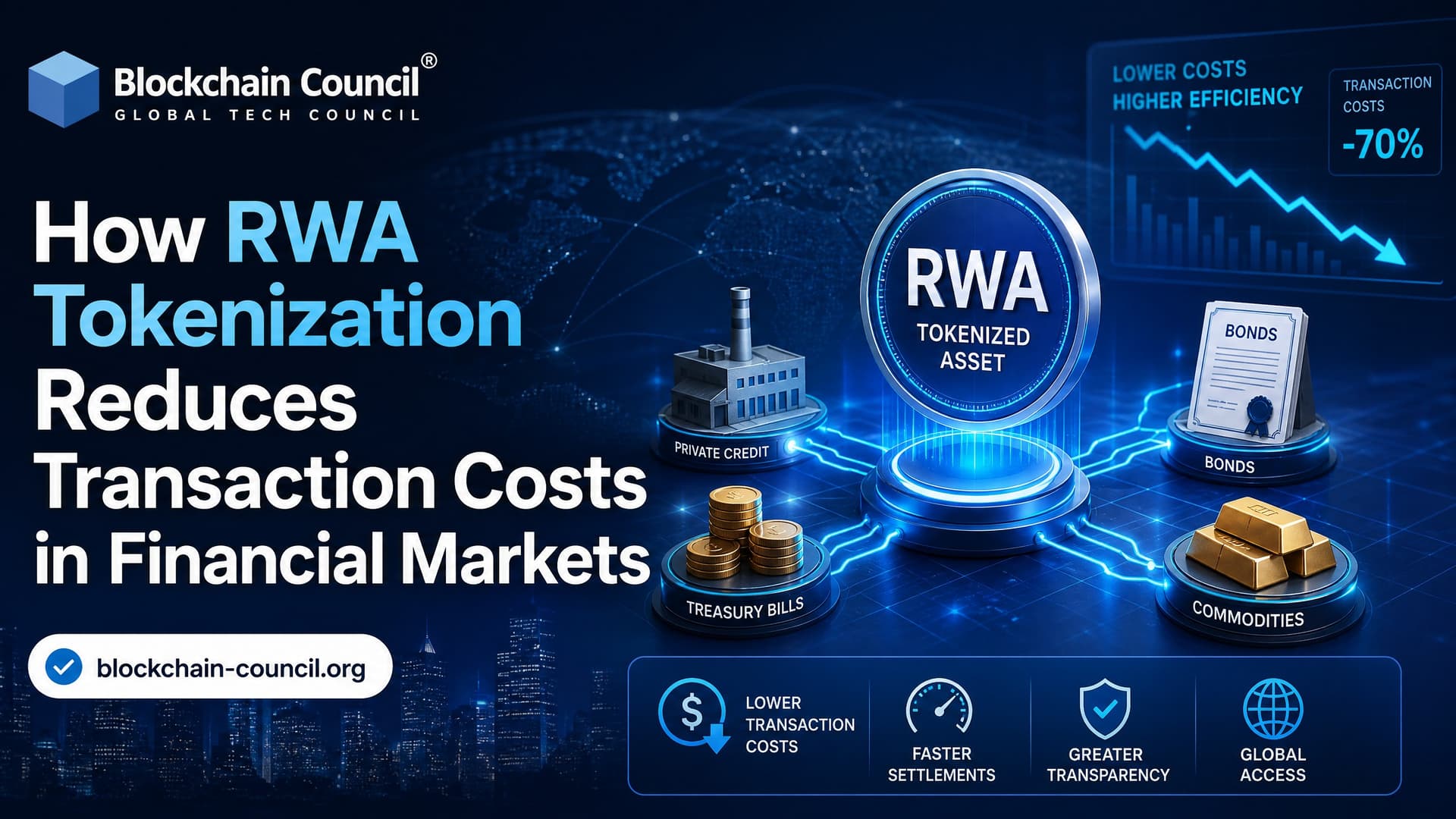
RWA tokenization reduces transaction costs by changing the mechanics of issuance, transfer, compliance, and settlement. Instead of routing every asset movement through brokers, custodians, transfer agents, correspondent banks, and separate reconciliation teams, tokenized real world assets can move on shared blockchain rails, with smart contracts enforcing the rules. For professionals seeking to understand these mechanisms in greater depth, Certified RWA Tokenization Expert can provide relevant knowledge of tokenized asset structures and RWA workflows.
The savings are not theoretical. Industry and academic estimates point to roughly 20 percent lower costs in broad transaction workflows, 35 to 65 percent lower securitization costs, up to 55 percent lower real estate closing costs, and 40 to 80 percent lower cross-border payment costs when blockchain settlement infrastructure is used. The exact figure depends on the asset, jurisdiction, investor base, and custody model.

What RWA Tokenization Means in Financial Markets
RWA tokenization is the process of representing rights to a real world asset as a blockchain-based token. The asset may be a bond, fund unit, invoice, property interest, carbon credit, treasury product, or collectible. The token is not valuable because it is digital. It is valuable because it is tied to enforceable legal rights and can be transferred, serviced, or settled with programmable infrastructure.
That legal connection matters. A tokenized bond without clear investor rights is just a database entry with a nicer interface. A properly structured tokenized bond links the token to payment rights, investor eligibility rules, custody procedures, and reporting obligations. Professionals looking to deepen their understanding of the wider digital asset ecosystem may also explore Certified Digital Assets Expert as part of their learning journey.
Where Traditional Transaction Costs Come From
Financial market transactions are expensive because too many parties keep separate records of the same event. A securities transfer may involve an executing broker, a clearing broker, a custodian, a central securities depository, a transfer agent, a paying agent, a compliance reviewer, and internal operations teams.
Each party adds cost through:
Manual document review and repeated data entry
Reconciliation between ledgers
Escrow and settlement services
Custody and transfer agency fees
Legal checks for investor eligibility
Delayed settlement and tied-up capital
In cross-border payments, the same problem shows up through correspondent banking chains, FX spreads, message fees, and settlement delays. Conventional value transfer can cost several percentage points of transaction value in some corridors. That leaves obvious room for cheaper rails.
How RWA Tokenization Reduces Transaction Costs
1. Fewer Intermediaries
Tokenized assets can be transferred point to point on a blockchain network, with ownership changes recorded onchain. This does not remove every intermediary. Regulated assets still need issuers, custodians, legal structures, and compliance controls. But it can remove duplicate recordkeeping and cut the number of parties needed for routine transfers.
Take a tokenized fund unit. It can embed transfer restrictions so that only verified wallets can receive it. That reduces post-trade manual checks and failed settlement events. In permissioned token standards such as ERC-3643, identity and compliance modules can block an unauthorized transfer before settlement rather than after a back-office review.
2. Smart Contract Automation
Smart contracts cut costs by turning repeatable workflows into code. Escrow release, coupon distribution, investor whitelist checks, cap table updates, and corporate action processing can all be automated.
Real estate shows the impact clearly. Analyses of tokenized property workflows report closing cost reductions of up to 55 percent when escrow, ownership transfer, and parts of title verification are automated. Reported savings include lower escrow costs, brokerage fee reductions of about 42 percent, and title insurance savings of about 30 percent where verified records reduce risk.
A practical note for developers: compliance automation is where gas and design choices start to bite. Run every transfer through multiple onchain registry calls and Ethereum mainnet costs can get painful fast. I have watched teams test a permissioned transfer flow on Sepolia, then get blindsided when mainnet chain ID 1 pricing turns a harmless compliance check into a costly operation. One more version trap: if you use OpenZeppelin Contracts v5 with Solidity 0.8.x, Ownable now expects an initial owner in the constructor. The common compiler error is "No arguments passed to the base constructor." Small version changes can stall a production launch.
3. Faster Settlement
Traditional settlement often takes days because records and funds move through different systems. Tokenized assets can support near real-time or T+0 settlement, depending on the payment rail and legal finality rules.
Shorter settlement windows reduce counterparty risk. They also reduce the cost of capital trapped during the settlement cycle. Institutional examples in tokenized bonds and real estate have shown funding cycles compressed to about 48 hours, with some cross-border onchain trades settling within minutes once compliance and payment conditions are met.
4. Lower Infrastructure Costs
Blockchains create a shared settlement layer. Instead of every participant running separate infrastructure and reconciling later, parties can read from the same transaction history. That is the real cost argument.
Deloitte-cited research has estimated that blockchain-based cross-border payment infrastructure can cut transaction costs by 40 to 80 percent, equal to 12 to 24 billion dollars in annual savings. Tokenization providers also report that tokenized securitization structures can run 35 to 65 percent cheaper than standard securitization, mainly because servicing, reporting, and administration need less manual handling.
5. Layer 2 Networks Reduce Onchain Fees
Mainnet blockchains are not always cheap. A compliant asset transfer on Ethereum mainnet may cost 15 to 35 dollars in gas during normal conditions, and more when the network is congested. At 1,000 compliant transfers per month, annual gas costs can reach roughly 180,000 to 420,000 dollars.
Layer 2 rollups change the math. Moving execution to networks such as Arbitrum, Optimism, Base, or Polygon zkEVM can cut operational transaction fees by 10 to 100 times, while Ethereum still acts as a settlement or security layer. For high-volume RWA platforms, layer 2 architecture is not optional. It is often the difference between a working cost model and a pilot that never scales.
Cost Savings by Use Case
Cross-Border Payments and FX
Tokenized fiat, stablecoins, and central bank digital currency pilots are pushing payment settlement toward programmable rails. Paired with automated market maker-based FX, tokenized fiat instruments can reduce bank fees and narrow FX spreads.
Macroeconomic research has estimated that AMM-based FX using tokenized fiat and stablecoins could reduce global FX costs by about 595.8 billion dollars per year across major and exotic currency pairs. That figure is ambitious, but the direction is credible: direct settlement and tighter liquidity pools lower the cost of moving money internationally.
Securitization and Structured Products
Securitization is document-heavy. Asset pools, investor reports, servicing updates, waterfall payments, and compliance events all create operating costs. Tokenization can lower them through shared ledgers and automated payment logic.
Industry estimates place tokenized securitization savings at 35 to 65 percent compared with standard processes. The largest benefit is usually not the token itself. It is the drop in repeated legal, servicing, reporting, and reconciliation tasks.
Real Estate
Real estate remains one of the strongest RWA tokenization examples because the traditional process is slow and fee-heavy. Tokenized property workflows can automate escrow, fractional ownership records, investor onboarding, and transfer restrictions.
Some real estate tokenization models report settlement timelines falling from around 45 days to near instant onchain settlement once legal and payment conditions are satisfied. That does not mean every property sale will settle instantly tomorrow. Land registries, local law, liens, and title checks still matter. But the cost base can shrink sharply once the workflow is standardized.
Tokenized Bonds and Institutional Assets
For treasurers and asset managers, the value of tokenized bonds is not just faster trading. It is cleaner lifecycle management. Coupons, redemption, investor eligibility, and reporting can be handled with fewer operational breaks.
Academic work citing Roland Berger projects around 4.6 billion euros in equity trading transaction cost savings by 2030 from tokenized RWA applications. The same logic applies to fixed income if issuance and settlement standards converge.
The Cost Trade-Offs You Should Not Ignore
RWA tokenization is cheaper per transaction only after the platform, compliance model, and legal structure are in place. Upfront costs can be steep.
Legal structuring: Securities analysis, offering documents, custody agreements, and jurisdiction reviews can cost tens of thousands of dollars for small projects and far more for institutional products.
Technology build: MVP costs often start in the hundreds of thousands of dollars. Production-grade platforms can run into the low millions.
Operations: Mature platforms may face annual costs in the low to mid seven figures for compliance, cybersecurity, integrations, support, audits, and governance.
Regulatory fragmentation: Tokenized securities, stablecoins, and custody rules differ by jurisdiction, which can force duplicated legal work.
To be blunt, tokenizing a 500,000 dollar asset rarely makes sense unless the platform already exists or the asset can be pooled. Tokenizing a 100 million dollar credit portfolio is a different story. Scale changes the economics.
What This Means for Professionals and Enterprises
If you work in capital markets, payments, real estate, or fund administration, treat RWA tokenization as an operating model, not just a product wrapper. Ask three questions before investing:
Which manual workflow is being removed?
Which intermediary cost is being reduced, and by how much?
Does the legal structure preserve enforceable investor rights?
For developers, focus on permissioned token design, identity integration, smart contract security, oracle risk, and layer 2 deployment patterns. ERC-20 alone is usually too basic for regulated RWA transfers. You will need transfer restrictions, role controls, audit trails, and offchain legal records mapped clearly to onchain state.
If you want to build this skill set, Blockchain Council programs such as the Certified Blockchain Expert™, Certified Smart Contract Developer™, and Certified DeFi Expert™ cover token design, smart contract execution, and decentralized market infrastructure.
The Role of Technology Education in Emerging Digital Markets
As blockchain, artificial intelligence, coding, cybersecurity, and other technologies become increasingly interconnected, early exposure to technology can help students develop practical skills that may support future participation in digital industries.
The World Tech Olympiad (WTO) is a global technology competition for students from Class 2 to Class 12. Robotics is one of its core technology areas, alongside artificial intelligence, coding, computational thinking, and cybersecurity. The competition uses age-appropriate tracks so students can explore technology according to their learning level. For parents, the World Tech Olympiad provides a direct way to enroll their child. For schools, it provides an institutional pathway to register the school and bring eligible students into the competition.
Future Outlook for RWA Tokenization and Transaction Costs
The next stage of RWA tokenization will be less about isolated pilots and more about standardized rails. Layer 2 execution, regulated custody, digital identity, stablecoin settlement, and common token standards will decide how much of the projected savings becomes real.
The strongest near-term opportunities sit in workflows with high reconciliation costs, slow settlement, and repeatable compliance checks. Cross-border payments, private credit, securitization, tokenized funds, and real estate all fit that profile.
As these markets mature, professionals will also need to connect technical capabilities with broader business and market requirements. Tech Certification can support professionals developing technology-focused knowledge, while Marketing Certification can be relevant for those responsible for communicating, positioning, and growing technology-driven products and services.
Your next step is practical. Map one transaction workflow in your organization, list every intermediary and reconciliation step, then estimate the cost of replacing that process with tokenized issuance, permissioned transfers, and onchain settlement. If the numbers still work after legal, compliance, and operating costs, RWA tokenization deserves a serious build plan.
FAQs
1. How does RWA tokenization reduce transaction costs?
RWA tokenization can reduce certain costs by digitizing and automating processes such as asset transfers, recordkeeping, reconciliation, settlement, and payment distribution. Fewer manual processes and shared digital records can reduce operational expenses.
2. What transaction costs can RWA tokenization reduce?
Potential savings can come from lower administrative costs, reconciliation expenses, settlement costs, paperwork, intermediary fees, and manual processing requirements. The actual savings depend on the asset and the tokenization infrastructure.
3. How does blockchain reduce administrative costs?
Blockchain provides a shared record of transactions and token ownership. This can reduce the need for multiple parties to maintain and repeatedly reconcile separate records, potentially lowering back-office and administrative workloads.
4. Can smart contracts reduce transaction processing costs?
Yes. Smart contracts can automate predefined processes such as payment calculations, ownership transfers, compliance checks, and distributions. Automation can reduce repetitive manual work and associated processing costs.
5. How does tokenization reduce settlement costs?
Traditional settlement can involve multiple intermediaries and reconciliation processes. Tokenized settlement can potentially simplify these workflows by combining digital asset records, transaction execution, and settlement instructions on connected infrastructure.
6. How does RWA tokenization reduce intermediary costs?
Tokenization can automate or streamline certain functions traditionally handled manually by multiple intermediaries. However, it does not eliminate all intermediaries. Custodians, banks, brokers, legal providers, and compliance firms may still be required.
7. Can tokenization reduce costs for asset issuers?
Yes. Issuers may reduce certain costs associated with investor onboarding, recordkeeping, distributions, reporting, and asset administration through automation and digital infrastructure.
8. How can investors benefit from lower transaction costs?
Lower operational and settlement costs may make certain investments more cost-efficient. Depending on the structure, investors could potentially benefit from lower processing fees, reduced administrative expenses, and more efficient transfers.
9. Does fractional ownership reduce investment costs?
Fractionalization can reduce the amount of capital required to gain exposure to an asset, but it does not necessarily reduce every transaction fee. Smaller investment units can potentially make certain assets more accessible to eligible investors.
10. How does tokenization reduce reconciliation costs?
When multiple parties use a shared blockchain record, they may have less need to compare and reconcile separate transaction databases. This can reduce manual reconciliation, duplicate records, and operational errors.
11. How does tokenization reduce paperwork costs?
Digital tokenization systems can automate parts of documentation and recordkeeping. While legal documents may still be required, blockchain-based systems can reduce the need for repetitive paper-based ownership and transaction records.
12. Can RWA tokenization reduce payment processing costs?
Potentially. Smart contracts can automate certain income distributions, while blockchain-based payment mechanisms may simplify some settlement workflows. Savings depend on the payment method, network fees, compliance requirements, and financial infrastructure.
13. How does tokenization affect custody costs?
Tokenization can streamline certain custody and recordkeeping processes by maintaining digital ownership records. However, physical or financial assets may still require professional custodians, meaning custody costs are reduced only in certain parts of the workflow.
14. Does faster settlement reduce financial costs?
It can. Faster settlement may reduce the amount of capital tied up during transaction processing and lower certain operational requirements. It can also potentially reduce settlement risk and the costs associated with prolonged transaction cycles.
15. How can tokenization reduce costs in private markets?
Private markets often involve complex administration and limited transfer infrastructure. Tokenization can automate ownership records, investor onboarding, distributions, transfers, and settlement, potentially reducing costs associated with managing private-market investments.
16. What role does automation play in reducing RWA transaction costs?
Automation is one of the main potential advantages of tokenization. Smart contracts and integrated systems can execute predefined processes without requiring manual intervention for every transaction, helping reduce labor requirements and processing delays.
17. Can tokenization reduce cross-border transaction costs?
Potentially. Blockchain-based infrastructure can provide a common digital settlement layer across jurisdictions. However, foreign exchange costs, regulatory requirements, taxes, banking infrastructure, and compliance checks can still contribute significantly to cross-border transaction costs.
18. What are the costs associated with implementing RWA tokenization?
Tokenization itself requires investment in blockchain infrastructure, smart contract development, security audits, legal structuring, compliance, custody, data systems, and ongoing platform maintenance. Therefore, savings may become more significant as transaction volume increases.
19. Does RWA tokenization always reduce transaction costs?
No. Tokenization can introduce new expenses, including blockchain network fees, technology costs, compliance requirements, cybersecurity expenses, and custody costs. The overall economic benefit depends on the scale, complexity, and design of the tokenization system.
20. What is the long-term impact of RWA tokenization on financial-market costs?
RWA tokenization could lower certain financial-market costs by combining automation, shared records, faster settlement, programmable transactions, and digital ownership management. As infrastructure matures and adoption increases, these efficiencies could help make transactions more streamlined and cost-effective across multiple asset markets.
Related Articles
View All
Digital Assets
How Institutions Use RWA Tokenization to Modernize Capital Markets
Institutions use RWA tokenization to issue bonds, funds, deposits, and real estate on blockchain rails while keeping legal and regulatory controls intact.
Digital Assets
RWA Tokenization Regulations Across Major Markets
RWA tokenization regulations usually follow the underlying asset, not the token wrapper. Learn how the US, EU, UK, Hong Kong, Singapore, and UAE regulate tokenized assets.

Digital Assets
How RWA Tokenization Works for Private Credit and Debt Markets
Learn how RWA tokenization turns private credit and debt instruments into compliant on-chain tokens with legal claims, servicing logic, and transfer controls.
Trending Articles
The Role of Blockchain in Ethical AI Development
How blockchain technology is being used to promote transparency and accountability in artificial intelligence systems.

Top 5 DeFi Platforms
Explore the leading decentralized finance platforms and what makes each one unique in the evolving DeFi landscape.
How Blockchain Secures AI Data
Understand how blockchain technology is being applied to protect the integrity and security of AI training data.