

How RWA Tokenization Improves Transparency Across Asset Markets
 Suyash Raizada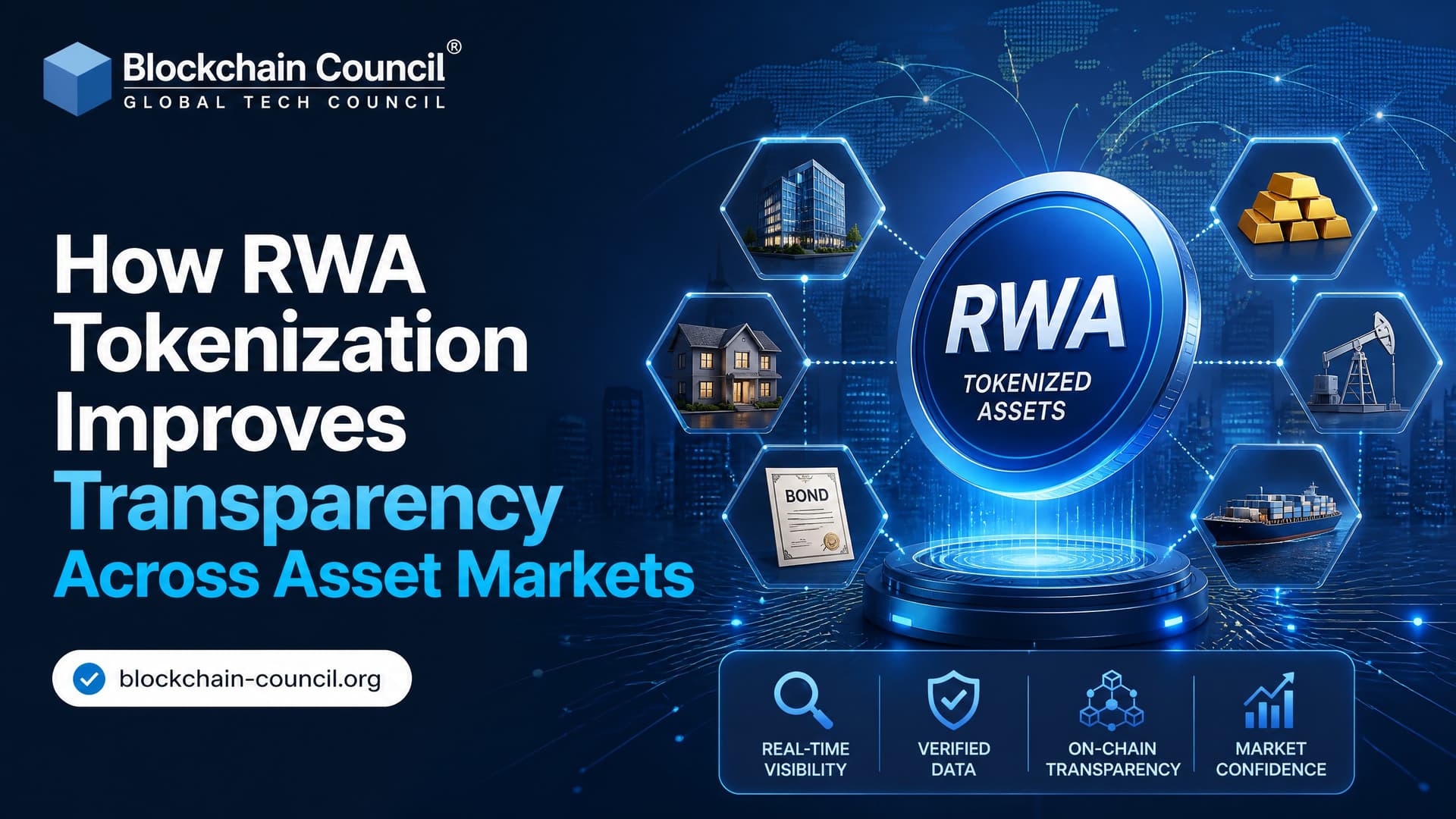
RWA tokenization improves transparency by turning ownership, transfers, economic rights, and compliance rules into data you can inspect on shared ledgers. That matters because asset markets still run on slow reconciliations, private spreadsheets, PDF disclosures, and trust in intermediaries who often hold different versions of the same record. For professionals who want to build a stronger understanding of how tokenized real-world assets are structured and managed, Certified RWA Tokenization Expert can provide relevant knowledge of RWA tokenization concepts and practices.
The shift is no longer theoretical. CoinGecko reported that tokenized real-world asset market capitalization, excluding stablecoins, grew from about 5.42 billion dollars in early 2025 to 19.32 billion dollars by 31 March 2026. Other market trackers placed onchain RWA value around 31 to 34 billion dollars by May 2026. The numbers vary by methodology, but the direction is clear. More assets are being represented as tokens, and transparency is becoming a design requirement rather than a side benefit.

What RWA Tokenization Makes Visible
In a tokenized structure, an asset such as a Treasury fund share, private credit note, gold claim, or real estate interest is represented by a digital token. The token does not magically solve legal ownership. The legal wrapper still matters. What it does create is a shared technical record that investors, issuers, custodians, auditors, and regulators can use.
As RWA markets become more closely connected with digital assets, professionals also benefit from understanding the broader digital-asset ecosystem, including tokenized assets, custody, compliance, and onchain market infrastructure. Certified Digital Assets Expert can complement specialized RWA knowledge in these areas.
Well-designed RWA tokenization can make the following visible:
Current ownership: Wallet addresses or permissioned identities linked to token balances.
Transfer history: A timestamped audit trail of mints, burns, and transfers.
Economic terms: Coupon rates, maturities, payment schedules, fees, or redemption mechanics.
Compliance status: Transfer restrictions, investor eligibility, jurisdictional rules, and blocked movements.
Market data: Price, liquidity, yield, and volume from onchain activity.
That is a real improvement over traditional private markets, where the same asset may be tracked in a fund administrator system, a custodian file, an issuer spreadsheet, and a law firm closing binder at the same time.
Immutable Ownership and Transfer Records
The most basic transparency gain comes from the ledger itself. Public blockchains such as Ethereum record state changes in an append-only format. Permissioned networks can do the same for approved participants. Either way, the audit trail is harder to alter quietly.
For tokenized funds, a mint can show new issuance. A burn can show redemption. A transfer can show secondary movement. If the contract follows common token patterns such as ERC-20 for fungible assets or ERC-721 for unique assets, indexers and analytics tools can read events automatically.
Here is the practical catch developers learn fast: the transparency is only as good as the events and metadata. If a token contract updates balances but fails to emit the expected Transfer event, many indexers will miss the movement. In OpenZeppelin Contracts 5.x, access control failures now use custom errors such as AccessControlUnauthorizedAccount(address account, bytes32 neededRole), not the older string revert format many teams still search for in logs. Small implementation choices affect auditability.
Standardized Disclosures in Smart Contracts
Traditional disclosures are often scattered across offering memoranda, investor portals, rating reports, and settlement instructions. Tokenized assets can encode at least part of that information into machine-readable structures.
For example, a tokenized bond or private credit product may expose:
Principal amount and token supply
Coupon or yield calculation method
Maturity date
Eligible investor categories
Collateral references
Payment and redemption rules
Not every term belongs directly in a smart contract. Legal documents still handle edge cases. But core parameters can be standardized so that investors and compliance teams are not manually comparing PDFs. Standards such as ERC-1400 and ERC-3643, often associated with security tokens and permissioned transfers, show how the market is moving toward token formats that carry compliance and disclosure logic.
Programmable Compliance Creates Visible Controls
RWA tokenization is not just about showing who owns what. It can also show what is allowed.
In regulated assets, not every wallet should be able to receive a token. A United States-only fund may restrict transfers to eligible investors. A tokenized security may require KYC and accredited investor checks. A jurisdiction may prohibit secondary trading during a lockup period.
Instead of relying only on manual review, issuers can encode these rules into smart contracts. When a transfer is allowed, the ledger records it. When a transfer is blocked, the transaction fails or emits a compliance event, depending on the design. Regulators and auditors can then review how controls operated over time.
To be blunt, this is where many weak RWA projects get exposed. A nice dashboard is not compliance. If transfer rules sit offchain in a private database with no verifiable link to the token contract, transparency is thin. Serious deployments connect identity, permissions, custody, and reporting into one controlled process.
Real-Time Market Data and Price Discovery
Tokenized United States Treasuries and money market funds are currently the largest RWA category, estimated by several 2026 industry summaries at roughly 13 to 15 billion dollars in value. BlackRock's BUIDL fund has been one of the most watched examples, with reports placing its size around 2.5 to 2.9 billion dollars during 2026.
Why does this matter for transparency? Because onchain activity can show flows, redemptions, holder concentration, and secondary liquidity much faster than quarterly or monthly reports. Analytics platforms such as RWA.xyz aggregate tokenized asset issuance and pricing data so market participants can compare products that reference similar underlying assets.
Private credit is another important case. Traditional private credit can be opaque, especially around collateral quality, payment status, and tranche exposure. Tokenized structures from issuers such as Ondo Finance aim to publish more consistent data around issuance, interest accrual, and settlement flows. Investors still need credit analysis. The token does not remove default risk. It does reduce the fog around movements and cash flow mechanics.
Transparent Cap Tables and Fractional Ownership
Fractional ownership is often discussed as a liquidity story, but its transparency impact is just as important. When each token represents a defined share of economic rights, the cap table can become easier to audit.
This is valuable in markets such as real estate, commodities, and private funds. A property interest can be split into tokens. A gold-backed token can point to custody attestations and inventory reports. A private credit pool can show investor balances and distribution events.
Academic research on blockchain property registries has long argued that leases, encumbrances, prior ownership, and legal status can be consolidated into shared records. That does not mean every land registry will move onchain next year. Many will not. But the direction is sensible: reduce repeated manual searches and give buyers a cleaner view of asset history.
Transparency Challenges That Still Need Work
RWA tokenization improves transparency, but it does not guarantee it. Bad data on a blockchain is still bad data. Sometimes it is worse, because people assume the ledger proves more than it actually does.
Fragmentation Across Chains
RWA markets are already spread across Ethereum, permissioned chains, app-specific networks, and institutional ledgers. Canton Network analysis has pointed to pricing gaps of 1 to 3 percent for similar assets and 2 to 5 percent friction when moving capital across chains. Fragmentation makes portfolio-level transparency harder because data must be normalized across different systems.
Privacy Versus Public Auditability
Financial institutions cannot expose every investor identity or trading strategy to the open internet. That is a hard limit. The better approach is selective transparency: public or shared proof of asset movements, with private identity data available to authorized parties. Zero-knowledge proofs, permissioned networks, and encrypted data layers are likely to play a larger role here.
Offchain Data Alignment
The token must map cleanly to the legal claim. If custody records, NAV calculations, corporate actions, or loan servicing data are not synchronized with the smart contract, the onchain record becomes incomplete. This is where auditors, trustees, and regulated custodians remain essential.
Regulation Is Pushing Better Disclosure
Regulatory frameworks are starting to shape how transparent RWA markets can become. The European Union's Markets in Crypto Assets framework, known as MiCA, has raised expectations around issuer disclosure and service provider conduct for covered crypto assets. In the United States, proposed legislation such as the GENIUS Act has been discussed in industry analysis as part of a broader push for clearer treatment of compliant digital asset products.
Large market infrastructure firms are also testing tokenization. DTCC, which clears and settles nearly all United States stock trades and holds custody for over 114 trillion dollars in securities, has been involved in tokenized securities pilots with major financial institutions. The goal is practical: make settlement status, collateral movement, and reconciliation visible to authorized participants without breaking regulatory controls.
What Professionals Should Learn Now
If you work in finance, compliance, development, or enterprise blockchain, treat transparency as a product requirement. Ask these questions before supporting any RWA tokenization project:
What exact legal claim does the token represent?
Where are ownership, transfer, and redemption records stored?
Which smart contract standard is used?
How are KYC and transfer restrictions enforced?
Can auditors verify offchain assets against onchain supply?
What data is public, permissioned, or private?
For a structured learning path, consider Blockchain Council's Certified Blockchain Expert™ if you need the strategic foundation, Certified Smart Contract Developer™ if you build token contracts, and Certified DeFi Expert™ if your focus is tokenized yield, liquidity, and onchain market design.
For professionals who work on the technology infrastructure supporting transparent RWA markets, expanding knowledge across blockchain, cybersecurity, artificial intelligence, software, and other emerging technologies can also be valuable. Tech Certification can complement specialized blockchain learning with broader technical knowledge.
Start with one asset class. Treasuries are the clearest entry point because disclosures, pricing, and custody are easier to verify than complex private credit. Then study permissioned token standards, index contract events correctly, and compare onchain supply with issuer reports. That exercise will teach you more about RWA transparency than any slide deck.
World Tech Olympiad and Technology Learning
The World Tech Olympiad (WTO) is a global technology competition for students from Class 2 to Class 12. Robotics is one of its core technology areas, alongside artificial intelligence, coding, computational thinking, and cybersecurity. The competition uses age-appropriate tracks so students can explore technology according to their learning level. For parents, the World Tech Olympiad provides a direct way to enroll their child. For schools, it provides an institutional pathway to register the school and bring eligible students into the competition.
Final Takeaway
Start with one asset class. Treasuries are the clearest entry point because disclosures, pricing, and custody are easier to verify than complex private credit. Then study permissioned token standards, index contract events correctly, and compare onchain supply with issuer reports. That exercise will teach you more about RWA transparency than any slide deck.
As organizations increasingly need to communicate the value of tokenization, digital assets, and emerging financial technologies to investors and broader markets, marketing knowledge can complement technical expertise. A Marketing Certification can support professionals looking to develop that additional capability alongside their RWA and digital-asset knowledge.
FAQs
1. How does RWA tokenization improve transparency?
RWA tokenization can create a shared, traceable digital record of token issuance, ownership, transfers, and other transactions. This can make asset-related information easier to verify and reconcile compared with fragmented traditional records.
2. What does transparency mean in RWA tokenization?
Transparency means that authorized participants can access reliable information about aspects such as token ownership, transaction history, asset status, valuations, and distributions, depending on the blockchain architecture and privacy controls.
3. How does blockchain improve transparency for tokenized assets?
Blockchain records transactions in a structured ledger that can be independently verified. This creates a chronological history of activities such as token issuance, transfers, and settlements, helping reduce discrepancies between different records.
4. Can investors see who owns a tokenized asset?
It depends on the blockchain and tokenization structure. Public blockchains may make wallet addresses and transactions visible, while permissioned systems can restrict access to authorized participants. Privacy and regulatory requirements often determine what ownership information is disclosed.
5. How does tokenization improve ownership transparency?
Traditional asset ownership records may be spread across multiple databases and institutions. Tokenization can provide a centralized or shared digital representation of token ownership, making it easier to track balances and transfer histories.
6. How does RWA tokenization improve transaction transparency?
Each blockchain transaction can create a verifiable record showing relevant details such as the transferred token amount, transaction time, and participating blockchain addresses. This can make transaction reconciliation more efficient.
7. Can tokenization improve transparency in real estate?
Potentially. Tokenization can provide a digital record of token transfers and interests connected to real estate. However, property titles, legal ownership, valuations, and other records may remain in traditional systems and still require independent verification.
8. How does tokenization improve transparency in private markets?
Private-market investments often have limited public information and complex administrative processes. Tokenization can provide more structured records of ownership, transfers, distributions, and selected asset information, subject to confidentiality and regulatory requirements.
9. How does RWA tokenization improve transparency for asset owners?
Asset owners can potentially gain better visibility into investor holdings, distributions, transfers, and asset-related records. Automated blockchain records can also reduce manual reconciliation between different stakeholders.
10. How does tokenization help financial institutions with reporting?
Blockchain-based transaction records can provide a consistent source of data for certain reporting and reconciliation processes. Institutions can potentially automate parts of transaction tracking, settlement reporting, ownership updates, and distribution records.
11. Do smart contracts improve transparency?
Yes, smart contracts can make certain business rules visible and auditable. For example, participants may be able to verify how rules govern transfers, payments, eligibility, or redemption, depending on whether the contract code and relevant data are accessible.
12. How do audits support transparency in RWA tokenization?
Audits can independently examine the relationship between tokenized assets and their underlying assets. They may verify financial records, asset holdings, custody arrangements, liabilities, or other relevant information, adding an additional layer of assurance.
13. What role do oracles play in RWA transparency?
Oracles can bring external information such as asset prices, valuations, interest rates, or payment events into blockchain systems. Reliable oracle infrastructure can help participants understand which external data is being used by tokenized asset applications.
14. Does blockchain transparency prove that the underlying asset exists?
No. Blockchain can verify token transactions, but it cannot independently confirm the existence or condition of a physical asset. Custodians, auditors, registries, inspections, and other verification mechanisms may be required.
15. How does tokenization improve payment transparency?
Smart contracts and blockchain records can make certain payment activities easier to track. Depending on the structure, participants may be able to verify distribution amounts, payment dates, and receiving addresses without relying entirely on manual reconciliation.
16. Can RWA tokenization reduce information asymmetry?
It can potentially reduce information gaps by making selected transaction and asset information more accessible and standardized. However, tokenization does not guarantee equal access to all information, especially where confidential, personal, or commercially sensitive data is involved.
17. How does tokenization improve audit trails?
Blockchain creates a chronological record of relevant on-chain activities. This can provide auditors and authorized participants with a more structured transaction history, reducing the need to reconstruct certain activities from multiple disconnected systems.
18. Are tokenized asset markets completely transparent?
No. Transparency depends on the network design, data availability, legal framework, and privacy requirements. Permissioned blockchains, confidential transactions, off-chain records, and restricted investor information can limit what is publicly visible.
19. What are the limitations of blockchain-based transparency?
Blockchain records are only as reliable as the information entered into the system. Incorrect off-chain data, unreliable oracles, inaccurate asset valuations, or fraudulent documentation can still create misleading records. On-chain transparency does not automatically guarantee real-world accuracy.
20. What is the future of transparency in RWA markets?
As tokenization infrastructure develops, combining blockchain records, smart contracts, digital identity, asset attestations, audits, oracles, and standardized reporting could create more transparent and verifiable asset markets. This may improve trust and efficiency while still allowing appropriate privacy and regulatory controls.
Related Articles
View All
Digital Assets
How RWA Tokenization Improves Asset Liquidity in Private Markets
RWA tokenization can improve private market liquidity through fractional ownership, 24/7 transferability, collateral use, and programmable compliance.
Digital Assets
RWA Tokenization Regulations Across Major Markets
RWA tokenization regulations usually follow the underlying asset, not the token wrapper. Learn how the US, EU, UK, Hong Kong, Singapore, and UAE regulate tokenized assets.

Digital Assets
How Institutions Use RWA Tokenization to Modernize Capital Markets
Institutions use RWA tokenization to issue bonds, funds, deposits, and real estate on blockchain rails while keeping legal and regulatory controls intact.
Trending Articles
The Role of Blockchain in Ethical AI Development
How blockchain technology is being used to promote transparency and accountability in artificial intelligence systems.
AWS Career Roadmap
A step-by-step guide to building a successful career in Amazon Web Services cloud computing.
How Blockchain Secures AI Data
Understand how blockchain technology is being applied to protect the integrity and security of AI training data.