

RWA Tokenization in Institutional Finance: Use Cases for Banks and Asset Managers
 Suyash Raizada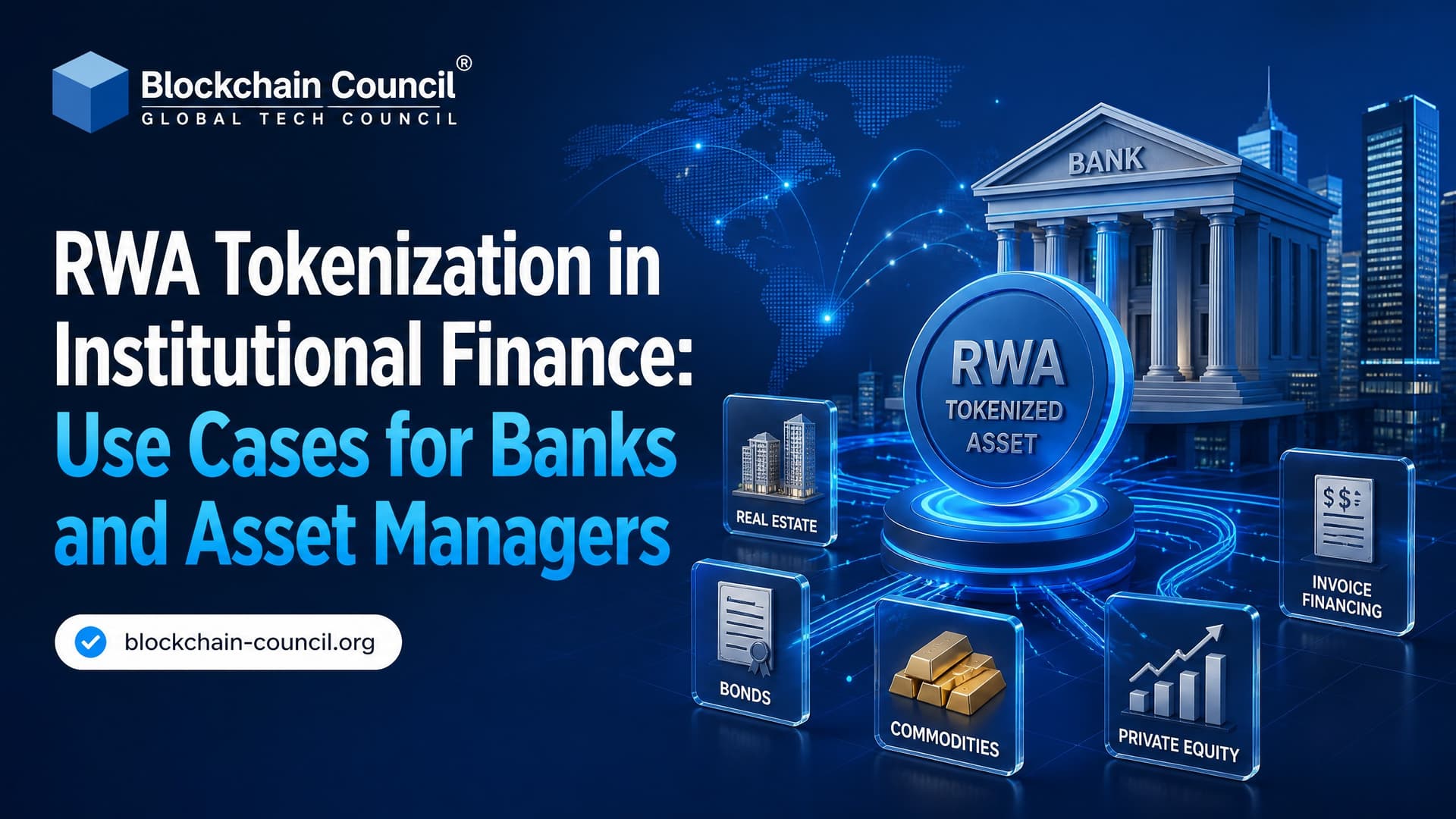
RWA tokenization is no longer a lab project for banks and asset managers. It has become a production pattern for tokenized treasuries, money market funds, collateral networks, digital bonds, private credit, and trade finance. Here is the short version. Institutions are not trying to replace finance with crypto. They are putting familiar regulated assets on programmable rails. For professionals looking to develop specialized expertise in this rapidly evolving area, a Certified RWA Tokenization Expert can provide a structured understanding of tokenization models, institutional use cases, and the infrastructure behind real-world digital assets.
That distinction matters. A tokenized Treasury fund is still a fund. A tokenized deposit is still a bank liability. The token is a digital representation of a legal claim, recorded on a shared ledger and controlled by rules around eligibility, transfers, custody, reporting, and settlement.

What RWA Tokenization Means in Institutional Finance
Real world asset tokenization represents ownership or economic claims on traditional assets as digital tokens on blockchain or distributed ledger infrastructure. The IMF describes digital tokens as representations of assets on shared, trusted, programmable ledgers. The BIS has framed tokenized platforms as a way to connect payments, securities, collateral, and settlement inside one programmable environment.
For institutions, the target is practical:
Shorter settlement cycles
Better collateral mobility
More transparent ownership records
Automated compliance checks
Fractional distribution of assets that are usually hard to access
For professionals working with tokenized securities, digital financial instruments, and blockchain-based investment products, a Certified Digital Assets Expert can complement this knowledge by developing a broader understanding of digital assets, tokenization, custody, compliance, and related financial applications.
Do not confuse this with unregulated token issuance. The serious institutional market is being built around regulated funds, broker dealers, transfer agents, custodians, banks, and securities law. That is why names such as BlackRock, Franklin Templeton, JPMorgan, Societe Generale, Fidelity, and WisdomTree matter in this segment.
How Large Is the RWA Tokenization Market?
Market estimates vary. Some activity happens on public blockchains, while large bank pilots and private ledgers are not always visible. Still, the direction is clear.
The RWA tokenization market rose from roughly $8.5 billion in early 2024 to about $34 billion by mid 2025, and estimates citing RWA.xyz data put it near $36 billion by late 2025. Longer term forecasts are far larger. IOSCO has referenced projections suggesting tokenized real world assets could reach up to $30.1 trillion by 2034, with midpoint scenarios from Ripple and BCG estimates near $18.9 trillion by 2033.
Read those numbers with care. Forecasts can run ahead of implementation. To be blunt, tokenization will not fix a poor asset, a weak servicing process, or an unclear legal claim. But when the asset is simple, highly liquid, and already institutionally accepted, such as US Treasury bills, the model is working.
Asset Manager Use Cases for RWA Tokenization
Tokenized Treasury and Money Market Funds
The clearest institutional use case is tokenized short term liquidity.
BlackRock launched the BlackRock USD Institutional Digital Liquidity Fund, known by its BUIDL token, in March 2024 on Ethereum through Securitize. The fund is backed by cash, US Treasury bills, and repurchase agreements. It distributes yield daily to approved token holders, with wallet whitelisting and qualified investor controls. BUIDL passed $500 million in value within a few months of launch and later grew past $1.7 billion in assets by 2025 according to market trackers.
Franklin Templeton moved even earlier. Its Franklin OnChain US Government Money Fund, represented by BENJI tokens, launched in 2021 after engagement with the US Securities and Exchange Commission. The fund invests at least 99.5 percent of assets in government securities, cash, and repurchase agreements collateralized by government securities or cash. By 2025 it had expanded across multiple chains, including Stellar, Polygon, and Avalanche.
Why does this matter for an asset manager? Tokenized fund shares can act like programmable cash equivalents inside digital asset markets. They can support subscriptions, redemptions, collateral posting, treasury management, and settlement liquidity without forcing institutions to sit entirely in stablecoins.
Onchain Distribution With Regulated Controls
Tokenization can lower operational friction in distribution, especially for funds that want global access without losing control over investor eligibility. A tokenized share can include transfer restrictions, investor whitelists, jurisdictional checks, and transaction records that update faster than traditional registry processes.
Here is the practitioner detail people often miss. Permissioned tokens are not just normal ERC-20 tokens with a prettier interface. If you test a transfer from a non-whitelisted wallet, the transaction should fail. In Solidity 0.8.x with newer OpenZeppelin patterns, your test may see a custom error rather than the old string revert you expected. That tiny difference breaks many beginner Hardhat and Foundry test suites. Compliance logic lives in the transfer path, not in a PDF policy document.
Tokenized Private Credit and Alternatives
Private credit is the next large candidate. Apollo introduced a tokenized private credit product in 2025, and other managers are exploring tokenized access to structured credit, real estate, and infrastructure exposures.
This is useful when the asset has strong demand but poor transfer mechanics. Tokenization can create cleaner position records and controlled secondary transfer windows. It will not create instant liquidity where no buyer exists. That is the trade-off. A token can improve market plumbing, but it cannot manufacture credit quality.
Multi Chain Liquidity
BlackRock expanded BUIDL beyond Ethereum, including to Solana. Franklin Templeton has used several chains for its onchain money market products. Multi chain distribution can help meet investors where they already operate, but it adds custody, monitoring, reconciliation, bridge, and operational risk.
For conservative asset managers, one well governed chain deployment beats five poorly monitored ones. Chain choice should follow client demand, security review, legal comfort, and integration requirements.
Bank Use Cases for RWA Tokenization
Tokenized Collateral Networks
JPMorgan's Kinexys platform and its Tokenized Collateral Network show where banks can use tokenization directly. Institutions can post tokenized money market fund shares or securities as collateral with near real time movement and release. BlackRock and Fidelity have been connected to this type of collateral use case.
The benefit is simple. Collateral that sits in the wrong account at the wrong time is expensive. Tokenized collateral can move faster, carry embedded rules, and support intraday financing more efficiently than legacy batch processes.
Tokenized Deposits and Programmable Cash
The IMF defines tokenized deposits as standard bank liabilities recorded and transferred on blockchain or DLT. They remain commercial bank money. The difference is programmability.
Banks are exploring tokenized deposits for wholesale settlement, delivery versus payment, intraday liquidity, and institutional payment flows. This is one of the most important pieces of the puzzle. Tokenized securities need tokenized cash or central bank money to settle cleanly. Otherwise institutions end up with one leg onchain and the cash leg stuck in older payment rails.
Digital Bonds and Capital Markets Instruments
Societe Generale issued a US dollar digital bond on blockchain in 2025, showing how tokenized debt issuance can move from pilot to institutional execution. BIS work on tokenized government bonds points to a wider path. Primary issuance, settlement, custody, lifecycle events, and collateral use can all be handled in a more integrated environment.
Digital bonds are especially relevant for banks because banks already sit at the center of underwriting, custody, trading, and settlement. If tokenization reduces reconciliation across those functions, the savings can be material.
Trade Finance and Tokenized Credit
IOSCO has identified trade finance as one of the leading categories for future tokenized RWAs. This makes sense. Trade finance is document-heavy, cross border, and full of reconciliation problems. Tokenized receivables, loan exposures, and supply chain finance instruments could help banks track claims, automate interest accrual, and manage collateral triggers.
Still, the legal layer is hard. If the token says you own a receivable but the local court does not recognize that claim, you own a database entry, not enforceable finance. Banks should solve legal finality before optimizing token design.
Regulatory Direction: Supportive, But Not Relaxed
Global standard setters are broadly positive but cautious. The BIS sees tokenization as part of a future monetary system anchored by central bank reserves, commercial bank money, and government bonds. The IMF has said tokenization can reduce settlement frictions and improve transparency, while warning that interconnected tokenized markets may amplify shocks if leverage and liquidity are poorly managed.
The FSB has raised concerns about cyber risk, operational risk, concentration of service providers, and procyclical liquidity behavior. IOSCO's 2025 work on tokenization of financial assets has helped frame the market for securities regulators.
At the national level, the United States, Singapore, Hong Kong, and the UAE have been moving toward clearer digital asset and tokenization frameworks. In the United States, measures such as the GENIUS Act point to growing legal structure, and the CFTC's work on tokenized money market fund shares as collateral shows that regulators are considering where these instruments fit in margin and derivatives markets.
Operational Risks Banks and Asset Managers Cannot Ignore
The biggest blocker is not always the blockchain. Often it is the back office.
Legacy integration: Tokenized positions must flow into risk, treasury, fund accounting, tax, and client reporting systems.
Custody and keys: Private key management, multi-party approval, recovery, and segregation of duties need institutional controls.
Interoperability: Too many closed platforms can recreate today's fragmentation in a new format.
Legal enforceability: The token must map clearly to ownership, transfer rights, collateral rights, and insolvency treatment.
Cybersecurity: Smart contracts, wallets, APIs, administrators, and oracles all expand the attack surface.
If you are building or reviewing these systems, basic blockchain knowledge is not enough. You need smart contract awareness, custody design, compliance architecture, and capital markets context. Blockchain Council's Certified Blockchain Expert™, Certified Blockchain Architect™, and Certified Smart Contract Developer™ certifications work well as internal learning paths for teams building tokenized securities, collateral networks, and institutional Web3 infrastructure.
For professionals who want to broaden their technical understanding of the infrastructure supporting these systems, a Tech Certification can complement specialized blockchain knowledge. This can be particularly useful for teams working across distributed ledgers, smart contracts, digital asset infrastructure, and enterprise technology.
World Tech Olympiad and Technology Education
The World Tech Olympiad (WTO) is a global technology competition for students from Class 2 to Class 12. Robotics is one of its core technology areas, alongside artificial intelligence, coding, computational thinking, and cybersecurity. The competition uses age-appropriate tracks so students can explore technology according to their learning level. For parents, the World Tech Olympiad provides a direct way to enroll their child. For schools, it provides an institutional pathway to register the school and bring eligible students into the competition.
What Comes Next for Institutional RWA Tokenization?
The near term winners are likely to be simple, high quality, short duration assets: tokenized Treasury funds, money market funds, and collateral instruments. Banks will keep testing tokenized deposits, repo, fund collateral, and digital bonds. Asset managers will expand from tokenized liquidity into private credit and alternative strategies.
The wrong approach is to tokenize everything just because the technology exists. Start with assets where faster settlement, cleaner transfer records, or collateral mobility creates measurable value. Then build the legal, operational, and technical stack around that asset.
If you work at a bank, begin with collateral and settlement workflows. If you work at an asset manager, study tokenized fund share classes and distribution controls. If you are a developer, build a permissioned ERC-20 or ERC-3643 style prototype with whitelist checks, role based administration, and transfer restrictions. Then test the failure cases. That is where real tokenization knowledge starts.
As institutional RWA tokenization develops, organizations will also need professionals who can communicate complex digital asset products, technology solutions, and emerging financial services clearly to the right audiences. A Marketing Certification can complement technical and financial expertise by strengthening the marketing skills needed to position and communicate these solutions effectively.
FAQs
1. What is RWA tokenization in institutional finance?
RWA tokenization in institutional finance is the process of representing real-world financial or physical assets as blockchain-based digital tokens. Banks and asset managers can use tokenization to modernize asset issuance, ownership records, settlement, and investment workflows.
2. Why are banks interested in RWA tokenization?
Banks can use tokenization to potentially improve settlement efficiency, collateral management, asset issuance, payments, liquidity, and operational processes. It can also create new digital financial products connected to traditional assets.
3. How can asset managers use tokenized real-world assets?
Asset managers can potentially tokenize fund shares, bonds, private credit, real estate interests, and other investment products. This can support fractional access, digital distribution, automated administration, and more efficient ownership tracking.
4. What are the main institutional use cases for RWA tokenization?
Key use cases include tokenized securities, fund units, private credit, collateral management, treasury assets, trade finance, real estate, commodities, and digital settlement.
5. How does tokenization improve institutional settlement?
Blockchain can provide a shared digital record of asset ownership and transactions. When integrated with suitable payment infrastructure, tokenization can support faster settlement, reduced reconciliation, and more synchronized delivery-versus-payment processes.
6. How can banks use tokenized assets as collateral?
Banks can potentially use eligible tokenized assets to track and manage collateral more efficiently. Blockchain can provide records of ownership, pledges, transfers, and collateral release, while legal agreements establish enforceable rights.
7. How does RWA tokenization support institutional liquidity?
Tokenization can make certain asset interests digitally transferable and potentially enable access to new pools of investors. However, tokenization alone does not guarantee liquidity. Market participation, regulatory permissions, pricing, and secondary-market infrastructure remain important.
8. Can banks issue tokenized bonds?
Yes, banks and other eligible institutions can potentially issue tokenized bonds where permitted by applicable regulations. Blockchain can support issuance, ownership tracking, coupon payments, transfers, and settlement.
9. How can asset managers tokenize fund shares?
An asset manager can establish the fund under an appropriate legal structure and represent eligible fund interests through blockchain tokens. Investors can then receive tokens representing their legally defined interests, with systems supporting subscriptions, transfers, distributions, and redemptions.
10. How does tokenization improve institutional asset management?
Tokenization can potentially automate ownership records, investor onboarding, settlement, distributions, reconciliation, reporting, and transfer controls. This may reduce operational complexity across multiple financial systems.
11. What role do smart contracts play in institutional RWA tokenization?
Smart contracts can automate predefined financial processes such as asset issuance, investor eligibility, transfer restrictions, coupon payments, distributions, collateral management, and redemption.
12. How can RWA tokenization support private credit?
Banks and asset managers can represent interests in private loans, credit funds, structured debt, and other private credit instruments as tokens. This may improve administration, investor access, transferability, and settlement for eligible participants.
13. How does tokenization benefit institutional investors?
Institutional investors may gain access to new investment structures, fractional interests, programmable assets, faster settlement, improved transparency, and potentially more efficient portfolio management.
14. What compliance requirements apply to institutional RWA tokenization?
Institutions may need to address securities regulations, KYC/AML requirements, investor eligibility, custody rules, data protection, reporting, taxation, licensing, and transfer restrictions. Requirements depend on the asset and jurisdiction.
15. How can banks maintain compliance with tokenized assets?
Banks can integrate identity verification, transaction monitoring, sanctions screening, permissioned wallets, transfer restrictions, regulatory reporting, and audit controls into tokenized asset platforms.
16. What are the risks of RWA tokenization for financial institutions?
Major risks include regulatory uncertainty, cybersecurity threats, smart-contract vulnerabilities, operational failures, liquidity limitations, valuation challenges, custody risks, data-quality problems, and legal enforceability issues.
17. Can RWA tokenization reduce costs for banks and asset managers?
It can potentially reduce costs associated with manual reconciliation, paperwork, settlement, recordkeeping, payment processing, and certain administrative activities. Actual savings depend on the technology architecture and level of integration.
18. How do stablecoins support institutional RWA tokenization?
Stablecoins can provide blockchain-based digital settlement for tokenized assets. They may support asset purchases, transfers, payments, and distributions, although institutions must also assess stablecoin reserves, counterparty exposure, regulatory requirements, and operational risks.
19. What is the role of private and permissioned blockchains in institutional finance?
Permissioned blockchain networks can provide controlled access, identity management, and transaction restrictions that may suit regulated financial institutions. They can allow institutions to combine blockchain efficiency with governance and compliance requirements.
20. What is the future of RWA tokenization in institutional finance?
RWA tokenization could become an important part of institutional financial infrastructure by connecting traditional assets with programmable settlement, digital ownership, automated compliance, and blockchain-based payments. As regulations, interoperability, custody, and institutional standards mature, banks and asset managers may increasingly integrate tokenized assets into mainstream financial operations.
Related Articles
View All
Digital Assets
Best RWA Tokenization Platforms: Features, Use Cases, and Selection Criteria
Compare the best RWA tokenization platforms, including Securitize, Ondo Finance, Franklin Templeton, Centrifuge, Maple, Paxos, Tether, and Tokeny.

Digital Assets
RWA Tokenization Trends in 2026: Regulation, DeFi, AI and Institutional Adoption
RWA tokenization trends in 2026 show rapid institutional growth, clearer regulation, deeper DeFi use, AI-driven operations, and real liquidity risks.

Digital Assets
How Institutions Use RWA Tokenization to Modernize Capital Markets
Institutions use RWA tokenization to issue bonds, funds, deposits, and real estate on blockchain rails while keeping legal and regulatory controls intact.
Trending Articles
How Blockchain Secures AI Data
Understand how blockchain technology is being applied to protect the integrity and security of AI training data.
What is AWS? A Beginner's Guide to Cloud Computing
Everything you need to know about Amazon Web Services, cloud computing fundamentals, and career opportunities.

Can DeFi 2.0 Bridge the Gap Between Traditional and Decentralized Finance?
The next generation of DeFi protocols aims to connect traditional banking with decentralized finance ecosystems.