

Digital Asset Use Cases: Practical Applications Across Industries
 Suyash Raizada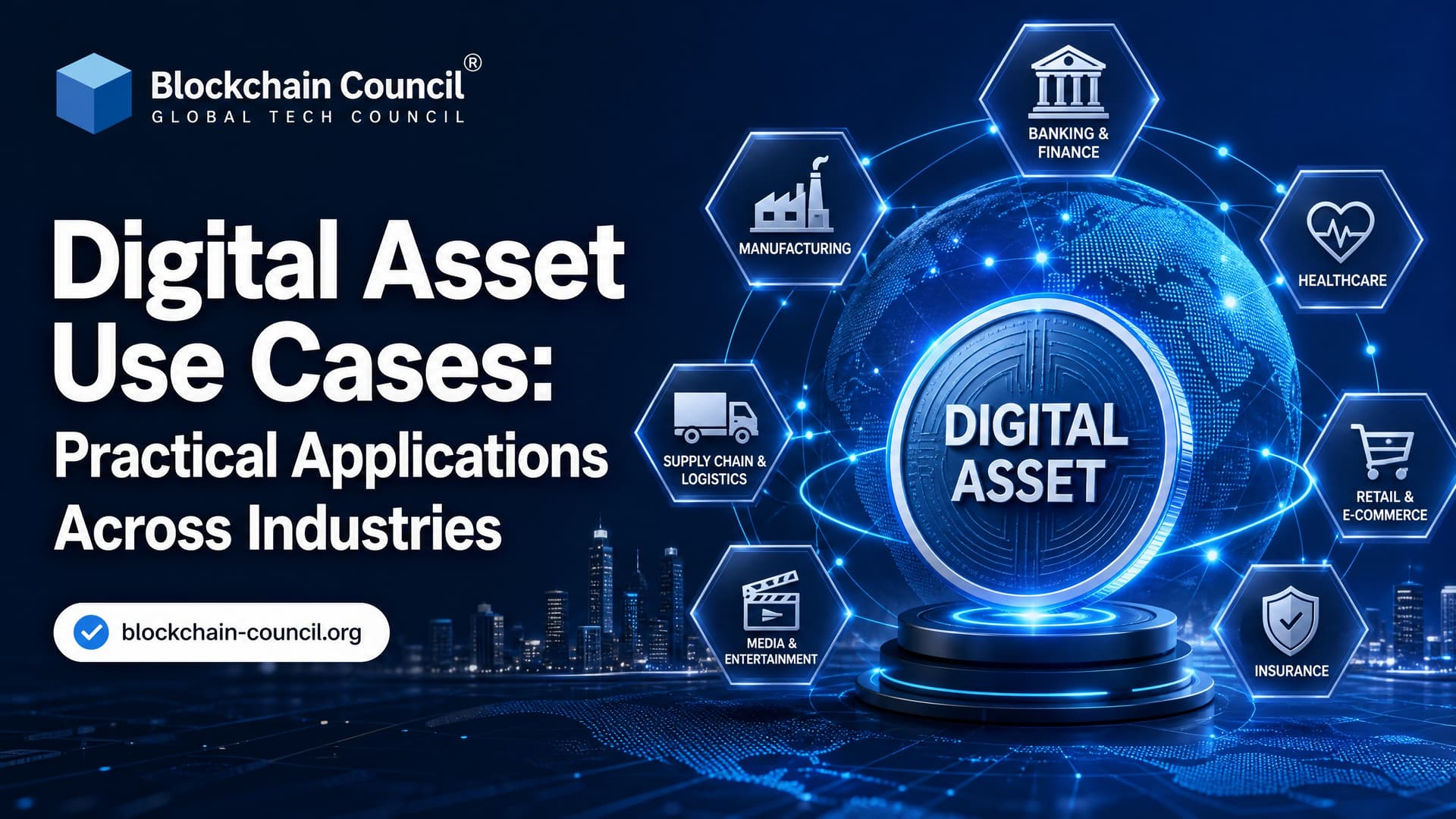
Digital asset use cases reach far beyond crypto trading desks and NFT marketplaces now. You will find digital assets in bank settlement systems, supply chain audit trails, real estate tokenization pilots, customer loyalty programs, and enterprise content systems. The common thread is simple. A digital asset is any digitally stored item of value, ownership, access, or record that can be managed, transferred, verified, or monetized.
That definition matters. Bitcoin is a digital asset. So is a tokenized bond, a stablecoin, a patient record access credential, a digital media library, a carbon credit, or an in-game item. The practical question is not whether digital assets are real. They are. The real question is where they solve a business problem better than the system they replace.

As digital assets become part of mainstream finance and enterprise operations, professionals need more than a basic understanding of cryptocurrencies. A Certified Digital Assets Expert credential helps build practical knowledge of tokenization, digital asset management, governance, compliance, and emerging blockchain applications, making it easier to evaluate real-world business use cases.
What Counts as a Digital Asset?
Digital assets now span several categories:
Cryptocurrencies and stablecoins: Bitcoin, Ether, and fiat-backed tokens used for payments, settlement, collateral, and investment.
Non-fungible tokens: Unique tokens representing art, media rights, collectibles, game items, or access privileges.
Tokenized real-world assets: Digital representations of securities, commodities, real estate, carbon credits, and fund interests.
DeFi assets: Governance tokens, liquidity provider tokens, and tokenized claims on lending or trading pools.
Enterprise digital assets: Brand files, customer data, software, databases, product media, and operational records.
Digital identity and records: Tokenized IDs, property titles, certificates, credentials, and licenses.
Crypto is part of the story, not the whole story. Digital assets have grown from Bitcoin and NFTs into financial instruments, business data, identity, sustainability markets, and everyday enterprise operations. Frame the topic that broadly and the use cases make more sense.
Why Digital Asset Adoption Is Accelerating
Institutional interest has moved from watching to active testing. A Fireblocks survey found that 44 percent of surveyed US banks were taking tangible action on digital assets, with 28 percent identifying use cases and 16 percent already in pilots or proof of concepts. The leading use case was payments at 36 percent, followed by custody at 24 percent, tokenization at 18 percent, and lending at 17 percent.
Morgan Stanley has described digital assets as a multi-trillion-dollar business moving closer to the center of global capital markets. TRM Labs has reported that financial institutions are looking past speculation toward stablecoin settlement, tokenized deposits, crypto-backed lending, custody, and real-time treasury functions.
Outside finance, the enterprise digital asset management market is growing fast. MarketsandMarkets projected the DAM market to rise from 5.3 billion dollars in 2024 to 10.3 billion dollars by 2029. That growth is not about coins. It is about companies needing better control over logos, videos, product data, marketing files, and regulated records.
Behind these growing use cases is blockchain technology, which enables secure recordkeeping, decentralized verification, and programmable digital ownership. A Certified Blockchain Expert credential helps professionals strengthen their understanding of blockchain architecture, consensus mechanisms, smart contracts, and enterprise adoption, providing the technical foundation needed to support digital asset initiatives across industries.
Digital Asset Use Cases in Banking and Payments
Banking is where many high-value use cases surface first.
Cross-border payments
Stablecoins and payment tokens can settle transactions faster than traditional correspondent banking routes. A business paying a supplier in another country may wait days through legacy rails, especially when several banks sit in the middle. A regulated stablecoin flow can cut that lag, though compliance screening and local regulations still apply.
Merchant settlement and treasury
For merchants, stablecoins can act as programmable settlement assets. Treasury teams are testing digital cash equivalents for faster movement between subsidiaries, exchanges, custodians, and counterparties. To be blunt, this beats using volatile tokens for everyday invoices. Stablecoins fit payments better than Bitcoin in most commercial workflows.
Tokenized deposits and securities
Banks and fintechs are exploring tokenized deposits, tokenized bonds, fund shares, and digital representations of equities. The advantage is not just fractional ownership. It is faster settlement, clearer audit trails, and programmable compliance rules. That said, tokenized securities are not a shortcut around securities law. If you issue a regulated asset, the token wrapper does not remove disclosure, custody, or investor protection duties.
Custody and trading
Custody is less glamorous than trading, but it is where real institutional adoption often begins. If private keys are lost, assets can be lost. If signing controls are weak, assets can be stolen. Banks see demand for secure custody of crypto, stablecoins, and tokenized instruments because clients need governance, reporting, insurance, and access controls.
If you build in this area, study key management deeply. A common beginner mistake in smart contract testing is treating wallet signatures as an afterthought. On Ethereum, a transaction signed for mainnet uses chain ID 1, and signing against the wrong network can break deployment workflows or expose users to replay assumptions in poorly designed systems.
Supply Chain and Logistics
Supply chain digital assets represent products, batches, documents, or certificates. A coffee shipment, luxury handbag, pharmaceutical batch, or aerospace part can link to a tokenized record that shows origin, custody changes, inspection data, and certification status.
The strongest use case here is provenance. If you need to prove that a product came from a verified supplier or passed through approved facilities, blockchain can create a shared record across companies that do not fully trust each other. It is not magic, though. Bad data entered at the source stays bad data. You still need scanners, audits, tamper-resistant packaging, and accountability.
Healthcare and Life Sciences
Healthcare uses digital assets differently. The asset may be a record, a credential, a consent token, or a shipment record.
Medical records: Patients can get stronger control over access permissions while providers verify data integrity.
Drug traceability: Tokenized shipment records can help pharmacies and regulators detect counterfeit drugs.
Clinical research: Consent records and trial data can be timestamped for auditability.
Privacy is the hard part. Do not put raw patient data directly on a public blockchain. A better pattern is to store sensitive data off-chain, then place hashes, permissions, or proofs on-chain. This trips up many certification candidates because they confuse immutability with safe public storage.
Real Estate and Tokenized Ownership
Real estate is a natural fit for tokenization because property ownership already depends on records, rights, payments, and transfer processes.
Use cases include tokenized property funds, fractional ownership, blockchain-based title registries, and smart contract escrow. A token can represent an economic interest in a building, rental income, or a fund that owns several properties.
But tokenized real estate is not automatically liquid. With no buyers, no compliant secondary market, and no clear redemption process, the token can be as illiquid as the underlying property. Use tokenization when it improves distribution, reporting, or settlement. Do not use it as decoration.
Retail, E-Commerce, and Consumer Brands
Retailers use digital assets for payments, loyalty, authentication, and engagement.
Crypto and stablecoin payments: Useful for global customers, especially where card access is limited or settlement fees run high.
Digital collectibles: Brands can issue NFTs as access passes, limited digital merchandise, or loyalty rewards.
Proof of authenticity: Physical products can link to digital certificates that verify origin and ownership history.
The best brand projects give customers a reason to care. A collectible that grants event access or warranty benefits beats a generic JPEG with no utility.
Media, Entertainment, and Gaming
Media companies already manage huge digital asset libraries: video, music, artwork, 3D models, scripts, metadata, and licensing files. Digital asset management systems help teams organize, permission, version, and distribute that content.
Blockchain adds another layer when ownership and transferability matter. NFTs can represent art, music rights, game items, or limited releases. Gaming is especially practical because players already understand virtual goods. Still, not every game needs on-chain items. If the asset never leaves one closed game economy, a regular database is often cheaper and faster.
Government, Identity, and Public Records
Governments can use digital assets for identity credentials, property records, certificates, permits, and voting audit trails. The core benefit is tamper resistance. A birth certificate, land title, or professional license can be verified without relying on a fragile paper process.
Digital identity is one of the more serious long-term use cases. Citizens can hold cryptographic credentials and share only the information a service needs. Done well, this cuts fraud. Done badly, it creates surveillance risk. Design choices matter.
Successfully deploying digital asset solutions also requires expertise beyond blockchain itself, including cybersecurity, cloud infrastructure, APIs, enterprise integration, analytics, and automation. A Tech Certification helps professionals develop these complementary technical skills, enabling them to design and manage secure, scalable digital asset ecosystems.
Environmental Markets
Carbon credits and environmental certificates can be tokenized so issuance, transfer, and retirement are easier to track. This can support sustainability reporting and reduce double counting.
Quality control is the catch. A tokenized low-quality carbon credit is still low quality. Buyers need project verification, registry alignment, and clear retirement records. Blockchain improves tracking, not environmental truth on its own.
How to Evaluate a Digital Asset Use Case
Before you build, ask five practical questions:
What asset is being represented? Money, ownership, identity, content, data, or access?
Who needs to verify it? One company, many partners, regulators, or the public?
Does it need transferability? If not, a conventional database may be enough.
What are the legal rights? A token must map to enforceable rights, especially for securities and property.
How will keys and custody be managed? Poor wallet controls can wreck an otherwise sound system.
Developers should test contract behavior carefully too. In Solidity 0.8.x, arithmetic overflow checks are built in by default, which changed assumptions from older versions that required SafeMath for basic overflow protection. Small version details like that affect audits, gas costs, and deployment behavior.
Skills Professionals Need Next
If you work in finance, risk, product, or engineering, focus on three areas: tokenization models, custody and compliance, and smart contract fundamentals. For structured learning, Blockchain Council programs such as the Certified Blockchain Expert™, Certified Blockchain Developer™, Certified Smart Contract Developer™, and Certified Cryptocurrency Expert™ map well to role-based training paths.
Your next step is concrete. Pick one use case in your industry and map the asset, the owner, the transfer rules, the verification process, and the compliance controls. If that map shows multiple parties need a shared, tamper-resistant record, digital assets may be the right tool. If it does not, save the blockchain budget for a problem that deserves it.
As digital asset adoption continues to expand across industries, organizations also need professionals who can clearly communicate the value of these technologies to customers, partners, investors, and internal stakeholders. A Marketing Certification helps strengthen strategic communication, brand positioning, and market education skills, complementing technical expertise while supporting successful digital transformation initiatives.
FAQs
1. What are digital asset use cases?
Digital asset use cases refer to the practical ways blockchain-based assets such as cryptocurrencies, stablecoins, tokenized real-world assets (RWAs), non-fungible tokens (NFTs), and digital securities are applied across industries. These applications aim to improve efficiency, transparency, security, and accessibility in digital and financial ecosystems.
2. How are digital assets used in financial services?
Financial institutions use digital assets for cross-border payments, settlement, tokenized deposits, asset tokenization, digital custody, decentralized finance (DeFi), and liquidity management. Adoption depends on regulatory requirements, operational readiness, and the specific financial products involved.
3. How do digital assets improve cross-border payments?
Digital assets can enable faster settlement and reduce reliance on multiple intermediaries for certain payment workflows. While benefits vary by implementation, organizations may experience improved transaction transparency and lower operational complexity compared to some traditional payment methods.
4. How are digital assets used in supply chain management?
Supply chain organizations use digital assets and blockchain technology to track goods, verify product authenticity, manage ownership records, automate documentation, and improve end-to-end traceability. These capabilities can enhance transparency and reduce fraud across complex global supply chains.
5. What role do digital assets play in healthcare?
Healthcare providers are exploring digital assets for secure medical record management, consent tracking, pharmaceutical traceability, research collaboration, and digital identity verification. Implementations must comply with applicable healthcare regulations and data privacy requirements.
6. How are digital assets transforming real estate?
Real estate firms are using tokenization to represent ownership interests in properties, streamline transactions, improve liquidity for certain assets, and simplify recordkeeping. Legal structures and regulatory treatment vary significantly across jurisdictions.
7. How are digital assets applied in retail and e-commerce?
Retailers use digital assets for customer loyalty programs, digital gift cards, tokenized rewards, secure payments, NFT-based memberships, and authenticated digital collectibles. These initiatives can strengthen customer engagement while enabling new digital business models.
8. How do governments use digital assets?
Governments are exploring blockchain-based digital assets for land registries, digital identity systems, public record management, tax administration, procurement transparency, and research into central bank digital currencies (CBDCs). Adoption differs by country and regulatory framework.
9. How are digital assets used in insurance?
Insurance companies are evaluating digital assets and smart contracts to automate claims processing, improve policy administration, reduce fraud, and streamline verification processes. These applications may improve operational efficiency when integrated with existing systems.
10. What role do digital assets play in manufacturing?
Manufacturers use blockchain-based digital assets to monitor product lifecycles, verify component authenticity, manage supplier relationships, track inventory, and support quality assurance. Tokenized records can improve traceability across production and distribution networks.
11. How are digital assets used in the entertainment industry?
Entertainment companies use digital assets for NFT collectibles, digital ticketing, royalty distribution, fan engagement, gaming assets, creator monetization, and intellectual property management. Business models continue to evolve as technology and regulations mature.
12. How do educational institutions use digital assets?
Educational organizations use blockchain technology to issue tamper-resistant digital certificates, verify academic credentials, manage lifelong learning records, and support decentralized identity initiatives for students and graduates.
13. How are digital assets used in energy and sustainability?
Energy companies are exploring tokenized carbon credits, renewable energy certificates, peer-to-peer energy trading, and blockchain-based sustainability reporting. These applications can improve transparency in environmental reporting and energy markets.
14. What role does AI play in digital asset applications?
Artificial intelligence supports fraud detection, transaction monitoring, predictive analytics, compliance automation, customer service, cybersecurity, portfolio analysis, and operational optimization. AI outputs should be reviewed alongside human expertise and organizational controls.
15. What are tokenized real-world assets (RWAs)?
Tokenized real-world assets are physical or traditional financial assets represented as digital tokens on a blockchain. Examples include real estate, bonds, commodities, private credit, artwork, and investment funds, with ownership rights governed by applicable legal and regulatory frameworks.
16. What regulatory considerations apply to digital asset use cases?
Organizations should consider securities regulations, anti-money laundering (AML), know-your-customer (KYC), consumer protection, tax reporting, sanctions compliance, privacy laws, intellectual property rights, and sector-specific guidance. Regulatory requirements vary across jurisdictions and industries.
17. What challenges do organizations face when adopting digital assets?
Common challenges include regulatory uncertainty, cybersecurity risks, interoperability limitations, legacy system integration, scalability, governance, operational complexity, employee training, and establishing clear business cases for adoption.
18. What trends are shaping digital asset use cases in 2026?
Key trends include institutional tokenization of real-world assets, AI-powered blockchain analytics, stablecoin adoption, decentralized identity solutions, enterprise blockchain integration, programmable payments, cross-chain interoperability, digital custody innovations, and expanding regulatory frameworks.
19. How can businesses successfully implement digital asset solutions?
Businesses should begin by identifying measurable use cases, performing legal and regulatory assessments, selecting appropriate technology platforms, implementing strong security and governance controls, conducting pilot programs, and continuously monitoring performance and compliance.
20. What is the future of digital asset applications across industries?
Digital assets are expected to become increasingly integrated into finance, healthcare, supply chains, government services, manufacturing, retail, and digital commerce as technology and regulatory frameworks continue to mature. Organizations that focus on practical business value, security, compliance, and interoperability are likely to be better positioned for sustainable adoption than those pursuing technology without a clearly defined purpose. Sometimes the most valuable digital asset is not the token itself, but the trust built around how it is managed.
Related Articles
View All
Digital Assets
RWA Tokenization in Institutional Finance: Use Cases for Banks and Asset Managers
RWA tokenization is moving into production across tokenized funds, collateral networks, deposits, bonds, private credit, and trade finance.

Digital Assets
Best RWA Tokenization Platforms: Features, Use Cases, and Selection Criteria
Compare the best RWA tokenization platforms, including Securitize, Ondo Finance, Franklin Templeton, Centrifuge, Maple, Paxos, Tether, and Tokeny.

Digital Assets
How RWA Tokenization Improves Transparency Across Asset Markets
RWA tokenization improves transparency by making ownership, transfers, compliance rules, and market data auditable across asset markets.
Trending Articles
AWS Career Roadmap
A step-by-step guide to building a successful career in Amazon Web Services cloud computing.

Top 5 DeFi Platforms
Explore the leading decentralized finance platforms and what makes each one unique in the evolving DeFi landscape.
What is AWS? A Beginner's Guide to Cloud Computing
Everything you need to know about Amazon Web Services, cloud computing fundamentals, and career opportunities.