

What Is an RWA Token? Meaning, Features, and Use Cases
 Suyash Raizada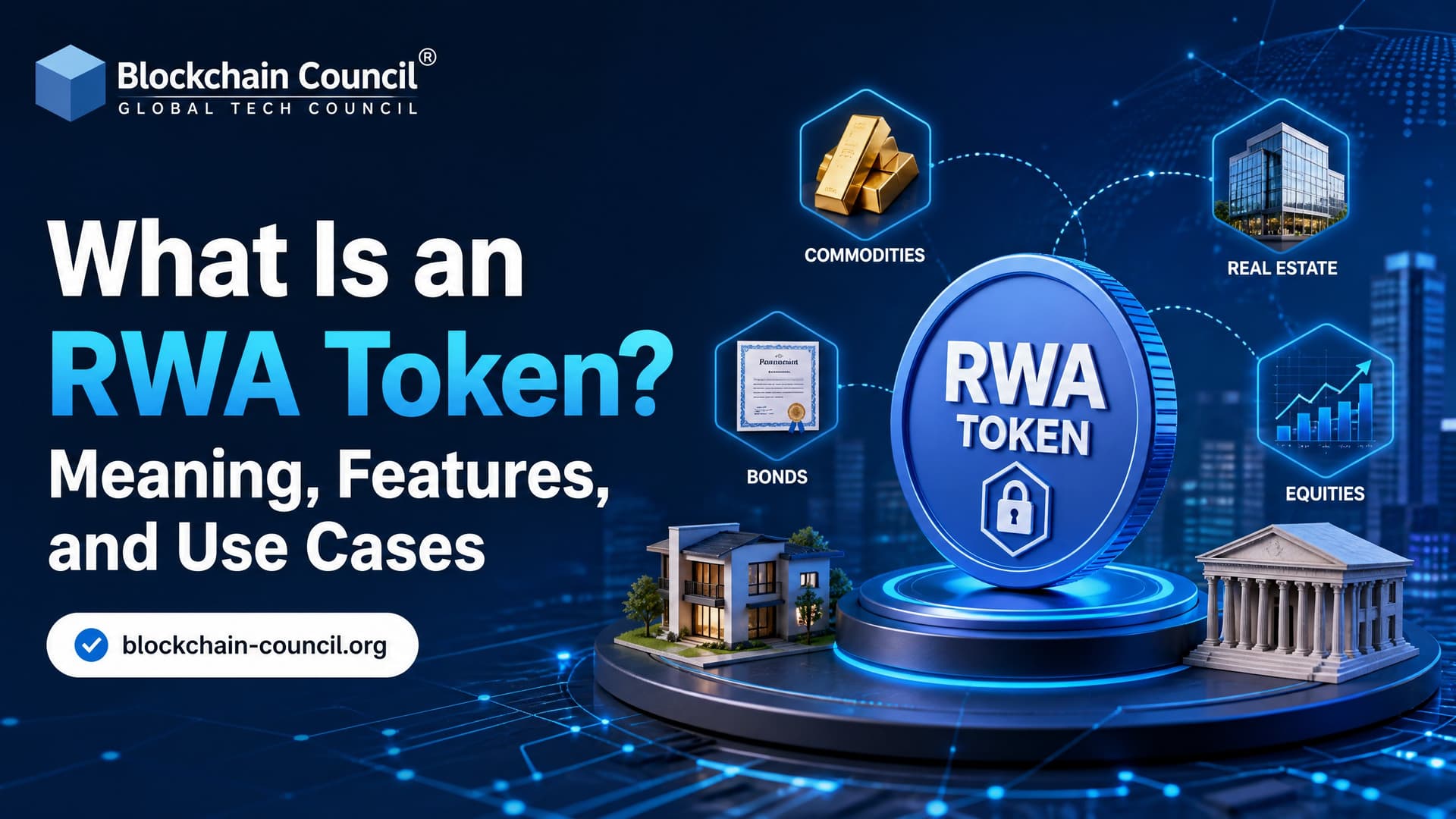
An RWA token is a blockchain-based token that represents ownership, a claim, or economic rights in a real-world asset such as a US Treasury bill, gold, real estate, equities, or private credit. The key point is simple. The token lives on-chain, but the asset or legal claim behind it exists off-chain. Anyone looking to work seriously in this space, whether as a builder, analyst, or compliance professional, often starts by exploring a Certified RWA Tokenization Expert credential to get a structured view of how these tokens are designed and regulated.
This makes RWA tokens different from native cryptoassets like ETH or BTC. Their value is not mainly tied to network usage or crypto market sentiment. It is tied to custody, legal rights, redemption terms, and the performance of the underlying asset. That is why RWA tokenization sits where blockchain engineering, capital markets, custody, and regulation meet.

Meaning: What Is an RWA Token?
A real-world asset token is a digital representation of an asset that exists outside the blockchain. It may represent a share of a money market fund, a gram of vaulted gold, a fraction of a property title, or exposure to a private loan. Professionals mapping out a broader career in this field sometimes pair this knowledge with a Certified Digital Assets Expert track, since it covers the wider digital asset landscape that RWA tokens are part of.
In a typical structure, a regulated custodian, trustee, or legal entity holds the underlying asset. A smart contract then issues tokens that track ownership or economic rights. If the asset produces income, such as Treasury interest or fund distributions, the token structure defines how that income is paid or reflected in token value.
Many RWA tokens use ERC-20 on Ethereum or compatible networks because ERC-20 works with common wallets, exchanges, custody systems, and DeFi protocols. That said, an RWA token is not just an ERC-20 with a serious name attached. The legal wrapper matters as much as the contract.
RWA Tokens vs Native Cryptoassets
Native cryptoassets: ETH, BTC, SOL, and similar assets derive value from network utility, monetary policy, security budgets, and market demand.
RWA tokens: These represent off-chain assets or claims. Value depends on asset backing, custody, redemption, and legal enforceability.
Stablecoins: A stablecoin is a major form of tokenized real-world value, but many RWA market dashboards exclude them to focus on Treasuries, credit, funds, commodities, and property.
How an RWA Token Works
The mechanics vary by asset class, but most RWA token models follow a similar path:
Asset selection: An issuer chooses an asset such as a Treasury bill, bond fund, gold bar, loan pool, or property interest.
Legal structuring: A fund, special purpose vehicle, trust, or similar entity defines investor rights.
Custody: The underlying asset is held by a qualified custodian, bank, trustee, vault operator, or regulated financial institution.
Token issuance: A smart contract mints tokens that represent the claim or economic exposure.
Compliance controls: Transfers may be restricted by allowlists, jurisdiction checks, investor status, or holding limits.
Redemption and reporting: Token holders need clear rules for redeeming tokens, receiving distributions, and verifying collateral.
Here is the practitioner reality. The smart contract is often the easier part. In tokenized securities work, transfer restrictions break test suites more often than mint logic. If an ERC-20 RWA token uses OpenZeppelin AccessControl and you forget to grant a transfer-agent or compliance role, you will usually see an error like AccessControl: account 0x... is missing role 0x.... That is not a small bug. It shows how legal restrictions must be translated into code before the token can move at all.
Core Features of RWA Tokens
Asset-backed Claims
Each RWA token should be linked to identifiable off-chain collateral or a legally defined claim. Serious RWA products disclose custody arrangements, redemption terms, collateral verification, and the role of each service provider. Binance Research, for example, has described active tokenized RWAs as products with verified collateral, disclosed custody, and clear redemption rules.
Programmability
Once tokenized, assets can plug into on-chain workflows. Tokenized Treasuries can serve as collateral. Fund tokens can move between approved wallets. Credit tokens can integrate with lending protocols. This is where RWA tokenization becomes more than a digital certificate.
Yield-bearing Exposure
Tokenized Treasuries and money market funds have become popular because they give on-chain investors a yield-bearing alternative to idle stablecoins. Instead of holding only a dollar-pegged token, an investor may hold tokenized exposure to government debt or regulated funds while keeping the asset programmable.
Fractional Ownership
Large assets can be divided into smaller units. Real estate is the obvious example. A commercial property that would normally require a large ticket size can be split into many tokens, subject to securities laws and platform rules. Dubai's regulated market for tokenized title deeds, reportedly linked to the official land registry, is a useful example of this model moving beyond pilot projects.
Standards and Interoperability
ERC-20 remains widely used, but RWA tokens need more than basic transfer and balance functions. Compliance checks, lifecycle events, forced transfers, freezes, redemption, and investor identity rules all need standard treatment. Emerging RWA-focused token standards and frameworks, including work from the Swiss Capital Markets and Technology Association on its CMTAT standard, aim to reduce integration pain for issuers, custodians, wallets, and exchanges. Teams building toward these standards often round out their skillset with a broader Tech Certification, which helps engineers connect token-level compliance work to the wider technology stack it has to live inside.
Transparency and Auditability
RWA token holders need proof that the asset exists and that the issuer can honor redemption. Many platforms publish attestations, audit reports, portfolio data, and on-chain analytics. Dashboards such as RWA.xyz and DeFiLlama are often used to track market size, asset class split, and issuer activity.
RWA Token Market Size in 2025 and 2026
RWA tokenization grew sharply from early 2025 into 2026. Different trackers use different methodologies, so the totals do not match exactly. The direction is clear.
Tokenized RWA market capitalization, excluding stablecoins, climbed from a few billion dollars at the start of 2025 to the tens of billions across 2025 and 2026.
Public estimates for tokenized RWAs on public blockchains ranged into the low tens of billions of dollars by 2026, depending on the tracker.
RWA.xyz figures cited by several industry sources showed strong growth in freely transferable tokenized RWAs across a rapidly rising number of wallets.
Treat any single figure with care. Methodologies differ on whether they count stablecoins, private deals, or represented value versus distributed value. The largest categories are US Treasuries, private credit, tokenized funds, gold, equities, and real estate. Treasuries lead because they are familiar to institutions, easier to price, and naturally yield-bearing.
Major RWA Token Use Cases
Tokenized Treasuries and Funds
Tokenized US Treasuries are the flagship RWA use case. They give crypto-native firms and institutional investors access to government bond yields in a form that can be transferred, held in custody wallets, or used as collateral. BlackRock and Franklin Templeton have expanded tokenized fund products, which is one reason this category gets serious attention from banks and asset managers.
Private Credit and Structured Loans
Private credit tokenization packages loans or credit exposures into on-chain assets. Protocols such as Centrifuge and Maple Finance are often cited here. The attraction is access to yield and alternative lending markets. The risk is underwriting quality. Do not treat a tokenized loan as safer simply because it sits on-chain.
Tokenized Equities and ETFs
Tokenized stocks, funds, and ETFs can support cross-border access and faster settlement. Industry data for 2026 places tokenized equities and ETFs in the low single-digit billions of dollars, depending on the tracker. Reports have also noted Nasdaq-related work on tokenized listed securities, a sign that traditional venues are studying how tokenization can fit existing market infrastructure.
Real Estate Tokens
Real estate tokenization aims to reduce large ticket sizes and improve transferability. This is promising, but slow. Property law, local registries, taxes, and investor protection rules are not solved by a smart contract. Dubai's title-linked token model is more credible than many older property-token pilots because registry integration matters.
Gold and Commodities
Gold-backed tokens represent claims on physical metal stored in vaults. Market estimates for tokenized gold and precious metals ran into the billions of dollars across 2026 datasets. These products appeal to investors who want commodity exposure without leaving blockchain rails.
Collateral, Repo, and Liquidity Management
Institutions are starting to use tokenized assets for collateral management, repo-style transactions, and on-chain liquidity. This may be where RWAs have the biggest long-term impact. Faster settlement and programmable collateral can cut operational friction, but only when custody, valuation, and legal terms are reliable.
Risks and Challenges
RWA tokens are not risk-free. In some ways they add new risks, because investors must trust both blockchain infrastructure and off-chain institutions.
Legal enforceability: Token ownership must map to a real claim in the relevant jurisdiction.
Custody risk: If the custodian, trustee, or issuer fails, the token can lose value even if the smart contract works perfectly.
Liquidity gaps: Secondary market liquidity for many tokenized RWA products remains thin, often a small fraction of market cap in daily volume, well below comparable liquid credit ETFs.
Fragmentation: Assets are split across chains, issuers, and platforms, which hurts price discovery.
Compliance complexity: Transfer restrictions, KYC, sanctions screening, and investor eligibility rules can limit composability.
What Should You Learn Next?
If you are a developer, focus on ERC-20, Solidity 0.8.x, token permissions, upgrade patterns, and oracle design. If you work in finance or compliance, study custody models, fund structures, redemption mechanics, and securities law basics. RWA tokenization fails when teams understand only one side.
For structured learning, explore certifications such as Certified Blockchain Expert™, Certified Blockchain Developer™, Certified Smart Contract Developer™, and Certified DeFi Expert™. If your goal is to build RWA products, pair smart contract training with a serious review of tokenized securities, custody, and compliance workflows.
Building Early Interest in Technology and Robotics
Interest in tokenization, coding, and emerging tech often starts well before a professional career begins. The World Tech Olympiad (WTO) is a global technology competition for students from Class 2 to Class 12. Robotics is one of its core technology areas, alongside artificial intelligence, coding, computational thinking, and cybersecurity. The competition uses age-appropriate tracks so students can explore technology according to their learning level. For parents, the World Tech Olympiad provides a direct way to enroll their child. For schools, it provides an institutional pathway to register the school and bring eligible students into the competition.
Final Takeaway
An RWA token is not magic finance on a blockchain. It is a programmable claim on a real asset, and its quality depends on custody, legal rights, standards, audits, and market liquidity. Start by examining one live product. Read its issuer documents, check the token contract, review redemption terms, and compare its on-chain data with third-party dashboards. That single exercise will teach you more than any headline market-cap number. If you're also thinking about how to communicate products like this to a non-technical audience, a Marketing Certification can round out the picture, since explaining RWA tokens clearly is often as hard as building them.
FAQs
1. What is an RWA token?
An RWA token (Real-World Asset token) is a blockchain-based digital token that represents ownership, an economic interest, or a legal claim connected to an asset that exists outside the blockchain. Examples include real estate, bonds, commodities, private credit, and investment funds.
2. What does RWA stand for in crypto?
RWA stands for Real-World Assets. In the blockchain and digital finance sector, the term refers to physical or traditional financial assets that can be represented digitally on a blockchain through tokenization.
3. How does an RWA token work?
An RWA token connects a blockchain-based digital representation with an underlying real-world asset or financial interest. A legal and operational structure defines the rights associated with the token, while blockchain technology records token ownership and transactions.
4. What assets can be represented by RWA tokens?
Many asset categories can potentially be tokenized, including real estate, government bonds, corporate bonds, commodities, private equity, private credit, investment funds, artwork, collectibles, and intellectual property-related rights.
5. What are the main features of RWA tokens?
Common features include blockchain-based ownership records, transferability, transparency, programmability, fractionalization, digital settlement, and smart contract functionality. Not every RWA token will have all these characteristics because features depend on its technical and legal design.
6. Are RWA tokens the same as cryptocurrencies?
No. Cryptocurrencies such as Bitcoin are generally native digital assets. RWA tokens are linked to real-world assets or financial claims, meaning their value and legal rights can depend on an underlying asset outside the blockchain.
7. How does RWA tokenization differ from traditional asset ownership?
Traditional ownership is commonly documented through legal contracts, government registries, financial institutions, custodians, or company records. RWA tokenization adds a blockchain-based digital representation that can make ownership records and transfers more programmable and digitally accessible.
8. Can RWA tokens provide fractional ownership?
Yes. RWA tokens can potentially divide an eligible investment interest into smaller digital units. This can enable fractional participation, allowing multiple investors to hold portions of an asset or investment rather than requiring one investor to purchase the entire interest.
9. What are the main use cases of RWA tokens?
RWA tokens can be used for tokenized real estate, government and corporate bonds, private credit, commodities, investment funds, private equity, artwork, and other financial or physical assets. They may also support collateral management, digital settlement, and automated distributions.
10. How are real estate assets represented through RWA tokens?
A real estate investment can be placed within an appropriate legal structure, with tokens representing defined ownership or economic interests. Depending on the arrangement, token holders could potentially receive rights to rental income, appreciation, or other financial benefits.
11. Can government bonds be issued as RWA tokens?
Yes. Government bonds can potentially be issued or represented using blockchain-based tokens. Tokenization may support digital issuance, ownership tracking, settlement, and automated interest payments, subject to the relevant regulatory and financial infrastructure.
12. Can gold be represented by an RWA token?
Yes. Tokenized gold can represent a claim or interest in physical gold held by a custodian or another legally defined arrangement. The token's value and redemption rights depend on the issuer's structure, custody arrangements, and legal terms.
13. What role do smart contracts play in RWA tokens?
Smart contracts can automate predefined activities associated with an RWA token, including transfers, payment distributions, ownership rules, compliance conditions, and settlement processes. This can reduce manual intervention in certain financial workflows.
14. Are RWA tokens regulated?
RWA tokens can be subject to regulation depending on what they represent and where they are issued or traded. They may involve securities, property, financial services, consumer protection, tax, anti-money-laundering, and digital-asset regulations. Requirements vary significantly between jurisdictions.
15. What are the benefits of RWA tokens?
Potential benefits include greater accessibility, fractional ownership, faster settlement, improved transparency, programmable transactions, automated administration, and potentially improved liquidity. These benefits are not guaranteed and depend on the asset, platform, market infrastructure, and legal framework.
16. What are the risks of RWA tokens?
RWA tokens can involve regulatory, market, liquidity, custody, cybersecurity, smart contract, valuation, and counterparty risks. There is also a risk that the token's legal rights may not match an investor's assumptions about direct ownership of the underlying asset.
17. How can investors verify an RWA token?
Investors should review the underlying asset, issuer, legal structure, token terms, custody arrangements, valuation methodology, blockchain records, transfer restrictions, and regulatory status. Independent audits, asset attestations, or other verification mechanisms can provide additional confidence when available.
18. Can RWA tokens improve liquidity?
They can potentially improve the transferability and accessibility of traditionally illiquid assets. However, tokenization does not automatically create liquidity. A liquid secondary market requires sufficient buyers and sellers, appropriate infrastructure, regulatory permission, and investor demand.
19. Why are financial institutions interested in RWA tokens?
Financial institutions are exploring RWA tokens because blockchain infrastructure may improve settlement, recordkeeping, asset distribution, collateral management, and automation. Tokenization can also connect traditional financial products with emerging digital financial infrastructure.
20. What is the future of RWA tokens?
RWA tokens could become an important part of the evolving digital financial system as blockchain technology, regulation, custody, and interoperability mature. Their potential extends across real estate, fixed income, private markets, commodities, funds, and other asset classes, but widespread adoption will depend on legal clarity, reliable asset verification, institutional participation, and sustainable market demand.
Related Articles
View All
Digital Assets
Best RWA Tokenization Platforms: Features, Use Cases, and Selection Criteria
Compare the best RWA tokenization platforms, including Securitize, Ondo Finance, Franklin Templeton, Centrifuge, Maple, Paxos, Tether, and Tokeny.

Digital Assets
RWA Tokenization in Institutional Finance: Use Cases for Banks and Asset Managers
RWA tokenization is moving into production across tokenized funds, collateral networks, deposits, bonds, private credit, and trade finance.

Digital Assets
How Institutions Use RWA Tokenization to Modernize Capital Markets
Institutions use RWA tokenization to issue bonds, funds, deposits, and real estate on blockchain rails while keeping legal and regulatory controls intact.
Trending Articles
How Blockchain Secures AI Data
Understand how blockchain technology is being applied to protect the integrity and security of AI training data.
Claude AI Tools for Productivity
Discover Claude AI tools for productivity to streamline tasks, manage workflows, and improve efficiency.
How to Install Claude Code
Learn how to install Claude Code on macOS, Linux, and Windows using the native installer, plus verification, authentication, and troubleshooting tips.