

Israel Securities Authority to use the Blockchain Messaging System
 Toshendra Kumar Sharma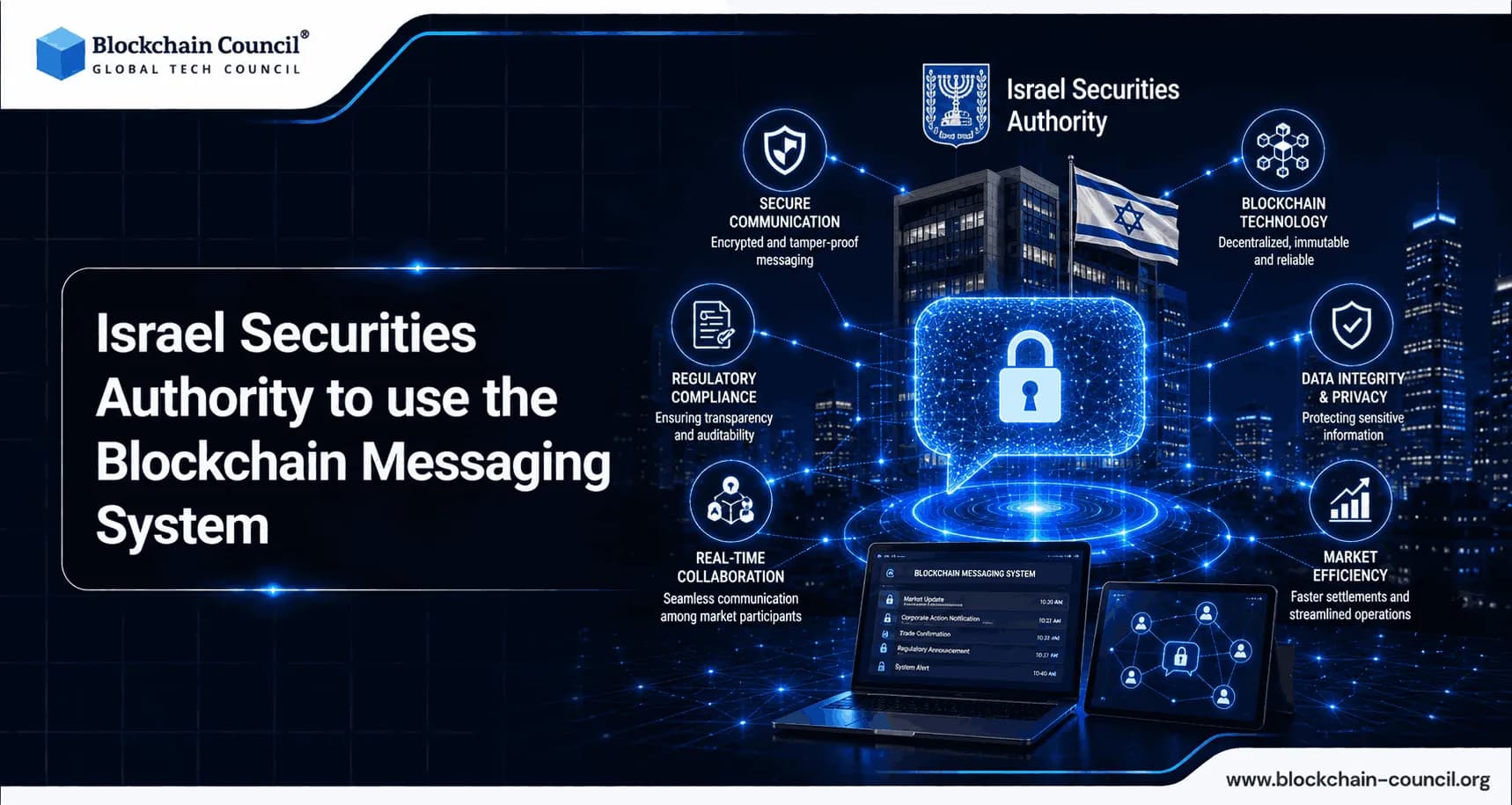
The Israel Securities Authority (ISA) has explored blockchain technology as a way to strengthen the security and reliability of its communications with entities under its supervision. In 2018, the regulator integrated blockchain into its Yael messaging system, adding a layer designed to verify the authenticity of messages and protect them against unauthorized alteration or deletion.
For professionals interested in understanding how blockchain can be applied to institutional systems, a Certified Blockchain Expert can provide foundational knowledge of distributed ledgers, blockchain architecture, security, and real-world applications.

Why Did the Israel Securities Authority Adopt Blockchain?
Financial regulators handle sensitive information that can influence companies, investors, and capital markets. Ensuring that official communications are authentic, traceable, and protected from unauthorized modification is therefore extremely important.
The ISA integrated blockchain into Yael to add another security layer to its existing messaging infrastructure. The system was used to communicate information from the authority to supervised entities.
Blockchain Adds an Additional Verification Layer
Rather than replacing the existing messaging infrastructure, blockchain was integrated as an additional layer. This approach allowed the authority to use blockchain's characteristics without completely rebuilding its existing systems.
The implementation illustrates an important enterprise blockchain principle: organizations can use distributed ledger technology for a specific problem instead of attempting to move their entire information infrastructure onto a blockchain.
How Does the Blockchain Messaging System Work?
The blockchain layer was designed to help establish the authenticity and integrity of messages sent through the Yael system.
According to reporting about the ISA's implementation, the technology could help:
Verify the authenticity of messages
Protect messages against unauthorized modification
Prevent fraudulent communications
Provide evidence associated with message receipt
Improve confidence in information transmitted to supervised entities
The OECD also reported that the blockchain integration was intended to prevent messages from being fabricated, edited, or erased and to reduce the possibility of denying receipt of communications.
Blockchain and Cybersecurity in Financial Regulation
Cybersecurity is particularly important for financial regulators because their systems process information involving public companies, investors, market participants, and regulatory activities.
Blockchain can contribute to cybersecurity by creating records that are difficult to alter without detection. However, blockchain should be viewed as one component of a broader security architecture rather than a complete cybersecurity solution.
A secure implementation still requires appropriate identity management, access controls, infrastructure security, monitoring, software maintenance, and governance.
For professionals focusing on this area, a Certified Blockchain Security Professional can help develop knowledge related to blockchain security principles and the protection of blockchain-based systems.
What Other ISA Systems Could Use Blockchain?
The ISA indicated plans to extend blockchain technology to other information systems. These included an online investor voting platform and Magna, the system used for electronic reports filed by entities under the authority's supervision.
Blockchain for Investor Voting
An online voting system can benefit from strong requirements around authentication, transparency, and record integrity. Blockchain could provide an additional mechanism for maintaining trustworthy records of voting-related activity.
The goal is not necessarily to make voting decentralized. Instead, blockchain can be used selectively to strengthen the integrity and traceability of digital records.
Blockchain for Regulatory Reporting
Magna is used for publishing electronic reports submitted by supervised entities. Applying blockchain concepts to such a system could potentially strengthen the integrity and traceability of regulatory information.
These applications demonstrate that blockchain can have value in regulatory technology, often referred to as RegTech, without necessarily involving cryptocurrency.
Why Is This Important for the Financial Industry?
The ISA's experiment is significant because it shows blockchain being applied by a financial regulator to an operational security problem.
Blockchain is often associated with cryptocurrencies, but distributed ledger technology can also be used for:
Regulatory reporting
Audit trails
Digital identity
Securities settlement
Investor voting
Document verification
Financial record management
Secure information exchange
The OECD noted that the ISA's blockchain initiatives aligned with its broader interest in financial innovation and regulatory technology.
Benefits of Blockchain for Regulatory Communication
Greater Data Integrity
Blockchain-based records can make unauthorized changes easier to detect, helping organizations maintain confidence in the integrity of important communications.
Better Traceability
A reliable transaction history can help organizations establish what information was recorded and when, supporting auditing and accountability.
Reduced Risk of Message Manipulation
When blockchain is appropriately integrated into a communication system, it can provide additional protection against attempts to alter or fabricate records.
Stronger Institutional Trust
Regulators depend on trusted communication with supervised entities. Additional verification mechanisms can increase confidence in the authenticity of information exchanged between institutions.
What Are the Challenges?
Blockchain adoption in regulatory systems also requires careful planning.
Integration With Existing Systems
Regulators cannot simply replace established infrastructure without considering operational continuity, compatibility, security, and cost. The ISA's approach demonstrates how blockchain can instead be added to existing systems for targeted purposes.
Privacy Requirements
Regulatory systems may contain confidential information. Blockchain implementations must therefore carefully control who can access transaction data and how information is stored.
Governance and Maintenance
A blockchain system still requires clear governance, responsible administrators, security controls, and ongoing maintenance. Technology alone cannot guarantee reliable outcomes.
Blockchain's Growing Role in RegTech
The ISA's adoption of blockchain reflects a broader movement toward using emerging technologies to improve financial regulation. Distributed ledger technology can potentially support more reliable records, automated compliance processes, auditing, and secure information sharing.
A broader Tech Certification can complement blockchain expertise by helping professionals develop wider technology knowledge relevant to digital transformation and emerging technology applications.
Future-Ready Skills
As technology becomes increasingly important across industries, students need opportunities to develop future-ready skills early in their education. A World Tech Olympiad can introduce students to areas such as artificial intelligence, coding, cybersecurity, robotics, and computational thinking while encouraging curiosity and continuous learning.
The Future of Blockchain in Financial Regulation
The ISA's blockchain messaging initiative provides an example of how regulators can use emerging technology for practical purposes. Instead of focusing solely on cryptocurrencies, blockchain can address specific institutional requirements involving information integrity, authentication, traceability, and secure recordkeeping.
As financial markets become increasingly digital, regulators may continue exploring blockchain alongside artificial intelligence, cloud computing, cybersecurity, and other technologies.
The most successful implementations are likely to be those that solve clearly defined problems while fitting within existing regulatory, technological, and governance frameworks.
Conclusion
The Israel Securities Authority's use of blockchain in its Yael messaging system demonstrates how distributed ledger technology can be applied to improve the security and credibility of regulatory communications. The initiative was designed to strengthen message authenticity, prevent unauthorized changes, and provide greater assurance around information exchanged with supervised entities.
The example also highlights an important lesson for financial institutions and regulators: blockchain does not need to replace existing systems to create value. When integrated strategically, it can provide an additional layer of verification, security, and traceability.
As financial regulation continues its digital transformation, professionals who understand both emerging technologies and business communication will become increasingly valuable. A Marketing Certification can provide complementary knowledge for professionals working with technology-driven organizations, digital strategies, and modern business environments.
FAQs
1. Why did the Israel Securities Authority use blockchain for its messaging system?
The Israel Securities Authority (ISA) adopted blockchain technology to strengthen the cybersecurity and reliability of its communications with regulated entities. The technology was integrated into its Yael messaging system to help verify message authenticity and protect information from unauthorized changes or deletion.
2. What is the Israel Securities Authority's blockchain messaging system?
The ISA's blockchain messaging system refers to the integration of blockchain technology into its Yael platform, which was used to send messages and information to organizations under the authority's supervision. Blockchain added an additional security and verification layer to the existing communication system.
3. What is Yael in the Israel Securities Authority?
Yael was an information system used by the Israel Securities Authority to communicate messages and information to entities it regulated. In 2018, blockchain technology was integrated into Yael to improve the credibility, authenticity, and security of those communications.
4. How does blockchain improve the security of ISA messages?
Blockchain can create tamper-resistant records that make unauthorized modification of recorded information more difficult. In the ISA's implementation, the technology was intended to verify the origin and authenticity of messages and prevent messages from being improperly edited or deleted.
5. Can blockchain prevent fraudulent messages?
Blockchain can help verify whether a message originated from an authorized source and whether its recorded contents have subsequently been altered. The ISA said its implementation added protection against forgery and strengthened confidence in information transmitted to regulated entities.
6. How can blockchain prove that a message was received?
A blockchain-backed messaging system can maintain verifiable records associated with message transmission and receipt. The ISA stated that its system was designed to prevent a recipient from denying that an official message had been received.
7. Did the ISA replace its existing database with blockchain?
No. Blockchain was integrated as an additional technology layer rather than completely replacing the existing database infrastructure. Contemporary reporting noted that the blockchain component complemented the database used by the ISA.
8. Who developed the ISA's blockchain messaging system?
The blockchain integration for the ISA's Yael system was developed by the Israeli IT company Taldor. Contemporary reports stated that development took approximately three months.
9. What are the main benefits of blockchain for government communication?
Blockchain can provide stronger data integrity, traceability, authentication, and auditability for official communications. These characteristics can be valuable when government agencies need to demonstrate that information was issued by an authorized source and was not subsequently altered.
10. Why is blockchain useful for financial regulators?
Financial regulators handle sensitive information involving companies, investors, markets, and regulatory filings. Blockchain can potentially provide an additional layer of integrity and auditability, helping regulators establish trustworthy records of communications and transactions.
11. Did the Israel Securities Authority plan to use blockchain beyond messaging?
Yes. In 2018, the ISA said it planned to integrate blockchain into additional systems, including an online voting system that would allow investors to participate remotely and Magna, its system for regulatory reports.
12. How could blockchain support online shareholder voting?
Blockchain could provide a verifiable record of votes and help establish confidence in the integrity of an electronic voting process. The ISA explored blockchain integration for its investor voting system to support participation in meetings regardless of investors' physical location.
13. What is Magna in the Israel Securities Authority ecosystem?
Magna is a system used for regulatory reporting by entities supervised by the ISA. The authority planned to explore blockchain integration for Magna so that regulatory information could benefit from additional integrity and traceability mechanisms.
14. Does the ISA's blockchain initiative involve cryptocurrency?
Not necessarily. The ISA's use of blockchain for its messaging infrastructure was focused on information security and data integrity, rather than creating or using a cryptocurrency. Blockchain is a technology that can support many applications beyond digital currencies.
15. Why is blockchain's immutability important for regulators?
Immutability, or strong resistance to retrospective alteration, can help preserve reliable records of important communications and transactions. For regulators, maintaining trustworthy historical information can be particularly important for audits, compliance, investigations, and accountability.
16. Can blockchain improve trust between regulators and financial institutions?
It can potentially improve trust by making important records easier to verify and by reducing uncertainty about whether information has been modified. In the ISA's case, the objective was to increase the credibility of information sent to organizations under its supervision.
17. Was the ISA an early government adopter of blockchain?
Yes. The 2018 implementation positioned the ISA as an early example of a public-sector regulator using blockchain technology for an operational cybersecurity application. The authority described the move as part of a broader global trend toward adopting innovative technologies in financial services.
18. How did the ISA view blockchain for Israel's capital market?
The ISA later examined distributed-ledger technology more broadly for digital securities markets. Its committee identified potential for DLT to advance Israel's capital market while emphasizing that risks should be managed carefully and that technology adoption should not compromise regulatory objectives.
19. What challenges can regulators face when adopting blockchain?
Regulators must consider cybersecurity, privacy, interoperability, scalability, governance, legal requirements, and integration with existing systems. The ISA itself emphasized the need for a controlled and responsible approach to adopting distributed-ledger technology within core systems.
20. What does the Israel Securities Authority's blockchain initiative demonstrate?
The ISA's initiative demonstrates that blockchain can have applications beyond cryptocurrency. Its use in regulatory messaging shows how distributed-ledger technology can be applied to authentication, data integrity, cybersecurity, auditability, and trusted communication within government and financial-market infrastructure.
Related Articles
View All
Blockchain
Blockchain in Banks: Use Cases, Benefits, Risks, and the AI Connection
Explore how blockchain in banks is reshaping payments, trade finance, tokenized deposits, KYC, AML, and AI-driven risk workflows.

Blockchain
User Experience in Blockchain Products: How to Make Web3 Apps Easier to Use
Learn how to improve user experience in blockchain products with simpler onboarding, clearer transaction flows, safer wallet UX, and better Web3 metrics.
Blockchain
Top Blockchain Use Cases in Banks and Financial Services
Explore the top blockchain use cases in banks, from payments and trade finance to tokenization, settlement, lending, KYC, and digital asset services.
Trending Articles
How to Install Claude Code
Learn how to install Claude Code on macOS, Linux, and Windows using the native installer, plus verification, authentication, and troubleshooting tips.
Blockchain in Supply Chain Provenance Tracking
Supply chains are under pressure to prove not just efficiency, but also authenticity, sustainability, and fairness. Customers want to know if their coffee really is fair trade, if the diamonds are con
How to Create Claude Skills?
Claude Skills are one of the most important features Anthropic has introduced for users who want automation that is structured, consistent and reusable. Instead of giving Claude long instructions ever