

How Blockchain Can Be Used in Asset Registry & Tracking?
 Toshendra Kumar Sharma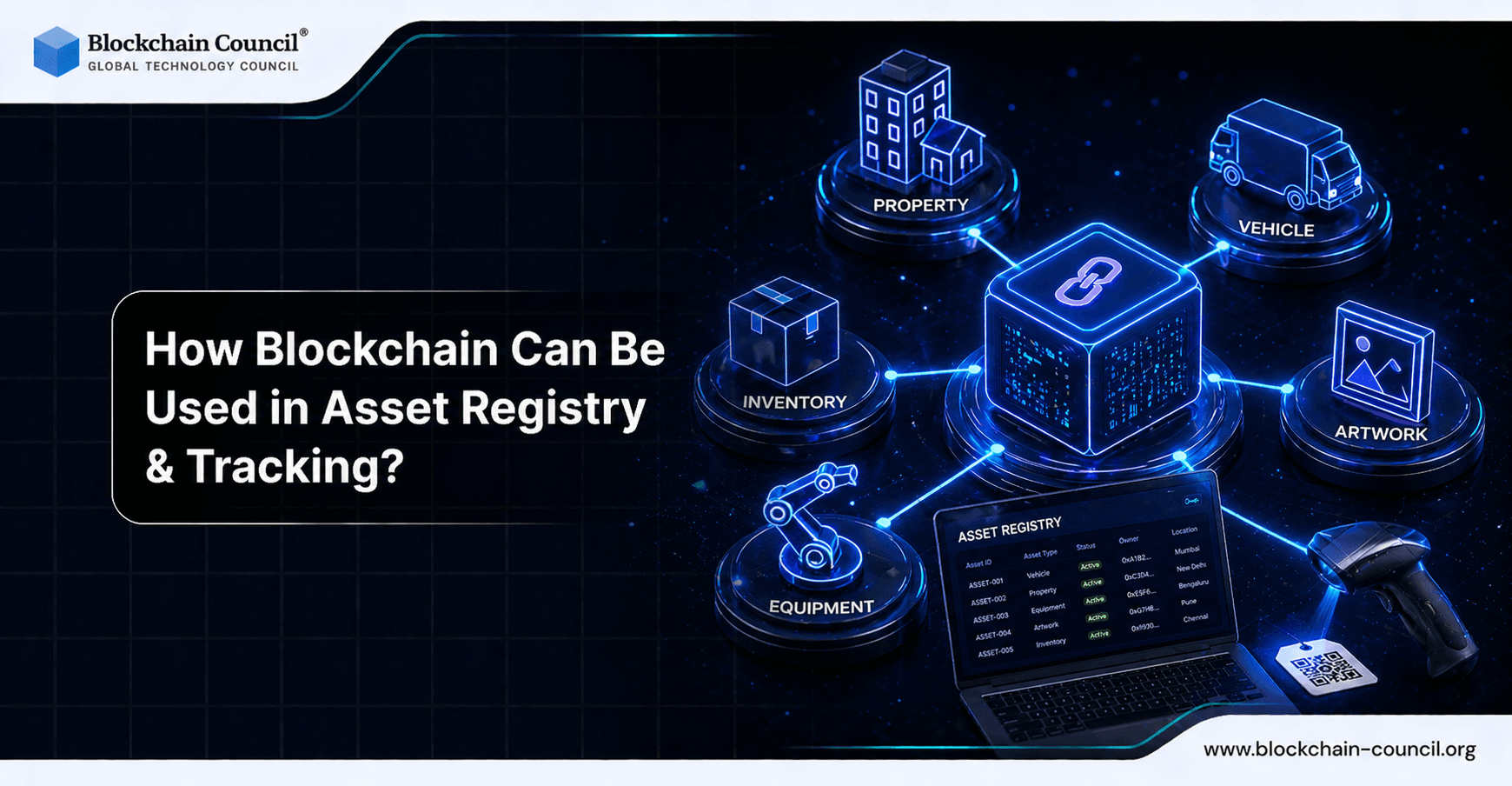
Blockchain technology is increasingly used to improve how assets are registered, tracked, and managed. From supply chains to real estate and digital assets, organizations need reliable systems to record ownership and monitor movement. Traditional systems often rely on fragmented databases, manual processes, and intermediaries, which can lead to errors, delays, and fraud.
Blockchain offers a decentralized and tamper-resistant solution for asset registry and tracking. It creates a single, shared source of truth that improves transparency, traceability, and trust across participants. Understand how blockchain enables transparent asset registries and real-time tracking across supply chains by building expertise through a Certified Blockchain Expert, developing tracking systems using a Python certification, and scaling adoption using a Digital marketing course.

This explains how blockchain works in asset registry and tracking, its benefits, real-world use cases, and challenges in 2026.
What Is Asset Registry and Tracking?
Asset registry refers to the process of recording ownership and details of assets in a system. Asset tracking involves monitoring the location, status, and movement of those assets over time.
Assets can include physical items such as goods, machinery, and real estate, as well as digital assets like intellectual property or tokens.
Accurate registry and tracking are essential for compliance, auditing, and operational efficiency.
Limitations of Traditional Systems
Traditional asset management systems face several challenges.
Data is often stored in isolated databases, leading to inconsistencies. Manual processes increase the risk of human error. Verification requires intermediaries, which adds time and cost.
Records may be incomplete or outdated, making it difficult to trace asset history. Paper-based documentation and fragmented systems reduce efficiency and transparency.
These limitations make it harder to maintain a reliable and unified record of assets.
How Blockchain Improves Asset Registry
Blockchain provides a decentralized ledger where asset data is recorded securely and transparently.
Each asset can be assigned a unique digital identity. Ownership and transaction history are stored as immutable records.
Because all participants access the same ledger, there is no need for reconciliation between systems. This creates a single source of truth for asset information.
How Blockchain Improves Asset Tracking
Blockchain enhances tracking by recording every movement or status change of an asset.
Each transaction is time-stamped and linked to previous records. This creates a complete and verifiable history.
Participants can track assets in real time, improving visibility across supply chains and operations.
Integration with technologies like IoT devices further improves tracking accuracy.
How Blockchain Asset Registry Works
Blockchain-based asset registry follows a structured process.
First, an asset is digitized and assigned a unique identifier. This identifier is recorded on the blockchain.
Next, ownership details are added, along with relevant metadata such as location and condition.
When the asset is transferred, a new transaction is recorded. This updates ownership and maintains a continuous history.
All changes are validated by the network and stored permanently.
Role of Smart Contracts
Smart contracts automate processes in asset management.
They can enforce rules such as ownership transfer, compliance checks, and access permissions.
For example, a smart contract can automatically transfer ownership when payment is received.
This reduces manual intervention and improves efficiency.
Tokenization of Assets
Tokenization is a key concept in blockchain asset management.
Physical or digital assets are represented as tokens on a blockchain. These tokens can be transferred, divided, or traded.
Tokenization improves liquidity and simplifies ownership transfer. It is widely used in real estate, art, and financial assets.
Benefits of Blockchain in Asset Registry and Tracking
Blockchain offers several advantages.
It improves transparency by providing a shared and verifiable record. It enhances traceability by recording every transaction.
Security is strengthened through cryptographic protection. Costs are reduced by eliminating intermediaries and manual processes.
Trust is increased among participants, as all data is consistent and tamper-resistant.
Real-World Use Cases
Blockchain is used across various industries for asset registry and tracking.
In supply chains, companies track goods from production to delivery. In real estate, ownership records are stored securely and transferred efficiently.
Healthcare systems track medical equipment and records. Governments use blockchain for land registries and public records.
These applications demonstrate the practical value of blockchain.
Integration with IoT and Other Technologies
Blockchain becomes more powerful when combined with other technologies.
IoT devices can provide real-time data about asset location and condition. This data can be recorded on the blockchain.
Artificial intelligence can analyze asset data to improve decision-making.
Integration ensures accurate and automated tracking.
Challenges and Limitations
Despite its benefits, blockchain adoption faces challenges.
Regulatory frameworks are still evolving, especially for asset ownership. Integration with existing systems can be complex.
Scalability remains a concern for large-scale operations. Data privacy must be managed carefully.
Organizations must address these issues for successful implementation.
Blockchain vs Traditional Asset Systems
Traditional systems rely on centralized databases and manual processes. Blockchain uses a decentralized ledger with automated validation.
Blockchain provides greater transparency and security, while traditional systems offer familiarity and established workflows.
Hybrid systems are emerging to combine the strengths of both approaches. Build blockchain-based asset tracking solutions with immutable records and audit trails by mastering enterprise systems through a Certified Blockchain Expert, integrating backend systems using a Node JS Course, and promoting enterprise solutions using an AI powered marketing course.
The Future of Asset Registry and Tracking
Blockchain is expected to play a major role in asset management.
Tokenization will expand to more asset classes. Real-time tracking will become standard with IoT integration.
Regulatory clarity will improve adoption. Businesses will increasingly rely on blockchain for accurate and efficient asset management.
Frequently Asked Questions
1. What is asset registry in blockchain?
Asset registry is the process of recording ownership and details of assets on a blockchain.
2. What is asset tracking in blockchain?
Asset tracking involves monitoring the movement and status of assets using blockchain technology.
3. How does blockchain improve asset tracking?
It provides a transparent and immutable record of all asset movements and transactions.
4. What types of assets can be tracked?
Both physical assets like goods and digital assets like tokens can be tracked.
5. What is tokenization of assets?
Tokenization converts assets into digital tokens that can be managed on a blockchain.
6. Are blockchain records secure?
Yes, blockchain uses cryptography to protect data from tampering.
7. What is a smart contract in asset management?
It is a program that automates processes such as ownership transfer and compliance checks.
8. Can blockchain reduce fraud in asset tracking?
Yes, transparent and immutable records make fraud more difficult.
9. What industries use blockchain for asset tracking?
Supply chain, real estate, healthcare, and government sectors use it widely.
10. What is a digital asset identity?
It is a unique identifier assigned to an asset on the blockchain.
11. How does IoT work with blockchain?
IoT devices provide real-time data that can be recorded on the blockchain.
12. Is blockchain scalable for asset tracking?
Scalability is improving, but large-scale systems still face challenges.
13. What are the benefits of blockchain asset registry?
Benefits include transparency, security, efficiency, and reduced costs.
14. Can blockchain replace traditional systems?
It can improve or complement them, but full replacement depends on adoption.
15. What is the role of metadata in asset tracking?
Metadata provides additional information such as location, condition, and ownership details.
16. How does blockchain ensure data accuracy?
Data is validated by multiple nodes before being added to the ledger.
17. What are the challenges of blockchain adoption?
Challenges include regulation, integration, and technical complexity.
18. Can blockchain track real-time asset movement?
Yes, especially when integrated with IoT devices.
19. What is the future of blockchain in asset management?
It will expand with better technology, regulation, and integration.
20. Is blockchain suitable for small businesses?
Yes, but adoption depends on cost, use case, and technical readiness.
Related Articles
View All
Blockchain
Top Blockchain Intelligence Tools for Tracking Wallets, Transactions, and DeFi Activity
Explore the top blockchain intelligence tools for wallet tracking, transaction tracing, DeFi analytics, compliance screening, and market research.

Blockchain
Blockchain Certification Programs You Can Join Online
Discover the best blockchain certification programs you can join online. Learn blockchain fundamentals, smart contracts, enterprise blockchain, and career opportunities with globally recognized certifications.

Blockchain
Agile for Blockchain Teams: Managing Sprints, Smart Contracts, and Decentralized Roadmaps
Learn how agile for blockchain teams works when sprints, smart contracts, audits, governance, and decentralized roadmaps are planned around risk.
Trending Articles
The Role of Blockchain in Ethical AI Development
How blockchain technology is being used to promote transparency and accountability in artificial intelligence systems.
AWS Career Roadmap
A step-by-step guide to building a successful career in Amazon Web Services cloud computing.

Top 5 DeFi Platforms
Explore the leading decentralized finance platforms and what makes each one unique in the evolving DeFi landscape.