

How Blockchain Can Be Used In Payments-B2B, B2C, P2P & How It Works?
 Toshendra Kumar Sharma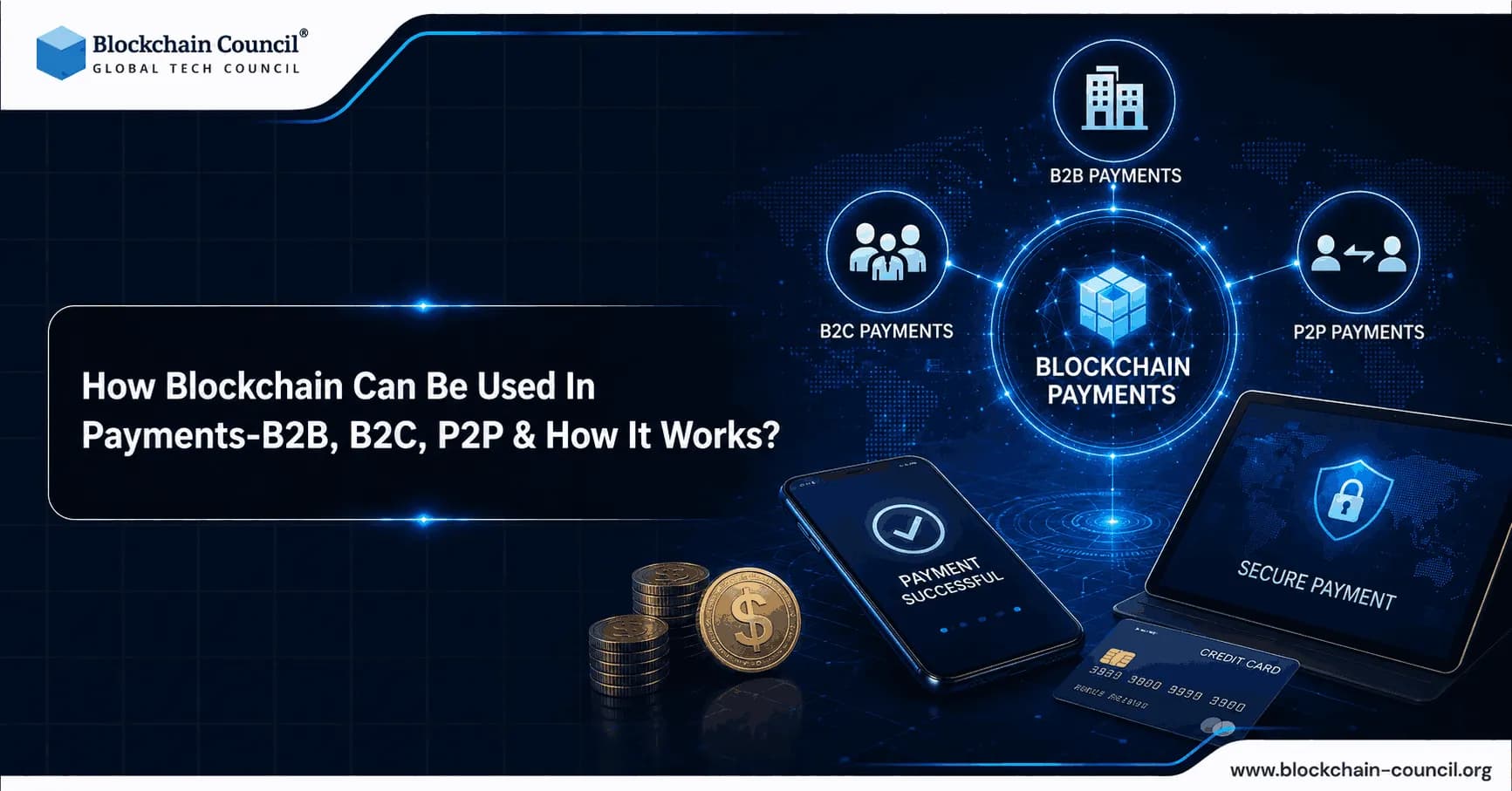
Moving money across borders, between businesses, or even between friends still often means dealing with delayed settlements, high transfer fees, and multiple intermediary banks clearing a single transaction. Blockchain technology is reshaping payments by enabling direct, verifiable transfers of value without relying on a chain of intermediaries to process every transaction. As businesses and consumers increasingly adopt blockchain-based payment rails, more professionals are pursuing a Certified Blockchain Expert credential to understand how this technology is transforming B2B, B2C, and peer-to-peer (P2P) payments alike.
In this article, we'll break down how blockchain powers each of these payment models, how the technology works step by step, the benefits it offers over traditional payment rails, and the challenges still shaping adoption.

What Is Blockchain-Based Payment Processing?
Blockchain payment processing uses a distributed ledger to record and verify the transfer of value directly between parties, without requiring a central bank or clearinghouse to process every transaction. Instead of money moving through multiple correspondent banks each taking time and fees to process a transfer blockchain allows value to move directly from sender to receiver, verified by network consensus rather than institutional approval at every step.
This model applies across three core payment relationships: B2B (business-to-business), where companies settle invoices and cross-border trade payments; B2C (business-to-consumer), where companies pay out to customers or accept payments from them; and P2P (peer-to-peer), where individuals send money directly to one another, domestically or internationally.
Because blockchain payments intersect both financial infrastructure and how businesses communicate value to customers and partners, professionals working at that intersection increasingly pursue a Certified Blockchain & Digital Marketing Professional qualification combining a solid grasp of blockchain payment mechanics with the skills needed to position these products clearly to businesses and consumers who may be unfamiliar with how they work.
Quick Answer (for readers in a hurry)
Blockchain enables faster, lower-cost payments across B2B, B2C, and P2P use cases by removing intermediary banks from the transfer process, using smart contracts to automate payment conditions, and settling transactions directly on a shared ledger often reducing cross-border payment times from days to minutes.
How Blockchain Works in Payments (Step-by-Step)
Here's how a blockchain-based payment typically flows, regardless of whether it's a B2B, B2C, or P2P transaction:
1. Wallet-to-Wallet Initiation
Instead of routing a payment through a bank account tied to an institution, both sender and receiver hold digital wallets secured by cryptographic keys. A payment begins when the sender initiates a transfer directly to the receiver's wallet address.
2. Network Verification
The transaction is broadcast to the blockchain network, where participants (validators or miners, depending on the network) verify that the sender has sufficient funds and that the transaction is legitimate, using the network's consensus mechanism.
3. Smart Contract Automation (for B2B Payments)
In B2B use cases especially, smart contracts can automate payment conditions for example, releasing payment to a supplier automatically once a shipment is confirmed delivered, removing the need for manual invoice approval and follow-up.
Platforms built specifically around streamlining these blockchain payment flows, such as Blockchain0x, illustrate how dedicated infrastructure providers are working to make B2B and B2C blockchain payment integration more accessible for businesses that don't want to build settlement systems from scratch.
4. Recording on the Ledger
Once verified, the transaction is permanently recorded on the blockchain, creating a transparent, time-stamped record that both parties and, where relevant, regulators or auditors can reference without needing a bank to provide a separate transaction statement.
Actually implementing this kind of payment infrastructure wallet integration, smart contract logic, and network security requires genuine technical depth. This is why developers and engineers building blockchain payment systems frequently pursue a formal Tech Certification to validate their blockchain development skills before deploying systems that move real money for businesses and consumers.
5. Near-Instant Settlement
Because there's no chain of correspondent banks each taking time to process their portion of the transfer, blockchain payments can settle in minutes rather than the days typically required for traditional cross-border wire transfers.
6. Immutable Transaction History
Every payment remains permanently recorded on the ledger, giving businesses and consumers a verifiable, unalterable history that simplifies reconciliation, dispute resolution, and financial reporting.
Blockchain Payments Across B2B, B2C, and P2P
B2B payments: Companies use blockchain to settle invoices, cross-border trade payments, and supplier contracts faster, often with smart contracts automating payment release once delivery conditions are met.
B2C payments: Businesses use blockchain to accept customer payments with lower processing fees than traditional card networks, and to pay out refunds, rewards, or payroll directly to customer or employee wallets.
P2P payments: Individuals send money directly to one another domestically or across borders without relying on remittance services that typically charge high fees and take days to complete a transfer.
Introducing Technology Learning From an Early Age
Blockchain and related technologies are becoming increasingly relevant across payments, finance, and digital infrastructure, making early exposure to technology an important part of developing future skills. Designed to encourage technology learning among school students, the World Tech Olympiad (WTO) brings together participants from Class 2 to Class 12 through different technology-focused challenges. Its areas include robotics, AI, programming, computational thinking, and cybersecurity, with competition levels structured to suit different age groups and abilities.
The Olympiad supports participation through separate routes for families and educational institutions. Parents can enroll their children directly, while schools can register as institutions and facilitate participation for students who meet the eligibility requirements. Early exposure to programming, AI, computational thinking, and cybersecurity can help students build foundational technology skills that may support future learning in blockchain, financial technology, and other emerging digital fields.
Key Benefits of Blockchain in Payments
Lower transaction fees: Removing intermediary banks and processors cuts costs for all parties.
Faster settlement: Cross-border payments can move from days to minutes.
Greater transparency: Every transaction is recorded on a shared, verifiable ledger.
Reduced fraud risk: Cryptographic verification makes payment records extremely difficult to falsify.
Broader financial access: P2P and B2C blockchain payments can reach unbanked or underbanked users with just a digital wallet.
Real-World Use Cases
Ripple's payment network has been used by financial institutions to settle cross-border B2B payments faster and at lower cost than traditional SWIFT transfers. Stripe has explored stablecoin-based payment options to give businesses faster B2C settlement without relying solely on card networks. On the P2P side, cryptocurrencies like Bitcoin and stablecoins are already widely used for direct peer-to-peer transfers, particularly for cross-border remittances where traditional services charge high fees.
Challenges to Consider
Blockchain payment adoption still faces real hurdles: price volatility in cryptocurrencies used for payment (though stablecoins are increasingly addressing this), regulatory uncertainty that varies significantly by country, the need for both businesses and consumers to become comfortable managing digital wallets, and integration costs for businesses connecting blockchain payment rails to existing accounting and banking systems.
Final Thoughts
Blockchain is steadily reshaping how value moves between businesses, consumers, and individuals replacing slow, fee-heavy intermediary chains with direct, verifiable transfers settled in minutes rather than days. Whether it's a business automating supplier payments, a company accepting lower-fee customer transactions, or an individual sending money home across borders, the underlying benefits of speed, transparency, and cost reduction remain consistent.
As blockchain payment adoption grows, businesses need more than reliable infrastructure they need to clearly explain these new payment options to customers and partners who may not be familiar with digital wallets or blockchain technology. That's why teams working on blockchain payment products are increasingly pairing their expertise with a Marketing Certification to communicate these changes clearly and build trust with a broader, non-technical audience.
Blockchain in payments isn't a distant concept anymore from B2B settlements to everyday P2P transfers, it's already changing how money moves around the world.
FAQs
1. What is blockchain in digital payments?
Blockchain in digital payments refers to the use of distributed ledger technology (DLT) to transfer value securely between individuals and businesses without relying entirely on traditional payment infrastructure. It enables transparent, tamper-resistant, and programmable payment processing using cryptocurrencies, stablecoins, tokenized assets, and blockchain-based payment networks.
2. What do B2B, B2C, and P2P payments mean?
B2B (Business-to-Business): Payments between companies for goods or services.
B2C (Business-to-Consumer): Payments between businesses and customers.
P2P (Peer-to-Peer): Direct payments between individuals without traditional banking intermediaries.
Blockchain technology can support all three payment models.
3. How does blockchain work in payments?
A payment transaction is initiated through a digital wallet or payment application, verified by the blockchain network, and recorded on a distributed ledger. Depending on the blockchain, settlement may occur within seconds or minutes, with every transaction permanently recorded for auditing and verification.
4. Why is blockchain important for payments?
Blockchain improves payment transparency, reduces settlement delays, lowers dependence on intermediaries, supports programmable transactions through smart contracts, and enables efficient domestic and cross-border transfers.
5. How does blockchain improve B2B payments?
Blockchain can automate invoice settlement, supplier payments, trade finance workflows, escrow services, recurring business payments, and reconciliation processes. Businesses also benefit from improved audit trails and greater transparency across payment operations.
6. How does blockchain improve B2C payments?
Businesses can accept blockchain-based payments from customers using cryptocurrencies or stablecoins where supported. Smart contracts can automate refunds, loyalty rewards, subscriptions, digital purchases, and other customer payment processes.
7. How does blockchain improve P2P payments?
Blockchain enables individuals to send digital assets directly to one another without requiring multiple intermediaries. P2P transfers can support domestic or international payments, subject to network capabilities and local regulations.
8. What are smart contracts in blockchain payments?
Smart contracts are blockchain-based programs that automatically execute payment instructions when predefined conditions are met. They can automate payroll, invoice payments, subscriptions, escrow arrangements, royalty distributions, and recurring financial transactions.
9. How do stablecoins support blockchain payments?
Stablecoins are digital assets designed to maintain relatively stable value by being linked to reference assets such as fiat currencies. They are commonly used for blockchain payments because they reduce the price volatility associated with many cryptocurrencies while retaining the benefits of blockchain-based transfers.
10. Can blockchain improve cross-border payments?
Yes. Blockchain can simplify international money transfers by reducing intermediaries, improving settlement speed, increasing transparency, and lowering certain transaction costs. Actual performance depends on the payment network, compliance requirements, and local regulations.
11. Which industries use blockchain payments?
Blockchain payment solutions are being explored across retail, e-commerce, banking, logistics, healthcare, travel, manufacturing, gaming, digital content, real estate, remittances, and business-to-business commerce.
12. Which blockchain networks support payments?
Popular blockchain payment networks include Bitcoin, Ethereum, Solana, XRP Ledger (XRPL), Stellar, Tron, Polygon, Avalanche, BNB Smart Chain, Base, Arbitrum, and other Layer 1 and Layer 2 blockchain platforms.
13. What are the advantages of blockchain payments?
Benefits include faster settlement, increased transparency, reduced reliance on intermediaries, enhanced security, global accessibility, programmable payments, improved auditability, support for microtransactions, and greater financial inclusion in some regions.
14. What challenges exist with blockchain payments?
Challenges include regulatory uncertainty, cryptocurrency price volatility, scalability limitations on some networks, transaction fees that vary by blockchain, wallet usability, cybersecurity risks, interoperability, and merchant adoption.
15. Can blockchain replace traditional payment systems?
Not entirely. Blockchain is expected to complement rather than completely replace existing payment infrastructure. Many payment providers are integrating blockchain technology alongside traditional banking networks to improve efficiency and expand payment options.
16. What common mistakes should users avoid?
Common mistakes include sending funds to incorrect wallet addresses, failing to verify recipient information, storing recovery phrases insecurely, using untrusted wallets or exchanges, ignoring network fees, and falling for phishing scams or fake payment requests.
17. What are best practices for using blockchain payments?
Best practices include using reputable wallets and payment providers, enabling two-factor authentication (2FA), verifying wallet addresses before sending funds, protecting recovery phrases offline, understanding transaction fees, monitoring regulatory developments, and using stablecoins where lower price volatility is important.
18. How does blockchain fit into the future of digital payments?
Blockchain complements artificial intelligence (AI), digital identity, open banking, cloud computing, Central Bank Digital Currencies (CBDCs), tokenization, and financial APIs to create more automated, secure, and globally connected payment ecosystems.
19. What trends are shaping blockchain payments in 2025-2026?
Major trends include stablecoin adoption, Central Bank Digital Currency (CBDC) pilots, tokenization of real-world assets (RWAs), Layer 2 scaling solutions, AI-assisted fraud detection, account abstraction, decentralized identity (DID), cross-chain payment interoperability, embedded finance, and increasing institutional adoption of blockchain payment infrastructure.
20. What is the future of blockchain in B2B, B2C, and P2P payments?
Blockchain is expected to become an increasingly important component of the global payments ecosystem by enabling faster settlement, greater transparency, lower operational costs, and programmable financial services. As regulations mature and blockchain networks become more scalable and user-friendly, businesses and consumers are likely to see broader adoption across domestic payments, international transfers, e-commerce, supply chains, and enterprise finance. The future of payments will probably involve traditional financial systems and blockchain working together, each contributing the strengths they perform best. After all, most people care less about the technology moving their money than about whether it arrives quickly, securely, and without a collection of mysterious fees appearing along the way.
Related Articles
View All
Blockchain
Blockchain Fundamentals Explained: A Beginner's Guide to How Blockchain Works
Learn blockchain fundamentals from first principles: blocks, hashes, consensus, smart contracts, use cases, and the best learning path for beginners.

Blockchain
Beyond Cryptocurrency: How Blockchain Is Transforming Real-World Industries
Explore how blockchain works beyond cryptocurrency in banking, supply chains, healthcare, tokenisation, CBDCs, and government, plus key challenges and career paths.
Blockchain
Smart Contracts & dApps: How Blockchain Becomes Programmable
Learn how smart contracts and dApps make blockchain programmable, from Ethereum and tokens to DeFi, NFTs, real use cases, benefits, and key risks.
Trending Articles
AWS Career Roadmap
A step-by-step guide to building a successful career in Amazon Web Services cloud computing.
What is AWS? A Beginner's Guide to Cloud Computing
Everything you need to know about Amazon Web Services, cloud computing fundamentals, and career opportunities.
How to Install Claude Code
Learn how to install Claude Code on macOS, Linux, and Windows using the native installer, plus verification, authentication, and troubleshooting tips.