

Is the Future of Wealth AI-Driven?
 Michael Willson
The world of wealth is changing fast, and artificial intelligence is at the center of that change. From robo-advisors that manage your savings to complex systems that predict market trends in seconds, AI is no longer a side tool. It is becoming a foundation for how wealth is created, managed, and grown. The future of wealth is looking increasingly AI-driven because these systems can handle complexity at a scale humans cannot. They process massive streams of market data, cut through noise, and offer insights that once required entire teams of analysts. This transformation is not only about technology; it is also about accessibility, trust, and reshaping financial systems. For professionals who want to play an active role in this shift, building skills through an AI certification is an early step into this new landscape.
Overview of AI-Driven Wealth Management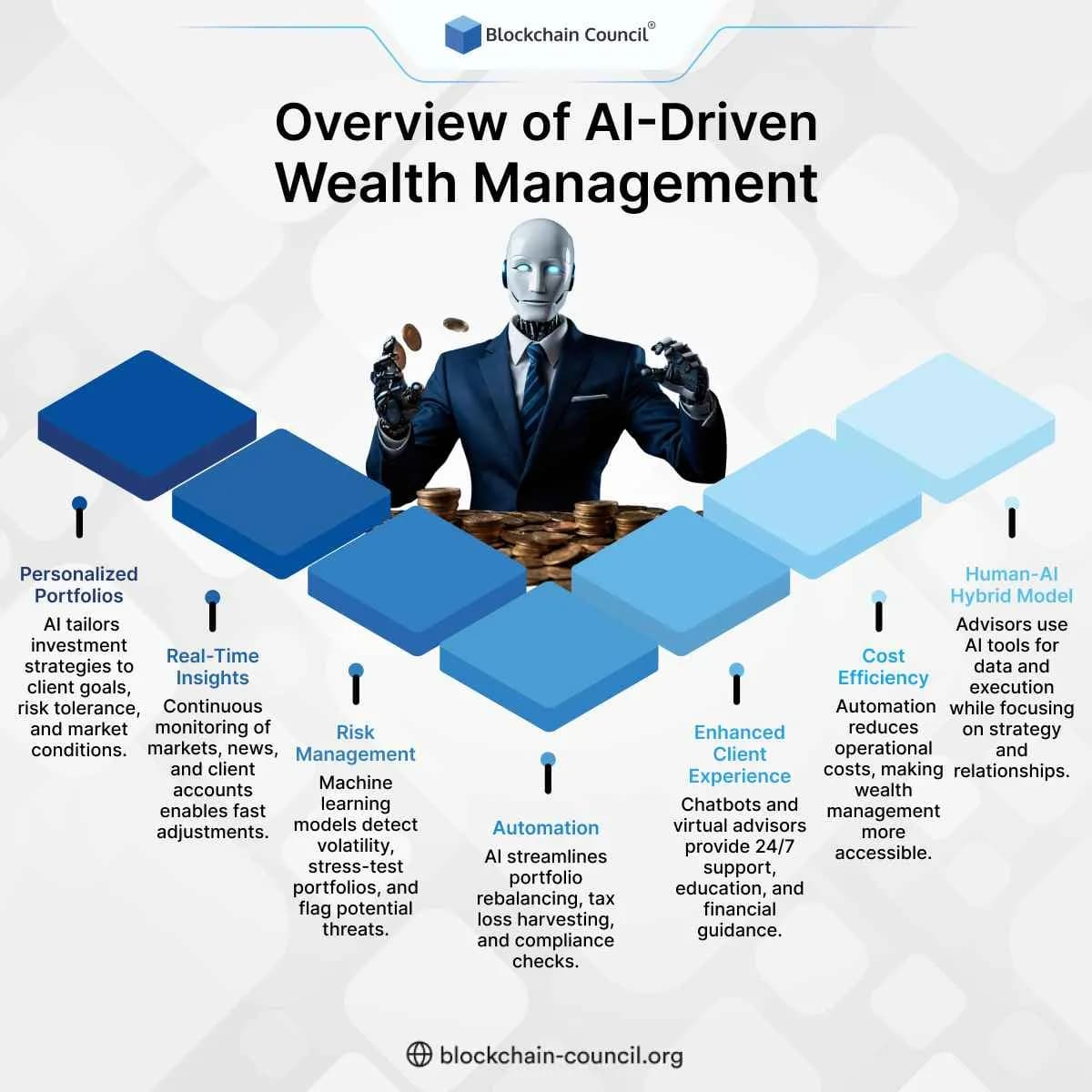
- Personalized Portfolios
AI tailors investment strategies to client goals, risk tolerance, and market conditions. - Real-Time Insights
Continuous monitoring of markets, news, and client accounts enables fast adjustments. - Risk Management
Machine learning models detect volatility, stress-test portfolios, and flag potential threats. - Automation
AI streamlines portfolio rebalancing, tax-loss harvesting, and compliance checks. - Enhanced Client Experience
Chatbots and virtual advisors provide 24/7 support, education, and financial guidance. - Cost Efficiency
Automation reduces operational costs, making wealth management more accessible. - Human-AI Hybrid Model
Advisors use AI tools for data and execution while focusing on strategy and relationships.
From Robo-Advisors to AI Wealth Engines
When robo-advisors first appeared, they promised affordable, automated investment management for retail investors. These systems followed simple rules: allocate funds across stocks and bonds, rebalance portfolios, and keep fees low. They were a revolution for those who could not afford high-end wealth managers. Today, robo-advisors have grown into something more powerful.

AI has added intelligence to these platforms. Instead of just following preset allocation models, modern robo-advisors analyze alternative data such as social media sentiment, satellite images of retail parking lots, and supply chain signals. This lets them anticipate shifts in consumer behavior or company performance before it shows up in quarterly reports.
By 2027, analysts expect that AI-based wealth tools will dominate personal finance, with up to 80 percent of everyday investors using them for advice and portfolio management. This does not mean human advisors will vanish. Instead, AI becomes the silent partner, running the math and suggesting strategies while humans focus on personal goals and relationships.
AI as a Co-Pilot in Wealth Management
In the present moment, AI functions like a co-pilot. It identifies patterns, flags anomalies, and suggests trades, but final decisions often rest with human advisors or asset managers. This partnership is changing the economics of financial services. Wealth managers who once needed large research teams now rely on AI models to scan global markets in real time.
The co-pilot role extends beyond trading. AI handles compliance checks, automates client onboarding, and predicts when customers might need to rebalance portfolios. In practice, this means wealth managers can serve more clients with the same resources. For clients, it means faster, more personalized service.
The next step will be autonomous AI wealth engines that manage portfolios end-to-end. These systems will not just recommend but also execute trades, optimize taxes, and adjust strategies in real time. For regulators, this raises questions of accountability and fiduciary responsibility. But the trend is clear: automation is moving deeper into the core of wealth management.
New Ways AI Adds Value
AI is reshaping wealth in four key areas:
- Process Optimization
Back-office operations like trade settlement, reconciliation, and reporting consume time and money. AI streamlines these tasks, reducing costs and lowering the risk of human error.
- Scaling Advisory Services
Traditional advisors can only handle so many clients. AI makes it possible to scale advice to thousands of investors at once, each receiving customized insights based on their financial goals, risk appetite, and spending patterns.
- Generating Alpha
One of the holy grails of wealth management is generating alpha—returns above the market average. AI helps by detecting hidden signals in massive datasets. For example, machine learning models can connect weather forecasts to commodity prices or track consumer spending in real time.
- Enhancing Client Experience
Wealth is not just about numbers. It is also about trust. AI improves the client experience with faster onboarding, personalized dashboards, and more accurate risk profiling. The result is smoother service and stronger engagement.
These four areas show how AI is already changing the daily operations of wealth firms, not in theory but in practice.
Barriers and Challenges Ahead
While the future looks promising, there are clear hurdles. Regulation is the biggest. Financial advice is heavily regulated because bad advice can wipe out savings. If an AI system gives flawed guidance, who is accountable—the software provider, the advisor, or the client? Policymakers are beginning to grapple with these questions, but answers are still evolving.
Data quality is another challenge. AI models are only as strong as the data they are trained on. If the data is biased or incomplete, the recommendations may be misleading. This could harm not just individual clients but also entire markets if many systems act on the same flawed signals.
Trust remains a major factor. Many clients still prefer human advisors because they value personal relationships and emotional reassurance, especially during volatile markets. AI systems must prove their reliability over time before they can fully replace human intuition in wealth management.
Finally, scaling AI solutions across firms is not simple. Many institutions run on legacy systems that do not integrate well with modern AI platforms. Upgrading infrastructure requires heavy investment, and not all firms are ready for that leap.
Systemic Implications of AI Wealth
Beyond individual portfolios, AI has broader effects on the economy. Academic research suggests that expectations around transformative AI can influence interest rates, capital flows, and even wealth inequality long before fully autonomous systems arrive. Investors who anticipate gains from AI may shift their strategies, concentrating wealth in certain sectors and regions.
There is also the risk of inequality. Those who control advanced AI tools and datasets may capture disproportionate value. This could widen the gap between large financial institutions and smaller players, as well as between wealthy investors and those with modest means. International organizations such as the World Trade Organization have already warned about AI’s potential to deepen global inequality if access remains uneven.
Still, there is a counterpoint: AI can also democratize wealth management. By lowering costs and scaling services, it can provide high-quality advice to people who previously could not afford it. Whether AI narrows or widens wealth gaps will depend on how it is deployed and regulated.
Real-World Case Studies of AI in Wealth
Theories about AI in wealth are interesting, but what makes the discussion real are examples of how companies are already using it. Global banks, asset managers, and brokerages are testing AI tools not just in pilot projects but in daily workflows.
At Goldman Sachs, an AI tool was launched to help staff in wealth management. Its role is not to replace advisors but to act as a knowledge assistant. The system pulls together market data, internal reports, and client information to provide faster insights. For advisors, this means more time to focus on client conversations rather than digging through spreadsheets and reports. The concern, however, is clear—if AI proves capable enough, could jobs be at risk in the future? The launch highlights how large institutions see AI as a necessity, not an optional add-on.
In China, brokerages have been quick to embrace AI. Tiger Brokers, for instance, adopted DeepSeek, a local AI model, to improve research and client engagement. By automating analysis of company filings, earnings calls, and market patterns, the system makes their analysts more efficient. In a competitive market, this kind of tool can be the difference between staying ahead and falling behind.
These examples show that AI is already embedded in wealth management. It is not a question of “if” but “how far” it will go.
Predictive Investing and Alpha Generation
One of the most talked-about areas in AI-driven wealth is predictive investing. The idea is simple but powerful: if AI can find patterns in data that others miss, it can generate higher returns. This is often referred to as generating alpha.
Traditional investing relies on financial statements, economic reports, and human judgment. AI expands that universe by analyzing alternative data sources. For example, satellite images of shipping ports can reveal global trade activity in near real time. Social media chatter can signal consumer interest in a new product long before sales numbers confirm it. Weather forecasts can shift commodity prices.
Machine learning models can process these signals at speeds humans cannot match. For hedge funds, this is already becoming standard practice. In mainstream wealth management, the challenge is adapting these methods in a way that complies with regulations and serves ordinary investors. But the potential is undeniable—AI gives access to insights that were invisible before.
Risk Management in an AI World
Wealth management is not only about maximizing gains but also about minimizing losses. Here, AI offers powerful tools for risk management.
By analyzing historical market data alongside real-time signals, AI can stress-test portfolios under different scenarios. For example, what happens to a client’s portfolio if inflation rises by two percent, or if oil prices crash? Traditional risk models can simulate these, but AI systems can run thousands of scenarios in minutes, factoring in variables that humans might overlook.
AI can also detect anomalies, such as unusual trading activity that could indicate fraud or market manipulation. This makes it a useful ally for compliance and regulatory teams. In practice, AI becomes a shield as well as a guide, protecting clients while helping them grow wealth.
Regional Adoption and Financial Inclusion
Adoption of AI in wealth management varies across regions. In developed markets like the United States and Europe, regulators are cautious, and firms are integrating AI step by step. The emphasis is on co-pilot systems where human advisors stay in charge.
In Asia, adoption is faster. Markets like China and Singapore are experimenting more boldly with AI in finance, often driven by tech-savvy investors and competitive brokerages. The speed of digital adoption in these regions makes them ideal testing grounds for AI-driven finance.
For developing countries, AI offers an opportunity for financial inclusion. Many people do not have access to traditional wealth management services because of cost barriers. AI-driven platforms can deliver affordable financial advice at scale, making wealth tools accessible to middle- and low-income groups. This could reshape the global distribution of wealth, though it depends on infrastructure, internet access, and regulatory openness.
The Human + AI Factor in Wealth Management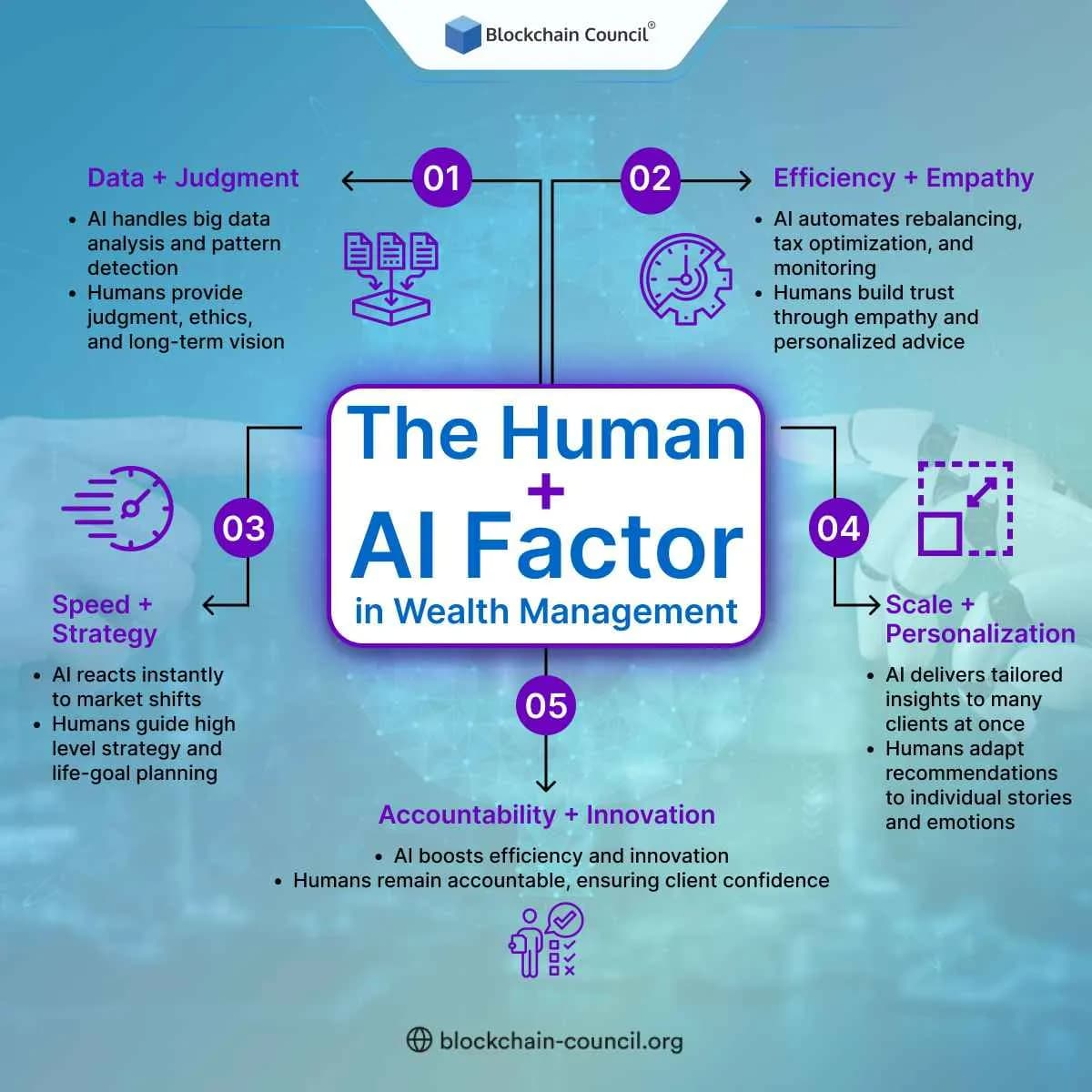
- Data + Judgment
- AI handles big data analysis and pattern detection
- Humans provide judgment, ethics, and long-term vision
- Efficiency + Empathy
- AI automates rebalancing, tax optimization, and monitoring
- Humans build trust through empathy and personalized advice
- Speed + Strategy
- AI reacts instantly to market shifts
- Humans guide high-level strategy and life-goal planning
- Scale + Personalization
- AI delivers tailored insights to many clients at once
- Humans adapt recommendations to individual stories and emotions
- Accountability + Innovation
- AI boosts efficiency and innovation
- Humans remain accountable, ensuring client confidence
A common question is whether AI will replace human advisors. The truth is more nuanced. While AI can outperform humans in data analysis, human advisors bring emotional intelligence, trust, and life experience that machines cannot replicate.
For example, during a market crash, investors may panic and want to sell assets at a loss. An AI system might suggest holding, but it cannot calm a nervous client or understand personal circumstances like medical expenses or family obligations. This is where human advisors remain essential.
The future likely lies in synergy. AI will handle the heavy lifting of analysis, compliance, and execution. Humans will focus on relationships, ethics, and guiding clients through life decisions. This model balances efficiency with empathy, making wealth management both smarter and more human.
Ethics and Trust in AI Wealth
The ethics of AI in wealth are becoming more important as adoption spreads. If an AI system makes a bad investment, who is accountable? How do we ensure that AI advice aligns with a client’s best interest rather than maximizing profits for a firm?
Regulators are starting to demand transparency. Wealth managers must show how AI models reach conclusions. This is known as explainability. Clients are unlikely to trust a “black box” system that cannot justify its decisions. Building systems that are explainable and auditable will be a key requirement in the years ahead.
There are also concerns about bias. If AI systems are trained on historical data that reflects inequality, they may reinforce existing wealth gaps. For example, if certain groups were underrepresented in investment opportunities, AI may continue to sideline them. Correcting for this requires careful oversight and inclusive data practices.
Skills for the AI-Driven Wealth Era
For professionals, the rise of AI in wealth creates both opportunities and challenges. Advisors, analysts, and portfolio managers must adapt to new tools, learning how to work alongside algorithms rather than competing with them.
One pathway is through advanced learning programs. Building competence in data science is especially important. A program such as the Data Science Certification equips professionals with the skills to handle large financial datasets, train models, and apply insights responsibly.
Another pathway is blending business and technology knowledge. The Marketing and Business Certification provides training for those who want to connect AI-driven wealth strategies with client engagement, financial branding, and sustainable growth. In wealth management, knowing how to use AI to deliver business results is as valuable as technical expertise.
By combining technical and business knowledge, professionals position themselves at the center of the AI-driven wealth revolution.
Long-Term Economic Shifts
AI in wealth is not just a tool for individual investors or firms. It has the potential to reshape global economics. Academic research suggests that as expectations of AI’s impact grow, they influence interest rates, capital allocation, and even international trade.
If large amounts of capital shift into AI-heavy industries, traditional sectors could see slower investment. This could accelerate economic divides between countries that lead in AI and those that lag behind. The result might be new centers of wealth in regions that successfully build and deploy AI systems.
At the same time, AI may lower barriers for small investors globally. By making advanced analytics available at low cost, it could democratize access to wealth tools. Whether AI deepens or reduces inequality depends on how widely and fairly the benefits are shared.
Toward Autonomous AI Wealth Managers
The shift from co-pilot systems to fully autonomous AI wealth managers is one of the biggest future trends in finance. Right now, AI mostly supports human advisors by analyzing data and suggesting actions. In the coming years, however, systems will likely be capable of running portfolios with very little human input.
These autonomous platforms will not just execute trades but also manage taxes, rebalance portfolios in real time, and even shift strategies in response to global events as they unfold. Imagine a system that recognizes geopolitical tensions escalating in one part of the world and automatically reduces exposure to affected markets while increasing investments in safer assets.
The benefits of such systems are clear: speed, efficiency, and the ability to respond instantly to risks. But the risks are also significant. Who takes responsibility when an autonomous AI makes a decision that harms a client’s wealth? Will regulators treat these platforms as legal entities with fiduciary duties, or will firms that deploy them shoulder the liability? These are unanswered questions that will shape how quickly fully autonomous wealth managers arrive.
The transition will likely be gradual. First, AI systems will handle specific tasks such as tax optimization or currency hedging. Over time, as trust grows and regulations adapt, more responsibility will shift to the machines.
Global Inequality: The Double-Edged Sword of AI Wealth
One of the most debated questions is whether AI will reduce or increase inequality. On one hand, AI can democratize wealth by giving low-cost, high-quality advice to millions of people who never had access before. For example, retail investors in developing countries could use AI-driven platforms to receive the same level of financial guidance as clients of major banks.
On the other hand, the concentration of AI talent and infrastructure in a few regions raises the risk of wealth concentrating further at the top. Large institutions with access to proprietary datasets and computing resources could pull further ahead, capturing outsized gains while leaving smaller firms and individual investors behind.
International organizations such as the WTO have warned that without careful oversight, AI could worsen global wealth inequality. Wealth may shift toward countries and companies that dominate AI infrastructure, much as the industrial revolution shifted wealth to nations that controlled factories and trade.
The outcome depends on policy choices. If regulators encourage fair access, ensure data diversity, and require transparency in AI systems, the benefits can be shared more widely. But if AI wealth tools remain locked within a small group of institutions, inequality may deepen.
Roadmap to 2040: The AI-Driven Wealth Journey
Looking ahead, it is possible to outline a roadmap for how AI could transform wealth management between now and 2040.
2025–2030: Scaling Co-Pilot Systems
During this period, most firms will continue to rely on AI as a co-pilot. Advisors will remain central, but AI will handle analytics, compliance, and personalized recommendations. Robo-advisors will expand into emerging markets, and regulatory frameworks will adapt to ensure transparency and accountability.
2030–2035: Early Autonomous Systems
By the early 2030s, autonomous AI systems will begin to manage small portfolios independently. These platforms will start with less risky clients or limited asset classes. Financial institutions will experiment with hybrid models where AI takes the lead but humans provide oversight.
2035–2040: Mainstream Autonomous Wealth Managers
By the late 2030s, it is likely that fully autonomous AI wealth managers will be mainstream for many investors. These systems will operate continuously, rebalancing in real time and offering advanced tax strategies at scale. Regulations will evolve to recognize them as trusted financial tools, though human advisors will still play a role for complex or emotionally sensitive decisions.
This roadmap suggests that while AI will not take over wealth management overnight, the direction is clear. Step by step, it will move deeper into the core of financial decision-making.
Skills and Training for the Next Era
As AI transforms wealth, professionals will need new skills. Advisors who once relied on traditional financial models will now need to understand how algorithms make decisions. This means learning not just finance but also data science, ethics, and responsible AI practices.
One option is to pursue advanced training through programs such as the agentic ai certification. This type of certification equips professionals with the knowledge to work with AI systems that can operate independently and make decisions with minimal oversight.
Broader tech certifications are also valuable. These programs build a foundation in emerging technologies, ensuring that professionals understand not just AI but also the larger ecosystem of tools that shape finance today.
For those focused on security and transparency, blockchain technology courses provide critical insights. Blockchain plays a growing role in ensuring that financial transactions are verifiable and tamper-proof, which complements AI systems that generate and manage wealth strategies.
It is also important to study how technology is reshaping global finance more broadly. Understanding the convergence of AI, blockchain, and data science allows professionals to see the bigger picture rather than focusing on a single tool.
By pursuing these skills, professionals prepare themselves not just to survive but to thrive in an AI-driven financial world.
Risks That Cannot Be Ignored
The vision of AI-driven wealth is exciting, but it comes with risks that must be addressed.
- Regulatory Uncertainty: Without clear global standards, AI wealth tools may develop unevenly, leading to confusion and potential misuse.
- Black Box Decisions: Many AI models are not fully explainable. Clients and regulators may be reluctant to trust systems they cannot understand.
- Cybersecurity: AI systems managing large amounts of wealth are prime targets for hackers. Ensuring robust protection is non-negotiable.
- Overreliance on Automation: If too many investors rely on similar AI models, markets could become vulnerable to synchronized errors.
Mitigating these risks requires collaboration between regulators, firms, and technology providers. Transparency, auditing, and human oversight will remain key pillars even as AI grows more powerful.
Final Takeaway
The future of wealth is undeniably AI-driven. From robo-advisors to predictive investing, from risk management to fully autonomous portfolio systems, artificial intelligence is transforming how we save, invest, and grow assets. The benefits are vast: more personalized advice, broader access, faster insights, and greater efficiency.
But the challenges are real. Regulation, trust, inequality, and technical risks must be addressed carefully. The future will likely not be a world where humans are replaced but one where humans and AI work together. Advisors will guide, while AI powers the engine.
For individuals and professionals, this is the moment to prepare. Investing in education through programs like agentic ai certification, tech certifications, blockchain technology courses, and other skill-building pathways ensures readiness for this new financial era. The decisions made now—by regulators, firms, and individuals—will determine whether AI narrows wealth gaps or widens them.
The answer to the question, “Is the future of wealth AI-driven?” is yes. The bigger question is whether we will guide that future responsibly, ensuring that AI serves not just the wealthy few but everyone who seeks financial security and growth.
Related Articles
View All
AI & ML
NVIDIA’s New AI Models: Nemotron 3.5 Lightning, Cosmos 3 and the Future of Agentic AI
Explore NVIDIA Nemotron 3.5 Lightning and Cosmos 3, how they support agentic and Physical AI, and what these models reveal about NVIDIA’s broader vision for autonomous intelligent systems.

AI & ML
The Future of System One Models
Explore the future of System One Models, including how fast, structured, probabilistic AI could reshape automation, real-time software, decision systems, and machine-native intelligence.

AI & ML
AI Video Generator: The Future of Video Production
### Excerpt AI video generators are transforming video production by enabling creators and businesses to generate high-quality videos from text, images, scripts, and prompts. Explore how AI video generation is shaping the future of content creation, filmmaking, marketing, and automated video production.
Trending Articles
The Role of Blockchain in Ethical AI Development
How blockchain technology is being used to promote transparency and accountability in artificial intelligence systems.

Top 5 DeFi Platforms
Explore the leading decentralized finance platforms and what makes each one unique in the evolving DeFi landscape.
What is AWS? A Beginner's Guide to Cloud Computing
Everything you need to know about Amazon Web Services, cloud computing fundamentals, and career opportunities.