

Why Do AI-Savvy Investors Win More?
 Michael Willson
AI is reshaping the world of investing. Investors who understand how to use AI tools are proving they can earn more, reduce risk, and move faster than those who don’t. Recent studies show that AI-driven models have outperformed many human fund managers. Big firms are deploying AI across credit markets, equities, and even alternative data analysis. At the same time, everyday investors are starting to use AI-powered apps to gain insights and streamline portfolios. So why do AI-savvy investors win more? The answer lies in speed, scale, risk management, and the ability to combine human judgment with machine intelligence. If you want to learn how to apply these advantages to your own strategies, the AI powered investing certification is a great starting point.
What Does Being AI-Savvy Mean?
Being AI-savvy does not mean handing over every decision to algorithms. It means knowing how AI works, where it adds value, and where its limitations lie. AI-savvy investors can:

- Use machine learning tools to scan massive amounts of financial data.
- Understand signals from unstructured sources like news, earnings calls, and social sentiment.
- Recognize when AI output is useful and when it needs human oversight.
- Apply AI to automate repetitive tasks, freeing time for strategic thinking.
These investors see AI as a partner. Instead of fighting against it or fearing it, they integrate it into their workflows.
Benefits of AI-Powered Investing Strategy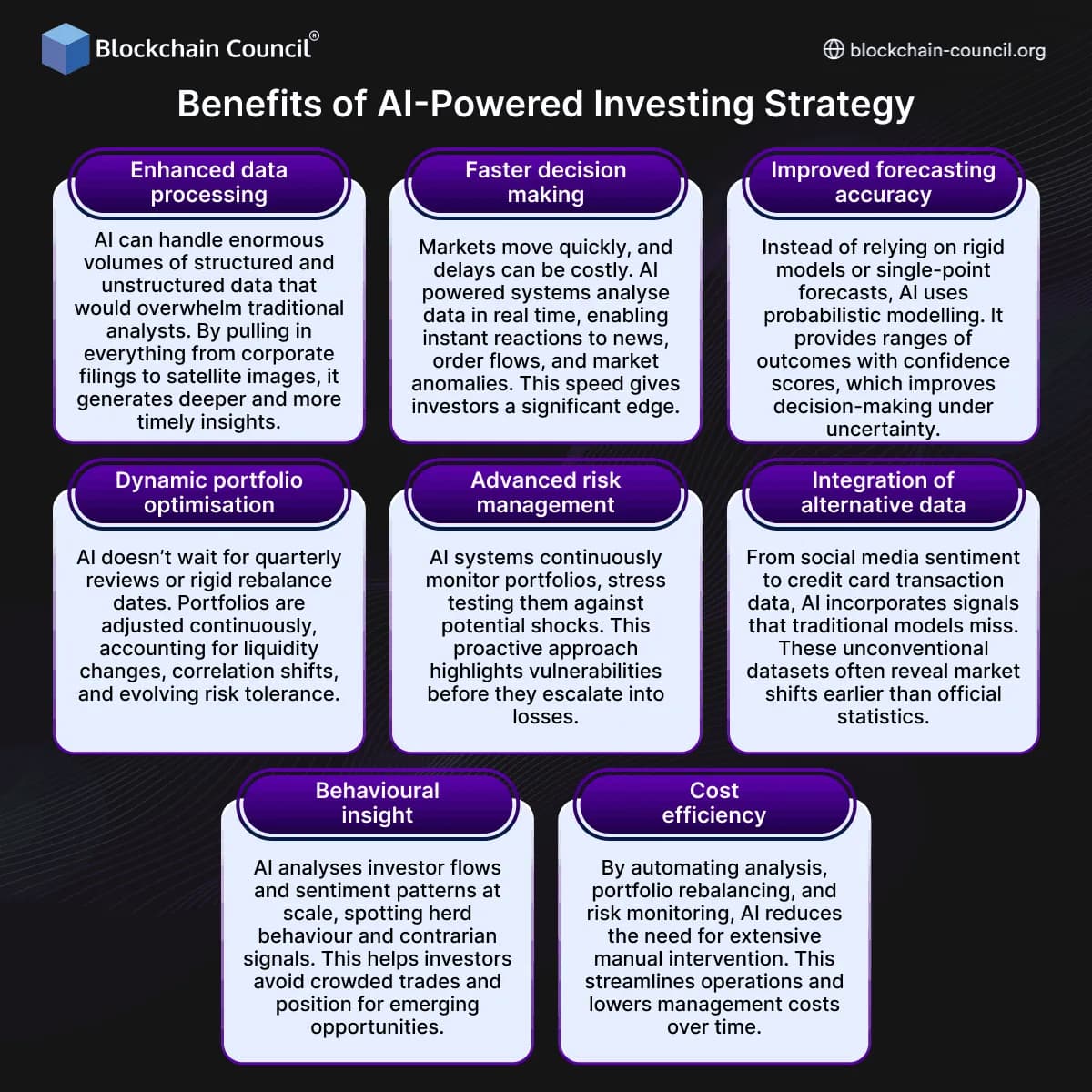
Enhanced data processing
AI can handle enormous volumes of structured and unstructured data that would overwhelm traditional analysts. By pulling in everything from corporate filings to satellite images, it generates deeper and more timely insights.
Faster decision-making
Markets move quickly, and delays can be costly. AI-powered systems analyse data in real time, enabling instant reactions to news, order flows, and market anomalies. This speed gives investors a significant edge.
Improved forecasting accuracy
Instead of relying on rigid models or single-point forecasts, AI uses probabilistic modelling. It provides ranges of outcomes with confidence scores, which improves decision-making under uncertainty.
Dynamic portfolio optimisation
AI doesn’t wait for quarterly reviews or rigid rebalance dates. Portfolios are adjusted continuously, accounting for liquidity changes, correlation shifts, and evolving risk tolerance.
Advanced risk management
AI systems continuously monitor portfolios, stress-testing them against potential shocks. This proactive approach highlights vulnerabilities before they escalate into losses.
Integration of alternative data
From social media sentiment to credit card transaction data, AI incorporates signals that traditional models miss. These unconventional datasets often reveal market shifts earlier than official statistics.
Behavioural insight
AI analyses investor flows and sentiment patterns at scale, spotting herd behaviour and contrarian signals. This helps investors avoid crowded trades and position for emerging opportunities.
Cost efficiency
By automating analysis, portfolio rebalancing, and risk monitoring, AI reduces the need for extensive manual intervention. This streamlines operations and lowers management costs over time.
Adaptability
Unlike static models, AI learns and improves continuously. As new data and market regimes emerge, AI strategies adapt, maintaining their relevance and resilience in shifting conditions.
Regulatory alignment
With advances in explainable AI, these systems are becoming more transparent. This fosters trust among regulators and institutional investors, smoothing adoption across financial markets.
Evidence That AI-Savvy Investors Outperform
The proof is building. Researchers at Stanford created an AI analyst trained only on public data. Over thirty years, this system outperformed 93 percent of mutual fund managers, producing returns 600 percent higher than the average human-managed portfolio. That is a remarkable signal that AI, when used correctly, can beat traditional strategies.
Other studies found that AI forecasts beat human analyst forecasts 54.5 percent of the time in predicting stock returns between 2001 and 2018. Even small percentage advantages add up when compounded over years.
Institutional examples confirm the trend. Firms like AllianceBernstein have deployed AI to manage credit portfolios more efficiently. China’s fund managers have begun using models like DeepSeek to gain an edge, lowering the barriers for smaller firms to compete with large incumbents. Hedge funds such as AQR Capital are openly shifting more of their strategies into machine learning systems after seeing solid results.
Why Speed and Scale Matter
One of the biggest reasons AI-savvy investors win is their ability to process information at speeds no human team can match.
Markets move fast. Every day, companies release filings, analysts publish reports, governments issue economic data, and millions of people post opinions on social media. No single human can process this firehose of information. AI can.
- Speed: AI can scan thousands of filings in minutes. A human analyst might take weeks.
- Scale: AI can monitor dozens of markets and asset classes at the same time.
- Depth: AI can spot subtle connections, like links between oil prices, shipping costs, and company earnings.
This speed and scale mean AI-savvy investors are informed earlier and more fully. They don’t just know what happened yesterday—they can see signals forming today.
Risk Management With AI
Winning in investing is not only about chasing high returns. It is also about avoiding big losses. AI helps here as well.
By monitoring volatility, AI can flag risks in real time. For example, if a stock’s trading pattern suddenly diverges from its sector, AI can highlight it for further review. It can also model stress scenarios: “What happens to this portfolio if interest rates rise by two percent?”
AllianceBernstein shared case studies where AI improved credit risk analysis. The systems could scan through debt markets to detect early signs of trouble that would take human teams much longer to spot. This does not mean AI removes risk, but it does help manage it more effectively.
For everyday investors, this means using AI-driven robo-advisors or apps that alert you when your portfolio is drifting toward higher risk than you planned. Education helps here too. A Tech Certification gives you the skills to understand how AI builds these risk models and how to interpret them correctly.
How AI Processes Market Data
Many people wonder: how does AI actually turn raw data into useful insights?
- Natural Language Processing (NLP): AI reads reports, news, and even executive transcripts. It can summarize earnings calls or highlight unusual language that signals risk.
- Machine Learning Models: These systems look for patterns in price history, volume, and macro data. They don’t predict the future directly but calculate the probabilities of different outcomes.
- Sentiment Analysis: AI scans social media, forums, and financial news to gauge investor mood. This helps detect trends early, especially in volatile sectors like crypto.
- External and Alternative Data: AI-savvy investors often feed in unusual data sources—satellite images, weather data, shipping records—to gain unique insights that competitors miss.
These approaches give AI-savvy investors a wider, richer picture of the market than traditional methods.
AI vs Traditional Investment Strategies
To understand why AI-savvy investors win more, it helps to compare AI methods with traditional approaches.
Fundamental Analysis
Fundamental analysis has long been the bedrock of investing. Analysts study a company’s revenue, expenses, growth prospects, and market position. This approach works, but it is slow. An analyst might cover 10 or 20 companies in depth. AI, on the other hand, can cover thousands at once. It can read every earnings call transcript in a sector, compare language, and find signals that humans would need months to uncover.
Technical Analysis
Technical analysis focuses on charts and price patterns. Traders watch indicators like moving averages and volume. AI can do the same, but it does more by blending technical data with news, sentiment, and macroeconomic trends. The result is a broader, more adaptive model that goes beyond lines on a chart.
The Advantage of AI Integration
AI-savvy investors don’t throw away traditional methods. Instead, they integrate them. AI makes fundamental and technical analysis faster and richer, while humans still provide the judgment to decide how to act on the signals.
Human Judgment vs AI Logic
Markets are influenced not only by numbers but also by human emotion. Fear, greed, and herd behavior often push prices in unpredictable directions.
AI brings discipline. It doesn’t panic when markets fall or become euphoric when markets rise. It processes the data and delivers probabilities. This objectivity is a major reason why AI-savvy investors stay ahead.
But humans still matter. AI cannot fully understand political events, cultural shifts, or sudden black swan events. Investors who combine AI’s logic with their own contextual judgment create the strongest strategies.
Success Stories of AI in Investing
Outperforming Fund Managers
The Stanford AI analyst experiment is one of the clearest success stories. Over three decades, the AI outperformed most human-managed funds. That kind of long-term evidence shows AI is not a gimmick.
Sovereign Wealth Fund Efficiency
Norway’s trillion-dollar sovereign wealth fund adopted AI to improve trading execution. By cutting inefficiencies, it saved hundreds of millions of dollars. That’s not just about higher returns—it’s about smarter operations.
Hedge Funds Embracing AI
AQR Capital, one of the world’s largest hedge funds, has increased its reliance on machine learning after seeing better performance in several strategies. For firms that manage billions, even small percentage gains can mean huge profits.
Cautionary Tales
Retail Investor Losses
Not every AI story is positive. Surveys show that about one in five retail investors lost money following AI advice. Some tools offered generic guidance or outdated insights. This highlights the need for caution and human oversight.
AI Washing
Some firms have exaggerated their use of AI to attract investors. Regulators have already fined advisers for making false or misleading AI claims. This shows that trust and transparency are critical in AI-driven finance.
Model Fragility
AI models trained on past data can sometimes fail when the market shifts dramatically. Overfitting—a model that works well on historical data but poorly in live conditions—remains a common risk. AI-savvy investors know to test tools carefully before relying on them.
Why Education and Upskilling Are Essential
Being AI-savvy is not just about downloading an app. It requires understanding how AI works and how to interpret its output.
- A Crypto certification equips investors to navigate crypto markets, where AI tools often scan sentiment and blockchain data.
- A Marketing and Business Certification helps professionals understand how AI reshapes customer behavior and product growth strategies—skills that overlap with how markets respond to trends.
- Blockchain technology courses provide insights into how AI and blockchain are merging, especially in decentralized finance and asset tracking.
Upskilling ensures that investors don’t just follow AI blindly. Instead, they know how to evaluate it, question it, and combine it with their own strategy.
The Future of AI-Savvy Investing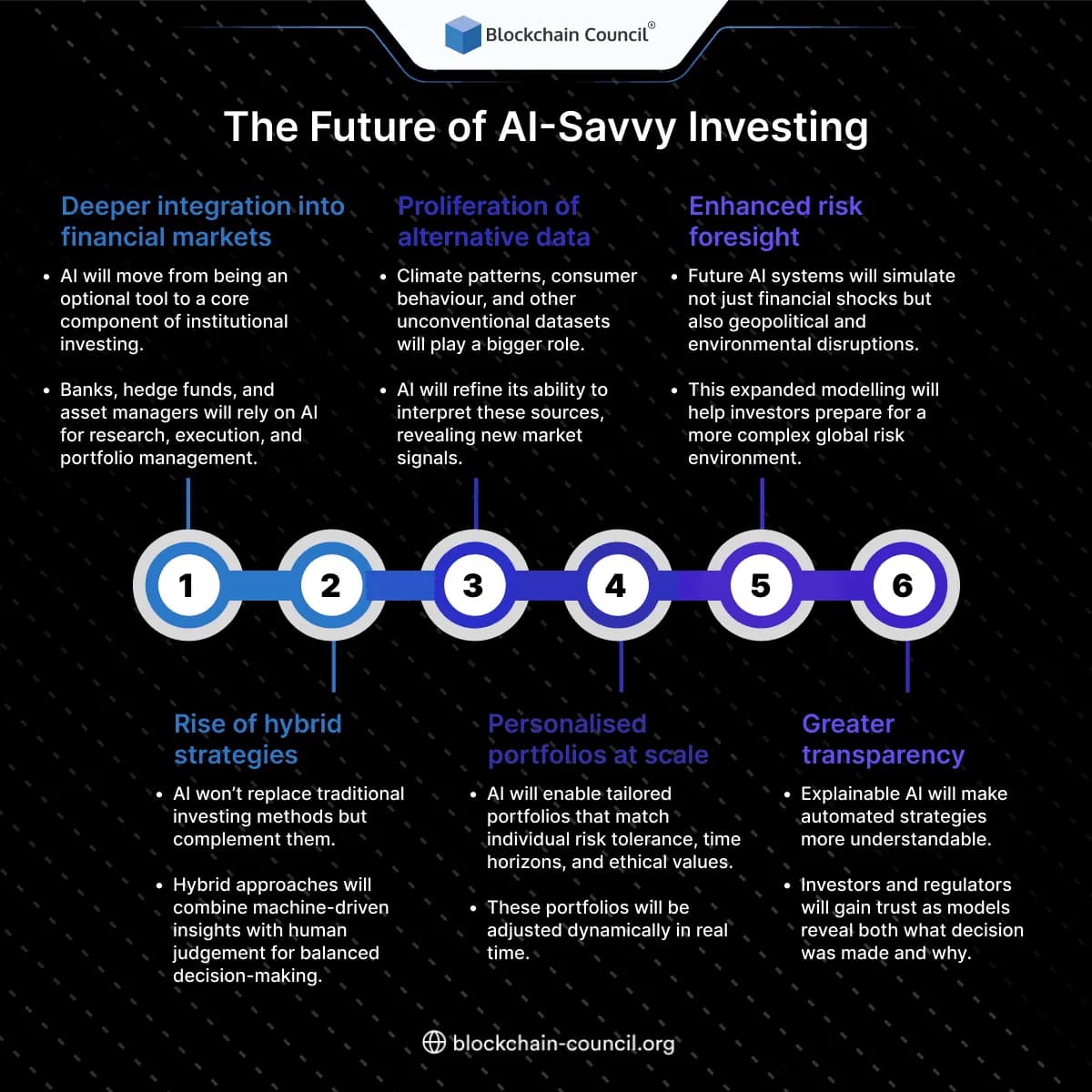
Deeper integration into financial markets
- AI will move from being an optional tool to a core component of institutional investing.
- Banks, hedge funds, and asset managers will rely on AI for research, execution, and portfolio management.
Rise of hybrid strategies
- AI won’t replace traditional investing methods but complement them.
- Hybrid approaches will combine machine-driven insights with human judgement for balanced decision-making.
Proliferation of alternative data
- Climate patterns, consumer behaviour, and other unconventional datasets will play a bigger role.
- AI will refine its ability to interpret these sources, revealing new market signals.
Personalised portfolios at scale
- AI will enable tailored portfolios that match individual risk tolerance, time horizons, and ethical values.
- These portfolios will be adjusted dynamically in real time.
Enhanced risk foresight
- Future AI systems will simulate not just financial shocks but also geopolitical and environmental disruptions.
- This expanded modelling will help investors prepare for a more complex global risk environment.
Greater transparency
- Explainable AI will make automated strategies more understandable.
- Investors and regulators will gain trust as models reveal both what decision was made and why.
Global democratisation of tools
- Cloud-based platforms and AI-driven robo-advisors will spread access beyond elite funds.
- Smaller firms and retail investors will gain institutional-grade insights.
Continuous adaptation
- AI systems will evolve continuously, learning from new data and market structures.
- This adaptability ensures resilience across shifting market cycles.
The future of investing will not be AI versus humans. It will be AI with humans.
- AI Research Assistants: Investors will soon ask plain-language questions like “What are the risks in this sector?” and get instant, AI-generated summaries.
- Everyday Access: Brokerage apps are adding AI chat features, making advanced insights available to regular investors.
- Regulation and Transparency: Regulators will demand more explainability. Investors will not only see recommendations but also understand why the AI made them.
- Human-AI Teams: Analysts and investors will increasingly rely on AI for scale, while applying their own judgment for context.
Those who embrace this shift now will be positioned to lead.
How AI-Savvy Investors Use Data Differently
AI-savvy investors do not simply have better tools. They also have a different relationship with data. Where traditional investors may stop at a company’s earnings report or a chart of historical stock prices, AI-savvy investors use a wider range of inputs, a faster process, and a more disciplined framework for turning information into action. This shift is one of the main reasons they consistently outperform.
Structured Data: Beyond Basic Financials
Traditional investors lean heavily on structured data—numbers that fit neatly into rows and columns. This includes metrics such as revenue, net income, price-to-earnings ratios, and debt levels. While these remain essential, AI-savvy investors use machine learning to analyze far larger sets of structured data than humans can.
Instead of reviewing a handful of companies, AI can compare thousands. It can detect patterns like “companies with steadily rising R&D spending and stable gross margins tend to outperform in the next three years.” These patterns would take human analysts months, if not years, to uncover.
AI-savvy investors also apply predictive models to structured data. For example, rather than simply reporting that a company’s debt ratio has risen, AI can model the probability that this increase will lead to credit rating downgrades or a higher chance of default. That level of foresight provides a competitive edge.
Unstructured Data: Turning Words Into Signals
The real revolution comes with unstructured data—text, audio, and video that traditional analysts struggle to quantify. AI-savvy investors rely on natural language processing (NLP) to make sense of this information.
Take earnings calls. A human analyst might note whether a CEO sounded confident. AI, however, can measure changes in tone, word choice, and sentence structure across years of transcripts. Subtle shifts—such as executives using more cautious language or avoiding direct answers—can be flagged as potential red flags.
AI-savvy investors also analyze regulatory filings. Instead of skimming hundreds of pages manually, they use NLP to detect new risk factors, unusual phrasing, or differences compared with past filings. This allows them to spot changes before competitors do.
Even social media becomes a source of signals. AI tools scan millions of posts to measure sentiment around brands, sectors, or entire markets. This is especially valuable in sectors like crypto, where public opinion often drives price swings.
Alternative Data: Insights From the Real World
AI-savvy investors are also distinguished by their use of alternative data—sources outside traditional financial channels. These include:
- Satellite imagery: Used to track retail parking lot activity, giving early insight into store traffic and sales.
- Shipping and trade data: AI models process port traffic to forecast global commodity flows.
- Weather patterns: Farmers and agricultural investors use AI to connect climate data with crop yields and commodity prices.
- Consumer receipts and transactions: Some hedge funds purchase anonymized credit card data to measure real-time consumer spending.
These datasets, once considered fringe, are now mainstream in advanced investing. AI-savvy investors understand that the market reflects human behavior as much as corporate reports, and they look wherever signals may appear.
From Noise to Actionable Insight
Markets produce oceans of information. For many investors, this creates paralysis: too much data leads to indecision. AI-savvy investors solve this problem by using algorithms that separate noise from signal.
For example, Twitter alone generates hundreds of millions of posts per day. Most of them are irrelevant to finance. But an AI model trained on sentiment can isolate the subset of posts that matter for a given stock or sector. It doesn’t drown in irrelevant chatter; it pinpoints the signal.
This ability to filter noise also prevents overreaction. Traditional investors might panic at a sensational headline. AI-savvy investors use models to weigh whether that headline is part of a meaningful trend or just a short-lived spike.
Behavioral Edge: How AI-Savvy Investors Interpret Data
It’s not just about what data is used, but how it is interpreted. Traditional investors often bring bias to data—confirmation bias, recency bias, or anchoring. AI-savvy investors rely on models that strip away much of this bias.
For instance, when a stock dips sharply, human instinct may be to assume something is wrong. An AI-savvy investor will check whether the dip fits into a larger pattern or whether it is simply noise. By trusting data-driven models, they avoid the emotional traps that catch many traditional traders.
Limitations of Data-Driven AI
Of course, even AI-driven data analysis has limitations. Models can overfit to historical patterns, meaning they work well on backtests but fail in new market conditions. Alternative data can sometimes be misleading, especially if correlations are mistaken for causation.
AI-savvy investors know this. They do not blindly follow outputs. Instead, they test models, apply human judgment, and verify that insights make sense in the broader market context. This balance prevents overreliance and reduces the chances of costly errors.
Why This Matters
The way investors use data is just as important as the data itself. AI-savvy investors treat information as raw material, refining it through algorithms until it becomes clear, actionable signals. Traditional investors, by contrast, often remain stuck with partial views or rely on instinct. Over time, this difference compounds into measurable performance gaps.
By combining structured, unstructured, and alternative data with disciplined interpretation, AI-savvy investors expand their view of the market and reduce the role of guesswork. This is one of the clearest reasons why they consistently win more.
Real-World Applications of AI-Savvy Strategies
AI-savvy investors are already proving their edge in the real world. They do not rely on hype or guesswork. Instead, they apply AI across multiple parts of the investment process.
Portfolio Optimization at Scale
Traditionally, investors rebalance portfolios every quarter or year. AI-savvy investors rebalance continuously. Algorithms can detect when correlations shift between stocks, bonds, or commodities and recommend adjustments in real time. This makes portfolios more resilient in volatile conditions.
Gaining an Alternative Data Edge
Some of the biggest wins come from alternative data. AI systems process unusual sources like satellite images, shipping manifests, or consumer receipts. Hedge funds, for example, have analyzed parking lot activity to estimate retail sales before companies released official results. By acting earlier, they positioned themselves ahead of the market.
Monitoring Market Sentiment
In fast-moving sectors like crypto, sentiment can shift prices dramatically. AI-savvy investors use sentiment analysis to monitor online forums, tweets, and news headlines. They don’t just track numbers—they track how people feel, which often drives short-term moves.
Real-Time Risk Alerts
AI models provide real-time alerts about risks. For institutions, this might mean detecting compliance breaches. For retail investors, it could be a simple notification that their portfolio is now too concentrated in one sector. These alerts help prevent small risks from turning into big losses.
The Behavioral Advantage of AI-Savvy Investors
Having AI tools is one part of the story. Knowing how to behave when using them is another. AI-savvy investors often win because their behavior differs from traditional investors.
Staying Rational in Volatile Markets
Fear and greed drive many market decisions. Traditional investors panic when markets fall or chase hype when prices rise. AI-savvy investors lean on data-driven signals. They see probabilities and scenarios, which helps them remain calm and disciplined during volatility.
Avoiding Herd Behavior
When a stock goes viral, many investors pile in without checking fundamentals. AI-savvy investors compare the hype with the data. If the signals don’t support the narrative, they stay out. This discipline protects them from losses that follow market bubbles.
Continuous Learning Through Feedback
AI-savvy investors treat the market as a learning system. They review when AI predictions succeed and when they fail. Instead of abandoning the tool after one mistake, they adjust strategies and improve over time. This feedback loop strengthens their edge.
Why Transparency Matters
For AI to be trusted, it must be explainable. Investors do not just want a recommendation—they want to know why it was made. AI-savvy investors demand transparency from the tools they use.
This insistence on explainable AI prevents blind trust. It also reduces the risk of being misled by overhyped claims. With regulators cracking down on false “AI-powered” advertising, investors who prioritize transparency are better protected.
The Long-Term Vision of AI-Savvy Investing
Looking ahead, the role of AI-savvy investors will only grow stronger.
- AI research assistants will provide instant answers to natural language queries like “Which companies in this sector have rising debt risks?”
- Brokerage platforms will integrate AI into everyday tools, giving retail investors access to insights once reserved for hedge funds.
- Explainability requirements will ensure that AI models show their reasoning, improving trust.
- Human-AI collaboration will become the norm: AI for scale and analysis, humans for judgment and vision.
Over the long term, those who embrace AI today will be positioned to lead tomorrow.
Conclusion
AI-savvy investors win more because they combine technology with discipline. They process more information, act faster, and manage risks with greater precision. They avoid emotional traps and resist hype by grounding decisions in data. Their edge is not luck—it is preparation, education, and the smart use of tools.
But AI is not magic. It cannot predict the future with certainty or replace human judgment. The real strength comes when investors combine AI’s speed and logic with their own context and strategy. That partnership defines why AI-savvy investors are outperforming others in today’s markets.
The future of investing will not be about humans versus machines. It will be about humans and machines working together. Those who understand this balance—and start adapting now—will continue to win more in the years ahead.
Related Articles
View All
Cryptocurrency
Rug Pull vs Exit Scam: Key Differences Crypto Investors Must Understand
Understand rug pull vs exit scam differences, how each works, key warning signs, real examples, and due diligence steps for safer crypto investing.

Cryptocurrency
How Crypto Gains and Losses Are Taxed: A Simple Guide for Investors
A practical guide to how crypto gains, losses, swaps, staking rewards, mining income, and new reporting rules affect investor taxes.

Cryptocurrency
Crypto Asset Recovery After a Phishing Attack: Step-by-Step Guide for Investors
A practical incident response guide for investors hit by crypto phishing, covering containment, evidence, tracing, exchange reports, legal action, and scam warnings.
Trending Articles
The Role of Blockchain in Ethical AI Development
How blockchain technology is being used to promote transparency and accountability in artificial intelligence systems.

Can DeFi 2.0 Bridge the Gap Between Traditional and Decentralized Finance?
The next generation of DeFi protocols aims to connect traditional banking with decentralized finance ecosystems.
Claude AI Tools for Productivity
Discover Claude AI tools for productivity to streamline tasks, manage workflows, and improve efficiency.