

Is AI the Future of Stock & Crypto Investing?
 Michael Willson
Investing has always been about finding an edge. For some, that edge comes from deep financial analysis, while others rely on technical charts or insider knowledge of industries. Today, however, a new contender is rewriting the rules—artificial intelligence. From stock markets to cryptocurrency exchanges, AI is transforming how investors analyze data, spot opportunities, and manage risks. The big question is whether this technology represents the future of investing or simply a useful add-on. Evidence from institutions, research studies, and crypto communities suggests AI may indeed be the future, provided investors learn how to use it wisely. For those ready to take that step, the AI powered investing program offers a structured way to start building the right skills.
Why AI Is Gaining Ground in Stock Investing
Traditional stock investing depends heavily on human analysts. These professionals sift through company filings, earnings reports, and macroeconomic indicators to form predictions. But humans are limited by time and attention. They can only cover so many companies and process so much information. AI changes the scale entirely.

A Stanford-led project developed an “AI analyst” that reviewed public market data. Over a thirty-year backtest, this system outperformed 93 percent of mutual fund managers, generating six times higher returns. This wasn’t magic—it was a result of AI’s ability to process vast data streams without fatigue, identify patterns invisible to humans, and apply consistent logic across decades of data.
Large institutions are already deploying such systems. BlackRock, one of the world’s largest asset managers, uses AI to support systematic investment approaches. Its Thematic Robot tool relies on large language models and datasets to build equity baskets with specific exposures. In practice, this means an investor doesn’t just buy a random mix of tech stocks; they get a carefully designed basket tuned to future trends like automation or green energy.
AI also shines in short-term execution. Norway’s sovereign wealth fund, which manages over a trillion dollars, has integrated AI into trade execution to cut costs. By reducing inefficiencies, it expects to save hundreds of millions annually. This shows AI’s future role is not only predicting stock performance but also making operations smarter and cheaper.
Why Crypto Investors Are Embracing AI
Crypto markets are younger, more volatile, and less regulated than traditional finance. That makes them fertile ground for AI experimentation. The unpredictability of Bitcoin, Ethereum, and thousands of smaller tokens has frustrated human traders, but AI thrives on messy, high-volume data.
One area drawing attention is AI-powered crypto tokens. Grayscale, a major asset manager, recently introduced an “Artificial intelligence Crypto Sector,” grouping tokens that combine blockchain with AI. This niche has grown from around $4.5 billion in early 2023 to more than $21 billion in 2025. Such growth reflects not just speculation but also belief in the synergy between blockchain’s transparency and AI’s processing power.
A survey by Kraken found that nearly half of U.S. crypto holders expect AI-related tokens to outperform other sectors in the coming years. Whether this prediction holds remains to be seen, but it highlights investor optimism about AI’s role in the next stage of crypto growth.
For traders, AI offers practical tools. Algorithms powered by neural networks and reinforcement learning analyze price movements and sentiment data to generate predictions. Some platforms combine fundamentals, chart patterns, and news analysis to give users a single dashboard of predictive insights. While not perfect, these systems give investors a clearer view of volatile markets than raw instinct ever could.
Strengths and Weaknesses of AI Models
AI excels at pattern recognition, but financial markets are not static. What worked last year may fail this year if macro conditions shift. This is one of the biggest challenges for AI-based investing.
Backtests often look great—AI models show strong performance on historical data. Yet live trading can tell a different story. Overfitting, where the model learns noise instead of true signals, is a common problem. Sudden global shocks, like a pandemic or geopolitical conflict, also test AI’s limits. Unlike humans, AI lacks intuition about unprecedented events.
In crypto, data quality adds another hurdle. Exchanges vary in reliability, volumes can be manipulated, and social media sentiment can be faked. AI tools may amplify these flaws if not carefully monitored. For this reason, the most successful investors treat AI as an assistant, not an oracle.
Despite these risks, AI’s scalability gives it a strong future. A human analyst might track fifty companies. An AI system can track thousands in real time, constantly updating its forecasts. This breadth makes it indispensable as markets become more interconnected.
The Human-AI Partnership
Investing has always required a mix of art and science. AI tilts the balance toward science by offering hard data analysis at speed and scale. But the art—the human element—remains essential.
Humans bring context, judgment, and ethical considerations. For instance, AI might flag a stock as attractive based on numbers, but a human investor may factor in pending lawsuits or environmental concerns. Similarly, AI might recommend a high-risk crypto token based on short-term signals, but only a human can decide whether that aligns with long-term strategy.
The most likely future is not AI replacing investors but investors working alongside AI. Machines handle data and execution. Humans set goals, interpret broader meaning, and ensure strategies align with personal or institutional values.
Benefits of the Human-AI Partnership in Investment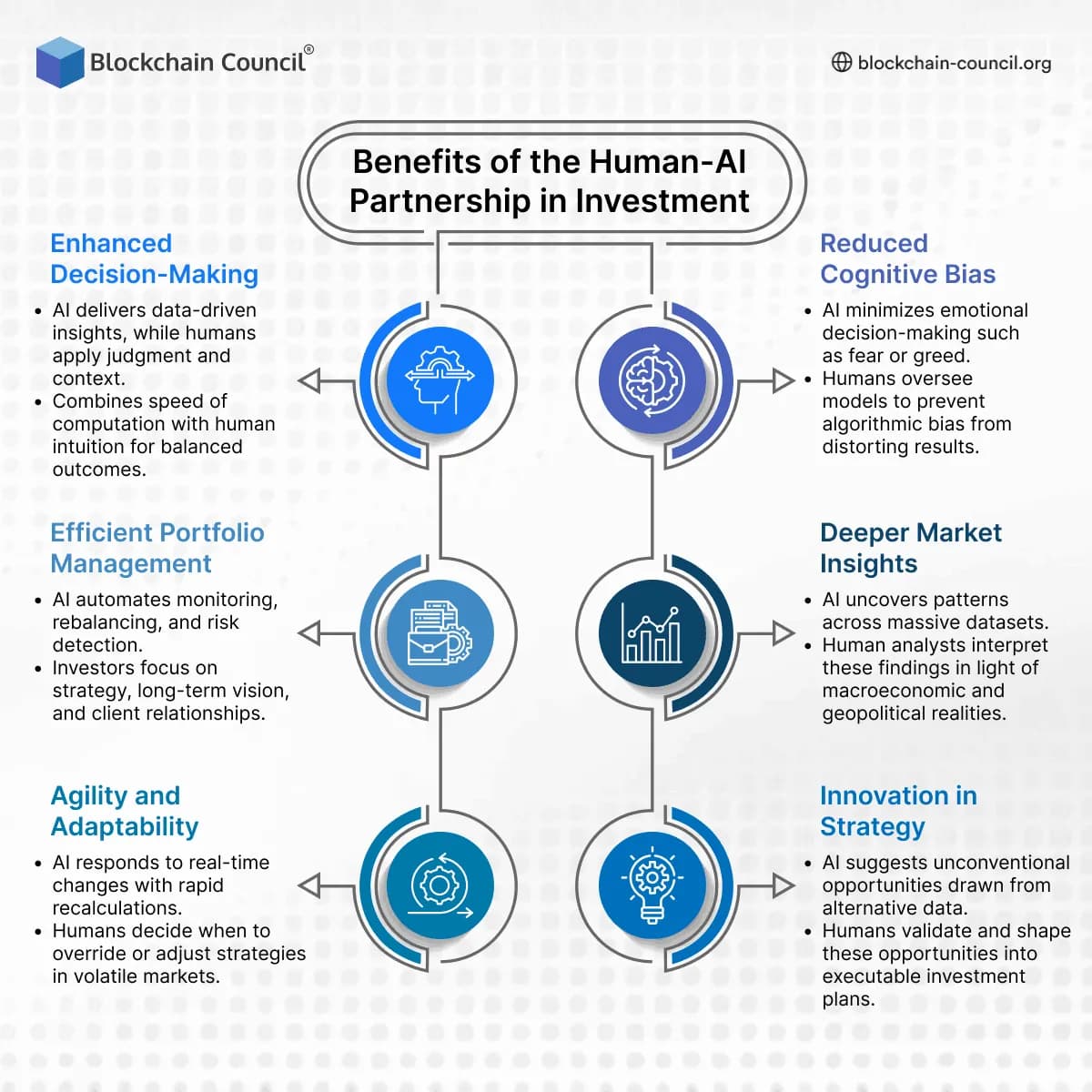
Enhanced Decision-Making
- AI delivers data-driven insights, while humans apply judgment and context.
- Combines speed of computation with human intuition for balanced outcomes.
Reduced Cognitive Bias
- AI minimizes emotional decision-making such as fear or greed.
- Humans oversee models to prevent algorithmic bias from distorting results.
Efficient Portfolio Management
- AI automates monitoring, rebalancing, and risk detection.
- Investors focus on strategy, long-term vision, and client relationships.
Deeper Market Insights
- AI uncovers patterns across massive datasets.
- Human analysts interpret these findings in light of macroeconomic and geopolitical realities.
Agility and Adaptability
- AI responds to real-time changes with rapid recalculations.
- Humans decide when to override or adjust strategies in volatile markets.
Innovation in Strategy
- AI suggests unconventional opportunities drawn from alternative data.
- Humans validate and shape these opportunities into executable investment plans.
Stronger Risk Management
- AI stress-tests portfolios under multiple scenarios.
- Human oversight ensures risk models align with ethical and regulatory standards.
Client Trust and Communication
- AI provides transparency through analytics and reporting.
- Human advisors translate insights into narratives clients understand and trust.
Why Education Will Define the Future
AI in investing is only as powerful as the people who use it. Investors who understand how these systems work have an advantage over those who simply trust the output. This is why education is crucial.
Learning data science concepts helps investors grasp how models process inputs and identify bias. Gaining knowledge of blockchain ensures crypto investors understand how AI tools interact with decentralized systems. Exploring business and marketing dynamics builds awareness of how consumer behavior, often measured by AI, feeds back into financial markets.
Without these skills, investors risk being dazzled by AI’s surface-level insights while missing its limitations. With them, they can ask the right questions, evaluate results critically, and design smarter strategies.
Case Studies of AI in Action
The best way to see whether AI represents the future of investing is to look at how it performs in the real world. Several stories stand out.
One of the clearest comes from Stanford’s AI analyst project. This system used only public information—financial reports, news articles, and macroeconomic data. Over three decades, it outperformed 93 percent of mutual fund managers and generated returns six times higher than average. This doesn’t just prove AI can predict patterns. It shows that traditional methods often overlook signals that machines can capture.
Another case comes from China, where smaller funds began using DeepSeek, a homegrown AI system, to compete against larger incumbents. DeepSeek’s strength lay in scanning massive datasets, spotting early signals in market narratives, and helping traders make faster decisions. For many smaller firms, it was a lifeline, showing how AI can level the playing field in competitive markets.
In crypto, tools like TokenMetrics and StockGPT have become popular. These platforms combine fundamentals, sentiment, and technical analysis to provide predictions. Traders use them to navigate volatile tokens and make decisions faster than manual research allows. While not foolproof, they give a clear edge in a market where delays can mean losses.
Why Crypto Needs AI Even More
The cryptocurrency market operates on a different logic than traditional stocks. Prices are influenced by technology upgrades, community sentiment, and sudden regulatory announcements. Data is fragmented across exchanges, forums, and social media. For human analysts, it is a nightmare to follow in real time.
AI thrives in this environment because it can process multiple inputs at once. Neural networks trained on crypto price history, reinforcement learning agents testing trading strategies, and NLP systems scanning forums like Reddit or X (formerly Twitter) all work together to form signals.
This combination helps investors spot sudden shifts. For example, if a new bug in a blockchain protocol is discussed in a developer forum, AI tools may catch it hours before the mainstream market reacts. That kind of early signal can be the difference between avoiding a crash and suffering a major loss.
It is no surprise, then, that surveys show nearly half of U.S. crypto holders believe AI-related tokens will outperform other sectors. Their optimism reflects a sense that AI isn’t just an accessory to crypto—it may be its natural partner.
The Risks of Over-Reliance
Yet optimism must be balanced with realism. There are serious risks in letting AI dominate investment decisions.
One problem is overfitting. Models trained on historical data often perform well in backtests but fail in live markets. This is especially true in crypto, where sudden regime shifts are common. An AI that learned from years of Bitcoin bull markets might be blind to the dynamics of a prolonged bear phase.
Another issue is data quality. Stock markets have regulated reporting systems. Crypto markets, by contrast, are full of noise, fake volume, and manipulation. If an AI system is fed bad data, it produces bad predictions. Retail investors who don’t question the source risk making poor decisions.
There is also the challenge of AI washing. Some products marketed as “AI-powered” are little more than basic algorithms. Regulators have already warned firms about making exaggerated claims. Investors must demand transparency and choose tools that show how predictions are generated, not just what the predictions are.
Human Judgment Remains Essential
Even as AI gets stronger, humans remain vital. Markets are influenced by politics, culture, and events that cannot always be captured in data. A sudden war or unexpected regulation can disrupt even the most advanced model.
Human investors bring context and long-term perspective. They can weigh ethical concerns, such as avoiding investments in companies with questionable practices, or decide whether short-term signals align with their broader strategy. AI may flag a risky token as a quick profit opportunity, but only humans can decide whether it fits their long-term vision.
In practice, the future lies in human-AI collaboration. Machines provide speed, scale, and objectivity. Humans provide judgment, creativity, and ethical oversight. Together, they are more powerful than either could be alone.
Why Education Is the True Secret Weapon
The investors who will benefit most from AI are not those who simply adopt the latest tool but those who understand it. Education is what transforms AI from a buzzword into a real edge.
A Tech Certification equips investors with the skills to understand how models work, how bias can creep in, and how to evaluate predictive accuracy. Instead of treating AI predictions as gospel, educated investors know how to ask the right questions.
For those focusing on digital assets, a Crypto certification is invaluable. It provides context on how blockchain markets operate, what factors move token prices, and how AI can integrate with blockchain data.
Professionals in broader industries can benefit from a Marketing and Business Certification. This highlights how AI is reshaping consumer behavior, branding, and product demand—all of which tie back into stock and crypto market trends.
Finally, blockchain technology courses help investors understand how blockchain and AI may converge. As decentralized finance evolves, being able to analyze blockchain data through AI will be a major advantage.
These forms of upskilling don’t just provide credentials. They build the confidence to question AI, test its outputs, and integrate it wisely into investment strategies.
The Road to an AI-Powered Future
If current trends continue, AI will not just be part of investing—it will be its backbone. Large institutions will embed AI in everything from portfolio design to trade execution. Retail investors will access AI-driven insights through everyday trading apps.
The rise of AI-related crypto tokens suggests the line between stock and crypto investing will blur further. Investors will not only use AI to analyze markets; they may also invest directly in AI-powered blockchain projects.
Regulation will shape this future too. Authorities are already demanding transparency in AI claims. As models grow more powerful, they will need to explain not just what they predict but why. This will build trust and protect investors from hype.
What is clear is that AI is not a passing trend. It is a structural shift in how markets operate. Those who resist may find themselves left behind, while those who embrace AI thoughtfully will have the chance to lead.
Future of AI in Investment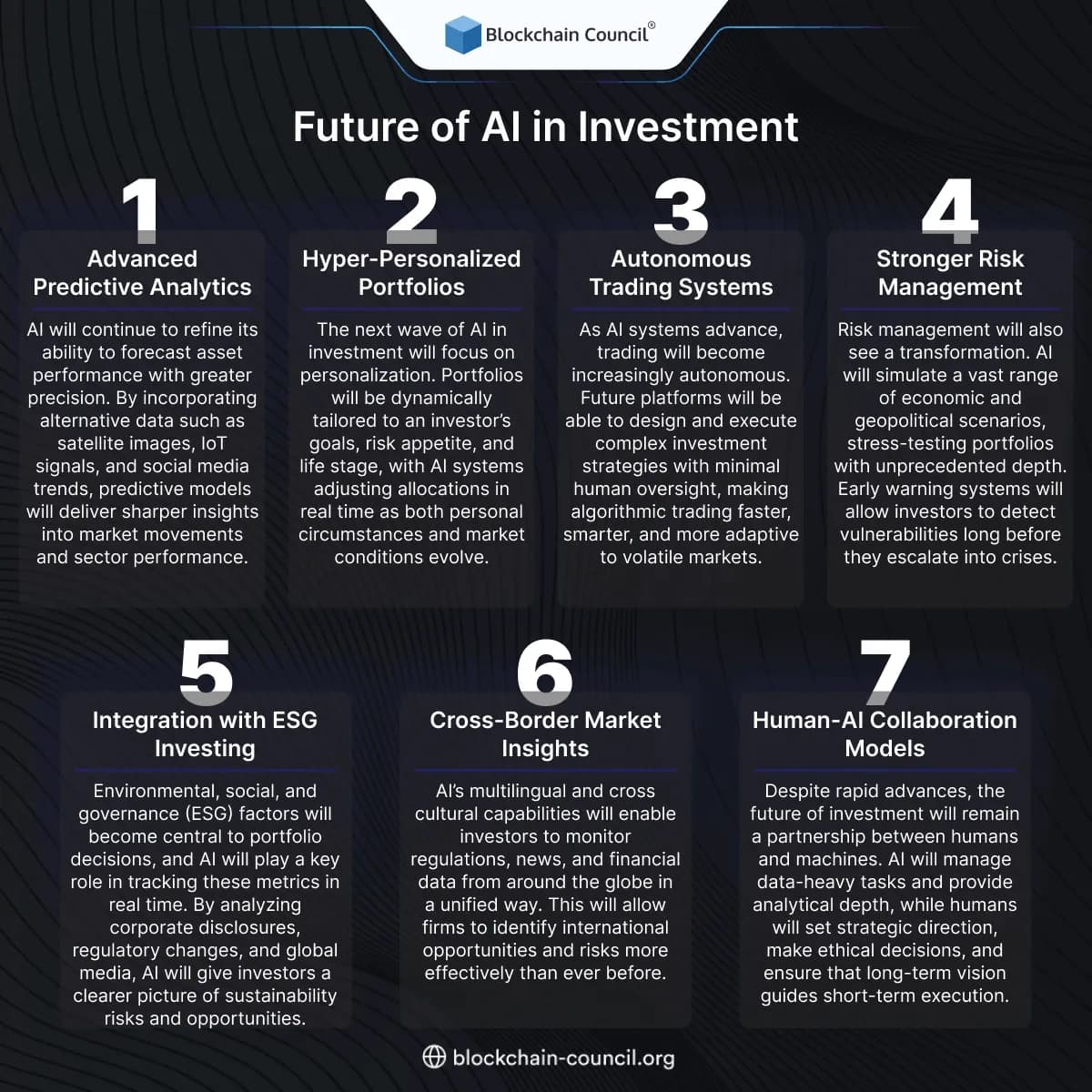
Advanced Predictive Analytics
AI will continue to refine its ability to forecast asset performance with greater precision. By incorporating alternative data such as satellite images, IoT signals, and social media trends, predictive models will deliver sharper insights into market movements and sector performance.
Hyper-Personalized Portfolios
The next wave of AI in investment will focus on personalization. Portfolios will be dynamically tailored to an investor’s goals, risk appetite, and life stage, with AI systems adjusting allocations in real time as both personal circumstances and market conditions evolve.
Autonomous Trading Systems
As AI systems advance, trading will become increasingly autonomous. Future platforms will be able to design and execute complex investment strategies with minimal human oversight, making algorithmic trading faster, smarter, and more adaptive to volatile markets.
Stronger Risk Management
Risk management will also see a transformation. AI will simulate a vast range of economic and geopolitical scenarios, stress-testing portfolios with unprecedented depth. Early warning systems will allow investors to detect vulnerabilities long before they escalate into crises.
Integration with ESG Investing
Environmental, social, and governance (ESG) factors will become central to portfolio decisions, and AI will play a key role in tracking these metrics in real time. By analyzing corporate disclosures, regulatory changes, and global media, AI will give investors a clearer picture of sustainability risks and opportunities.
Cross-Border Market Insights
AI’s multilingual and cross-cultural capabilities will enable investors to monitor regulations, news, and financial data from around the globe in a unified way. This will allow firms to identify international opportunities and risks more effectively than ever before.
Human-AI Collaboration Models
Despite rapid advances, the future of investment will remain a partnership between humans and machines. AI will manage data-heavy tasks and provide analytical depth, while humans will set strategic direction, make ethical decisions, and ensure that long-term vision guides short-term execution.
Regulatory and Ethical Safeguards
As AI becomes more embedded in investment, regulators will demand transparency and accountability. Ethical frameworks will emerge to govern AI-driven finance, ensuring fairness, reducing bias, and strengthening trust between investors and technology.
How AI Will Reshape Institutional and Retail Dynamics
One of the clearest ways AI is transforming investing is by shifting the balance between large institutions and individual investors. For decades, the edge belonged almost entirely to big funds. They had the analysts, the data subscriptions, and the computing power. Retail investors relied on delayed reports, broker recommendations, or gut instincts.
AI is changing this dynamic. Apps already offer AI-driven summaries of earnings calls, instant portfolio alerts, and market sentiment dashboards. What used to be the work of teams of analysts is now available in a mobile app. This democratization doesn’t eliminate the institutional advantage, but it narrows the gap.
At the same time, institutions are not standing still. They are embedding AI deeper into their systems—optimizing trade execution, analyzing alternative datasets, and designing thematic portfolios at scale. The future is likely to see a new arms race: retail empowered by smarter apps, institutions pushing into more exotic data sources and models.
Convergence of Stock and Crypto Investing
AI is also blurring the line between traditional stocks and digital assets. Investors once treated these as separate worlds. Stocks were driven by earnings and regulation, while crypto moved on sentiment and technology. But AI tools don’t recognize those boundaries. They process both markets using the same logic: identify signals in data, weigh probabilities, and forecast outcomes.
This creates an environment where investors can view opportunities across asset classes together. An AI model might flag renewable energy stocks and green crypto projects in the same analysis, drawing connections that human analysts rarely make. In practice, this convergence could mean investors build hybrid portfolios, combining equities and AI-driven crypto tokens to capture the full spectrum of innovation.
AI tokens themselves show how these worlds are merging. Grayscale’s creation of an “Artificial intelligence Crypto Sector” reflects rising confidence in blockchain projects powered by AI. With the sector ballooning from a few billion to more than $20 billion in value in just two years, it suggests that investors increasingly see AI not just as a tool for markets but as an investable theme in both stocks and crypto.
Regulation and the Push for Explainability
As AI’s role in finance grows, so too does the attention from regulators. Authorities worry about “AI washing,” where firms exaggerate their AI capabilities to attract investors. Already, some companies have faced penalties for overstating their use of machine learning. Future regulation is likely to make transparency a requirement.
Explainable AI is the natural next step. Investors will not just accept predictions; they will demand reasoning. Instead of “buy this stock,” systems will need to show supporting evidence: negative sentiment in news, unusual trading activity, or blockchain signals. This shift will protect investors and build trust. It may also push developers to design models that are not only accurate but understandable to the average user.
Regulation will likely extend to crypto too. With AI tokens gaining traction, authorities will want to ensure these assets are not used for scams or market manipulation. Clear frameworks could help legitimate projects grow while filtering out opportunistic hype.
Speculative Outlook: Where AI and Finance Could Go
Looking further ahead, the integration of AI into investing could take forms we are only beginning to imagine.
Multimodal models like Gemini, which process text, images, and potentially video, may provide richer insights. An investor could upload satellite images of shipping ports, a transcript of an earnings call, and a chart of commodity prices, and Gemini could combine them into a cohesive forecast. This type of multi-source reasoning could become the new standard in market analysis.
Another possibility is AI-driven personalization. Instead of everyone using the same dashboards, investors may have AI assistants tuned to their specific risk tolerance, portfolio mix, and goals. One investor’s AI might prioritize stability, while another’s focuses on high-growth crypto opportunities. This personalization could make AI not just a forecasting tool but a financial partner.
There is also the potential for AI to play a role in global market stability. If regulators and exchanges adopt AI monitoring tools, they could catch flash crashes, fraud, or systemic risks faster. In this sense, AI might evolve from an investor’s edge to a safeguard for entire financial systems.
Conclusion
AI is not just a passing trend in investing—it is reshaping the entire landscape. In stocks, it enhances portfolio design, uncovers signals in alternative data, and saves institutions millions. In crypto, it helps tame volatile markets, supports the rise of AI-driven tokens, and gives investors tools to act faster and smarter.
But the real shift comes from how AI changes the balance of power. Retail investors gain access to insights once reserved for Wall Street, while institutions push deeper into complex data. Stocks and crypto begin to converge under the same analytical lens. And regulators prepare to demand transparency, ensuring AI is not just powerful but trustworthy.
So, is AI the future of stock and crypto investing? The evidence says yes. Not because it replaces human investors, but because it works alongside them—faster, sharper, and more consistent than anything before. Those who learn to use AI wisely will not just keep up with markets; they will help define what investing looks like in the decades ahead.
Related Articles
View All
Cryptocurrency
The Future of AI Tokens: Opportunities, Risks, and Market Trends in Crypto
AI tokens link crypto assets with AI compute, model access, data markets, and agents. Learn the opportunities, risks, trends, and evaluation steps.

Cryptocurrency
Crypto Lending and Borrowing Explained: DeFi Loans, Rates, and Risks
Crypto lending and borrowing lets users earn yield or access liquidity through DeFi loans, but rates, collateral rules, and liquidations matter.

Cryptocurrency
Liquidity Mining Explained: How Crypto Users Earn Protocol Incentives
Liquidity mining lets crypto users supply assets to DeFi pools and earn fees plus token incentives. Learn how it works, where rewards come from, and the risks.
Trending Articles
The Role of Blockchain in Ethical AI Development
How blockchain technology is being used to promote transparency and accountability in artificial intelligence systems.

Top 5 DeFi Platforms
Explore the leading decentralized finance platforms and what makes each one unique in the evolving DeFi landscape.
How to Install Claude Code
Learn how to install Claude Code on macOS, Linux, and Windows using the native installer, plus verification, authentication, and troubleshooting tips.