

What is Automated Intelligence?
 Michael Willson
Automated Intelligence (AI) are machines or systems that do tasks independently without human help. These systems make decisions on their own and adapt as they learn new things. They notice what's happening around them, set goals, and even improve over time through learning.
Automated intelligence closely relates to something called "agentic AI." Agentic AI refers to machines that independently chase their goals. They actively make decisions, plan ahead, and carry out actions over time. That gives these machines a sense of digital independence. By 2026, agentic AI has moved from an experimental concept to a genuine enterprise category, with Gartner projecting that 40% of enterprise applications will include task-specific AI agents by the end of the year, up from under 5% just two years earlier.

As organizations adopt increasingly autonomous AI systems, professionals need more than a basic understanding of machine learning. They must also understand AI governance, intelligent automation, enterprise AI deployment, and responsible decision-making. A Certified Artificial Intelligence (AI) Expert credential helps build these practical capabilities, making it easier to design, implement, and manage AI-driven solutions across different industries.
What Does Automated Intelligence Mean?
Automated intelligence happens when machines perform smart tasks without humans guiding each move. It mixes two concepts: automation and intelligence.
Automation is like programming your coffee maker to start brewing automatically at 7 a.m. Intelligence appears when that same machine learns your preferences. For example, it adjusts how strong your coffee is based on yesterday's usage.
You might ask, "Isn't this just artificial intelligence (AI)?" Not exactly. AI is broader-teaching machines to think similar to people. Automated intelligence is narrower, specifically about machines using AI to manage tasks smoothly, without constant human input. Think of robot vacuums avoiding obstacles or drones delivering packages by selecting the quickest route themselves. That's automated intelligence at work.
Why should it matter to you? Today, automated intelligence is changing the way we live and work. It saves time, reduces costs, and leads to creative innovations. Let's explore how it operates and check out some real-world examples.
How Does Automated Intelligence Work?
Automated intelligence requires three basic parts:
Data collection: Machines gather information from their surroundings-like weather data or your buying habits.
Algorithms: These are instructions that tell the system exactly what to do with this collected data.
Hardware: Physical devices like computers, robots, or sensors run these instructions.
Here's the exciting part: these systems also learn. They observe patterns, predict outcomes, and adjust their behavior. For example, imagine a thermostat noticing you always raise the temperature at night. Soon it automatically adjusts, no buttons required. That's automated intelligence in action.
As automated systems become more autonomous, understanding how AI agents plan, reason, coordinate tasks, and adapt to changing environments is becoming increasingly valuable. A Certified Agentic AI Expert credential equips professionals with the knowledge to work with autonomous AI agents while understanding the governance, architecture, and decision-making processes that support enterprise-scale deployments.
What are Some Applications of Automated Intelligence?
How is Automated Intelligence Used in Customer Support?
Automated intelligence handles customer questions independently. Salesforce's "Agentforce" platform, introduced in 2024, has scaled dramatically since launch: by 2026, Salesforce reports it has handled well over a billion agent interactions globally and now resolves roughly 85% of customer queries without any human intervention, according to the company's own deployment data. In 2026, Salesforce also expanded the platform with "Agentforce 2DX" and "Agentforce Operations," extending automated intelligence from front-office customer service into back-office work like document processing, compliance checks, and approval routing.
How is Automated Intelligence Changing Business Operations?
Automated intelligence makes routine business tasks easier. An early example was Manus, an AI agent introduced in 2025 that independently analyzes financial transactions and screens job applicants without needing human intervention. Since then, similar autonomous business agents have become far more common: by 2026, most large enterprises are experimenting with AI agents in some form, though a much smaller share, generally estimated at around one in ten, have moved these agents fully into production, since many pilots stall over governance, reliability, and unclear return on investment.
How Does Automated Intelligence Improve Cybersecurity?
Automated intelligence can detect cyber threats instantly. It notices patterns, identifies security risks, and immediately acts to protect systems without waiting for human instructions.
Can Automated Intelligence Support Business Decisions?
Automated intelligence helps businesses make better decisions by analyzing data. It reviews large amounts of information, spots trends, and finds unusual activities. This helps companies plan strategies more effectively.
What are Recent Developments in Automated Intelligence?
What is Manus, the AI Agent?
Manus, an AI agent that independently thinks, plans, and decides, was introduced in March 2025. It performs tasks like financial analysis and applicant screening without human guidance. Manus represented an early step forward for automated intelligence, and by 2026 it sits alongside a much larger wave of similar autonomous business agents from vendors such as Salesforce, Microsoft, and a growing field of dedicated AI-agent startups.
How is McDonald's Using Automated Intelligence?
McDonald's continues to roll out automated intelligence across its tens of thousands of locations worldwide. This upgrade improves service speed and boosts customer satisfaction. Changes include smart kitchen devices, AI-driven drive-through ordering, and tools to help managers predict maintenance needs, with the rollout continuing to expand through 2026 as the company refines its AI-assisted ordering systems.
How is Automated Intelligence Improving News Accessibility?
Hearst Newspapers introduced audio stories on their websites, using advanced text-to-speech technology. Readers can now listen to news articles while commuting or multitasking. Automated intelligence makes accessing content easier and more convenient, and similar AI-narrated audio features have since become common across other major news publishers.
The rapid growth of automated intelligence also highlights the importance of broader technical skills, including cloud computing, cybersecurity, APIs, enterprise systems, data analytics, and AI integration. A Tech Certification helps professionals strengthen these complementary capabilities, enabling them to deploy intelligent automation solutions that are secure, scalable, and aligned with modern business requirements.
How is Automated Intelligence Different from Artificial Intelligence?
Are automated intelligence and artificial intelligence (AI) the same? People often confuse them, but here's the difference clearly explained:
AI is the broad concept of making machines think like humans. It includes things like chatbots and self-driving cars. Automated intelligence is narrower, specifically dealing with performing smart tasks independently.
Think of AI as a brain: it learns, reasons, and even creates new things. Automated intelligence, however, is more like the hands. It takes that brainpower and applies it practically to specific tasks.
For example, AI might design a new type of drone. Automated intelligence then guides that drone directly to your doorstep. Heading into 2026, major AI labs including Microsoft, Google, OpenAI, and Anthropic continue to push reasoning-focused models that plan through multi-step problems more like a human would. Meanwhile, automated intelligence is already active in real-world logistics, including drone and robot delivery pilots run by companies like Amazon.
Simply put, AI is the thinker, and automated intelligence is the action-taker.
What are the Challenges with Automated Intelligence?
Is Automated Intelligence Reliable and Affordable?
Running automated intelligence systems often requires expensive computing resources. High operational costs can become an issue. Additionally, these systems may struggle with tasks involving multiple complex steps. Reliability can sometimes be a concern, and by 2026 this has become one of the field's central challenges: industry research from Gartner suggests that more than 40% of agentic AI projects could be cancelled before 2027, mainly due to unclear business value, high costs, and inadequate risk controls, even as overall investment and adoption keep climbing.
Are There Ethical and Regulatory Issues?
Since automated intelligence operates independently, there are ethical concerns. For instance, who is responsible if something goes wrong? Regulations are now evolving to address these questions, and by 2026 several governments have introduced or strengthened AI-specific rules covering transparency, accountability, and risk management for autonomous systems. Authorities aim to guide the safe and responsible use of automated intelligence.
How Can Companies Integrate Automated Intelligence with Workers?
Automated intelligence is growing quickly, causing challenges in workplaces. Companies are now training employees to collaborate effectively with automated intelligence systems. This training ensures humans stay in control and continue giving valuable feedback, improving the AI. This human-oversight approach has become even more important in 2026, as organizations discover that agentic AI tends to succeed only when paired with clear governance, monitoring, and a defined escalation path back to a human.
Conclusion
Automated intelligence is a huge step forward in technology. It allows systems to operate independently, learning from data, and adapting quickly. Businesses across many industries use automated intelligence for greater efficiency and innovation. By 2026, this shift has accelerated further, with agentic AI moving from isolated experiments toward a genuine, if still uneven, feature of enterprise software.
Still, challenges remain. Reliability, ethical concerns, and human integration require attention. By overcoming these issues, automated intelligence can reach its full potential, benefiting everyone.
As automated intelligence becomes a larger part of everyday business, organizations also need professionals who can clearly communicate AI strategies, explain business value, and build trust among customers, employees, and stakeholders. A Marketing Certification helps develop strategic communication and stakeholder engagement skills, supporting successful adoption of AI-driven initiatives across the enterprise.
FAQs
1. What is Automated Intelligence?
Automated Intelligence refers to the use of software, algorithms, workflows, and rules-based systems to automate repetitive tasks and decision-making processes with minimal human intervention. Unlike systems designed to mimic human reasoning broadly, automated intelligence focuses on executing predefined processes efficiently, consistently, and at scale.
2. How does Automated Intelligence differ from Artificial Intelligence (AI)?
Automated Intelligence generally relies on predefined rules, workflows, or structured logic to perform specific tasks, while Artificial Intelligence can learn from data, recognize patterns, and make predictions or recommendations. In practice, many modern business solutions combine automation with AI capabilities to improve efficiency and decision support.
3. How does Automated Intelligence work?
Automated Intelligence operates by following programmed instructions, business rules, workflows, or decision trees. Some systems also integrate machine learning models, APIs, and enterprise software to automate end-to-end business processes while maintaining consistent execution.
4. What are the main components of Automated Intelligence?
Typical components include workflow automation, business rules engines, process orchestration, robotic process automation (RPA), integrations with enterprise systems, analytics dashboards, and monitoring tools. More advanced implementations may also incorporate AI models for classification, forecasting, or natural language processing.
5. What are the benefits of Automated Intelligence?
Automated Intelligence can improve operational efficiency, reduce manual errors, increase productivity, accelerate response times, enhance consistency, and lower operational costs. It also enables employees to spend more time on strategic and creative work rather than repetitive administrative tasks.
6. Which industries use Automated Intelligence?
Industries adopting Automated Intelligence include healthcare, banking, insurance, manufacturing, retail, logistics, telecommunications, education, government, energy, and professional services. Organizations use it to streamline operations, improve compliance, and enhance customer experiences.
7. What business processes can be automated?
Organizations commonly automate invoice processing, customer onboarding, document management, payroll, procurement, claims processing, compliance checks, reporting, inventory management, scheduling, customer support, and marketing workflows. The most suitable processes are repetitive, rules-based, and high in transaction volume.
8. What is the relationship between Robotic Process Automation (RPA) and Automated Intelligence?
Robotic Process Automation is a technology that automates repetitive digital tasks by interacting with software applications similarly to a human user. Automated Intelligence is a broader concept that may include RPA alongside workflow automation, decision engines, analytics, and AI-powered capabilities.
9. How does Automated Intelligence improve customer service?
Automated systems can route requests, answer common questions, process service requests, manage appointments, and escalate complex cases to human agents when needed. This helps organizations improve response times while maintaining service consistency.
10. Can Automated Intelligence use Artificial Intelligence?
Yes. Many enterprise automation platforms integrate AI technologies such as machine learning, computer vision, natural language processing, and predictive analytics. AI enhances automation by handling tasks involving unstructured data, while automation coordinates and executes business workflows.
11. How does Automated Intelligence support decision-making?
Automated Intelligence can gather information, apply predefined business rules, generate alerts, recommend actions, and trigger workflows based on established criteria. Human oversight often remains important for high-impact, regulated, or complex business decisions.
12. What are the risks of Automated Intelligence?
Potential risks include incorrect business rules, poor data quality, cybersecurity threats, system integration challenges, automation bias, compliance issues, and overreliance on automated decisions. Regular testing, governance, and monitoring help reduce these risks.
13. How can organizations implement Automated Intelligence successfully?
Successful implementation typically begins with identifying suitable processes, defining measurable objectives, documenting workflows, selecting appropriate technologies, integrating existing systems, training employees, and continuously monitoring performance for improvement opportunities.
14. What technologies support Automated Intelligence?
Supporting technologies include workflow automation platforms, RPA software, business process management (BPM) systems, cloud computing, APIs, AI models, data analytics platforms, enterprise resource planning (ERP) systems, customer relationship management (CRM) software, and low-code development tools.
15. How does Automated Intelligence improve compliance?
Automation helps standardize business processes, maintain audit trails, enforce approval workflows, monitor regulatory requirements, generate compliance reports, and reduce manual processing errors. Organizations should still review applicable legal and regulatory obligations for their industry.
16. What skills are valuable for working with Automated Intelligence?
Useful skills include business process analysis, workflow design, data analytics, automation platform configuration, project management, cybersecurity awareness, API integration, cloud computing, AI fundamentals, change management, and governance.
17. What trends are shaping Automated Intelligence in 2025-2026?
Key trends include AI-powered process automation, intelligent document processing, autonomous business workflows, generative AI integration, predictive analytics, hyperautomation, process mining, digital twins for operations, and stronger governance for responsible automation.
18. What are common use cases for Automated Intelligence?
Common applications include financial reporting, HR onboarding, fraud detection support, supply chain coordination, inventory optimization, contract processing, IT service management, healthcare administration, customer communications, and regulatory reporting across both public and private sectors.
19. What best practices should businesses follow when adopting Automated Intelligence?
Organizations should automate well-defined processes first, establish governance frameworks, ensure data quality, implement strong cybersecurity controls, involve stakeholders early, monitor system performance, maintain documentation, and regularly review automation outcomes to support continuous improvement.
20. What is the future of Automated Intelligence?
Automated Intelligence is expected to become increasingly integrated with artificial intelligence, cloud platforms, and enterprise software to deliver more adaptive, scalable, and efficient business operations. As organizations balance automation with human oversight, they are likely to improve productivity while maintaining transparency, security, and regulatory compliance. After all, computers are excellent at repetitive work, which is fortunate because humans have spent centuries inventing astonishing amounts of it.
Related Articles
View All
AI & ML
From Agentic AI to AGI & Super AGI: Where Is Artificial Intelligence Heading?
Follow the path from Agentic AI to AGI & Super AGI. Learn what AGI means, how it differs from today’s AI, what superintelligence could be, and the opportunities, risks, and alignment challenges ahead.

AI & ML
Jev as an Intelligence Primitive
Explore how Jev functions as an intelligence primitive for software, providing fast, typed, probabilistic decisions that developers can combine into larger automated workflows.
AI & ML
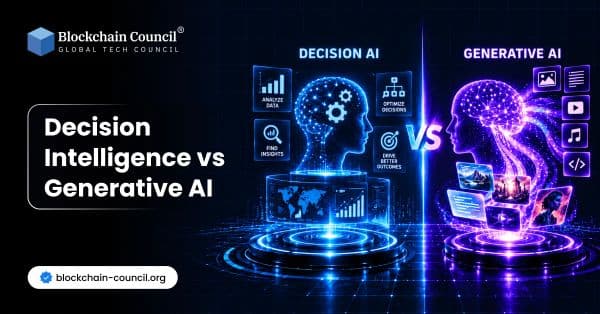
Decision Intelligence vs Generative AI
Compare decision intelligence and generative AI, including how they differ in purpose, outputs, data use, automation, reasoning, and business applications.
Trending Articles
What is AWS? A Beginner's Guide to Cloud Computing
Everything you need to know about Amazon Web Services, cloud computing fundamentals, and career opportunities.
Claude AI Tools for Productivity
Discover Claude AI tools for productivity to streamline tasks, manage workflows, and improve efficiency.
Blockchain in Supply Chain Provenance Tracking
Supply chains are under pressure to prove not just efficiency, but also authenticity, sustainability, and fairness. Customers want to know if their coffee really is fair trade, if the diamonds are con