

Artificial Intelligence in Robotics: All You Need To Know
 Blockchain Council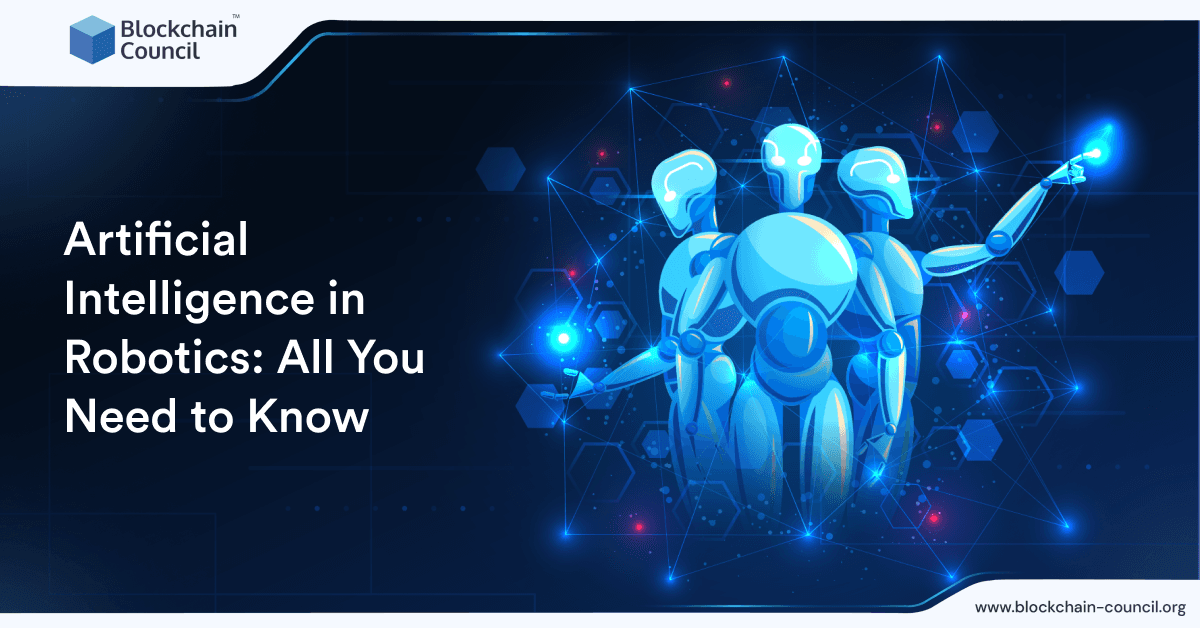

There are a lot of things that go on in the back end of designing a robot and integrating AI into it. You must be intrigued to understand how a robot can get human-like intelligence. Well, we are going to dive deep into understanding artificial intelligence in robotics and what is the role it plays.
What is Artificial Intelligence?
Before going directly into AI in robotics, we should at least have some basic idea of what artificial intelligence is. It is a term that has been heard by people globally but very few know the actual meaning of it. Artificial intelligence stands for an algorithm or program that lets a device achieve human-like interpretation, analysis, and intelligence. The machine gets a lot of data that gets processed by the algorithm and the output is efficiently produced according to the user of the device.
One of the best examples of AI is the use of google maps. Whenever you have to go from one place to another, you check the route through Google Maps. Based on your past driving activities, the road conditions, traffic situation, and the weather, google maps suggest you the best route and even gives you an approximate time of arrival. All of this has happened because of the algorithm that the software makes use of to interpret the data provided to it and generates a user-specific output.
So, it can be concluded that artificial intelligence is the simulation of human-like intelligence with the help of a carefully coded algorithm. It makes use of natural language processing, machine learning, expert systems, speech recognition, and machine vision to achieve such levels of intelligence. If you are interested in the field of artificial intelligence, you can even take up the courses available on the internet, offered by a lot of famous universities and companies. Artificial intelligence has found its application in a lot of industries and has become an ally for their functioning.
Artificial Intelligence in Robotics
Let us now get into the actual topic of what artificial intelligence is doing in the field of robotics. The primary function of AI in robotics is to provide better interpretation and less human reliance on robots. If robots can perform various tasks with their understanding and produce efficient results, then it makes the job even easier for humans. Artificial intelligence is mainly being used to teach four of the important functions to robots. You should know what these four primary functions are to understand what AI is doing in robotics.
Let’s take a look at the four functions that AI is teaching to all the robots for getting human-like intelligence:
Related Articles
View All
AI & ML
From Agentic AI to AGI & Super AGI: Where Is Artificial Intelligence Heading?
Follow the path from Agentic AI to AGI & Super AGI. Learn what AGI means, how it differs from today’s AI, what superintelligence could be, and the opportunities, risks, and alignment challenges ahead.
AI & ML
What Is an RSI Loop in Artificial Intelligence?
Learn what an RSI loop in artificial intelligence means, how recursive self-improvement works, and why verification and governance matter.
AI & ML
What Is the RSI Hypothesis in Artificial Intelligence?
Learn what the RSI hypothesis in artificial intelligence means, how recursive self-improvement works, why it matters for AI safety, and what is real today.
Trending Articles
The Role of Blockchain in Ethical AI Development
How blockchain technology is being used to promote transparency and accountability in artificial intelligence systems.
AWS Career Roadmap
A step-by-step guide to building a successful career in Amazon Web Services cloud computing.
Blockchain in Supply Chain Provenance Tracking
Supply chains are under pressure to prove not just efficiency, but also authenticity, sustainability, and fairness. Customers want to know if their coffee really is fair trade, if the diamonds are con