

AI-Powered Payment Gateways for Web3 Businesses and dApps

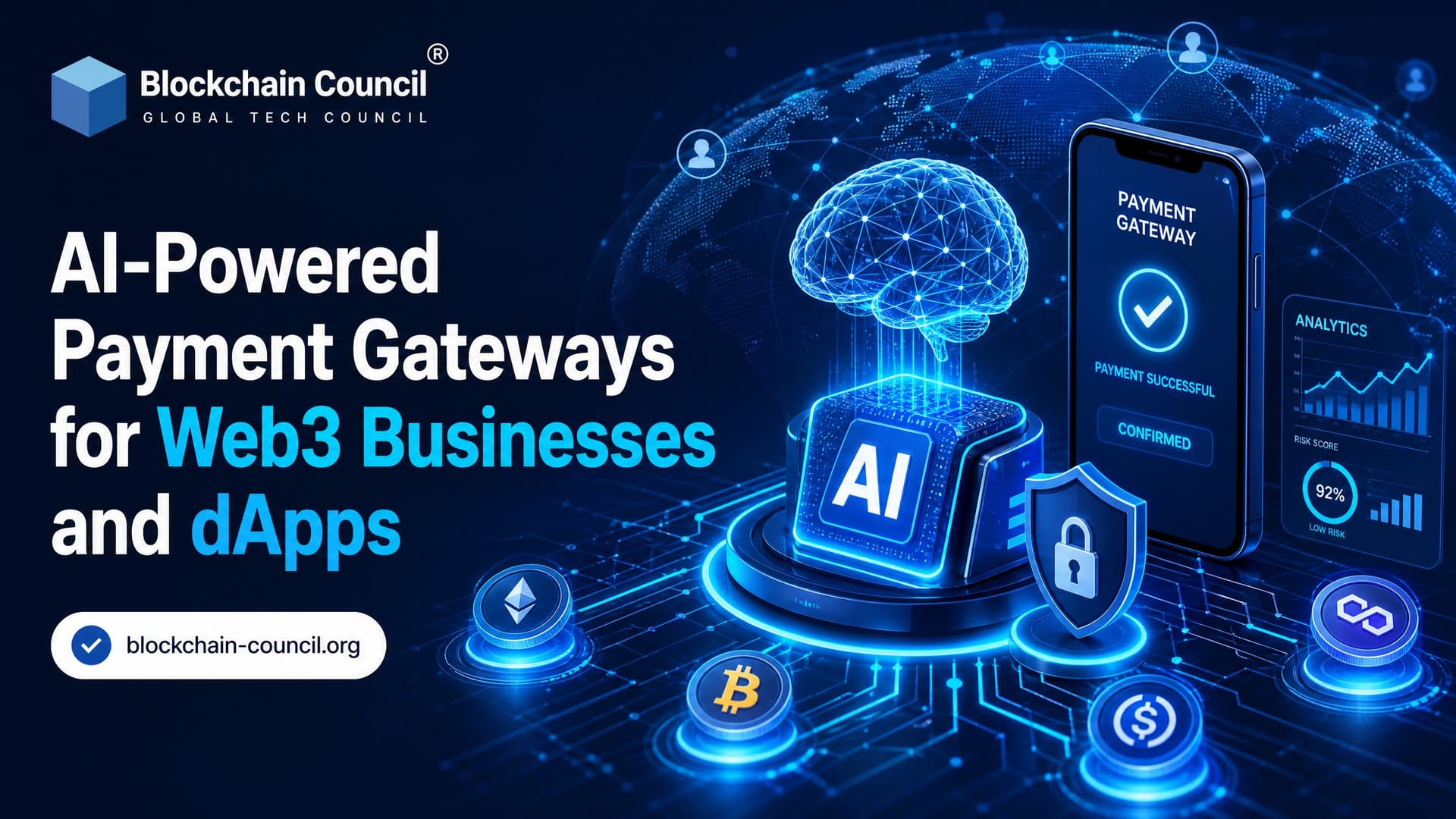
AI-powered payment gateways are becoming the control layer between wallets, smart contracts, stablecoins, fiat rails, and risk systems. For Web3 businesses and dApps, the payment gateway is no longer just a checkout screen. It is where fraud checks, routing decisions, compliance rules, token transfers, and user experience meet.
The shift is early, but real. Traditional payment providers already use machine learning for fraud scoring, payment routing, cash application, and customer behavior analysis. Web3 teams are now adapting the same patterns to on-chain assets, wallet-based identity, smart contract payments, and stablecoin settlement. Professionals exploring the AI side of this shift may find the Certified Artificial Intelligence (AI) Expert program relevant to building a stronger foundation in applied AI. Deloitte has described AI and blockchain as complementary technologies in payments: AI improves detection and decision-making, while blockchain provides tamper-resistant records for audit and settlement.

What Are AI-Powered Payment Gateways in Web3?
An AI-powered payment gateway is a payment infrastructure layer that uses machine learning models, rules engines, on-chain analytics, and smart contract integrations to process crypto or hybrid payments more intelligently.
In a Web3 setup, the gateway may support:
Wallet payments through MetaMask, WalletConnect, Coinbase Wallet, or embedded wallets
Stablecoin settlement using assets such as USDC or USDT
Smart contract based checkout, subscriptions, escrow, or revenue sharing
AI fraud detection based on wallet history, device behavior, velocity, and transaction context
Dynamic routing between on-chain payment, off-chain processing, stablecoins, or fiat settlement
Compliance checks for sanctions screening, KYC, AML, and transaction monitoring
Think of it as a programmable payment gateway with a risk analyst and routing engine built in. The smart contract handles settlement logic. The AI layer decides whether the payment looks normal, risky, costly, or worth extra verification.
Why Web3 Businesses Need Smarter Payment Infrastructure
Crypto payments solve some problems and create others. Settlement can be fast. Chargebacks are limited. Cross-border payments are easier with stablecoins. But you also face wallet spoofing, phishing, bridge risk, smart contract exploits, chain congestion, compliance pressure, and a user experience that can still break at the worst moment. For readers developing a broader understanding of decentralized applications and blockchain-based business models, the Certified Web3 Expert learning path may be a useful resource.
If you have shipped a dApp checkout, you know the small things hurt. USDC uses 6 decimals on Ethereum, not 18 like ETH. Many failed ERC-20 payments are not mysterious at all: the user approved the wrong spender, the allowance is too low, or the RPC returns insufficient funds for gas * price + value. Since EIP-1559, you also need to think about maxFeePerGas and maxPriorityFeePerGas, not only a single gas price. On Ethereum mainnet, chain ID 1 matters. Send a user to the wrong network and your conversion rate drops fast.
AI does not remove the need for good engineering. It helps the gateway make better decisions at scale.
Core Capabilities of AI-Powered Payment Gateways
1. Real-Time Fraud and Anomaly Detection
Fraud detection is the first strong use case. Many payment teams that add machine learning to their fraud stack report meaningful drops in losses, mainly by catching unusual behavior earlier and cutting manual review.
In Web3, the model can inspect signals such as:
Wallet age and transaction frequency
Links to mixers, hacks, sanctioned addresses, or high-risk contracts
Sudden changes in spending behavior
Device fingerprint and IP risk, where legally permitted
Repeated failed approvals or suspicious contract interactions
Mismatch between wallet behavior and expected dApp flow
A good gateway should not block every risky-looking transaction by default. That would punish legitimate users. Better design uses tiered controls: allow, step-up verification, delayed settlement, manual review, or reject.
2. Intelligent Routing Across Crypto and Fiat Rails
AI-powered payment gateways can choose the payment path based on cost, speed, success probability, and risk. For a Web3 business, that might mean accepting USDC on Polygon for a low-value subscription, routing a larger enterprise payment to Ethereum mainnet, or settling to fiat through a licensed provider when the merchant wants lower treasury exposure.
This matters because blockchain fees change quickly. During congestion, a $3 transaction can become uneconomic if gas costs spike. AI-based routing can compare network fees, liquidity, user wallet balances, and settlement urgency before showing the payment option.
3. Compliance Automation and Audit Trails
Enterprises do not adopt crypto payments unless compliance is clear. AI systems can support KYC checks, AML monitoring, sanctions screening, transaction clustering, and suspicious activity detection. Blockchain adds a record of what happened and when.
This combination is useful, but it must be handled carefully. A model that silently flags users without explanation creates regulatory and trust issues. Your gateway should log decision reasons, model version, data sources, and action taken. If you cannot explain why a payment was blocked, the system is not ready for serious business use.
4. Personalization Without Breaking Trust
AI in digital wallets and payment apps is often used to personalize checkout flows, offers, loyalty rewards, and payment timing. In Web3, this can mean fee discounts for long-term users, token rewards for verified community members, or simpler payment prompts for wallets with clean history.
Be careful here. Personalization should not feel like surveillance. If you analyze wallet behavior, tell users what data is used and why. Web3 users may accept analytics for security. They will not accept hidden profiling dressed up as convenience.
5. Payments for AI Agents
A newer category is non-custodial stablecoin gateways that allow both humans and autonomous AI agents to pay for services. This is important for data marketplaces, API platforms, compute networks, and LLM-powered tools where agents may need to buy access, trigger microtransactions, or settle usage fees.
The hard part is authorization. An AI agent should not have unlimited spending power from a hot wallet. Gateways need policies such as daily limits, approved contract lists, spending categories, human approval above a threshold, and revocation controls. Smart contract wallets and account abstraction can help, but the business rules still need careful design.
Architecture: Where the AI Layer Fits
A practical AI-powered Web3 gateway usually has five layers:
Wallet and identity layer: WalletConnect, embedded wallets, decentralized identity, KYC links, or account abstraction.
Payment orchestration layer: Asset selection, chain selection, order creation, invoice state, and settlement confirmation.
Smart contract layer: Escrow, subscriptions, revenue splits, token transfers, or payment intents.
AI decision layer: Fraud scoring, routing, anomaly detection, fee prediction, and user segmentation.
Compliance and reporting layer: Audit logs, sanctions checks, tax exports, reconciliation, and case management.
Do not put AI inside a smart contract unless you have a very narrow reason. On-chain computation is expensive, public, and deterministic. Most AI scoring belongs off-chain, with the result passed into gateway logic or contract calls through signed attestations, allowlists, or policy APIs.
Risks You Should Not Ignore
AI improves crypto payment gateways, but it also introduces new failure modes.
Privacy risk: Wallets are pseudonymous, not anonymous. Combining wallet history, device data, and behavior can de-anonymize users.
Model manipulation: Attackers can test a gateway repeatedly to learn what behavior avoids detection.
Data poisoning: Bad training data can teach the model to trust the wrong patterns.
False positives: Blocking legitimate wallets damages revenue and user trust.
Vendor lock-in: If your risk logic lives entirely inside a provider dashboard, migration becomes painful.
To be blunt, an AI gateway is the wrong choice if your team cannot maintain data governance, incident response, and model monitoring. Start with deterministic rules and basic on-chain analytics first. Add machine learning when transaction volume and risk justify it.
Best Practices for dApp Builders
If you are building or selecting an AI-powered payment gateway, use this checklist:
Minimize data collection: Collect only what you need for payment, fraud control, and legal duties.
Support stablecoins properly: Handle token decimals, contract addresses, network differences, and confirmation depth with care.
Separate risk score from final action: Let policies decide whether to approve, review, delay, or reject.
Log model decisions: Store model version, input categories, output score, and rule outcome for audits.
Use human review for edge cases: High-value payments deserve a second look.
Plan for agent payments: Add spending limits, allowlists, revocation, and human approval paths.
Test failed states: Simulate dropped RPC calls, chain reorgs, expired quotes, low gas, wrong chain, and duplicate payment attempts.
What This Means for Web3 Careers and Teams
Payment gateway work now sits at the intersection of blockchain development, AI engineering, cybersecurity, and compliance. A developer who understands only smart contracts will miss the risk layer. A payment professional who understands only card rails will miss wallet behavior and on-chain settlement. Professionals seeking structured ways to broaden their technical knowledge can explore a Tech Certification relevant to their role and learning goals.
If you want to build practical skill in this area, Blockchain Council courses can help you connect the pieces. Consider the Certified Web3 Expert™ if you need a broad understanding of dApps, wallets, tokens, and decentralized business models. Choose the Certified Blockchain Developer™ or Certified Smart Contract Developer™ if you plan to build payment contracts and integrations. If your role is focused on model design, fraud analytics, or intelligent automation, the Certified Artificial Intelligence (AI) Expert™ is a useful companion path.
Building Skills and Evaluating Talent
As blockchain technology continues to transform industries, organisations need professionals who understand its practical applications and technical foundations. Hiring the right talent requires more than reviewing qualifications; employers must also evaluate relevant knowledge and problem-solving skills. Platforms like HireValid can help organisations explore structured candidate assessments for more informed hiring decisions.
The Future of AI-Powered Payment Gateways
The next wave will be more than crypto checkout. Expect gateways to support tokenized deposits, programmable stablecoin flows, decentralized identity, on-chain credit signals, account abstraction, and machine-to-machine payments. AI will help decide which rail to use, which transaction needs review, and how to price risk in real time.
Regulation will shape the design. Privacy-preserving analytics, zero-knowledge proofs, federated learning, and secure multi-party computation may become more common as teams try to balance fraud control with user privacy. The winning gateways will not be the ones with the flashiest AI label. They will be the ones that settle correctly, explain decisions clearly, protect users, and survive audits.
Your next step: map your current payment flow from wallet connection to settlement and mark every decision point. Then decide which ones should be handled by rules, which ones need AI scoring, and which ones should stay under human review. That map is the foundation for a gateway that can support real Web3 commerce. For teams communicating the value of these solutions to customers and partners, a Marketing Certification may help develop complementary marketing skills.
FAQs
1. What Is an AI-Powered Payment Gateway for Web3?
An AI-powered payment gateway for Web3 is a payment system that combines blockchain payment infrastructure with AI-assisted automation and analysis. It can help businesses accept cryptocurrency, monitor transactions, detect suspicious activity, and streamline payment workflows. The gateway may use AI internally or connect to external AI agents that assist with payment operations.
2. How Do AI-Powered Web3 Payment Gateways Work?
A typical gateway connects a customer’s wallet or payment interface to blockchain networks, smart contracts, and payment-processing APIs. It creates a payment request, monitors the transaction, verifies the required confirmations, and notifies the application when payment is complete. AI can assist with fraud screening, payment routing, reconciliation, and customer support.
3. What Are the Main Features of an AI-Powered Crypto Payment Gateway?
Common capabilities include multi-chain payments, stablecoin acceptance, automated transaction monitoring, payment status notifications, API integrations, and reporting. AI-enhanced systems may also support anomaly detection, fee estimation, payment forecasting, and automated reconciliation. Features vary by provider, so businesses should distinguish available gateway functions from AI capabilities that require separate integration.
4. How Can Web3 Businesses Benefit From AI-Powered Payment Gateways?
Web3 businesses can use these gateways to reduce manual payment processing, simplify checkout, and improve transaction visibility. AI-assisted monitoring can help identify unusual activity and prioritize payment exceptions. Automated APIs and webhooks can also connect blockchain payments with accounting, customer management, and order-processing systems.
5. What Is the Role of Stablecoins in Web3 Payment Gateways?
Stablecoins such as USDC and USDT are digital assets designed to maintain a relatively stable value against a reference currency. They can simplify pricing and settlement for businesses that want to accept blockchain payments without relying exclusively on more volatile cryptocurrencies. However, businesses must consider issuer risk, redemption arrangements, liquidity, supported networks, and applicable regulations.
6. Can AI-Powered Gateways Accept Payments Across Multiple Blockchains?
Yes, gateways designed for multi-chain payments can accept supported assets across different blockchain networks. AI can help compare network fees, transaction speed, liquidity, and settlement requirements when choosing an available route. Cross-chain transfers may still involve bridge costs, technical risks, and additional confirmation requirements.
7. How Can AI Improve Payment Security in Web3 Applications?
AI can analyze transaction patterns, wallet activity, account behavior, and other permitted signals to identify potentially suspicious payments. It may help detect abnormal transaction frequency, unusual withdrawal behavior, or patterns associated with scams. AI should complement established controls such as secure wallet management, transaction simulation, access restrictions, and human review.
8. What Is the Difference Between a Traditional Crypto Payment Gateway and an AI-Powered Gateway?
A traditional crypto payment gateway focuses on payment creation, blockchain monitoring, settlement, refunds, and transaction notifications. An AI-powered gateway adds intelligent capabilities such as predictive risk scoring, anomaly detection, automated reconciliation, or AI-agent integration. Not every gateway marketed for Web3 payments includes these AI capabilities natively.
9. Can AI-Powered Payment Gateways Support Decentralized Applications (dApps)?
Yes. A dApp can integrate a payment gateway through APIs, software development kits, wallet connections, or smart contracts. This allows the application to accept payments for subscriptions, digital goods, gaming services, memberships, or decentralized services. AI can assist with payment support, fraud monitoring, and transaction workflows while blockchain infrastructure handles settlement.
10. How Do AI Agents Use Web3 Payment Gateways?
AI agents can use payment APIs and supported protocols to request services, initiate permitted payment workflows, and verify settlement results. For example, an agent might pay for an API request or purchase a digital service using an authorized stablecoin balance. Secure implementations need explicit permissions, spending limits, transaction verification, and safeguards against unauthorized transfers.
11. What Is the x402 Payment Protocol?
x402 is an internet payment protocol that uses the HTTP 402 “Payment Required” status to support payment-gated digital services. It can enable applications and AI agents to pay for API calls, digital content, and other resources using supported payment mechanisms. Implementations such as PayAI provide infrastructure for verifying and settling eligible payments, depending on the selected network and scheme.
12. Can AI-Powered Payment Gateways Automate Subscription Billing?
Some Web3 payment gateways support recurring payments, subscription workflows, or on-chain authorizations. AI can help monitor upcoming billing events, identify failed payments, and assist with customer notifications. Automated recurring charges require compatible payment infrastructure and valid authorization; an AI model alone cannot guarantee that a payment will execute.
13. How Do Web3 Payment Gateways Handle Payment Verification?
Gateways typically monitor the relevant blockchain and check whether a transaction matches the expected recipient, asset, amount, and network. They may wait for a required confirmation threshold before marking an order as paid. Applications should verify signed webhook notifications or independently validate payment status rather than relying only on a customer's claim or a browser redirect.
14. Can AI Help Reduce Web3 Payment Costs?
AI can estimate transaction fees, identify inefficient payment workflows, and recommend supported networks with lower total costs. It can also help identify opportunities to batch compatible operations or schedule non-urgent transactions. Actual savings depend on network conditions, provider fees, liquidity, and security requirements.
15. What Are the Best AI-Powered Payment Gateway Options for Web3 Businesses?
The right option depends on whether a business needs stablecoin checkout, merchant settlement, payment-gated APIs, or AI-agent payments. Examples of relevant infrastructure include Morph Payments for stablecoin payment APIs, Exodus Checkout for stablecoin checkout and subscription workflows, and PayAI for x402-based payments. These products offer different capabilities, and businesses should verify current availability, supported networks, fees, custody arrangements, and compliance requirements before selecting one.
16. How Can Developers Integrate an AI-Powered Payment Gateway Into a dApp?
Developers typically create a merchant account or configure a payment service, obtain API credentials, and integrate a checkout interface or payment endpoint. They then configure transaction monitoring, webhook verification, error handling, and order-status updates. AI capabilities can be added separately for risk analysis, customer support, or payment routing, with sensitive operations protected by deterministic rules and authorization checks.
17. Are AI-Powered Web3 Payment Gateways Non-Custodial?
Some gateways are non-custodial, meaning they monitor or facilitate transactions without taking custody of customer funds. Others may hold assets, manage wallets, or provide conversion and settlement services. Businesses should review the provider’s custody model, key-management responsibilities, refund process, and terms rather than assuming every blockchain payment gateway is non-custodial.
18. What Regulatory Challenges Affect AI-Powered Web3 Payment Gateways?
Depending on the jurisdiction and business model, providers may face requirements involving anti-money laundering, customer verification, sanctions screening, payment services, consumer protection, privacy, and crypto-asset regulation. AI-driven risk decisions can introduce additional concerns about explainability, data handling, and accountability. Businesses should assess the legal requirements that apply to their specific services and markets.
19. What Should Businesses Consider Before Choosing a Web3 Payment Gateway?
Businesses should compare supported blockchains and tokens, transaction fees, settlement options, API quality, webhook reliability, custody arrangements, refund capabilities, and regional availability. They should also evaluate security audits, incident response procedures, privacy practices, and compliance support. Testing the integration on a sandbox or testnet before processing real payments is essential.
20. What Is the Future of AI-Powered Payment Gateways for Web3?
AI-powered gateways may increasingly support autonomous payments, machine-to-machine commerce, stablecoin subscriptions, predictive fraud prevention, and intelligent payment routing. As more applications allow AI agents to purchase digital services, secure authorization and verifiable payment records will become increasingly important. Adoption will depend on reliable infrastructure, practical business value, interoperability, and regulatory clarity.
Related Articles
View All
Web3
Smart Contracts and AI: Autonomous Payment Systems for Web3
Learn how smart contracts and AI agents create autonomous Web3 payment systems, including architecture, use cases, risks, and skills needed.

Web3
AI Agents in Web3 Payment Networks: How Autonomous Payments Work
AI agents are becoming autonomous payment actors in Web3, using wallets, smart contracts, stablecoins, and oracles to execute controlled on-chain transactions.
Web3
AI Web3 and Real-Time Payments: A New Payment Stack
AI, Web3, and real-time payments are forming a faster, programmable payment stack for instant settlement, fraud controls, and agent commerce.
Trending Articles
The Role of Blockchain in Ethical AI Development
How blockchain technology is being used to promote transparency and accountability in artificial intelligence systems.
AWS Career Roadmap
A step-by-step guide to building a successful career in Amazon Web Services cloud computing.
Can DeFi 2.0 Bridge the Gap Between Traditional and Decentralized Finance?
The next generation of DeFi protocols aims to connect traditional banking with decentralized finance ecosystems.