

Web3 Identity vs Traditional Digital Identity: Key Differences Businesses Should Know

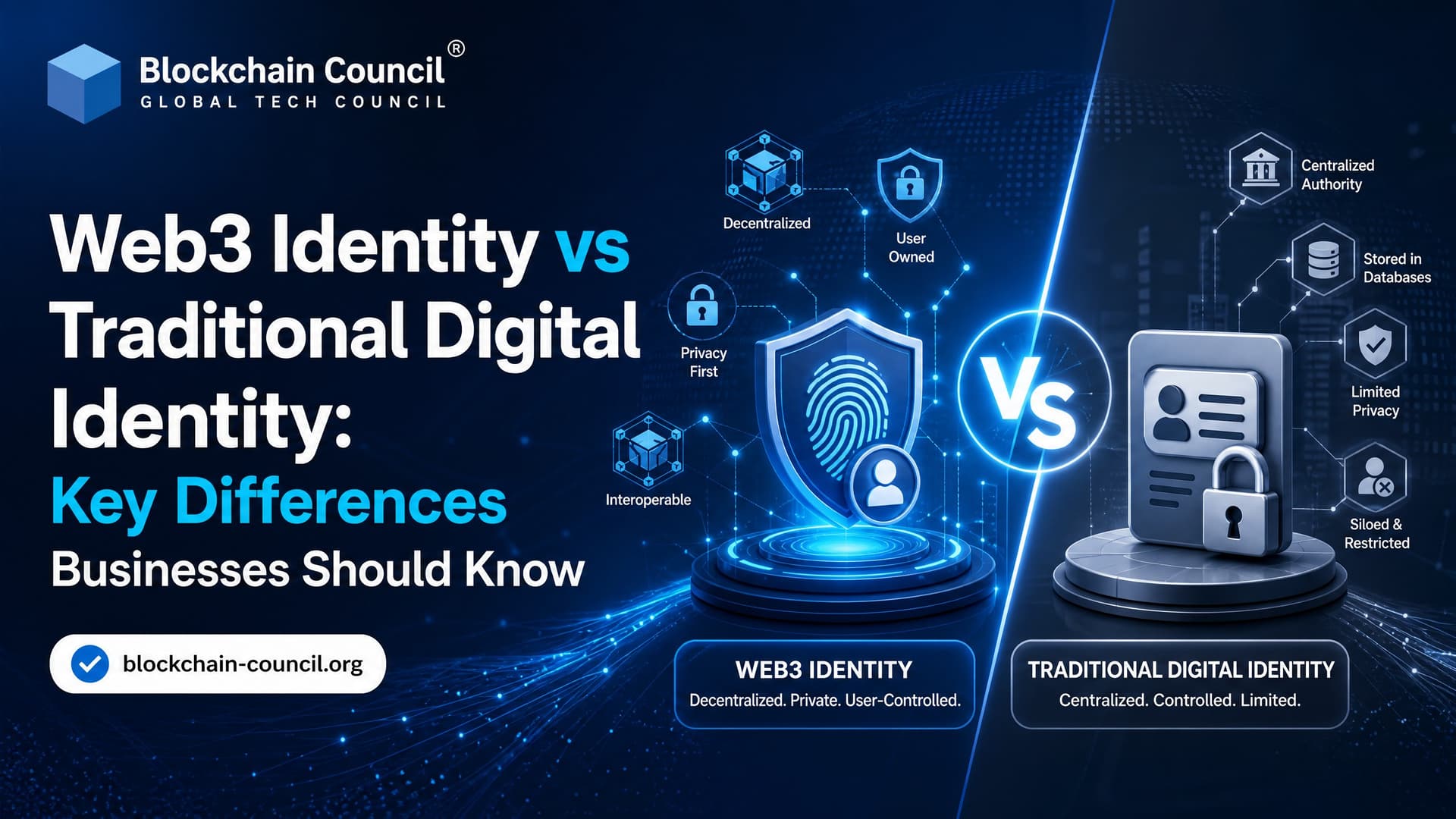
Web3 identity vs traditional digital identity is not just a technical debate about wallets and passwords. It changes who controls identity data, how trust is proven, where personal information lives, and what your business must verify before granting access, onboarding a customer, or accepting a credential.
Traditional digital identity was built around accounts. Web3 identity is built around cryptographic control, decentralized identifiers, and verifiable credentials. Both models will coexist for years. The practical question is simple: where should your business keep using established identity and access management, and where does wallet-based identity solve a real problem?

What traditional digital identity means
Traditional digital identity depends on centralized account providers. A bank, government agency, social platform, enterprise identity provider, or SaaS company stores identity records and decides how users authenticate.
You see this model every day:
- Usernames and passwords
- Single sign-on through SAML or OpenID Connect
- OAuth 2.0 authorization flows
- Customer identity and access management systems
- KYC files stored by banks, fintech firms, or exchanges
This model works. It is mature, regulated, and deeply integrated into enterprise systems. But it also creates large databases of personal information, and those databases are attractive targets for attackers. It also forces users to repeat the same identity process across services.
If you have ever uploaded your passport to three different fintech apps in the same week, you have felt the weakness of traditional identity.
What Web3 identity means
Web3 identity uses decentralized identifiers, often called DIDs, and verifiable credentials. A DID is a standards-based identifier that is not controlled by a single platform. The W3C approved DID v1.0 as an official Web standard in July 2022, and later work has refined the specification.
A DID looks like this: did:method:specific-id. For example, did:key can be generated directly from a cryptographic key, while other DID methods may use distributed ledgers or public registries for resolution.
In a Web3 identity model:
- An issuer signs a credential, such as proof of age, employment, qualification, or KYC status.
- The user or organization stores that credential in a wallet.
- A verifier checks the cryptographic proof when the credential is presented.
- Personal data is usually kept off-chain. Public infrastructure may store identifiers, schemas, revocation registries, or verification metadata.
That last point matters. A well-designed Web3 identity system should not put passports, addresses, or medical records on a blockchain. Once data is written to many public ledgers, deletion is hard or impossible. For regulated businesses, that creates a compliance mess.
Web3 identity vs traditional digital identity: the core differences
1. Control shifts from provider to subject
In traditional identity, the provider controls the account. It can reset passwords, suspend access, update attributes, or close the account. The user depends on the provider.
In Web3 identity, the user or organization controls the identifier through private keys. Issuers still matter because they attest to facts. A university can issue a degree credential. A bank can issue a KYC credential. But the holder presents the credential when needed.
For businesses, this means a move from storing everything to verifying what is presented. That is a big architectural shift.
2. Authentication changes from passwords to signatures
Traditional authentication still relies heavily on passwords, one-time codes, and device-based multi-factor authentication. Web3 authentication usually uses public-private key pairs. The user signs a challenge with a wallet key.
Developers will recognize this from Sign-In with Ethereum, defined by EIP-4361. A common mistake is verifying the signature but ignoring the domain, nonce, or chainId. That can produce confusing failures such as Invalid signature or, worse, an authentication flow that is open to replay attacks. Do not treat a wallet signature as magic login. Validate the message fields properly.
The upside is clear: no password database. The downside is also clear. If users lose keys or approve malicious signing prompts, your support and recovery design will be tested.
3. Privacy can improve, but only with discipline
Traditional identity often overshares. A service asks for a full ID document when it only needs to know whether the user is over 18. Another vendor stores a full address when it only needs country of residence.
Verifiable credentials can support selective disclosure. In some implementations, zero-knowledge proofs let a user prove a fact without revealing the underlying data. That fits privacy principles such as data minimization and purpose limitation under GDPR-style regulation.
Still, do not assume Web3 automatically equals privacy. Wallet addresses can be highly linkable. If the same wallet is used for trading, governance, and identity credentials, the user may expose more behavioral data than intended. Separate wallets and pairwise identifiers are often better for serious identity projects.
4. Trust moves from one gatekeeper to a trust framework
Traditional identity has familiar trust anchors: governments, banks, enterprise directories, certificate authorities, and regulated identity providers. This gives businesses clear contracts and liability paths.
Web3 identity distributes roles across issuers, holders, wallet providers, ledgers, verifiers, and governance bodies. Cryptography proves that a credential was signed and not altered. It does not tell you whether the issuer is trustworthy for your business purpose.
That is why governance matters. A bank should not accept a random age credential from an unknown issuer for AML onboarding. It needs an agreed trust framework, issuer accreditation, revocation rules, audit controls, and legal terms.
5. Portability becomes realistic
Traditional identity is fragmented. KYC at one exchange rarely carries over to another. A supplier may submit the same tax, insurance, and compliance documents to every enterprise customer.
Web3 identity aims to make credentials portable. A customer could reuse a KYC credential across approved financial services. An employee could present a verified professional certification. A supplier could present an insurance credential to multiple buyers.
This is where the business case gets interesting. Less duplication. Faster onboarding. Lower document fraud. Fewer copies of sensitive data sitting in vendor databases.
Market and regulatory signals businesses should watch
The broader digital identity market is already large, with analysts projecting growth from roughly 44.2 billion USD in 2025 to about 132.1 billion USD by 2031. Forecasts for decentralized identity vary widely, but several market reports project rapid expansion from a low single-digit billion-dollar base into much larger markets by the early 2030s.
The most important signal is not a market forecast. It is regulation.
The revised EU eIDAS 2.0 framework entered into force in May 2024. It requires EU member states to provide European Digital Identity Wallets, with rollout expected to reach hundreds of millions of citizens. These wallets are intended for public and private services, including age verification, education credentials, professional qualifications, telecom contracts, and bank account opening.
That means wallet-based identity is moving from crypto-native communities into regulated infrastructure. Businesses operating in Europe should track EUDI Wallet technical standards, assurance levels, and verifier obligations closely.
Where Web3 identity makes business sense
Use Web3 identity where portability, privacy, or multi-party verification creates measurable value.
- Financial services: reusable KYC credentials can reduce repeated document checks while preserving regulatory review.
- Education: diplomas, training records, and professional certifications can be verified without emailing an issuing institution.
- Healthcare: patients can prove eligibility, consent, or insurance status without exposing full medical records.
- Enterprise workforce: contractors, partners, and suppliers can present role or compliance credentials across company boundaries.
- Web3 applications: dApps can use wallet signatures and credentials for gated access, DAO roles, or reputation signals.
For Blockchain Council readers, this connects directly with skills covered in programs such as Certified Web3 Expert™, Certified Blockchain Expert™, and Certified Blockchain Developer™. If you work on identity architecture, smart contract systems, or Web3 product design, DIDs and verifiable credentials are no longer optional background knowledge.
Where traditional identity is still the better choice
To be blunt, Web3 identity is not the right answer for every login screen.
Traditional IAM and CIAM remain better for many internal systems, regulated employee access workflows, mature SSO environments, and cases where users expect account recovery through a help desk. Enterprise directories, OpenID Connect, SAML, passkeys, and device management are not going away.
Web3 identity is also a poor fit if your users cannot manage wallets, your legal team cannot define liability, or your ecosystem has no trusted issuers. Cryptography does not replace policy.
Implementation checklist for businesses
- Pick a narrow use case. Start with reusable KYC, professional credentials, supplier onboarding, or age verification. Avoid broad identity replacement projects.
- Keep personal data off-chain. Store only what must be public, such as identifiers, schemas, or revocation references.
- Define issuer trust. Decide which issuers you accept and for what claims.
- Plan recovery. Wallet loss, device changes, and key rotation are real user journeys, not edge cases.
- Test interoperability. Validate DID methods, credential formats, wallet support, and verifier behavior before scaling.
- Map compliance duties. Clarify who is the issuer, holder, verifier, controller, processor, and relying party under applicable law.
What to do next
Treat Web3 identity vs traditional digital identity as an architecture decision, not a branding decision. Keep traditional identity where centralized assurance, support, and compliance controls are stronger. Use Web3 identity where reusable credentials, user-held data, and cross-organization verification solve a real cost or trust problem.
If you are building the capability in-house, start by learning DIDs, verifiable credentials, wallet signing, and smart contract security basics. A practical next step is to pair identity standards training with Blockchain Council programs such as Certified Web3 Expert™ or Certified Blockchain Developer™, then build a small verifier prototype before committing to a full rollout.
Related Articles
View All
Web3
How to Build a Web3 Identity Solution: Key Technologies and Architecture
Learn how to build a Web3 identity solution using DIDs, verifiable credentials, wallets, SIWE, zero-knowledge proofs, and privacy-first architecture.

Web3
Digital Wallets as Identity Hubs: The Future of Web3 Authentication
Digital wallets as identity hubs are reshaping Web3 authentication with DIDs, verifiable credentials, EUDI wallets, and passwordless cryptographic access.

Web3
Web3 Identity Explained: How Decentralized Identity Is Changing Digital Ownership
Web3 identity uses wallets, DIDs, and verifiable credentials to give users control over access, data sharing, and digital ownership.
Trending Articles
AWS Career Roadmap
A step-by-step guide to building a successful career in Amazon Web Services cloud computing.

Can DeFi 2.0 Bridge the Gap Between Traditional and Decentralized Finance?
The next generation of DeFi protocols aims to connect traditional banking with decentralized finance ecosystems.
Claude AI Tools for Productivity
Discover Claude AI tools for productivity to streamline tasks, manage workflows, and improve efficiency.