

AI Agents in Web3 Payment Networks: How Autonomous Payments Work

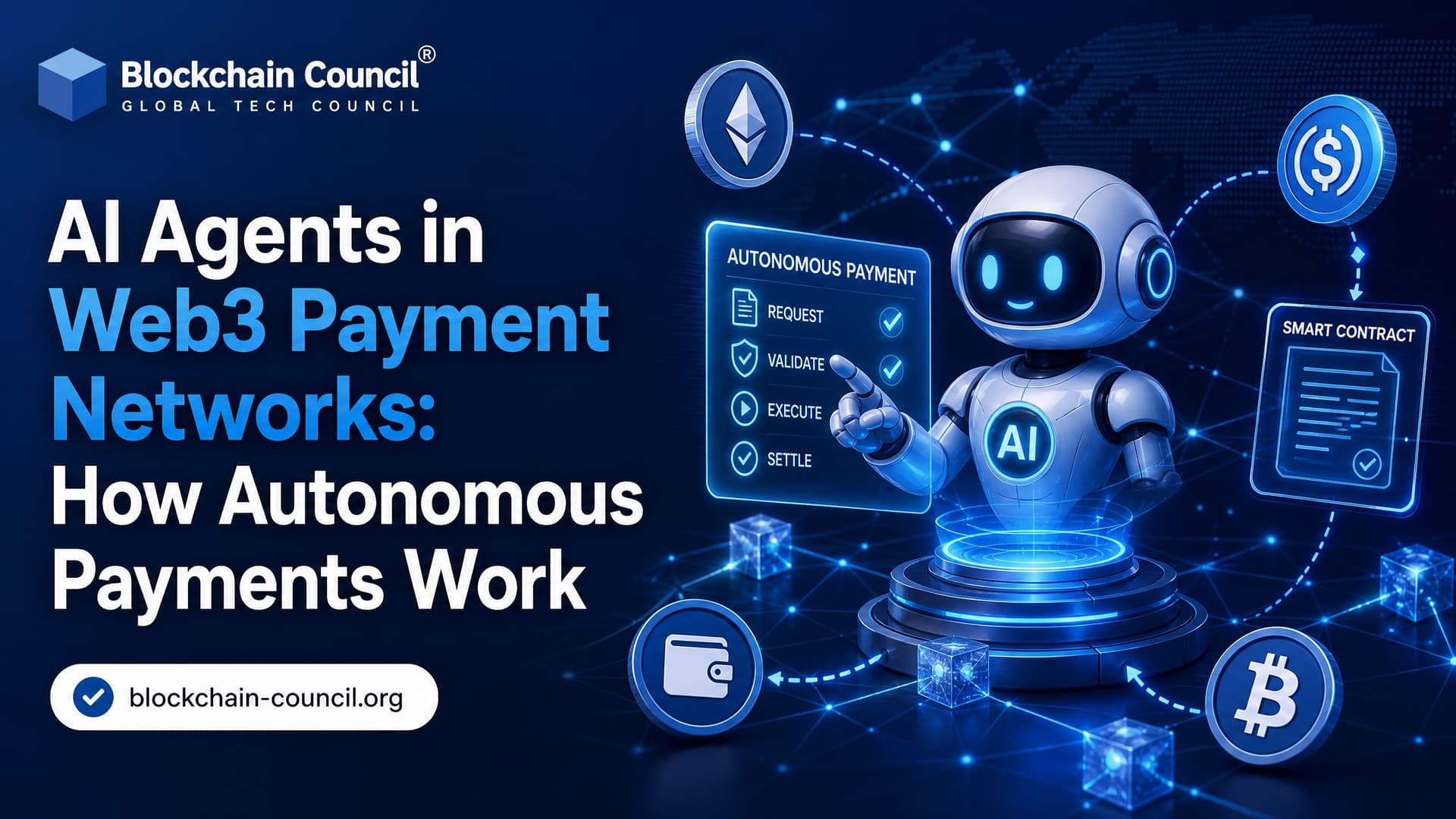
AI agents in Web3 payment networks are starting to do something software has rarely done safely at scale: hold value, make payment decisions, and settle transactions on-chain without a person clicking confirm every time. That shifts how you design wallets, smart contracts, compliance systems, and payment APIs. Professionals exploring autonomous AI systems can also consider the Certified Agentic AI Expert as a related learning path.
This is not science fiction anymore. Chainlink, Circle, Galaxy Research, Google Cloud, MoonPay, and Nevermined have all published work showing AI agents as autonomous economic actors that can initiate, route, and settle crypto payments through programmable wallets and smart contracts.

What Are AI Agents in Decentralized Web3 Payment Networks?
An AI agent is software that observes inputs, makes decisions against a goal, and takes actions. In a decentralized payment network, those actions can include sending stablecoins, calling smart contracts, paying for API access, rebalancing a DeFi position, or settling a machine-to-machine invoice.
MoonPay describes agentic payments as transactions initiated and executed by AI agents on behalf of a user or system. Chainlink and Galaxy Research frame these agents as economic actors because they can use wallets, sign transactions, interact with smart contracts, and rely on oracles for external data.
In plain terms: the agent becomes the operator, while the blockchain becomes the settlement and audit layer. For a broader foundation in decentralized applications and blockchain ecosystems, the Certified Web3 Expert may be a useful resource.
Why Web3 Payment Rails Fit AI Agents
Traditional payment rails were built around humans, merchants, card networks, banks, and batch settlement. They work well for many consumer payments. They are a poor fit for millions of tiny software-originated transactions.
AI agents need different payment properties:
Programmability: Smart contracts can encode spending limits, time locks, access rules, and conditional payouts.
Low-value settlement: Agents may pay fractions of a dollar for data, inference, storage, or bandwidth.
Global access: A wallet can interact with a contract without a local banking relationship.
Auditability: On-chain logs make agent actions easier to review after execution.
Composability: One agent can call DeFi, oracle, identity, and payment contracts in the same workflow.
Stablecoins matter here. Circle has shown reference patterns where agents control USDC wallets for recurring or conditional payments. For most business use cases, volatile tokens are the wrong base asset. If an agent is paying cloud invoices or API fees, price stability is not optional.
The Basic Architecture of Agentic Payments
A working AI-agent payment stack usually has five parts.
1. Agent logic
This is the decision layer. It might be an LLM-based assistant, a rules engine, a reinforcement learning model, or a hybrid system. The agent decides when to pay, whom to pay, how much to spend, and whether a condition has been met.
2. Wallet and identity
The agent needs an on-chain identity. That may be an externally owned account, but production systems are more likely to use smart contract wallets or account abstraction patterns such as ERC-4337. Why? Because policy control matters. You do not want a language model holding an unrestricted private key with treasury access.
3. Smart contracts
Contracts define payment rules. A contract can enforce a daily USDC limit, approve only specific counterparties, stream payments over time, or release funds after an oracle confirms delivery.
4. Oracles and off-chain data
Agents often decide based on off-chain signals: prices, device telemetry, API usage, model output, credit checks, or weather data. Oracle networks such as Chainlink help bring verified external data into smart contract workflows.
5. Payment rails
The blockchain and token determine cost, speed, and settlement finality. For high-frequency microtransactions, expensive mainnet execution is usually the wrong choice. Developers often test on Ethereum-compatible networks first, then decide whether settlement belongs on a layer 2, an appchain, or another low-fee network.
Current State: Early, But No Longer Theoretical
Nevermined has reported more than 17,000 AI agents operating across Web3 platforms and interacting with roughly 4.5 million daily active wallets. Public data is still thin, but the direction is clear. AI agents are moving from trading bots and assistants into direct payment execution.
Galaxy Research has discussed x402-style agentic payment standards, inspired by the HTTP 402 Payment Required status code, as a way for agents and services to interoperate economically. Payment API providers are also designing systems around programmatic authorization, streaming payments, and per-request billing.
To be blunt, standards will decide whether this market becomes usable or chaotic. Without common payment interfaces, every agent will need custom integration code for every API, wallet, and contract.
Real Use Cases for AI Agents in Web3 Payments
DeFi portfolio management
Google Cloud has outlined Web3 AI agents that monitor DeFi positions, rebalance portfolios, and interact with smart contracts. A practical agent could watch a lending position, detect liquidation risk, and add collateral before the health factor gets dangerous.
This is useful, but risky. Letting an agent chase yield across unknown pools is a bad default. A safer design restricts the agent to approved protocols, maximum slippage, position size limits, and emergency shutdown rules.
Machine-to-machine payments
Chainlink describes autonomous machine economies where devices and agents pay each other for data, compute, energy, or connectivity. Think of a sensor selling weather data per request, or an electric vehicle paying a charger using a stablecoin wallet.
These transactions may be tiny. Card fees make no sense there. On-chain or layer 2 payments can be a better fit if fees stay low and policy controls are strong.
AI and data marketplaces
AI agents can buy access to data sets, model APIs, compute clusters, or inference endpoints. Nevermined has focused on infrastructure for agents discovering, negotiating, and paying for AI services.
This is where per-call payments get interesting. An agent might pay for ten model calls, test the quality, then route future spend to the best provider. The payment network becomes part of the agent's decision loop.
Stablecoin subscriptions and recurring payments
Circle's USDC examples show how agents can execute recurring payments under user-defined constraints. A business could authorize an agent to pay SaaS invoices only if the vendor is allowlisted, the invoice is under a threshold, and the service was actually used.
That last condition is the point. Agentic payments are not just scheduled payments. They can be conditional, context-aware, and tied to external proofs.
Developer Notes: Where Implementations Usually Break
If you build this, the first hard lesson is permissions. The agent should rarely be the owner of funds. Give it delegated authority instead.
A common beginner failure is trying to make an ERC-20 transfer from a contract before setting allowance. Older OpenZeppelin-based tokens often revert with ERC20: insufficient allowance. OpenZeppelin Contracts 5.x uses custom errors such as ERC20InsufficientAllowance. That small version change can confuse test logs if your tooling expects the old revert string.
Use these controls from day one:
Daily and per-transaction spending caps.
Allowlisted contracts and counterparties.
Human approval for new vendors or high-value transfers.
Simulation before execution, using tools such as Tenderly, Hardhat, Foundry, or a forked chain.
Emergency pause functions and key rotation plans.
Clear logs that explain why the agent paid, not just that it paid.
If you are learning this stack, Blockchain Council's Certified Smart Contract Developer™ covers contract design, while Certified Blockchain Expert™, Certified Web3 Expert™, and Certified Artificial Intelligence (AI) Expert™ fit the broader architecture and AI governance skills. Professionals building skills across related technical areas can also explore a Tech Certification suited to their role.
Security, Compliance, and Accountability
The biggest risk is not that an AI agent sends one bad payment. The bigger risk is that it sends many bad payments fast.
Academic work on giving AI agents access to cryptocurrency highlights security, incentive design, and governance as open research problems. The risk categories are familiar, but the speed is new:
Prompt injection: A malicious web page or API response convinces the agent to pay the wrong address.
Data poisoning: Bad market or telemetry data triggers bad financial decisions.
Smart contract bugs: A contract flaw becomes more damaging when an automated agent repeatedly calls it.
Misaligned goals: An agent optimizes for savings, yield, or speed in a way that violates policy or law.
Compliance gaps: Regulators still expect a responsible human or legal entity behind payments.
MoonPay has pointed out the compliance challenge clearly: software may initiate the transaction, but accountability cannot disappear. In enterprise systems, every agent should map back to a user, team, policy, or legal entity. Anonymous autonomous finance is not a serious compliance model.
What Comes Next for AI Agents in Web3 Payment Networks?
The next phase will be less about flashy demos and more about boring infrastructure. That is good. Payment systems should be boring when they work.
Expect progress in four areas:
Agent wallet standards: More policy-based wallets, session keys, account abstraction, and delegated permissions.
Payment APIs for agents: Interfaces designed for software initiators rather than checkout screens.
Oracle-backed conditions: Payments tied to verified external data, usage metrics, and service-level events.
Governance and audit tooling: Dashboards that show what agents did, why they did it, and how to stop them.
Changpeng Zhao has predicted that AI agents may eventually conduct up to one million times more payments than humans, mostly through crypto rails. The exact multiplier is speculative. The direction is not. Software will originate far more economic activity than it does today.
Building Skills and Evaluating Talent
As blockchain technology continues to transform industries, organisations need professionals who understand its practical applications and technical foundations. Hiring the right talent requires more than reviewing qualifications; employers must also evaluate relevant knowledge and problem-solving skills. Platforms like HireValid can help organisations explore structured candidate assessments for more informed hiring decisions.
How Professionals Should Prepare
If you are a developer, start by building a small agent that can make testnet stablecoin payments under strict rules. Do not begin with cross-chain DeFi strategies. Start with an allowlisted recipient, a spending cap, and a contract that logs every decision.
If you work in risk, compliance, or enterprise architecture, focus on identity, delegated authority, monitoring, and audit trails. The winning systems will not be the most autonomous. They will be the ones that make autonomy controllable.
For structured learning, pair Web3 fundamentals with AI systems design. Blockchain Council's Certified Web3 Expert™ and Certified Artificial Intelligence (AI) Expert™ are practical next steps, especially if your role sits between product, engineering, and governance. Then build one controlled payment workflow. Real understanding starts when your agent hits its first failed transaction and you have to read the revert reason. For teams communicating technical solutions to customers and partners, a Marketing Certification may complement that technical expertise.
FAQs
1. What Are AI Agents in Web3 Payment Networks?
AI agents in Web3 payment networks are software systems that use artificial intelligence to analyze information, make decisions, and perform payment-related tasks. When connected to blockchain infrastructure, they can help initiate transactions, interact with smart contracts, and manage payment workflows according to predefined rules and permissions.
2. How Do Autonomous Payments Work in Web3?
Autonomous Web3 payments follow a programmed workflow in which an AI agent evaluates a condition, determines whether a transaction should occur, and requests its execution through an authorized wallet or payment system. The transaction is then processed by the blockchain network after applicable signing, validation, and smart contract requirements are met.
3. What Role Does Artificial Intelligence Play in Web3 Payments?
Artificial intelligence helps payment systems interpret data, identify patterns, assess risks, and select actions based on defined objectives. In Web3, these capabilities can support payment routing, fraud detection, transaction monitoring, spending decisions, and automated settlement processes.
4. How Do AI Agents Interact With Smart Contracts?
AI agents can read blockchain data, evaluate smart contract conditions, and submit transactions to contract functions through compatible blockchain tools. The smart contract executes its programmed logic when the transaction satisfies its requirements. AI does not automatically change a contract's rules or bypass blockchain validation.
5. Can AI Agents Make Cryptocurrency Payments Automatically?
Yes. AI agents can initiate cryptocurrency payments when connected to a wallet or transaction service with suitable permissions. However, the level of autonomy depends on the system's design, spending limits, approval requirements, and security controls. High-value or sensitive transactions may still require human authorization.
6. What Are the Main Benefits of AI-Powered Autonomous Payments?
AI-powered autonomous payments can reduce manual work, speed up routine transactions, improve payment monitoring, and support more responsive risk management. Businesses may also use them to automate recurring payments, supplier settlements, and transactions triggered by verified events.
7. How Do AI Agents Manage Web3 Wallets?
AI agents can interact with wallets to check balances, prepare transactions, estimate fees, and request transaction signing. Secure implementations keep private keys protected through mechanisms such as hardware-backed key storage, multi-party computation, or dedicated signing services. Agents should receive only the permissions necessary for their tasks.
8. How Can AI Agents Reduce Transaction Costs in Blockchain Payments?
AI agents can compare network fees, evaluate supported payment routes, and identify suitable transaction timing when the payment deadline allows flexibility. They may also help choose between compatible blockchain networks or layer-2 solutions. Actual savings depend on network conditions, bridge costs, liquidity, and the application's requirements.
9. How Is AI Used for Fraud Detection in Web3 Payments?
AI systems can analyze transaction patterns, wallet behavior, contract interactions, and other available signals to identify potentially suspicious activity. They can flag unusual transfers, possible scams, or deviations from established behavior for further review. AI-generated risk scores are indicators, not definitive proof of fraud.
10. What Security Risks Do Autonomous Web3 Payments Create?
Key risks include compromised credentials, malicious instructions, prompt injection, unsafe smart contracts, excessive wallet permissions, and incorrect agent decisions. Automated systems can also repeat an error quickly if safeguards are missing. Permission limits, transaction simulation, independent validation, and human approval for sensitive actions can reduce these risks.
11. Can AI Agents Use Stablecoins for Automated Payments?
Yes. AI agents can be designed to use supported stablecoins for transfers, recurring payments, or settlement workflows. Stablecoins may help reduce exposure to cryptocurrency price volatility, but they still carry risks involving issuer reserves, redemption, smart contracts, liquidity, network availability, and applicable regulations.
12. What Is the Difference Between AI Agents and Traditional Payment Automation?
Traditional payment automation typically follows fixed rules and predefined workflows. AI agents can use contextual information and model-based reasoning to choose among permitted actions, although their decisions may be less predictable. Both approaches need clear rules, testing, monitoring, and safeguards before handling real funds.
13. How Do AI Agents Support Cross-Border Web3 Payments?
AI agents can help evaluate supported networks, stablecoins, transaction fees, liquidity, and settlement requirements for cross-border payment workflows. They may automate parts of routing and reconciliation, but they do not eliminate every foreign exchange, compliance, or intermediary cost. Businesses must also consider local payment rules and the legal status of the assets used.
14. What Is the Role of Blockchain in Verifying AI-Initiated Payments?
Blockchain networks provide transaction validation and a shared ledger of confirmed transactions. Smart contracts can enforce programmable conditions, while transaction records can help with auditing and reconciliation. However, blockchain records do not independently prove that an AI agent's underlying decision was correct or that external data supplied to it was accurate.
15. Can AI Agents Automate DeFi Payments and Transactions?
AI agents can interact with supported decentralized finance protocols to perform tasks such as token swaps, liquidity operations, or payments governed by predefined strategies. These activities can involve market volatility, slippage, liquidation, protocol vulnerabilities, and malicious contracts. Automated DeFi actions therefore require risk limits and careful evaluation of protocol security.
16. How Can Businesses Control AI Agent Spending?
Businesses can establish per-transaction limits, daily budgets, approved recipient lists, restricted contract permissions, and multi-step approval workflows. They can also use separate wallets for different tasks and pause automation when unusual activity occurs. Spending controls should be enforced by systems that the AI agent cannot independently override.
17. Are AI Agents in Web3 Payment Networks Compliant With Regulations?
Compliance depends on the jurisdiction, the business model, the assets involved, and the activities performed. Requirements may include anti-money laundering controls, sanctions screening, customer due diligence, consumer protection, privacy, and licensing obligations. Using an AI agent or decentralized infrastructure does not automatically exempt a business from applicable laws.
18. What Is the Role of Human Oversight in Autonomous Payments?
Human oversight helps establish payment policies, approve sensitive transactions, investigate alerts, and intervene when an agent behaves unexpectedly. A well-designed system defines which actions are fully automated and which require approval. Emergency pause mechanisms and clear audit trails are important for limiting the impact of errors.
19. How Can Developers Build Reliable AI-Powered Web3 Payment Systems?
Developers should define the agent's permitted tasks, use secure wallet infrastructure, validate transaction parameters, and test smart contract interactions before deployment. They should also monitor agent behavior, protect against malicious inputs, maintain logs, and evaluate failures through simulations and controlled testing. Independent security reviews are especially important when systems can move real funds.
20. What Is the Future of AI Agents in Web3 Payment Networks?
AI agents may increasingly support machine-to-machine payments, automated business settlements, digital service payments, and programmable financial workflows. Wider adoption will depend on secure agent identity, reliable authorization, interoperability, transparent accountability, and regulatory clarity. Practical success will require combining AI capabilities with robust payment infrastructure and verifiable controls.
Related Articles
View All
Web3
AI Payment Bots and Autonomous Wallets: Web3 Commerce Moves to Agentic Payments
AI payment bots and autonomous wallets are enabling agentic Web3 commerce through stablecoins, scoped permissions, and programmable wallet infrastructure.
Web3
AI Web3 and Real-Time Payments: A New Payment Stack
AI, Web3, and real-time payments are forming a faster, programmable payment stack for instant settlement, fraud controls, and agent commerce.

Web3
AI Agents with Web3: How Autonomous Software Is Changing Decentralized Systems
AI agents with Web3 are becoming active on-chain participants, powering DeFi automation, compliance, security, DAOs, and digital services.
Trending Articles
The Role of Blockchain in Ethical AI Development
How blockchain technology is being used to promote transparency and accountability in artificial intelligence systems.
How Blockchain Secures AI Data
Understand how blockchain technology is being applied to protect the integrity and security of AI training data.
Claude AI Tools for Productivity
Discover Claude AI tools for productivity to streamline tasks, manage workflows, and improve efficiency.