

AI Web3 and Real-Time Payments: A New Payment Stack

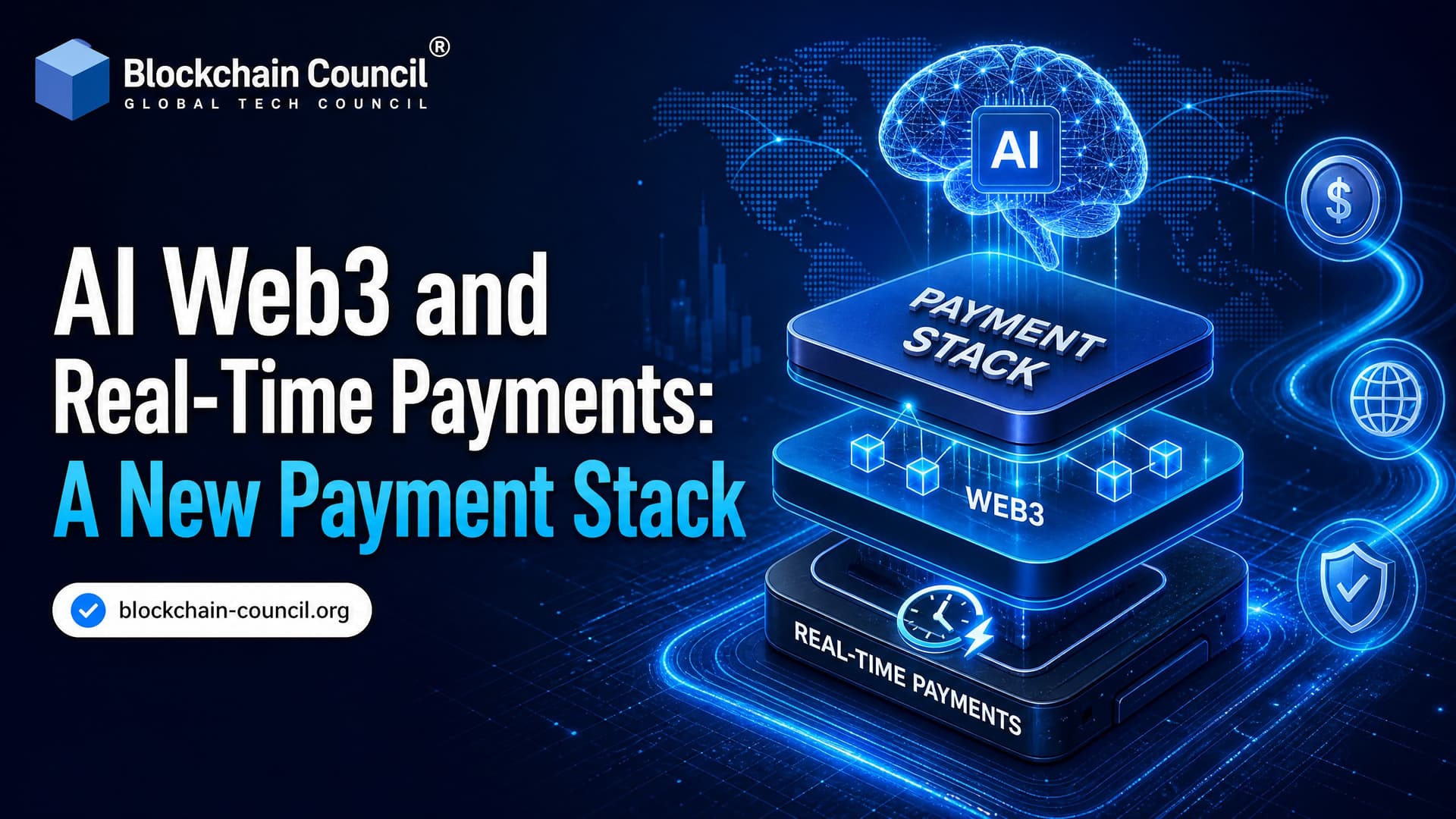
AI Web3 and real-time payments are starting to form a new financial stack: instant payment rails move money, Web3 adds programmable settlement, and AI decides how, when, and why a payment should happen. That stack is not theoretical anymore. It shows up in instant payroll, stablecoin settlement, fraud controls, agent payments, and cross-border treasury work. Professionals looking to build the AI capabilities behind this shift can explore the Certified Artificial Intelligence (AI) Expert program as one way to deepen their understanding of applied AI.
Why does this matter? Payments used to be slow, batch-based, and institution-heavy. The baseline is changing. If a customer can send money instantly through Pix in Brazil or UPI in India, they will not tolerate two-day settlement in a digital service. Enterprises feel the same pressure with suppliers, gig workers, refunds, and liquidity planning.

Real-Time Payments Are Becoming the Baseline
Real-time payments, or RTP, are account-to-account transfers that clear and settle almost immediately. J.P. Morgan describes them as instant and irrevocable, which is the key point for businesses. Once funds arrive, the recipient can use them. No waiting for a card batch. No uncertain clearing window.
The numbers show how fast this moved from niche to standard infrastructure. ACI Worldwide reported 266.2 billion real-time payment transactions globally in 2023, up 42.2 percent year over year. Earlier GlobalData figures cited by RedCompass Labs estimated 118 billion real-time transactions in 2021 and projected roughly 428 billion annually by 2026.
Three systems explain the trend better than any abstract definition:
Brazil's Pix: mobile-first, QR-friendly, low-cost instant transfers with strong public-sector backing.
India's UPI: open APIs, virtual payment addresses, QR codes, and massive adoption across daily commerce.
FedNow in the United States: a Federal Reserve instant payment and settlement service launched in July 2023 for real-time bank-account transfers.
Pix and UPI teach a hard lesson. Payment innovation is not just about speed. Distribution, aliases, QR codes, merchant acceptance, and simple mobile flows matter just as much.
Where Web3 Fits in the Payment Stack
Web3 payments use blockchain networks to transfer digital value, often through cryptoassets, stablecoins, or tokenized assets. The useful part is not speculation. It is programmability. For professionals building this layer, the Certified Web3 Expert learning path can be relevant to understanding blockchain-based applications and payment infrastructure.
A smart contract can hold funds until a condition is met. A stablecoin transfer can settle outside correspondent banking hours. A machine can pay another machine for API access without sending an invoice. These patterns are awkward on legacy rails and natural on Web3 infrastructure.
That does not mean Web3 replaces every bank payment system. It should not. Domestic salary payments in a mature RTP market usually belong on bank rails. Web3 earns its place when you need:
Cross-border value movement where correspondent banking is slow or expensive.
Micropayments for content, APIs, data, or compute.
Programmable escrow for delivery, usage, or outcome-based billing.
Machine-to-machine settlement between autonomous software agents or IoT systems.
A practical warning: Web3 payment code is unforgiving. USDC uses 6 decimals, not 18 like Ether. If you build metered billing and assume 18 decimals everywhere, your invoice math will be off by a factor of one trillion. I have seen this exact mistake in test integrations. The transaction succeeds. The accounting fails.
AI Becomes the Intelligence Layer
AI already runs in payments for fraud detection, risk scoring, customer support, transaction monitoring, and routing. What is changing is timing. Models now need to decide while the payment is still in motion.
Industry analysis from Webit notes that AI models can process large payment and behavior datasets in milliseconds, which lets systems adjust authentication, limits, and fraud checks in real time. That is essential when settlement is instant. You cannot review a suspicious payment tomorrow if the funds moved today and finality already happened.
AI also changes who participates in payments. Nevermined has reported more than 17,000 AI agents operating on Web3 platforms with real-time payments, flexible pricing, and outcome-based monetization. This points to a new pattern: agents buying data, paying for model calls, charging for work, and settling instantly.
To be blunt, many agent-payment demos are still rough. Wallet security, spending limits, dispute handling, and regulatory treatment all need more work. But the direction is clear. If AI systems act on behalf of users or businesses, they will need controlled ways to pay and get paid.
How AI Web3 and Real-Time Payments Work Together
The simplest way to think about the stack:
Real-time rails provide instant domestic movement between bank accounts.
Web3 networks provide programmable, global settlement for digital assets.
AI systems provide decisioning, risk controls, orchestration, and automation.
In an enterprise payment flow, AI might inspect the beneficiary, invoice metadata, sanctions risk, currency, cost, and settlement urgency. Then it routes the payment through FedNow, card rails, ACH, stablecoin settlement, or another channel. The best option can change by amount, country, counterparty, and time of day.
This is where payment orchestration becomes more than a checkout feature. It becomes treasury infrastructure.
Real-World Use Cases to Watch
1. Instant payroll and gig worker payments
Workers increasingly expect fast access to earned wages. Real-time rails can support instant disbursement, while AI can spot account takeover risk or unusual withdrawal behavior before funds move.
2. Supplier and treasury payments
Businesses can pay suppliers just in time instead of sending funds early to cover processing delays. That improves liquidity. AI can rank payment urgency, predict cash shortfalls, and choose the lowest-cost compliant rail.
3. Real-time refunds and insurance payouts
A refund that arrives instantly cuts support tickets and builds trust. For insurers, instant claim payouts can improve the customer experience after travel disruption, appliance failure, or minor auto claims.
4. Stablecoin cross-border settlement
Stablecoins can reduce friction in certain cross-border flows, especially where banking cut-off times and intermediary fees create delays. The trade-off is compliance. Enterprises need controls for wallet screening, transaction monitoring, tax treatment, and custody.
5. AI agent commerce
An AI agent might buy weather data, pay for GPU inference, or charge another agent for summarizing a dataset. Web3 rails fit well here because smart contracts can encode usage rules, spending caps, and settlement conditions.
Regulation and Risk Cannot Be an Afterthought
Instant payments raise the cost of weak controls. When settlement is final, fraud prevention has to happen before release. That puts pressure on identity checks, behavioral analytics, transaction monitoring, and customer education.
Web3 adds another layer. Stablecoins and tokenized assets need to fit within payment regulation, anti-money laundering rules, consumer protection requirements, and prudential expectations. The Financial Stability Board and national regulators have repeatedly focused on stablecoin governance, reserves, redemption, and systemic risk.
AI adds model risk. If a fraud model blocks legitimate payments for a certain customer group, you have more than a technical issue. You may have a fairness, auditability, and compliance problem. Keep logs. Track false positives. Test for drift. Do not let a black-box model make high-impact payment decisions without oversight.
Building Skills and Evaluating Talent
As blockchain technology continues to transform industries, organisations need professionals who understand its practical applications and technical foundations. Hiring the right talent requires more than reviewing qualifications; employers must also evaluate relevant knowledge and problem-solving skills. Platforms like HireValid can help organisations explore structured candidate assessments for more informed hiring decisions.
For professionals who want to broaden their technical capabilities, a Tech Certification may provide a structured way to explore relevant technology topics and strengthen practical knowledge.
What Developers and Professionals Should Learn Next
If you work in payments, banking, Web3, or AI, do not treat these as separate skills. The valuable roles will sit between them.
Start with the fundamentals:
Payment rails: RTP, FedNow, ACH, card settlement, ISO 20022 messaging, chargebacks, and finality.
Web3 engineering: wallets, smart contracts, stablecoins, ERC-20 token behavior, custody, and chain risk.
AI in finance: anomaly detection, model governance, explainability, transaction scoring, and real-time decision systems.
Security and compliance: key management, sanctions screening, AML monitoring, data privacy, and incident response.
You can map this learning path to Blockchain Council programs such as Certified Blockchain Expert™, Certified Blockchain Developer™, Certified Web3 Expert™, and Certified Artificial Intelligence (AI) Expert™. If your role is technical, pair Web3 development with AI risk and payment architecture. If your role is strategic, focus on use-case selection, compliance, and operating models.
The Strategic Takeaway
The new payment stack is not about one technology winning. Real-time systems are best for regulated, domestic, account-to-account transfers. Web3 is strongest where programmable settlement, digital assets, and global availability matter. AI is the control layer that routes, scores, personalizes, and automates those flows.
Your next step is practical. Pick one payment flow in your organization, such as supplier payouts, refunds, or cross-border settlement. Map its cost, settlement time, fraud risk, and compliance steps. Then test where real-time rails, Web3 settlement, or AI decisioning would actually improve the outcome. Build from that evidence, not from buzz. For teams bringing these capabilities to market, a Marketing Certification can also support broader skills in communicating technology value and reaching relevant audiences.
FAQs
1. What Is AI Web3 and Real-Time Payments?
AI Web3 and real-time payments combine artificial intelligence, blockchain technology, and fast digital payment infrastructure. AI helps interpret instructions, assess risks, and automate workflows, while Web3 enables programmable transactions and digital asset transfers. Real-time payment networks provide rapid movement of money through supported payment systems.
2. How Does AI Transform Web3 Payments?
AI can help automate payment decisions, detect fraud, estimate transaction fees, and select suitable payment routes. AI agents may also initiate transactions within predefined permissions and spending limits. Blockchain or conventional payment infrastructure then processes the transaction according to its rules.
3. What Is a Real-Time Payment System?
A real-time payment system enables electronic transfers to be processed quickly, often making funds available to recipients within seconds. Examples include India's Unified Payments Interface (UPI), Brazil's Pix, and the United Kingdom's Faster Payments Service. Availability, operating rules, transaction limits, and settlement arrangements differ between systems.
4. How Does Blockchain Work With Real-Time Payments?
Blockchain can provide a shared transaction record, programmable settlement conditions, and transfers of digital assets such as supported stablecoins. Real-time payment networks, meanwhile, move funds through their own banking and payment infrastructure. Connecting these systems may improve payment workflows, but it requires interoperability, compliance controls, and clear settlement arrangements.
5. What Role Do AI Agents Play in Digital Payments?
AI agents can interpret user goals, compare payment options, and carry out multistep tasks under delegated authority. For example, an authorized agent might pay a supplier invoice when it meets specified budget and approval conditions. Secure implementations need verifiable identity, spending limits, transaction records, and safeguards against unauthorized actions.
6. What Is an AI-Powered Payment Stack?
An AI-powered payment stack is the combination of technologies used to initiate, authorize, process, and settle payments with AI assistance. It may include an AI agent, identity and authorization controls, a payment API, fraud monitoring, blockchain infrastructure, and traditional payment rails. Each component has a distinct role in making transactions efficient and secure.
7. How Can AI Improve Cross-Border Payments?
AI can compare available payment routes, estimate fees, identify compliance risks, and help providers manage foreign exchange and liquidity. Blockchain-based settlement and stablecoins may offer additional options for moving value across borders. However, the final cost and speed depend on local payment systems, liquidity, conversion fees, regulations, and the receiving institution.
8. What Are Stablecoins, and Why Are They Important for Web3 Payments?
Stablecoins are digital tokens designed to maintain a relatively stable value against a reference asset, commonly a currency such as the US dollar. They can support blockchain-based transfers and programmable payment workflows. Their usefulness depends on reserve quality, redemption arrangements, liquidity, issuer reliability, and the regulatory framework that applies.
9. Can AI Make Payments Faster and More Cost-Effective?
AI can reduce manual processing, identify inefficient payment routes, estimate network fees, and automate routine reconciliation. These capabilities may improve speed and reduce operational costs. Actual savings depend on the payment infrastructure, transaction volume, model accuracy, and fees charged by service providers.
10. How Can AI Help Prevent Fraud in Real-Time Payments?
AI can analyze transaction patterns, account activity, device signals, and other permitted data to identify potentially fraudulent behavior. Real-time risk scoring can help trigger additional authentication, payment holds, or manual review before a transaction proceeds. Because false positives and missed fraud remain possible, AI should complement established security controls.
11. How Does Blockchain Improve Payment Transparency?
Public blockchains can make transaction records and wallet movements visible to network participants, depending on the network and its privacy design. This can help auditors and analytics systems trace transfers and verify transaction status. However, blockchain transparency does not automatically reveal the identity of a wallet owner or prove that a transaction is legitimate.
12. What Is the Difference Between Traditional Payments and Web3 Payments?
Traditional payments generally use banks, card networks, or regulated payment providers to transfer money through established financial infrastructure. Web3 payments can use blockchain networks and digital assets to execute transfers or smart contract operations. Both approaches can support digital commerce, but they differ in custody, settlement, reversibility, compliance obligations, and user protections.
13. How Can AI Optimize Payment Routing and Gas Fees?
AI can compare available networks and payment methods using estimated fees, congestion, settlement time, exchange rates, and liquidity. For blockchain transactions, it may recommend an appropriate execution window or a supported Layer 2 network. Routing systems must also account for bridge fees, security risks, and total transaction costs rather than focusing only on the headline gas fee.
14. What Are the Main Security Risks of AI-Powered Web3 Payments?
Potential risks include compromised private keys, fraudulent instructions, manipulated data, malicious smart contracts, AI-generated errors, and unauthorized agent activity. A system may also execute an unintended transaction if its authorization rules are poorly designed. Secure implementations require strong key management, restricted permissions, transaction simulation, spending caps, monitoring, and clear recovery procedures.
15. How Do Businesses Manage Compliance in AI and Blockchain Payments?
Businesses must determine which payment, crypto-asset, privacy, consumer protection, and anti-money laundering requirements apply to their activities. AI can support identity verification, transaction monitoring, and suspicious activity detection, but it cannot replace legal accountability. Companies should maintain audit trails, document automated decisions, and provide appropriate human oversight.
16. What Is Programmable Money in the New Payment Stack?
Programmable money refers to digital value that can be transferred or used according to predefined conditions. Smart contracts can, for example, release funds when specified delivery or verification conditions are met. AI can help interpret instructions and coordinate workflows, while deterministic contract rules enforce the conditions for execution.
17. How Can AI and Real-Time Payments Support Businesses?
Businesses can use these technologies for supplier payments, payroll workflows, automated billing, treasury operations, and rapid reconciliation. AI agents may help identify invoices, check payment instructions, and prepare transactions for approval. Integrating payment systems with accounting and enterprise software can reduce repetitive work while maintaining financial controls.
18. What Challenges Affect the Integration of AI, Web3, and Instant Payments?
Key challenges include incompatible systems, inconsistent regulations, transaction fees, limited interoperability, data privacy concerns, and cybersecurity risks. AI agents also introduce questions about authorization, accountability, and the handling of errors. Successful integration requires clear technical standards, secure interfaces, compliance processes, and reliable transaction monitoring.
19. What Is the Future of AI-Powered Real-Time Payments?
AI agents may increasingly coordinate purchases, recurring payments, business transactions, and machine-to-machine commerce. Payment providers are exploring ways to let software agents transact under controlled permissions across conventional payment networks and blockchain infrastructure. Wider adoption will depend on reliable identity verification, authorization safeguards, consumer protections, and clear responsibility for errors.
20. Why Is AI Web3 and Real-Time Payments Considered a New Payment Stack?
This combination brings together AI-driven decision-making, programmable digital assets, and fast payment infrastructure. Instead of relying only on a person to initiate every step, future payment systems may allow software to coordinate approved transactions automatically. The strongest implementations will combine automation with secure authorization, transparent records, regulatory compliance, and dependable settlement.
Related Articles
View All
Web3
AI Agents in Web3 Payment Networks: How Autonomous Payments Work
AI agents are becoming autonomous payment actors in Web3, using wallets, smart contracts, stablecoins, and oracles to execute controlled on-chain transactions.

Web3
AI Payment Bots and Autonomous Wallets: Web3 Commerce Moves to Agentic Payments
AI payment bots and autonomous wallets are enabling agentic Web3 commerce through stablecoins, scoped permissions, and programmable wallet infrastructure.

Web3
AI and Blockchain in Digital Payments: The Future of Web3 Transactions
AI and blockchain in digital payments are reshaping Web3 transactions with stablecoins, CBDCs, fraud analytics, and programmable settlement.
Trending Articles
What is AWS? A Beginner's Guide to Cloud Computing
Everything you need to know about Amazon Web Services, cloud computing fundamentals, and career opportunities.
How to Install Claude Code
Learn how to install Claude Code on macOS, Linux, and Windows using the native installer, plus verification, authentication, and troubleshooting tips.
Blockchain in Supply Chain Provenance Tracking
Supply chains are under pressure to prove not just efficiency, but also authenticity, sustainability, and fairness. Customers want to know if their coffee really is fair trade, if the diamonds are con