

Smart Contracts and AI: Autonomous Payment Systems for Web3

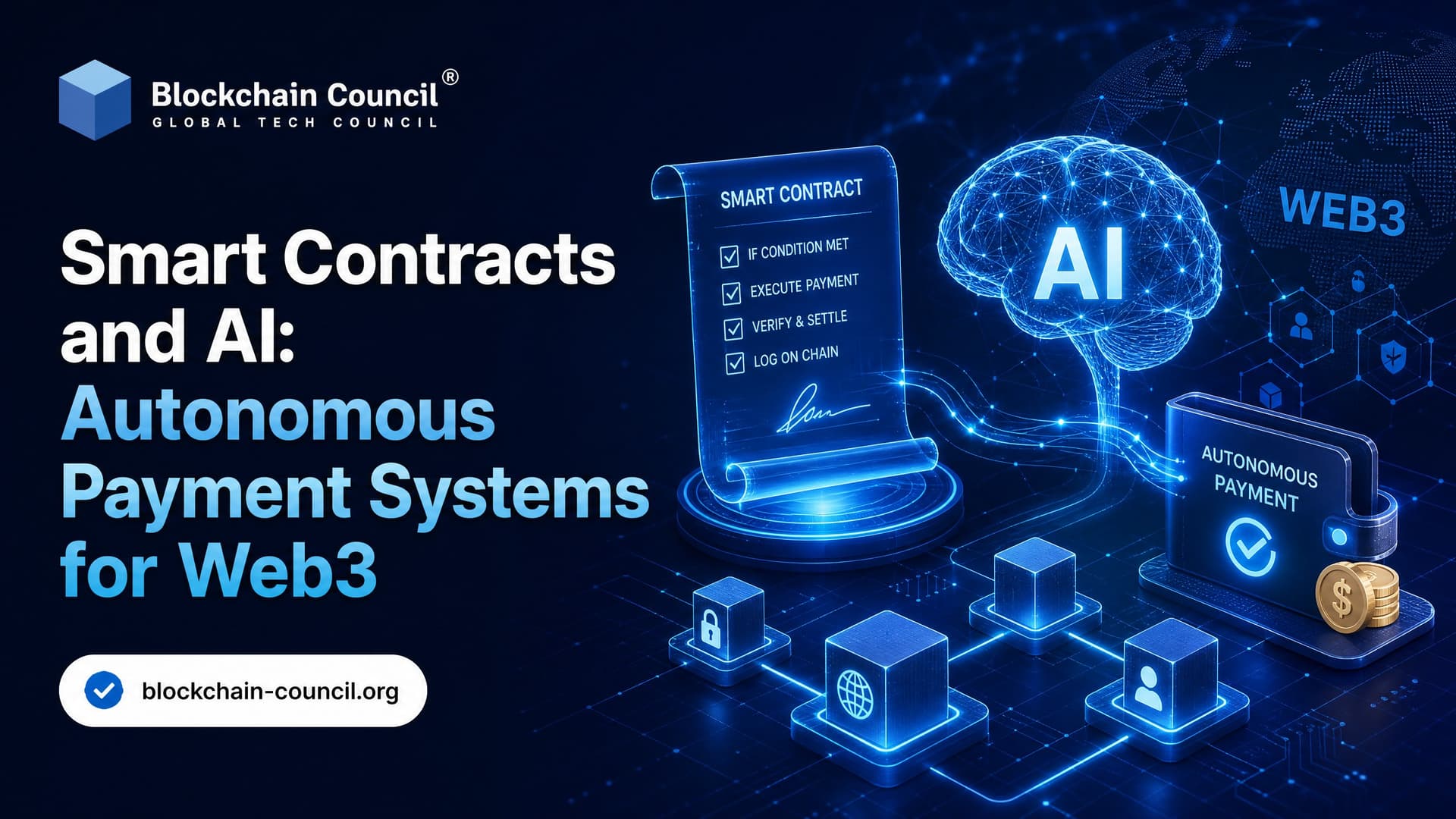
Autonomous payment systems for Web3 combine deterministic smart contracts with AI agents that can decide when, why, and how to move value on-chain. This is not just autopay with a crypto wallet. The difference is agency: the software can interpret context, compare options, sign a transaction, and call a contract within limits you define.
The idea is early, but it is moving fast. Galaxy Digital has described agentic capital markets, Chainlink has written about machine economies where agents and devices pay each other directly, and payment firms such as MoonPay and Very Good Security have framed agentic payments as a step beyond scheduled automation. For developers and enterprises, the question is no longer whether AI can initiate payments. It can. The harder question is how to make that safe, auditable, and useful. Professionals exploring AI systems that can act independently may find the Certified Artificial Intelligence (AI) Expert relevant to their learning goals.

What Smart Contracts and AI Add to Payments
Smart contracts are programs deployed to blockchains. They enforce rules for transfers, settlement, penalties, access, and state changes. On Ethereum, a Solidity 0.8.x contract might release USDC after a delivery proof is verified, or it might execute a Delivery versus Payment flow where asset transfer and cash settlement happen atomically.
AI agents are different. They are off-chain systems that read data, reason over objectives, and choose actions. An AI agent might compare gas fees, check a vendor risk score, read IoT delivery data, and decide whether a payment should be made now or delayed. The smart contract enforces the rule. The AI agent chooses the action. For a wider understanding of decentralized applications and blockchain ecosystems, the Certified Web3 Expert is another related learning option.
That split matters. Do not put model reasoning on-chain unless you have a very specific reason. It is expensive, hard to update, and usually unnecessary. Keep the AI off-chain, keep settlement rules on-chain, and use signatures, spending limits, and monitoring to control what the agent can do.
How an Autonomous Web3 Payment System Works
Most production-minded designs use five layers. You can build smaller prototypes, but skipping controls is where teams get hurt.
AI agent layer: The agent evaluates market data, contract milestones, sensor feeds, risk limits, and payment instructions.
Smart contract layer: Contracts define who can be paid, under what conditions, in which token, and with what limits.
Wallet and identity layer: The agent needs a cryptographic account. In practice, many teams use smart contract wallets or delegated signing rather than giving a model direct control of a hot wallet.
Oracle and data layer: Oracles connect off-chain data to on-chain execution. Price feeds, RFID events, weather data, and compliance checks all sit here.
Monitoring and governance layer: Alerts, kill switches, transaction simulation, policy logs, and human review thresholds keep the system within acceptable bounds.
A simple flow looks like this: the AI agent sees that a shipment has arrived, checks whether temperature readings stayed inside the agreed range, asks an oracle-backed contract for verification, and prepares a payment transaction. The contract releases funds only if the conditions match. If not, it reverts.
One practical warning: beginners often test this with an ERC-20 token and hit execution reverted: ERC20: insufficient allowance. The agent may have a wallet balance, but the payment contract cannot transfer tokens unless allowance was approved first. This small detail breaks many demos. In real systems, you should design approval limits carefully, use permit-style flows where supported, and avoid unlimited approvals for autonomous agents.
Where Agentic Payments Are Emerging
DeFi and Agentic Capital Markets
In DeFi, AI agents can rebalance portfolios, provide liquidity, repay loans, or hedge exposure by calling protocols such as automated market makers and lending markets. Galaxy has argued that this may lead to agentic capital markets, where treasury operations and liquidity decisions run continuously through smart contracts.
This is useful, but it is also overhyped in some pitches. Fully autonomous trading agents are not magic alpha machines. They can lose money faster than humans if pricing data is stale, slippage controls are weak, or the strategy overfits past market behavior. The better near-term use case is constrained execution: let the agent act inside strict risk bands, not with open-ended discretion.
Machine Economies and IoT Payments
Chainlink has described machine economies where AI agents, IoT devices, and services exchange value directly. Think of an electric vehicle paying for charging, a sensor network paying for bandwidth, or an industrial machine ordering maintenance once vibration data crosses a threshold.
In logistics, AI-driven smart contracts can process RFID data, vehicle telemetry, and temperature feeds. If goods arrive on time and within agreed conditions, the carrier is paid automatically. If the temperature rises above the contract limit, the payment can be reduced, paused, or routed into a dispute process.
Enterprise Contracting and B2B Payments
Enterprise Contract Lifecycle Management systems are also moving toward AI-assisted execution. Platforms such as Sirion discuss AI tools that extract obligations, track milestones, and connect contract performance to payment events. Add smart contracts, and milestone payments can become more transparent.
For example, a supplier contract could release 30 percent at purchase order acceptance, 50 percent after verified delivery, and 20 percent after inspection. The AI agent watches for evidence. The smart contract executes the payment. Finance teams get a clean audit trail instead of a chain of emails and spreadsheets.
Market Signals: Why This Matters Now
The smart contract market is growing quickly. Precedence Research estimated the global smart contracts market at 3.69 billion USD in 2025 and projected it could reach about 1,073.24 billion USD by 2035. Forecasts that large should be treated with caution, but the direction is clear: automated digital agreements are becoming core infrastructure across finance, supply chain, insurance, payroll, and enterprise operations.
Use cases are also broadening. Chainlink documents dozens of smart contract use cases, including real-time settlement, Delivery versus Payment, Payment versus Payment, and automated insurance payouts. Hedera has highlighted real-world uses such as contractor payments and digitized payroll tracking. AI agents can attach to many of these flows and gradually increase autonomy.
Risks You Cannot Ignore
Autonomous payment systems for Web3 introduce a painful combination: probabilistic AI decisions plus irreversible blockchain settlement. That is why governance has to be designed from day one.
Liability: If an AI agent sends the wrong payment, who is responsible: the model provider, wallet owner, developer, enterprise, or infrastructure vendor?
Compliance: Agentic payments need AML checks, sanctions screening, audit logs, and clear decision records in regulated environments.
Oracle risk: Bad data can trigger bad payments. If a manipulated sensor feed says cargo arrived, the contract may release funds incorrectly.
Key management: An agent with a private key is a high-value target. Use delegated permissions, spending caps, multisig approvals, and emergency pause functions.
Model drift: An AI agent that performed well in testing may behave differently when market conditions change.
To be blunt, do not let an AI agent control a treasury wallet directly. Start with a smart contract wallet, daily limits, allowlisted contracts, transaction simulation, and human approval above a threshold. Autonomy should be earned through observed performance.
Developer Pattern: Keep AI Flexible, Keep Contracts Strict
A sound architecture separates judgment from enforcement. The AI agent can decide that paying Vendor A now is optimal. The contract should still check whether Vendor A is allowlisted, whether the invoice hash matches, whether the milestone is verified, and whether the payment stays under the limit.
Use tools developers already trust: Hardhat or Foundry for contract testing, OpenZeppelin contracts for access control and token interfaces, Chainlink or other oracle networks for external data, and a wallet layer that supports policy-based signing. On Ethereum mainnet, remember chain ID 1. On testnets or L2s, configure chain IDs carefully. A wrong RPC or signer configuration can send a transaction to the wrong network, which is a boring mistake until real funds are involved.
Skills Professionals Need
This field sits across blockchain engineering, AI systems, cybersecurity, finance, and compliance. If you are building toward this career path, focus on:
Solidity smart contract development, especially access control, token standards such as ERC-20 and ERC-721, and upgrade risk.
AI agent design, including tool use, memory, policy constraints, and evaluation.
Wallet security, multisig operations, transaction signing, and account abstraction concepts.
Oracle design and data verification.
Regulatory awareness for payments, automated decision-making, and digital assets.
For structured learning, Blockchain Council readers can use related paths such as Certified Smart Contract Developer™, Certified Blockchain Developer™, Certified Artificial Intelligence (AI) Expert™, and Certified Web3 Expert™. Developers should prioritize the smart contract track first. Product and strategy teams may get more value by pairing Web3 fundamentals with AI governance. Professionals developing their technical capabilities can also explore a Tech Certification aligned with their responsibilities.
Building Skills and Evaluating Talent
As blockchain technology continues to transform industries, organisations need professionals who understand its practical applications and technical foundations. Hiring the right talent requires more than reviewing qualifications; employers must also evaluate relevant knowledge and problem-solving skills. Platforms like HireValid can help organisations explore structured candidate assessments for more informed hiring decisions.
The Next Practical Step
Build a small constrained prototype: an AI agent that recommends a payment, a smart contract that enforces a spending cap, and a test oracle that confirms a milestone. Run it on a testnet. Make it fail on purpose. Check reverts, allowance errors, stale oracle data, and signer permissions.
If you can explain every failed transaction and every control in that prototype, you are on the right path. Then deepen your skills with smart contract security, AI agent evaluation, and Web3 governance before moving anywhere near production funds. Teams that need to communicate these solutions clearly to customers and stakeholders may also consider a Marketing Certification to complement their technical knowledge.
FAQs
1. What are AI-powered smart contracts in Web3 payments?
AI-powered smart contracts combine blockchain-based agreements with artificial intelligence to automate payment decisions, analyze transaction data, and execute predefined financial actions. They enable faster, more efficient, and data-driven payment workflows in Web3 ecosystems.
2. How do smart contracts enable autonomous payment systems?
Smart contracts enable autonomous payment systems by executing transactions automatically when predefined conditions are met. They can manage recurring payments, release funds after service delivery, distribute revenue, and facilitate machine-to-machine transactions without requiring manual approval for every payment.
3. How does AI improve smart contract payment automation?
AI improves smart contract payment automation by analyzing transaction patterns, predicting payment risks, optimizing transaction timing, and identifying unusual activities. When integrated with blockchain infrastructure, AI can help payment systems make informed decisions while smart contracts enforce predefined rules.
4. What is an autonomous payment system in Web3?
An autonomous payment system in Web3 is a blockchain-based payment solution that can initiate, authorize, or execute transactions according to predefined rules or AI-driven decisions. These systems support automated settlements, recurring payments, decentralized finance (DeFi), and payments between AI agents.
5. Can AI agents execute payments using smart contracts?
Yes, AI agents can interact with smart contracts to initiate payments, manage transaction workflows, and execute authorized financial operations. However, their capabilities depend on wallet permissions, spending limits, blockchain infrastructure, and security controls established by the system.
6. What are the main benefits of combining AI and smart contracts for payments?
Combining AI and smart contracts can improve payment efficiency, reduce manual intervention, strengthen fraud detection, support programmable transactions, and enhance transaction monitoring. This combination also enables businesses to build more adaptable payment systems for decentralized applications and digital services.
7. How do AI and smart contracts support machine-to-machine payments?
AI and smart contracts support machine-to-machine payments by allowing connected devices, software applications, and autonomous agents to exchange digital assets programmatically. For example, an IoT device could pay for computing resources or data access when predefined usage and authorization conditions are satisfied.
8. Are AI-powered autonomous payments secure?
AI-powered autonomous payments can improve security through anomaly detection, transaction monitoring, spending limits, and smart contract verification. However, vulnerabilities in smart contracts, compromised wallets, manipulated AI outputs, and malicious external data can still create risks. Independent audits and robust access controls are essential.
9. What role does blockchain play in AI-driven payment systems?
Blockchain provides the decentralized transaction infrastructure on which AI-driven payment systems can operate. It records transactions, supports programmable agreements, and enables verifiable settlement. AI adds analytical capabilities, while smart contracts enforce the rules governing payment execution.
10. How can AI detect fraud in smart contract payments?
AI can analyze transaction histories, wallet behavior, transaction frequency, and other relevant signals to identify suspicious activity. When integrated with smart contract workflows, these insights can trigger alerts, additional verification, or predefined safeguards. Detection accuracy depends on data quality and the model's capabilities.
11. Can smart contracts automate recurring and subscription payments?
Yes, smart contracts can automate recurring payments by executing transfers according to predefined schedules and authorization rules. Depending on the blockchain and wallet architecture, additional mechanisms may be required to trigger scheduled transactions, verify available funds, and manage cancellations or failed payments.
12. How do AI-powered smart contracts reduce payment processing costs?
AI-powered smart contracts can reduce operational costs by automating reconciliation, minimizing manual processing, and optimizing transaction execution strategies. They may also help identify more cost-effective transaction routes or suitable blockchain networks, although gas fees, network congestion, and infrastructure costs still apply.
13. What is the difference between traditional payment automation and autonomous Web3 payments?
Traditional payment automation typically operates through centralized payment providers, banking infrastructure, and predefined workflows. Autonomous Web3 payments use blockchain networks and smart contracts to execute programmable transactions, potentially incorporating AI for decision support. The main differences involve infrastructure, control, transparency, and settlement mechanisms.
14. How do AI and smart contracts enable cross-border payments?
AI can help evaluate transaction routes, estimate costs, and identify potential compliance risks, while smart contracts can automate eligible settlement steps using supported digital assets. These systems may improve transparency and reduce manual processing, but exchange-rate volatility, local regulations, liquidity, and conversion fees remain important considerations.
15. What are the biggest challenges of AI-powered smart contract payments?
Key challenges include smart contract vulnerabilities, AI decision errors, unreliable external data, blockchain scalability, transaction fees, regulatory uncertainty, and wallet security. Businesses must also address accountability, privacy, authorization, and recovery procedures before deploying autonomous payment infrastructure.
16. How do oracles connect AI systems with smart contract payments?
Blockchain oracles deliver external information, such as exchange rates, delivery confirmations, or market data, to smart contracts. AI systems may analyze this information to generate recommendations or signals. Because smart contracts cannot independently verify every off-chain input, reliable oracle design is essential for secure payment execution.
17. Can AI-powered smart contracts support DeFi payments?
Yes, AI-powered smart contracts can support DeFi payment workflows involving lending, borrowing, automated settlements, liquidity management, and conditional asset transfers. AI can analyze market conditions or identify risks, while smart contracts execute permitted operations. Such systems still face smart contract, liquidity, market, and protocol risks.
18. What industries can benefit from autonomous Web3 payment systems?
Industries that may benefit include fintech, e-commerce, decentralized finance, supply chain management, gaming, digital content, IoT, and cloud computing. These systems can automate conditional payments, revenue sharing, digital service purchases, and settlements between businesses, users, devices, and software agents.
19. How can businesses implement AI-driven smart contract payment systems?
Businesses can begin by defining payment requirements, selecting a suitable blockchain, developing and auditing smart contracts, integrating AI models and reliable data sources, and establishing secure wallet permissions. Pilot testing, transaction limits, monitoring, compliance reviews, and emergency controls should precede wider deployment.
20. What is the future of AI and smart contracts in autonomous Web3 payments?
The future of AI and smart contracts in Web3 payments may include AI-agent commerce, programmable business-to-business settlements, machine-to-machine transactions, and more adaptive payment infrastructure. Wider adoption will depend on stronger security, interoperability, regulatory clarity, reliable AI decision-making, and effective human oversight.
Related Articles
View All
Web3
AI Agents in Web3 Payment Networks: How Autonomous Payments Work
AI agents are becoming autonomous payment actors in Web3, using wallets, smart contracts, stablecoins, and oracles to execute controlled on-chain transactions.

Web3
AI Payment Bots and Autonomous Wallets: Web3 Commerce Moves to Agentic Payments
AI payment bots and autonomous wallets are enabling agentic Web3 commerce through stablecoins, scoped permissions, and programmable wallet infrastructure.

Web3
AI Agents with Web3: How Autonomous Software Is Changing Decentralized Systems
AI agents with Web3 are becoming active on-chain participants, powering DeFi automation, compliance, security, DAOs, and digital services.
Trending Articles
The Role of Blockchain in Ethical AI Development
How blockchain technology is being used to promote transparency and accountability in artificial intelligence systems.
Can DeFi 2.0 Bridge the Gap Between Traditional and Decentralized Finance?
The next generation of DeFi protocols aims to connect traditional banking with decentralized finance ecosystems.
How to Install Claude Code
Learn how to install Claude Code on macOS, Linux, and Windows using the native installer, plus verification, authentication, and troubleshooting tips.