

Advantages and Disadvantages of Quantum Computing Explained

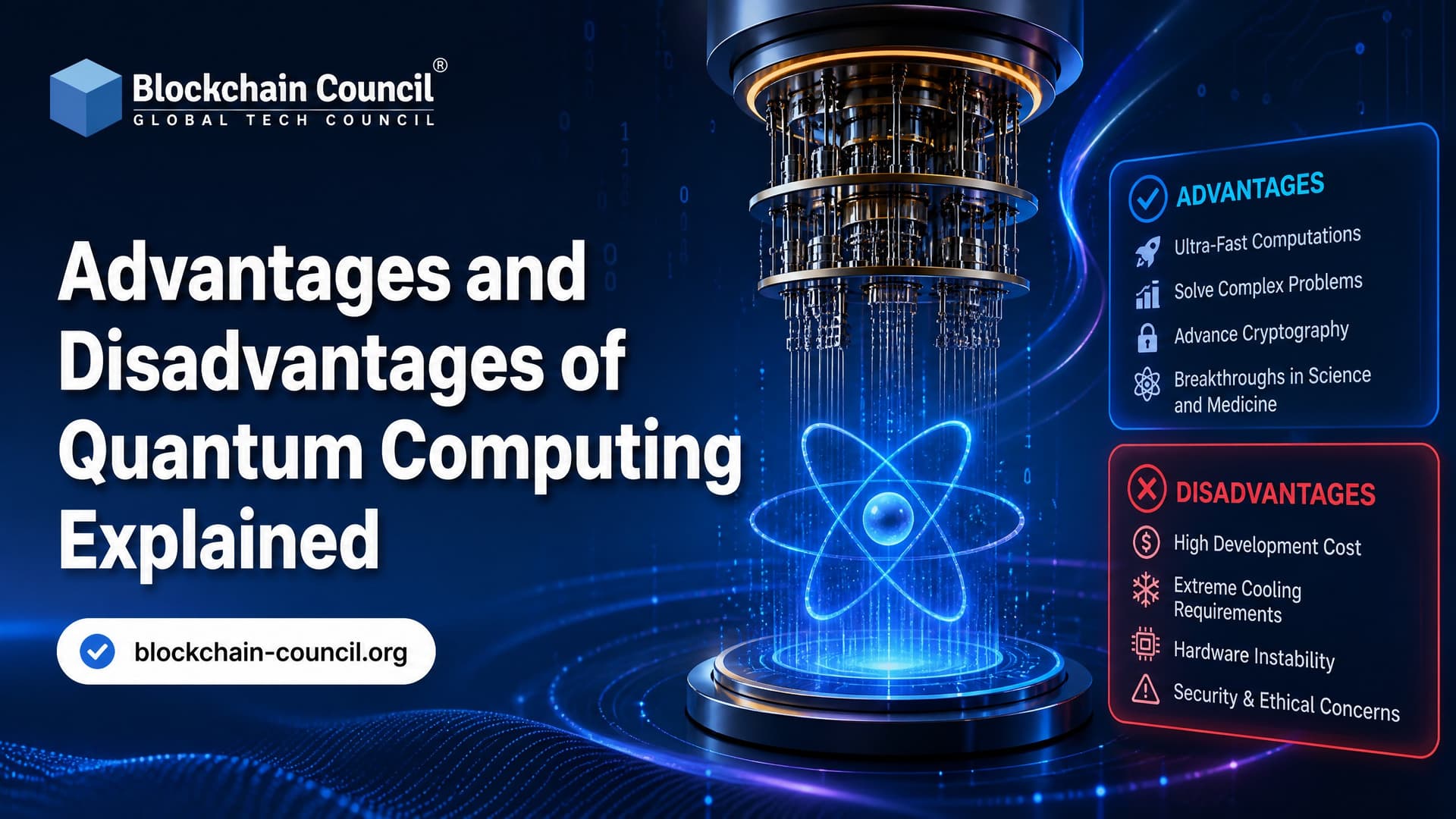
Advantages and disadvantages of quantum computing are best understood through a practical lens: quantum computers may outperform classical systems on selected problems, but they are not general-purpose replacements for servers, GPUs, or cloud platforms. Not yet. For most enterprises, quantum computing is an emerging specialist capability for optimization, simulation, cryptography, and research-heavy workloads.
The market is moving quickly. Industry estimates place the broader quantum technology market, including computing and sensing, at roughly USD 1.9 billion in 2025, with strong year-on-year growth. Still, production-scale, fault-tolerant quantum computers do not exist today. Current systems are noisy, expensive, and usually accessed through hybrid workflows that combine classical computing with quantum processors.

What Makes Quantum Computing Different?
Classical computers process bits as 0 or 1. Quantum computers use qubits, which can represent quantum states through superposition and entanglement. That difference gives quantum algorithms unusual mathematical power, but only for the right type of problem.
A common mistake is to say quantum computers try every answer at once. That is too simplistic. Quantum algorithms use interference to amplify useful outcomes and suppress the probability of wrong ones. If the algorithm is poorly designed, the measurement still gives you noise. Anyone who has run a beginner Qiskit circuit with only 1024 shots has seen this: the histogram can look persuasive until you raise the shot count or run it on a noisy backend.
Key Advantages of Quantum Computing
1. Speed for Specific Mathematical Problems
The most discussed advantage is speed. Quantum algorithms can offer major gains for selected problem classes, including integer factorization, search, linear algebra, and some combinatorial problems.
Shor's algorithm is famous because it can factor large integers efficiently on a sufficiently powerful fault-tolerant quantum computer. That matters because RSA encryption depends on the practical difficulty of factoring large numbers. Grover's algorithm offers a quadratic speedup for unstructured search, which is less dramatic but still meaningful at scale.
Be careful, though. Quantum speedup is not automatic. If your workload is a standard web application, database query, payroll system, or ERP process, quantum computing is the wrong tool.
2. Better Tools for Large-Scale Optimization
Optimization is one of the strongest near-term areas for quantum research. Enterprises are testing quantum and quantum-inspired methods for:
- Vehicle routing and fleet scheduling
- Supply chain planning
- Portfolio construction and risk balancing
- Manufacturing schedules
- Energy grid optimization
These are hard problems because the number of possible choices grows quickly. In logistics, adding just a few vehicles, time windows, or delivery constraints can make a classical optimization model much harder to solve.
The Quantum Approximate Optimization Algorithm, often called QAOA, and quantum annealing approaches are being studied for these cases. The honest view: many pilots are still exploratory. Classical solvers are very good, and quantum methods must prove they deliver better results, lower cost, or faster decisions in real production settings.
3. Strong Fit for Molecular and Materials Simulation
This is where quantum computing feels most natural. Molecules are quantum systems, so modeling them with classical computers becomes expensive very quickly. A quantum computer can, in principle, simulate molecular behavior more directly.
That could help in:
- Drug discovery and candidate screening
- Catalyst design
- Battery chemistry
- Fertilizer and chemical engineering
- Advanced materials for electronics
Some studies and pilots report large speedups for specific molecular property calculations. Do not read that as a blanket claim that quantum computers can design new drugs tomorrow. Drug discovery includes biology, toxicity, manufacturing, clinical trials, and regulation. Quantum simulation may speed one part of that pipeline, not the whole thing.
4. Possible Acceleration for AI and Machine Learning
Quantum machine learning is an active research area. The potential advantages include faster optimization, better sampling, and improved processing of high-dimensional data. Some approaches explore quantum-enhanced linear algebra, probabilistic modeling, and kernel methods.
Here is the practical trade-off. If you are training a transformer model today, GPUs and specialized AI accelerators are the proven route. Quantum computing may become useful for particular subroutines or data structures, but it is not a drop-in replacement for CUDA, PyTorch, or TensorFlow.
Professionals working at the intersection of AI and quantum should build strong foundations in both areas. Blockchain Council's Certified Quantum Computing Expert™ and Certified Artificial Intelligence (AI) Expert™ are relevant learning paths for readers who want structured study.
5. New Approaches to Security and Cryptography
Quantum computing creates both risk and opportunity in cybersecurity. On the defensive side, quantum key distribution uses quantum properties to detect eavesdropping. Post-quantum cryptography focuses on algorithms designed to resist attacks from future quantum computers.
NIST has already advanced post-quantum cryptographic standards, including CRYSTALS-Kyber for key establishment and CRYSTALS-Dilithium for digital signatures. Security teams should pay attention now because cryptographic migration takes years, especially in banking, government, healthcare, and critical infrastructure.
Main Disadvantages of Quantum Computing
1. Fragile Hardware and Decoherence
Qubits are extremely sensitive. Temperature changes, vibration, stray electromagnetic signals, and other environmental noise can destroy quantum information. This loss is called decoherence.
Many quantum systems require temperatures close to absolute zero. That means dilution refrigerators, shielding, specialized control electronics, and careful calibration. You do not install this next to a standard server rack and call it a day.
2. High Error Rates and Expensive Error Correction
Quantum operations are noisy. Gates can fail. Measurements can be wrong. Current devices are often called NISQ machines, meaning Noisy Intermediate-Scale Quantum devices.
Error correction is the path toward reliable quantum computing, but it is costly. Many physical qubits may be needed to create one stable logical qubit. This overhead is one reason large-scale fault-tolerant systems remain a long-term target.
A small developer detail matters here. If your old Qiskit tutorial fails with ImportError: cannot import name 'execute' from 'qiskit', you are likely mixing pre-1.0 code with Qiskit 1.x. The software stack is improving, but breaking changes and backend-specific behavior still trip up learners and pilot teams.
3. Scalability Is Still Unsolved
Building a few qubits is hard. Building thousands or millions of reliable, interconnected qubits is much harder. Scaling requires progress in fabrication, calibration, control systems, packaging, cryogenics, and error correction.
Different hardware approaches exist, including superconducting qubits, trapped ions, photonics, neutral atoms, and topological designs. Each has trade-offs. Superconducting platforms can run fast gates but require deep cooling. Trapped ions can have high fidelity but slower operations. There is no universal winner yet.
4. Cost and Infrastructure Barriers
Quantum computing is expensive. Access is often provided through cloud platforms because few organizations can justify buying or maintaining the hardware directly.
The cost problem includes:
- Specialized cryogenic or vacuum systems
- Precision control equipment
- Highly trained engineers and physicists
- Vendor-specific tooling
- Long research and testing cycles
For most companies, a cloud-based pilot is far more sensible than owning quantum hardware. To be blunt, if your use case cannot beat a classical solver in a controlled proof of concept, it should not move to procurement.
5. Skills Shortage and Immature Software
Quantum computing needs a rare mix of skills: linear algebra, quantum mechanics, algorithms, software engineering, and domain knowledge. That talent pool is growing, but it remains small compared with demand.
The software ecosystem is also young. Tools such as Qiskit, Cirq, PennyLane, and Amazon Braket are useful, but standards are still forming. Algorithms that look elegant in a paper may be difficult to map onto noisy hardware with limited circuit depth.
If you are preparing for certification or enterprise adoption, do not study quantum in isolation. Pair it with cybersecurity, AI, and blockchain fundamentals. Blockchain Council's Certified Cybersecurity Expert™ and Certified Blockchain Expert™ are useful for readers building cross-domain expertise.
6. Serious Cryptographic Risk
The biggest systemic disadvantage may be security disruption. A sufficiently powerful quantum computer could break widely used public-key systems based on factoring and discrete logarithms, including RSA and many elliptic curve schemes.
This creates a harvest-now, decrypt-later problem. Attackers can store encrypted data today and decrypt it in the future if quantum capabilities mature. Long-lived data, such as health records, state secrets, and financial archives, is especially exposed.
Real-World Use Cases Being Tested Today
Most real-world quantum work is still at the pilot or proof-of-concept stage. The strongest areas include:
- Pharmaceutical research: Molecular modeling, binding energy estimation, and candidate screening.
- Materials science: Battery materials, catalysts, superconductors, and chemical reactions.
- Finance: Portfolio optimization, risk modeling, derivatives pricing, and fraud pattern analysis.
- Logistics: Route planning, warehouse scheduling, and network optimization.
- Cybersecurity: Post-quantum migration planning and quantum-safe protocol testing.
- AI research: Quantum kernels, sampling methods, clustering, and optimization routines.
How Enterprises Should Approach Quantum Computing
Do not start with hardware. Start with a problem inventory. Look for workloads that are mathematically hard, high value, and already difficult for classical systems.
A practical enterprise roadmap looks like this:
- Identify optimization, simulation, or cryptography workloads.
- Benchmark current classical performance.
- Run small quantum or quantum-inspired experiments through cloud access.
- Compare outcomes against cost, accuracy, and repeatability.
- Begin post-quantum cryptography planning now, especially for long-lived sensitive data.
The near-term value is not replacing your data center. It is learning where quantum may create measurable advantage and where it will waste budget.
Final Take: Powerful, But Not Magic
The advantages and disadvantages of quantum computing point to the same reality: this technology is powerful for specific problems and weak for many everyday computing tasks. Speedups in optimization, simulation, cryptography, and selected AI workloads are promising. The disadvantages are just as real: fragile qubits, high error rates, cost, scarce skills, and major security risks.
If you are a professional, build foundations before chasing advanced claims. Start with quantum algorithms, post-quantum security, and hands-on tools such as Qiskit or PennyLane. For structured learning, explore Blockchain Council's Certified Quantum Computing Expert™ and pair it with cybersecurity or AI training if your role touches enterprise risk, cryptography, or data science.
Related Articles
View All
Quantum Computing
Qiskit Explained: A Beginner's Guide to IBM's Quantum Computing Framework
A beginner-friendly explanation of Qiskit, IBM's open source quantum framework, covering circuits, transpilation, recent updates, use cases, and learning steps.

Quantum Computing
Quantum Computing Programming Languages Explained: Q#, Qiskit, Cirq, and More
A practical guide to quantum computing programming languages, including Qiskit, Q#, Cirq, PennyLane, TKET, CUDA-Q, Braket, and PyQuil.

Quantum Computing
Shor's Algorithm Explained: How Quantum Computing Could Break RSA Encryption
Shor's algorithm could break RSA and ECC on a future fault tolerant quantum computer. Learn how it works, why it matters, and how PQC helps.
Trending Articles

Top 5 DeFi Platforms
Explore the leading decentralized finance platforms and what makes each one unique in the evolving DeFi landscape.
What is AWS? A Beginner's Guide to Cloud Computing
Everything you need to know about Amazon Web Services, cloud computing fundamentals, and career opportunities.
How to Install Claude Code
Learn how to install Claude Code on macOS, Linux, and Windows using the native installer, plus verification, authentication, and troubleshooting tips.