

Quantum Computing Programming Languages Explained: Q#, Qiskit, Cirq, and More

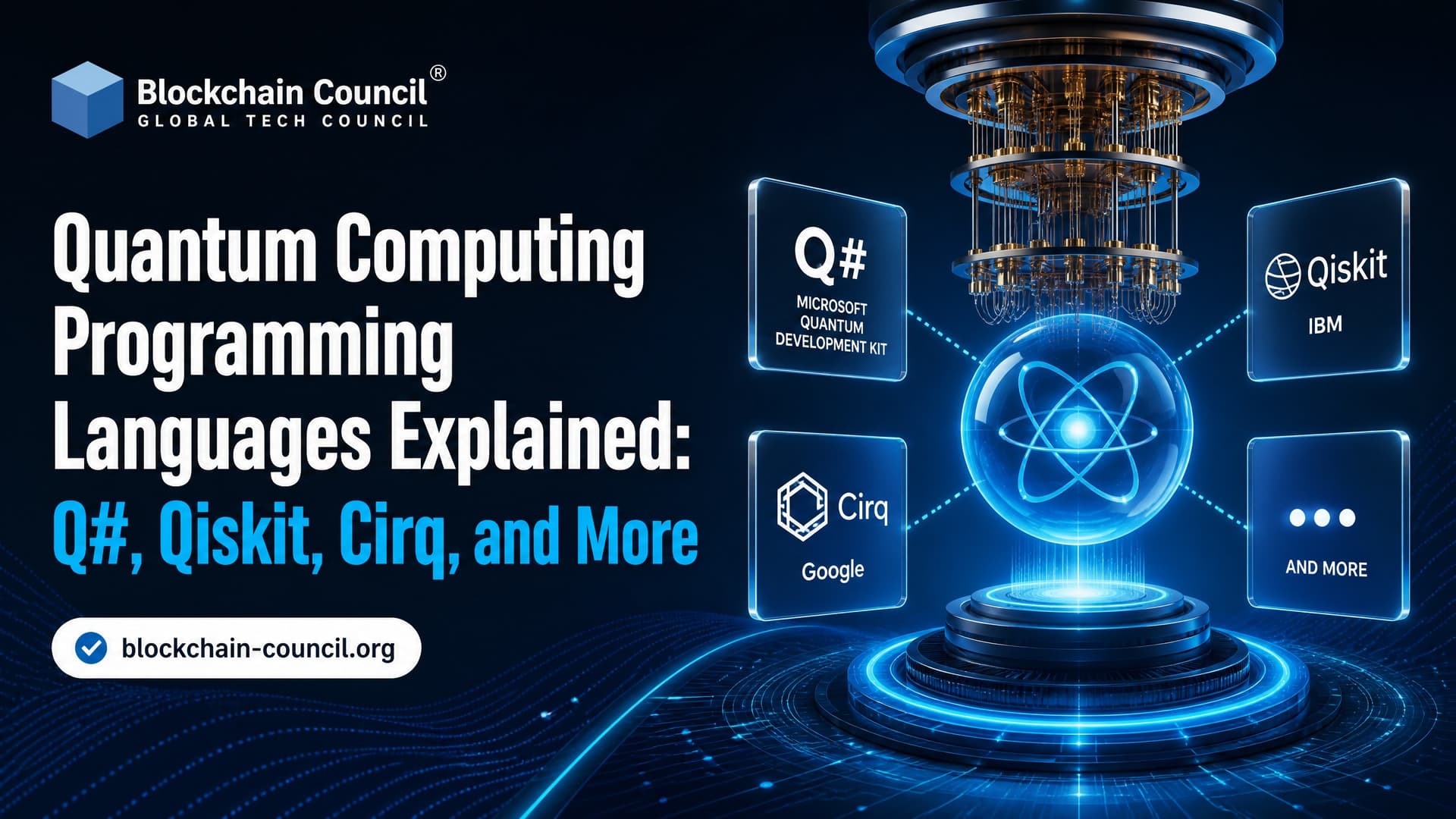
Quantum computing programming languages are the software layer between your algorithm and a quantum processor, simulator, or cloud runtime. If you are learning the field now, start with one practical rule: pick the language based on the hardware, workflow, and problem type you need, not because a framework is popular on GitHub.
The current ecosystem is Python-heavy, but not Python-only. Qiskit, Cirq, PennyLane, AWS Braket, PyQuil, and pytket all use Python as the main developer interface. Q# takes a different path as a domain-specific language from Microsoft. CUDA-Q supports both Python and C++ for heterogeneous quantum-classical work. Under the hood, more tools now rely on Rust, C, C++, and GPU acceleration, because circuit compilation and simulation get expensive fast.

What Are Quantum Computing Programming Languages?
These languages and SDKs help you define qubits, gates, circuits, measurements, noise models, and execution targets. They also handle the less glamorous parts: transpilation, backend selection, result parsing, and error mitigation.
In practice, you rarely write directly for the hardware. You write a circuit or a hybrid workflow, then a compiler maps it to the allowed gate set and qubit connectivity of a target device. This is where beginners get surprised. A two-qubit gate that looks simple in a notebook can expand into a much longer device-specific circuit after transpilation.
Market interest is rising for a reason. Analyst estimates for quantum software vary widely, from hundreds of millions of dollars in 2024 to multi-billion-dollar projections by the early 2030s. The exact figure depends on what gets counted as software, cloud access, services, or applications, but the direction is consistent: quantum programming skills are moving from research labs into enterprise pilots.
Qiskit: IBM's Python-First Quantum SDK
Qiskit is usually the safest first stop for developers learning quantum circuits. It is open source, Python-based, and closely tied to IBM Quantum hardware and cloud services. It also has a large tutorial base, which matters when you are debugging your first Bell state at 1 a.m.
Where Qiskit Fits Best
- Learning core quantum computing concepts with real circuits
- Running jobs on IBM Quantum systems through
qiskit-ibm-runtime - Experimenting with chemistry, optimization, finance, and sampling workloads
- Using primitives such as Sampler and Estimator for algorithm execution
Qiskit 2.x has pushed performance work deeper into the stack, including Rust-backed components for compilation and simulation. IBM has also moved toward higher-level execution models, dynamic circuits, and early fault-tolerant compilation flows such as Clifford+T oriented pass managers.
One practical note: older tutorials often show from qiskit import Aer. In newer setups, that commonly fails because Aer is distributed separately now. Install qiskit-aer and import from qiskit_aer. This small packaging detail trips up many learners, and it is a good reminder that quantum SDKs change quickly.
When Qiskit Is the Wrong Choice
Do not choose Qiskit just because it has the most tutorials. If your work is tied to Google-style device topology research, Cirq may be cleaner. If your focus is differentiable quantum machine learning, PennyLane will usually get you to gradients faster.
Q#: Microsoft's Quantum Programming Language
Q# is not just another Python library. It is a dedicated quantum programming language designed by Microsoft for expressing quantum algorithms and running them through the Azure Quantum ecosystem. You can use it with Python, but the language itself is strongly typed and purpose-built for quantum programs.
Why Developers Use Q#
- You want a structured language for quantum algorithms, not only notebook-style circuit building
- Your organization already uses Azure for governance, access control, and cloud workflows
- You need managed access to different quantum backends through Azure Quantum
- You prefer a clearer separation between quantum operations and classical orchestration
The Azure Quantum Development Kit reached a 1.0 milestone with a Rust-based core, which improved portability and browser-based development. Recent QDK releases have moved Python-facing functionality toward a unified qdk package, while older qsharp package paths have been deprecated.
My view: Q# is excellent for enterprise teams that already live in Microsoft tooling. It is less ideal if you only want a quick Python notebook to test a circuit on a simulator. For that, Qiskit or Cirq feels lighter.
Cirq: Google's Hardware-Aware Framework
Cirq is Google's open source Python framework for building, editing, and running quantum circuits, especially for noisy intermediate-scale quantum devices. It is more explicit than Qiskit in how it treats moments, qubit layout, and hardware constraints.
What Makes Cirq Different?
Cirq exposes scheduling and topology details that other SDKs abstract away. That can feel verbose at first. It is also the point. If your experiment depends on gate ordering, connectivity, or noise behavior, Cirq gives you fine control.
- Strong fit for NISQ research and device-aware algorithm design
- Useful when qubit placement and timing matter
- Works well in Google Colab and modern Python environments
- Suitable for noise modeling and variational algorithm experiments
Cirq releases in the 1.x series have focused on stability, bug fixes, and correctness, including noise-model patches such as Kraus operator fixes. That may sound minor, but for researchers simulating noisy circuits, a small noise-channel bug can change an experiment's conclusion.
PennyLane, TKET, CUDA-Q, Braket, and PyQuil
The phrase quantum computing programming languages covers more than Qiskit, Q#, and Cirq. Several specialized tools are often better for specific jobs.
PennyLane for Quantum Machine Learning
PennyLane, built by Xanadu, is designed for differentiable quantum programming. If your workflow involves gradients, optimizers, variational circuits, PyTorch, TensorFlow, or JAX, start here. It is the most natural fit for quantum machine learning experiments.
TKET and pytket for Circuit Optimization
TKET, from Quantinuum, is a cross-platform compiler toolkit. It earns its place when you care about circuit optimization across different backends. If you are comparing hardware providers, pytket can reduce provider lock-in at the compilation layer.
CUDA-Q for GPU-Accelerated Simulation
NVIDIA's CUDA-Q treats quantum processors as accelerators inside classical applications. It supports Python and C++, and it is compelling for simulation-heavy work where GPUs matter. Use it when your bottleneck is large-scale simulation or hybrid high-performance computing, not when you are just learning single-qubit gates.
AWS Braket and PyQuil
AWS Braket is a cloud service and SDK for accessing multiple quantum hardware providers and managed hybrid jobs. PyQuil, tied to Rigetti's Quil language, is useful for developers targeting Rigetti hardware or working closer to quantum assembly-style circuit descriptions.
How to Choose the Right Quantum Programming Language
Here is the plain recommendation.
- Choose Qiskit if you are new to quantum programming or want broad IBM hardware access.
- Choose Q# if you work in Azure-heavy enterprise environments and want a dedicated typed language.
- Choose Cirq if device topology, scheduling, and NISQ behavior are central to your research.
- Choose PennyLane if you are building quantum machine learning or variational algorithms.
- Choose TKET if circuit optimization across providers is the main challenge.
- Choose CUDA-Q if GPU-backed simulation and hybrid high-performance computing are required.
Do not try to master every framework at once. Learn the quantum model first: states, gates, measurement, entanglement, noise, and transpilation. Then pick the stack that matches your job.
Enterprise Use Cases for Quantum Programming
Most enterprise quantum work is still experimental, but it is not imaginary. Teams are testing quantum and hybrid algorithms in:
- Optimization: routing, scheduling, portfolio models, and facility planning
- Chemistry and materials: molecular ground-state estimation and reaction modeling
- Machine learning: variational classifiers and generative experiments
- Signal and image processing: transform-based research, including medical imaging and telecom studies
- Security: simulations of Shor's and Grover's algorithms to understand post-quantum risk
Cloud platforms shape most of this work. IBM Quantum, Azure Quantum, AWS Braket, Google tools, Xanadu, Quantinuum, Rigetti, and NVIDIA all connect languages to managed execution environments. Quantum programming is starting to look more like cloud AI and high-performance computing: APIs, queues, credentials, cost controls, and governance.
Skills You Need Before Writing Quantum Code
You do not need a PhD to begin, but you do need discipline. Learn linear algebra basics, probability, Python, circuit notation, and the difference between simulation and hardware execution. Also learn why noise matters. A circuit that runs perfectly on a statevector simulator may produce weak results on a real quantum processor.
If you want a structured learning path, consider Blockchain Council's Certified Quantum Computing Expert™, especially if you want formal coverage of quantum principles, algorithms, and practical programming concepts. Developers working at the AI intersection can pair it with the Certified Artificial Intelligence (AI) Expert™, while architects exploring blockchain and post-quantum security topics may also benefit from the Certified Blockchain Expert™.
The Future of Quantum Programming Languages
The next phase will be less about writing toy circuits and more about compilation, interoperability, and hybrid workloads. Expect more Rust and C++ inside SDKs, better intermediate representations, cloud-managed runtime services, and stronger support for early fault-tolerant workflows.
Qiskit is already moving toward multi-stage compiler flows. QDK is investing in a Rust-based core and cross-platform access. Cirq remains strong for hardware-aware research. PennyLane, TKET, and CUDA-Q will keep growing because they solve specific problems better than general-purpose tools.
Your next step is simple: install one SDK and build something small. Create a Bell state, run it on a simulator, then run it on a real or cloud-managed backend. After that, rewrite the same experiment in one other framework. The differences will teach you more than another comparison chart ever will.
Related Articles
View All
Quantum Computing
Qiskit Explained: A Beginner's Guide to IBM's Quantum Computing Framework
A beginner-friendly explanation of Qiskit, IBM's open source quantum framework, covering circuits, transpilation, recent updates, use cases, and learning steps.

Quantum Computing
Top Quantum Programming Frameworks Compared: Qiskit vs Cirq vs PennyLane vs Braket
Compare Qiskit, Cirq, PennyLane, and Amazon Braket SDK by ecosystem, hardware access, and best use cases. Choose the right quantum framework for learning or production.

Quantum Computing
Advantages and Disadvantages of Quantum Computing Explained
Understand the advantages and disadvantages of quantum computing, including speed, optimization, simulation, cryptography risks, hardware limits, and enterprise use cases.
Trending Articles
How Blockchain Secures AI Data
Understand how blockchain technology is being applied to protect the integrity and security of AI training data.
What is AWS? A Beginner's Guide to Cloud Computing
Everything you need to know about Amazon Web Services, cloud computing fundamentals, and career opportunities.
How to Install Claude Code
Learn how to install Claude Code on macOS, Linux, and Windows using the native installer, plus verification, authentication, and troubleshooting tips.