

Qiskit Explained: A Beginner's Guide to IBM's Quantum Computing Framework

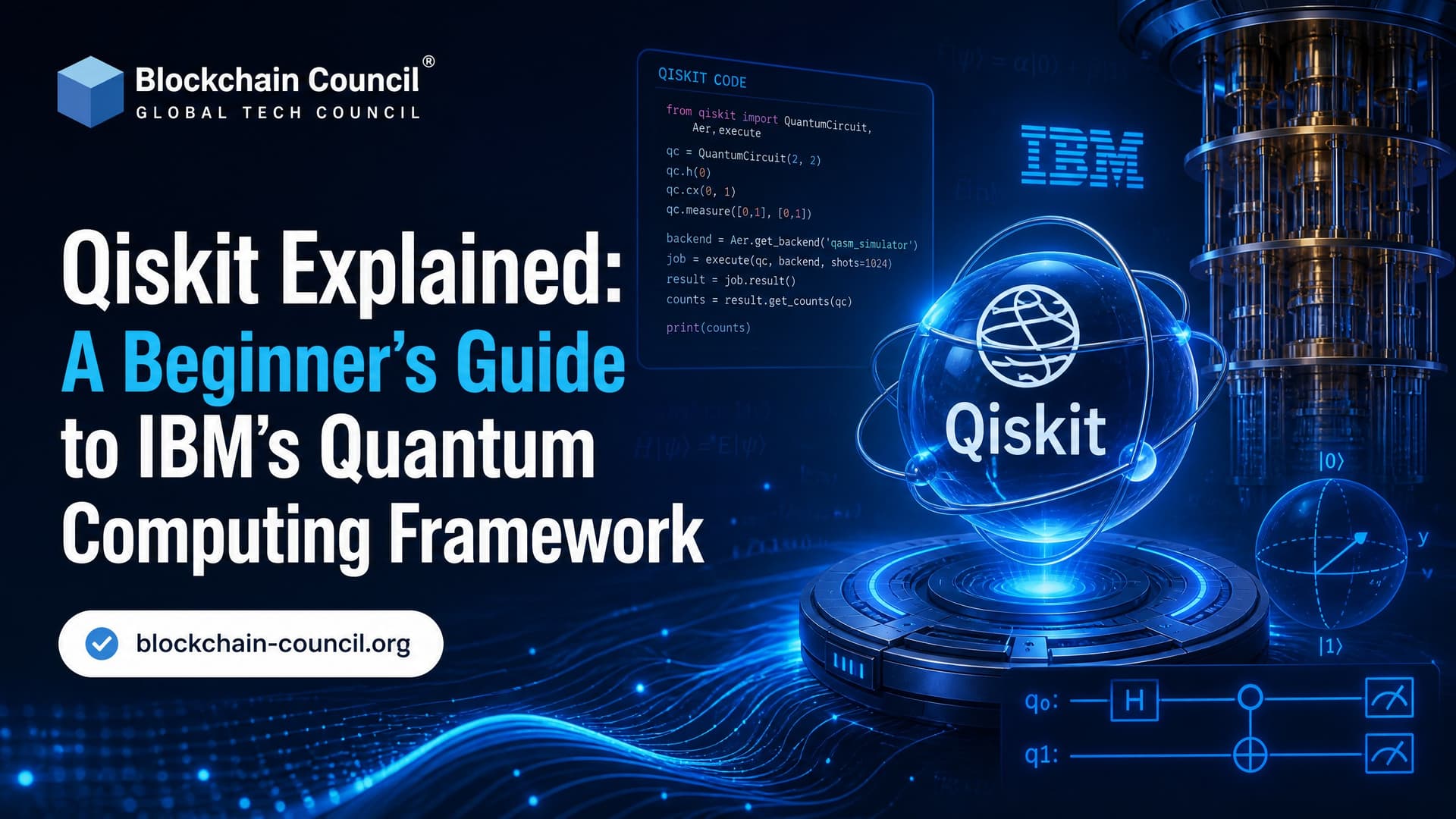
Qiskit is IBM's open source quantum computing framework for building, simulating, transpiling, and running quantum circuits. Know Python? You can write your first circuit in a few minutes. If you work in research or engineering, Qiskit also gives you access to IBM Quantum systems, compiler tools, error mitigation methods, and newer low-level APIs built for larger hybrid quantum-HPC workflows.
That range is why Qiskit matters. It is beginner friendly at the circuit level, but it is not a toy framework. IBM documentation and release notes point in a clear direction: faster transpilation, better scaling, stronger runtime execution, and compilation paths aimed at fault-tolerant quantum computing.

What Is Qiskit?
Qiskit, short for Quantum Information Software Kit, is an open source software development kit first released by IBM Research in 2017. It lets you describe quantum circuits, test them on simulators, and run suitable workloads on IBM's cloud-accessible quantum processors through the IBM Quantum Compute Service, formerly called Qiskit Runtime Service.
Think of Qiskit as the software layer between your algorithm idea and real quantum hardware. You describe gates, qubits, measurements, and classical control. Qiskit's compiler stack then maps that abstract circuit onto a target backend with real constraints, such as native gates, qubit connectivity, calibration data, and noise behavior.
Where Qiskit Fits in the Quantum Stack
- Circuit construction: Build quantum circuits using Python APIs, with newer support for lower-level C interfaces.
- Transpilation: Convert an ideal circuit into one that matches a simulator or IBM Quantum device.
- Execution: Run jobs on local simulators or IBM Quantum systems through managed cloud services.
- Analysis: Inspect counts, probabilities, circuit depth, gate choices, and error behavior.
- Domain workflows: Experiment with use cases in chemistry, optimization, cryptography, and quantum machine learning.
Here is the part beginners often miss. Qiskit is not a quantum programming language in the way Python is a programming language. It is closer to a compiler and runtime ecosystem for quantum programs. That distinction matters once your circuit stops being a classroom example.
A First Qiskit Circuit
The classic starting point is a Bell state circuit. It creates entanglement between two qubits, then measures both. You should mostly see 00 and 11 as outcomes, not 01 and 10.
from qiskit import QuantumCircuit, transpile
from qiskit_aer import AerSimulator

qc = QuantumCircuit(2, 2)
qc.h(0)
qc.cx(0, 1)
qc.measure([0, 1], [0, 1])

simulator = AerSimulator()
compiled = transpile(qc, simulator)
result = simulator.run(compiled, shots=1024).result()

print(result.get_counts())
A practical warning from teaching this material: many old tutorials still use BasicAer or imports that worked in earlier Qiskit versions. In current setups, install qiskit-aer separately and use AerSimulator. If you see an error like ModuleNotFoundError: No module named 'qiskit_aer', the issue is usually not your circuit. It means the simulator package is missing.
Core Concepts Beginners Should Learn First
Qubits, Gates, and Measurement
A qubit is the basic unit of quantum information. Gates change qubit states. Measurement converts quantum information into classical bits, which is why repeated runs, called shots, produce a distribution rather than one fixed answer.
Start with a small gate set: X, H, CX, RZ, and measurement. Do not rush into Shor's algorithm on day one. You will learn faster by checking how a two-qubit circuit changes when you move a Hadamard gate or reverse a control and target qubit.
Transpilation
Transpilation is where Qiskit becomes serious. Real quantum processors do not accept arbitrary circuits exactly as you draw them. The transpiler rewrites the circuit for a target backend, inserts swaps when qubits are not directly connected, decomposes gates into supported basis gates, and tries to reduce circuit depth.
This is also where many certification candidates get tripped up. They memorize quantum gates but overlook why a circuit that looks short on paper can become deeper after mapping to hardware. In noisy devices, extra depth can mean worse results.
Noise and Error Mitigation
Quantum devices are noisy. Gates have error rates. Measurements can be wrong. Qiskit supports simulators with noise models and has been adding error mitigation tools for more realistic experiments. IBM has reported that newer dynamic circuit capabilities improved accuracy at the 100-plus qubit scale compared with prior approaches, while HPC-powered error mitigation cut the cost of extracting accurate results in selected workflows.
What Changed in Recent Qiskit Versions?
Qiskit has changed a lot since the early 0.x releases. The 2.x line is now the main supported SDK family, and the 1.x series is being wound down. If you are starting now, learn the 2.x architecture rather than patching old notebooks.
Performance Is a Major Focus
IBM moved many transpiler passes to Rust in the Qiskit SDK 1.3 release, producing large speedups for many transpilation tasks. Later 2.x releases continued to improve transpilation performance through algorithmic and implementation changes.
That is not a minor cleanup. Compilation time becomes painful when you test large circuits, optimization loops, or multiple backend targets. Faster transpilation means quicker iteration.
The C API Is Growing
Qiskit 2.x expands the C API so lower-level tools can build circuits, targets, and compiler components with less overhead. Recent releases added support for compiled extensions, parameterized gates, Pauli-based computation, DAG-level transpiler passes, and deeper inspection of classical control flow.
For beginners, Python remains the right entry point. For teams building high-performance tooling, the C API is the signal to watch.
Dynamic Circuits and Fault-Tolerant Compilation
Dynamic circuits allow mid-circuit measurement and conditional operations. This gives developers more control over algorithms that react to intermediate results. Qiskit is also adding compiler paths for representations such as Pauli-based computation and Clifford+T, both relevant to fault-tolerant quantum computing.
To be blunt, most beginners do not need Clifford+T pipelines immediately. But you should know why they matter. They connect near-term circuit work to the longer-term goal of error-corrected quantum machines.
Real-World Uses of Qiskit
Most Qiskit use cases are still exploratory, not production systems replacing classical infrastructure. That is the honest view. Still, the experiments are useful because they help teams understand algorithm fit, hardware limits, and future compliance risk.
- Cryptography: Banks and security teams use Qiskit-style simulations to study quantum risk to RSA and prepare for post-quantum cryptography work aligned with NIST standardization.
- Optimization: Logistics and operations teams test route planning, portfolio models, and resource allocation problems using hybrid classical-quantum patterns.
- Chemistry and materials: Researchers model molecular interactions and electronic structure problems where quantum methods may eventually help at scale.
- Cybersecurity: Public sector and enterprise teams prototype quantum-safe workflows and study quantum key distribution concepts.
- Education: Universities use Qiskit because the Python interface makes superposition, entanglement, and measurement easier to demonstrate.
If your goal is business value next quarter, Qiskit is probably not a shortcut. If your goal is to build internal quantum literacy and test where quantum methods may matter in five years, it is a strong choice.
Qiskit vs Other Quantum Frameworks
Qiskit is strongest when you want close integration with IBM Quantum hardware, a large educational ecosystem, and a mature transpiler stack. It is a good first framework for Python developers.
It is not the only option. Cirq is often used around Google's quantum tooling. PennyLane is popular for differentiable programming and quantum machine learning. The Braket SDK fits teams working inside AWS quantum services. Pick based on hardware access, workflow needs, and team skills.
My recommendation: start with Qiskit if you are learning core quantum circuits or planning to use IBM Quantum systems. Add PennyLane later if your work centers on hybrid quantum machine learning.
How to Start Learning Qiskit
- Install the basics: Use a clean Python environment and install qiskit plus qiskit-aer for simulation.
- Build tiny circuits: Create one-qubit and two-qubit examples. Inspect counts after measurement.
- Study transpilation: Compare your original circuit with the transpiled circuit for different backends.
- Run noisy simulations: Learn why circuit depth and measurement error change results.
- Explore IBM Quantum Compute Service: Move from local simulation to real-device execution when your circuit is small enough.
- Connect theory to a domain: Try a small optimization, chemistry, or cryptography example instead of only abstract circuits.
For structured learning, link this path with Blockchain Council's quantum computing learning resources. If your work touches security or AI, it also pairs well with Blockchain Council's cybersecurity and artificial intelligence certification tracks as internal learning pathways.
Regulatory and Standards Context
Qiskit itself is an open source framework, so it is not directly regulated. The workloads around it can be. Cryptographic testing may involve sensitive security architecture. Cloud execution raises access control, data governance, and audit questions. Post-quantum migration planning increasingly connects with NIST standards and sector-specific risk management.
Do not upload sensitive cryptographic material to any cloud quantum service without checking your organization's governance policy. That sounds basic, but it is exactly the kind of mistake that happens when research notebooks become team demos.
Next Step
Install Qiskit, run the Bell state example, then change one line and observe what breaks. After that, study transpilation and noise before attempting larger algorithms. If you want a guided route, use Blockchain Council's quantum computing resources as your foundation, then branch into AI or cybersecurity certifications if your role sits at the intersection of quantum, security, and emerging technology strategy.
Related Articles
View All
Quantum Computing
Quantum Computing With Python: A Beginner's Guide to Building Quantum Programs
Learn quantum computing with Python using Qiskit, simulators, cloud hardware, and beginner workflows for building real quantum programs.

Quantum Computing
Quantum Computing Programming Languages Explained: Q#, Qiskit, Cirq, and More
A practical guide to quantum computing programming languages, including Qiskit, Q#, Cirq, PennyLane, TKET, CUDA-Q, Braket, and PyQuil.

Quantum Computing
Quantum Computing Explained for Beginners: Qubits, Gates, and Real-World Uses
Quantum computing explained for beginners: learn qubits, gates, circuits, real-world uses, market outlook, and what skills professionals should build next.
Trending Articles

Top 5 DeFi Platforms
Explore the leading decentralized finance platforms and what makes each one unique in the evolving DeFi landscape.
How Blockchain Secures AI Data
Understand how blockchain technology is being applied to protect the integrity and security of AI training data.
Claude AI Tools for Productivity
Discover Claude AI tools for productivity to streamline tasks, manage workflows, and improve efficiency.