

What Is Quantum AI? How Quantum Computing and AI Work Together

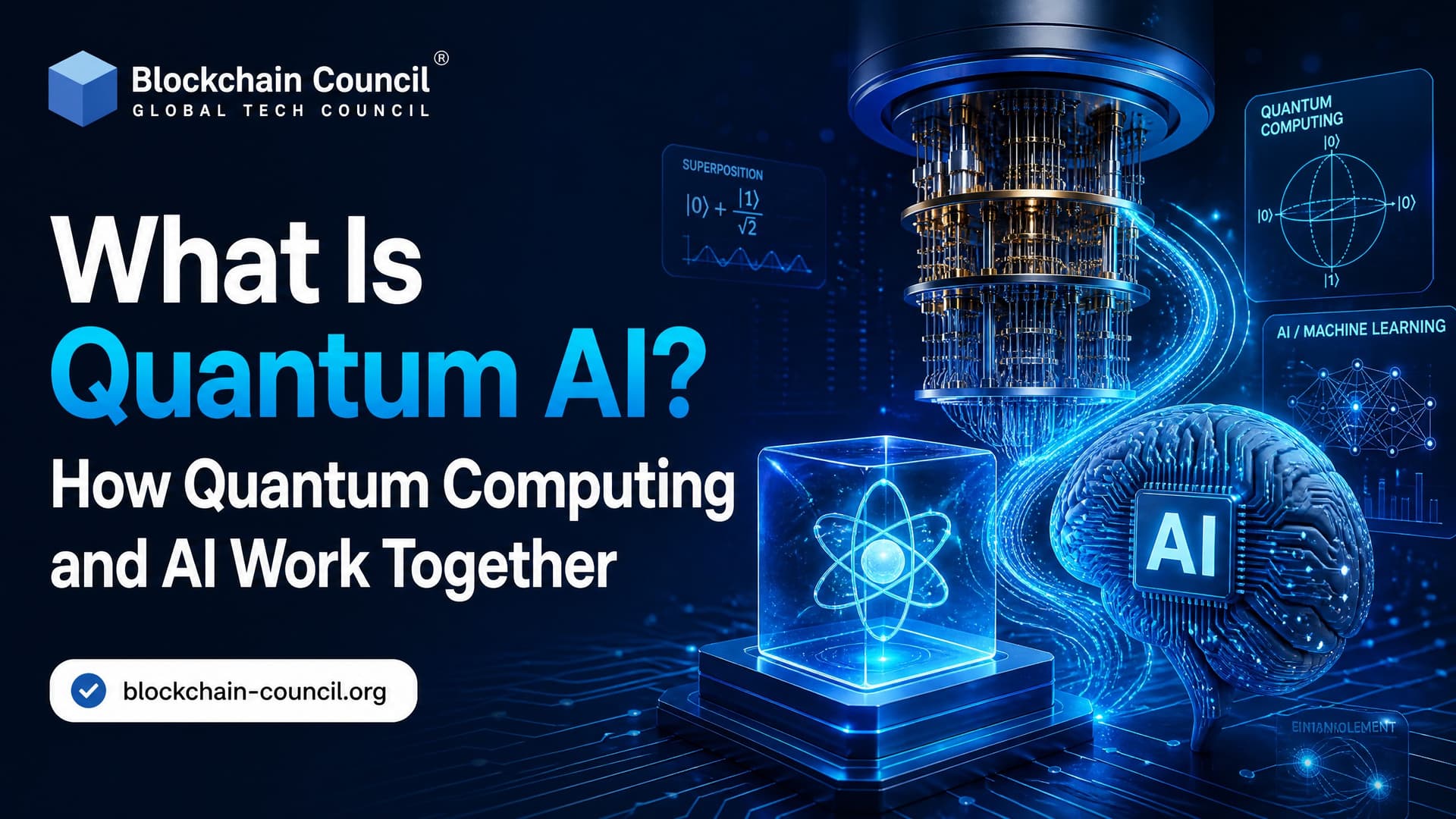
Quantum AI is the use of quantum computing with artificial intelligence, either to improve AI workloads or to use AI to improve quantum computers. That sounds neat, but be careful with the headline version of the idea. In 2026, Quantum AI is still mostly a research frontier, built from hybrid prototypes, cloud experiments, and narrow proofs of concept rather than standard enterprise deployments.
The practical view is simple. Classical computers still do most of the work. Quantum processors are tested as specialist accelerators for hard subproblems such as optimization, sampling, feature mapping, and simulation. AI also helps quantum engineers tune hardware, reduce noise, and design better circuits. It is a two-way relationship.

What Is Quantum AI?
Quantum AI, also called quantum artificial intelligence or quantum machine learning, sits at the intersection of two fields:
- Quantum computing, where information is processed using qubits instead of classical bits.
- Artificial intelligence, where models learn patterns, make predictions, generate content, or optimize decisions from data.
A classical bit is either 0 or 1. A qubit can be represented as a combination of states through superposition. Qubits can also be linked through entanglement, where the state of one qubit is correlated with another in ways that do not map neatly to ordinary classical logic.
That does not mean a quantum computer tries every answer and magically returns the best one. That is a common misconception. Quantum algorithms must be designed so that useful answers are amplified and unhelpful ones cancel out. This is hard. It is also why Quantum AI is not a plug-in replacement for TensorFlow, PyTorch, or classical GPU training.
How Quantum Computing and AI Work Together
There are two main directions. The first uses quantum computing to help AI. The second uses AI to make quantum computing better.
1. Quantum-enhanced AI
Quantum-enhanced AI uses quantum circuits or quantum algorithms inside an AI pipeline. Usually the architecture is hybrid: a CPU or GPU handles the normal machine learning workflow, while a quantum processing unit handles a specific mathematical bottleneck.
Common targets include:
- Data encoding and feature extraction: Classical data, such as vectors or matrices, is encoded into quantum states. A quantum circuit processes those states, then measurements convert the result back into classical data.
- Optimization: Many AI problems depend on finding a good solution in a huge search space. Quantum methods such as the Quantum Approximate Optimization Algorithm, often called QAOA, are studied for routing, scheduling, resource allocation, and portfolio selection.
- Sampling: Generative AI, probabilistic models, and risk simulations can involve difficult sampling tasks. Quantum systems are being explored for cases where classical sampling becomes too expensive.
- Quantum machine learning models: Variational quantum circuits can act like trainable models for classification, clustering, or generative tasks when data can be encoded efficiently.
The phrase when data can be encoded efficiently matters. Data loading can erase the advantage. If you spend more time encoding a massive classical dataset into quantum states than you save during computation, the whole design fails. This is one of the first reality checks developers meet when moving from a nice diagram to an actual notebook.
2. AI for quantum computing
The other direction is often more practical today. AI helps build and operate quantum systems.
Machine learning can support:
- Qubit calibration and control pulse tuning.
- Error prediction and noise characterization.
- Quantum circuit optimization and transpilation.
- Search over quantum error correction strategies.
- Benchmarking of quantum gates and device behavior.
Google Quantum AI, AWS, IBM, and several research groups publish work in this area because noisy hardware is still the central bottleneck. Better AI-based control may help improve coherence, reduce error rates, and make quantum processors more stable. No stable hardware, no useful Quantum AI at scale. That is the blunt version.
The Current State of Quantum AI in 2026
Quantum AI is not yet a mainstream enterprise technology. Most organizations cannot buy a Quantum AI system, connect it to their data warehouse, and expect production value next quarter. The field is closer to advanced R&D.
Today, most systems have three traits:
- Noisy intermediate-scale quantum hardware: Current devices have limited qubit counts and nontrivial error rates.
- Hybrid workflows: Classical systems do the orchestration, preprocessing, optimization loops, and deployment.
- Cloud-based access: Developers experiment through platforms such as Amazon Braket, IBM Quantum Platform, Google Cirq, PennyLane, and Qiskit.
If you have tried recent quantum SDKs, you know the tooling is moving fast. A practical example: code that used from qiskit import execute in older Qiskit examples can break in newer Qiskit 1.x environments with an import error because the execution workflow changed. That small migration issue is a good reminder that Quantum AI development is still not as settled as mainstream ML engineering.
Key Architectures in Quantum AI
Most serious Quantum AI work fits into one of three architectural patterns.
Quantum-assisted classical AI
Here the AI model is still mainly classical. A quantum routine helps with one part of the pipeline, such as feature selection, kernel estimation, sampling, or optimization. This is the most realistic near-term pattern for enterprises.
Quantum machine learning
In quantum machine learning, the quantum circuit is itself part of the learning model. Parameters in the circuit are adjusted during training, often with a classical optimizer wrapped around the quantum circuit. These are called variational quantum algorithms.
This approach is interesting, but it is not automatically better than a neural network. For many ordinary datasets, a classical model is cheaper, easier to debug, and good enough.
Hybrid quantum-classical workflows
This is the architecture most developers should study first. The workflow combines classical data processing, quantum circuit execution, measurement, and classical optimization. You send parameters to a quantum circuit, measure outputs, update parameters classically, then repeat.
The loop is familiar to ML engineers. The hardware behavior is not.
Real-World Use Cases Being Researched
Commercial impact is still limited, but several domains are strong candidates for Quantum AI research.
Optimization-heavy problems
Logistics routing, factory scheduling, airline crew planning, and supply chain design involve huge combinatorial spaces. Classical heuristics work, but they may miss better solutions as constraints multiply. Quantum optimization methods are being tested as possible accelerators.
Financial services and risk modeling
Banks and asset managers are studying quantum-enhanced portfolio optimization, Monte Carlo-style simulation, option pricing, and risk analysis. The appeal is clear: small percentage improvements can matter. The caution is also clear: financial models already run on strong classical infrastructure, so quantum methods must prove measurable advantage.
Chemistry, materials, and drug discovery
This is one of the most credible long-term areas. Molecules are quantum systems. Simulating them on classical machines becomes difficult as complexity grows. Quantum AI could combine quantum simulation with machine learning to screen molecules, materials, catalysts, or battery chemistries.
Cybersecurity research
Large fault-tolerant quantum computers could threaten widely used public-key cryptography such as RSA and elliptic curve systems. Quantum AI research also looks at anomaly detection, cryptographic testing, and post-quantum security analysis. If you work in security, pair this topic with post-quantum cryptography rather than treating Quantum AI as a standalone skill.
AI-assisted quantum hardware
This is already one of the strongest practical directions. AI can help calibrate qubits, tune gates, detect drift, and improve error correction experiments. Here AI supports the road toward better quantum hardware rather than running as a quantum model.
Quantum AI Benefits and Limits
The potential benefits are real, but narrow.
- Possible speedups for selected optimization, simulation, or sampling tasks.
- New modeling approaches for quantum-native data and physical systems.
- Better hardware development through AI-assisted calibration and error analysis.
- Cloud experimentation without owning quantum hardware.
The limits are just as important:
- Most quantum hardware is noisy and not fault tolerant.
- Data encoding can remove any expected performance gain.
- Benchmarks are often small and hard to compare with tuned classical methods.
- Quantum talent is scarce, especially at the intersection of physics, ML, and software engineering.
- Many vendor claims describe future potential, not current production results.
What Should Professionals Learn First?
If you are a developer, data scientist, architect, or technical leader, do not start with hype-heavy Quantum AI predictions. Build the foundations in this order:
- Learn quantum computing basics: qubits, gates, measurement, entanglement, noise, and simple circuits.
- Understand classical ML well: optimization, loss functions, kernels, sampling, and model evaluation.
- Practice with SDKs: try Qiskit, Cirq, PennyLane, or Amazon Braket on small examples.
- Study hybrid workflows: focus on how classical optimizers interact with parameterized quantum circuits.
- Evaluate use cases honestly: choose problems where optimization, sampling, or simulation is already a bottleneck.
For structured learning, you can connect this topic with certifications such as Certified Quantum Computing Expert™, Certified Artificial Intelligence (AI) Expert™, and Certified Blockchain Expert™. The combination is useful if you work on deeptech strategy, AI infrastructure, Web3 security, or enterprise R&D.
Future Outlook for Quantum AI
Over the next 5 to 10 years, expect more hybrid experiments, better SDKs, and deeper cloud integration. The first credible advantages are likely to appear in narrow technical problems, not general-purpose AI.
Beyond that, the outlook depends on fault-tolerant quantum computing. If hardware scales, Quantum AI could affect optimization, generative modeling, molecular simulation, and AI infrastructure design. If hardware progress slows, the field may still produce useful tools for quantum control and scientific computing, but not the sweeping changes often promised in headlines.
The best next step is practical. Build a small hybrid model, run it on a simulator, then compare it against a classical baseline. If the baseline wins, good. You learned something real. Then deepen your skills through a focused quantum computing or AI certification and return to Quantum AI with stronger judgment.
Related Articles
View All
Quantum Computing
How Does Quantum Computing Work? Key Concepts Explained Simply
A simple, practical guide to how quantum computing works, including qubits, superposition, entanglement, error correction, use cases, and skills.

Quantum Computing
Quantum Computing Certification: Benefits, Career Value, and How to Choose One
Learn how quantum computing certification supports career growth, what employers value, and how to choose a credential with real technical depth.

Quantum Computing
Best Quantum Computing Courses in India for Students and Professionals
Explore the best quantum computing courses in India, including IIT, NPTEL, AICTE aligned, C-DAC, and regional programmes for students and professionals.
Trending Articles
How Blockchain Secures AI Data
Understand how blockchain technology is being applied to protect the integrity and security of AI training data.
What is AWS? A Beginner's Guide to Cloud Computing
Everything you need to know about Amazon Web Services, cloud computing fundamentals, and career opportunities.

Can DeFi 2.0 Bridge the Gap Between Traditional and Decentralized Finance?
The next generation of DeFi protocols aims to connect traditional banking with decentralized finance ecosystems.