

Types of Blockchain
 Suyash Raizada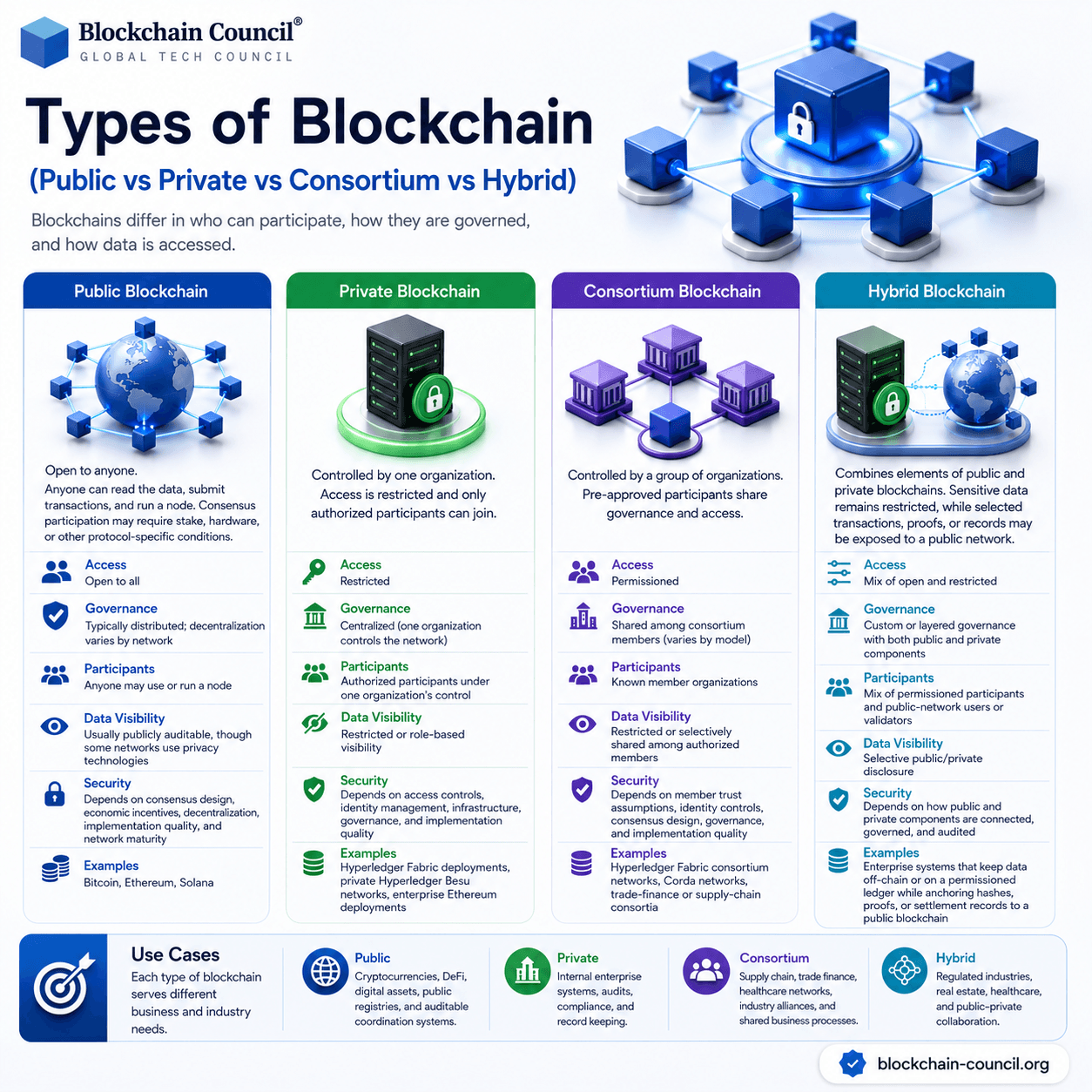
Blockchain is not a one-size-fits-all technology. Different organizations have different requirements for security, governance, transparency, and data access, which is why multiple types of blockchain networks exist. Choosing the right blockchain architecture depends on the specific goals of a project and the level of decentralization required.
Understanding the differences between blockchain architectures requires a solid grasp of distributed ledger technology, consensus mechanisms, governance models, and enterprise blockchain design. A Certified Blockchain Expert credential provides structured knowledge in these areas, helping professionals evaluate which blockchain model best fits different business and technical requirements.

Public Blockchain
A public blockchain is open to anyone. Users can read data, validate transactions, and participate in the network without requiring permission. These networks are highly transparent and decentralized, making them ideal for cryptocurrencies and public decentralized applications.
Common examples: Bitcoin, Ethereum, Solana.
Private Blockchain
Private blockchains are controlled by a single organization. Participation is restricted to authorized users, offering greater privacy, controlled access, and faster transaction processing. They are commonly used by enterprises for internal operations, compliance, and secure data management.
Implementing private blockchain solutions also demands expertise in cybersecurity, cloud infrastructure, networking, identity management, and enterprise systems integration. A broader Tech Certification helps professionals strengthen these complementary technical skills, making it easier to deploy and manage secure blockchain environments.
Consortium Blockchain
A consortium blockchain is governed by a group of trusted organizations rather than a single entity. Access is permissioned, and governance is shared among consortium members. This model is well suited for industries where multiple organizations collaborate while maintaining secure data sharing.
Typical use cases include supply chain management, trade finance, and healthcare networks.
Hybrid Blockchain
Hybrid blockchains combine features of both public and private networks. Organizations can keep sensitive information private while selectively sharing specific data or transaction proofs on a public blockchain. This approach offers flexibility, security, and transparency where needed.
Choosing the Right Blockchain
Each blockchain model serves different business requirements:
Public: Open innovation, cryptocurrencies, and decentralized applications
Private: Enterprise systems, compliance, and internal record management
Consortium: Multi-organization collaboration and shared governance
Hybrid: Combining privacy with public transparency
Understanding these blockchain types helps businesses and professionals choose the right technology for their use case while unlocking the full potential of decentralized innovation.
As blockchain adoption expands across industries, organizations also need to communicate the value of different blockchain models to customers, partners, and stakeholders. A Marketing Certification helps professionals develop expertise in product positioning, digital communication, and market adoption strategies, supporting the successful introduction of blockchain-based solutions.
FAQs
1. What Are the Main Types of Blockchain?
The four main types of blockchain are Public Blockchain, Private Blockchain, Consortium (Federated) Blockchain, and Hybrid Blockchain. Each type offers different levels of decentralization, privacy, and access control.
2. What Is a Public Blockchain?
A public blockchain is an open, decentralized network where anyone can join, validate transactions, and access the blockchain. It promotes transparency and security without requiring permission to participate.
3. What Is a Private Blockchain?
A private blockchain is a permissioned network managed by a single organization. Only authorized users can access, validate, or modify data, making it suitable for enterprise applications.
4. What Is a Consortium Blockchain?
A consortium or federated blockchain is managed by multiple organizations that collectively govern the network. It balances decentralization with controlled access and is commonly used for business collaborations.
5. What Is a Hybrid Blockchain?
A hybrid blockchain combines features of both public and private blockchains, allowing organizations to keep sensitive information private while making selected data publicly accessible for transparency.
6. What Is the Difference Between Public and Private Blockchains?
Public blockchains are open to everyone and prioritize decentralization, while private blockchains restrict participation to authorized users and focus on privacy, efficiency, and organizational control.
7. Which Type of Blockchain Is Best for Businesses?
The best blockchain depends on business requirements. Private, consortium, and hybrid blockchains are generally preferred for enterprise use because they offer better control, scalability, security, and regulatory compliance.
8. Which Blockchain Type Is the Most Secure?
All blockchain types can be secure when implemented correctly. Public blockchains benefit from broad decentralization, while private and consortium blockchains rely on controlled access and strong governance to maintain security.
9. Which Industries Use Private Blockchains?
Private blockchains are commonly used in banking, healthcare, supply chain management, insurance, manufacturing, government services, and enterprise resource planning.
10. What Are the Advantages of Public Blockchains?
Public blockchains offer transparency, decentralization, censorship resistance, global accessibility, and strong security through distributed consensus mechanisms.
11. What Are the Benefits of Consortium Blockchains?
Consortium blockchains enable multiple organizations to securely share data, reduce operational costs, improve collaboration, streamline business processes, and maintain shared governance.
12. What Are the Limitations of Private Blockchains?
Private blockchains may have reduced decentralization, require trusted administrators, involve governance complexity, and offer less transparency compared to public blockchain networks.
13. How Does a Hybrid Blockchain Improve Business Operations?
Hybrid blockchains allow organizations to protect confidential business data while selectively sharing verified information with customers, regulators, or business partners, improving both privacy and transparency.
14. Which Blockchain Type Supports Smart Contracts?
Public, private, consortium, and hybrid blockchains can all support smart contracts, depending on the platform and its capabilities.
15. Can Organizations Switch Between Different Blockchain Types?
Yes. Organizations may migrate or integrate different blockchain architectures as business requirements evolve, although migration requires careful planning, interoperability, and data management.
16. How Is AI Influencing Different Types of Blockchain in 2026?
AI is helping optimize blockchain networks through intelligent automation, fraud detection, smart contract auditing, predictive analytics, decentralized AI agents, and improved network monitoring across all blockchain types.
17. What Factors Should Businesses Consider When Choosing a Blockchain Type?
Organizations should evaluate security, scalability, privacy, governance, regulatory compliance, transaction speed, interoperability, cost, and business objectives before selecting a blockchain architecture.
18. Which Blockchain Type Is Best for Supply Chain Management?
Consortium and hybrid blockchains are often preferred because they allow multiple organizations to securely share information while protecting confidential business data.
19. What Career Skills Are Needed to Work with Different Blockchain Types?
Professionals should understand blockchain architecture, smart contracts, cryptography, distributed systems, consensus mechanisms, enterprise blockchain platforms, security, Web3, and blockchain governance.
20. Why Is It Important to Understand the Different Types of Blockchain?
Understanding the different types of blockchain helps businesses, developers, and technology professionals choose the right architecture for specific use cases. As blockchain adoption continues to grow across finance, healthcare, logistics, government, and enterprise applications, selecting the appropriate blockchain type is essential for achieving security, scalability, compliance, and long-term business success.
Related Articles
View All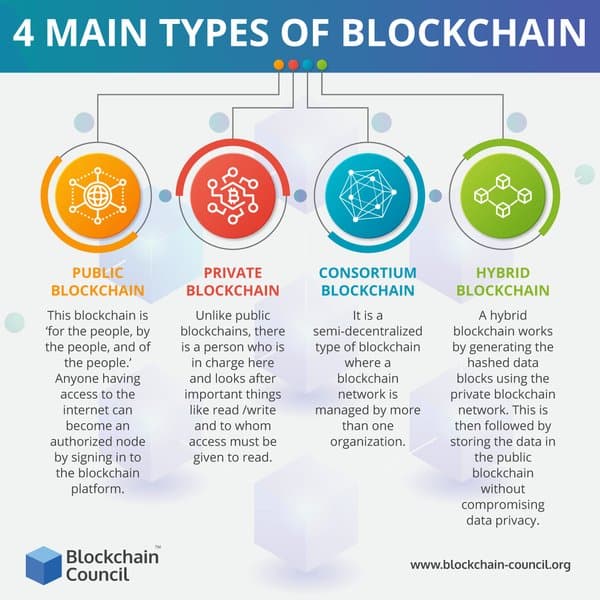
Infographics
4 Main Types of Blockchain
The two most common types of blockchains that we most often hear of are private blockchains and public blockchains. There are other variations such as the consortium and hybrid blockchains. Let us now understand each in detail.

Infographics
How Blockchain Works?
Blockchain works by recording transactions in blocks that are securely linked using cryptographic hashes. Each transaction is verified by network participants through consensus mechanisms before being added to an immutable ledger. This guide explains the blockchain process step by step, helping beginners understand how decentralized networks maintain transparency, security, and trust.

Infographics
What Is Blockchain?
Blockchain is a decentralized digital ledger that securely records transactions across a distributed network of computers. Known for its transparency, immutability, and security, blockchain powers cryptocurrencies, smart contracts, decentralized applications, and enterprise solutions. This beginner-friendly guide explains blockchain fundamentals, how it works, and its real-world applications.
Trending Articles
The Role of Blockchain in Ethical AI Development
How blockchain technology is being used to promote transparency and accountability in artificial intelligence systems.
Claude AI Tools for Productivity
Discover Claude AI tools for productivity to streamline tasks, manage workflows, and improve efficiency.
How to Install Claude Code
Learn how to install Claude Code on macOS, Linux, and Windows using the native installer, plus verification, authentication, and troubleshooting tips.