

Blockchain Voting Challenges and Solutions
 Suyash Raizada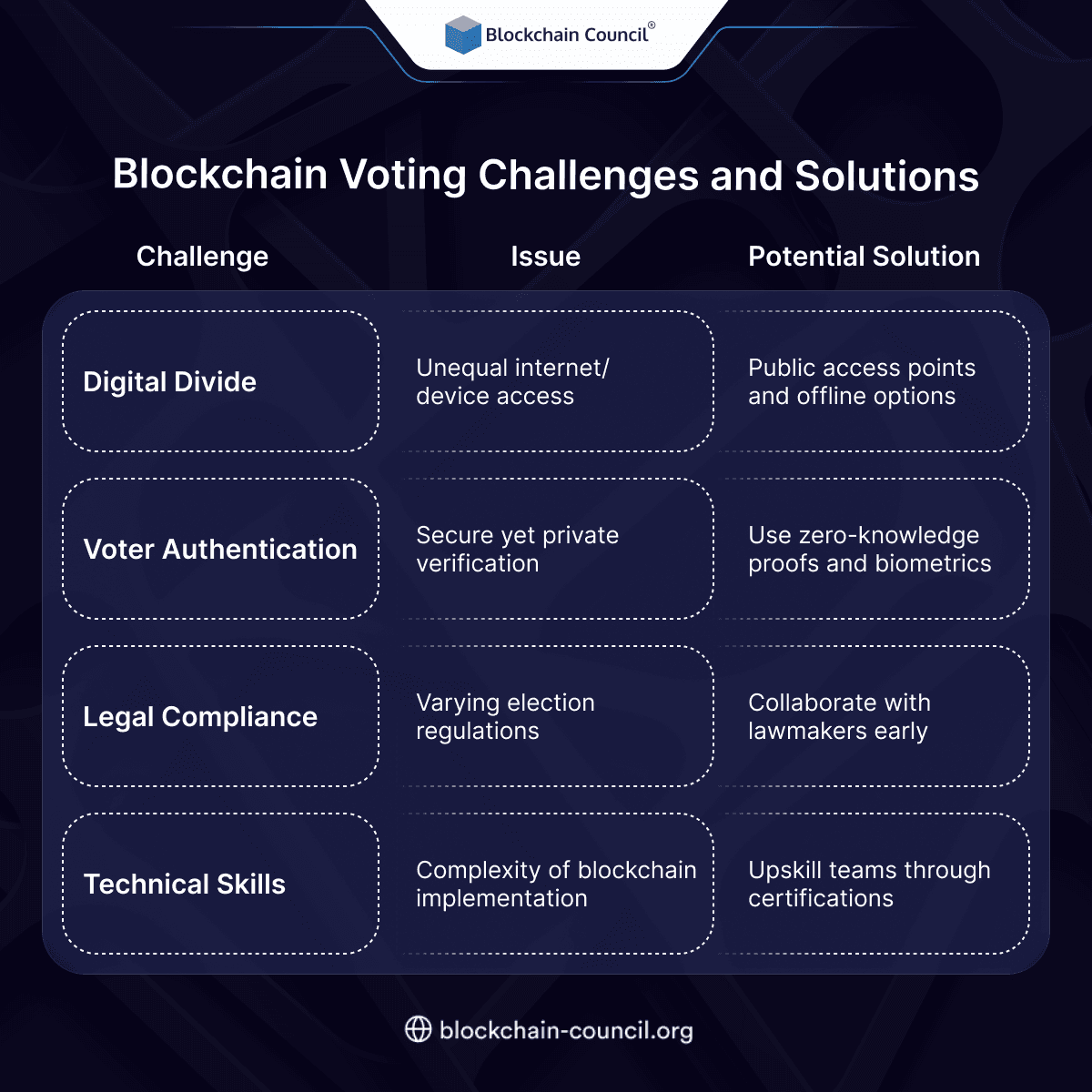
Blockchain voting challenges and solutions center on a difficult three-way balance: privacy (hiding the voter-vote link), coercion resistance (preventing vote-selling or forced voting), and end-to-end verifiability (E2E) (letting voters and observers verify the election outcome). Blockchain contributes to integrity through immutability and decentralized auditability, but it does not automatically solve voter privacy or coercion. Recent cryptographic and hybrid architectures demonstrate how these goals can be approached in practical deployments.
Why Blockchain Is Attractive for Elections
Electronic voting systems have historically struggled with centralized trust assumptions, audit complexity, and tampering concerns. A blockchain-based log can strengthen integrity by making recorded events difficult to alter without broad consensus, creating a durable audit trail for ballot casting and tallying activities.

However, elections are not purely a data integrity problem. A sound design must also protect secret ballots, limit information leakage, and remain usable for voters and election administrators alike.
Address challenges in blockchain-based voting systems such as security, scalability, and voter privacy by gaining expertise as a Certified Blockchain Expert, strengthening secure systems using Cyber security certifications, and promoting trust in digital governance via a Digital marketing course.
The Core Triangle: Privacy, Coercion Resistance, and Verifiability
Privacy (Unlinkability)
Privacy requires that no one - including insiders - can link a voter to a specific vote. In blockchain voting, this is difficult because ledgers are built for traceability. If ballots, credentials, or network metadata can be correlated, the voter-vote link may be reconstructed.
End-to-End Verifiability (E2E)
E2E verifiability allows:
Individual verifiability: a voter can confirm their ballot was recorded as cast.
Universal verifiability: anyone can check that all recorded ballots were tallied correctly.
The tension here is that verifiability often relies on receipts or proofs, which can become evidence of vote choice if not carefully designed.
Coercion Resistance
Coercion resistance aims to prevent a voter from proving how they voted, even if threatened or paid. This requirement is stronger than privacy alone. A system can be private yet still allow a voter to generate convincing proof of their vote, enabling vote-buying.
Practical Solutions in 2026-Era Designs
Modern research and prototypes increasingly rely on layered cryptography and hybrid ledgers. Rather than placing everything on a public chain, many systems use permissioned components and selectively anchor data to a public blockchain.
1) Zero-Knowledge Proofs for Private but Verifiable Tallies
Zero-knowledge proofs (ZKPs) allow a system to prove statements such as "this encrypted ballot is valid" or "the tally was computed correctly" without revealing the voter's selection. In ZKP-enabled blockchain architectures, these proofs can be applied to authentication, ballot validation, and tallying so that observers can audit correctness while individual votes remain secret.
What this solves:
Preserves ballot secrecy while enabling public auditability of tally correctness.
Reduces reliance on a central tallying authority.
What remains difficult: usability and operational complexity, particularly key management and the voter experience during verification steps.
2) Blind Signatures and Token-Based Eligibility
Blind signatures can validate voter eligibility without revealing the voter's identity to the ballot system. A voter obtains a signed token confirming eligibility, then uses it to cast a ballot anonymously. Several hybrid prototypes issue one-time tokens and provide receipts that confirm inclusion without exposing vote choice.
What this solves:
Separates identity verification from ballot casting to improve unlinkability.
Prevents double voting through one-time credentials.
3) Hybrid Blockchain Designs: Private Votes, Public Anchoring
Hybrid blockchain voting typically uses a private or permissioned chain to store encrypted ballots and election events, then anchors hashes or checkpoints to a public chain for tamper evidence. This approach combines operational control with external transparency.
Why this is practical:
Reduces privacy risks associated with fully public storage.
Improves performance and cost predictability compared with placing all election data on a public chain.
Still supports independent auditing through public anchors.
4) Revocable Anonymity and Coercion Recovery Mechanisms
A current design direction uses revocable anonymity in permissioned settings, paired with coercion safeguards such as allowing voters to override a coerced vote. The PVPBC approach, for example, combines distributed authorization with mechanisms inspired by coercion-resistant protocols and individual verifiability features such as code-vote tracking. The core idea is giving voters a safe path to recover from coercion without producing a receipt that proves their vote choice.
Tradeoff to manage: revocation and oversight mechanisms must be governed carefully to avoid introducing new trust weaknesses or dispute risks.
5) Biometric, Non-Transferable Credentials
Coercion and vote-selling often depend on transferring credentials. Biometric-based credentials can make voting rights harder to transfer and, when combined with privacy-preserving cryptography, can strengthen coercion resistance. The goal is not to expose biometric data on-chain, but to use biometric factors as a local, secure control for credential use.
Implementation Challenges Blocking Large-Scale Adoption
Despite successful proofs-of-concept, real elections introduce constraints that prototypes often underweight:
Usability and accessibility: verification steps must be optional, understandable, and inclusive for all voters.
Scalability: national elections require high throughput, robust DDoS resistance, and reliable availability.
Energy and consensus design: energy-efficient consensus and layer-2 scaling approaches are often necessary for viability.
Regulatory compliance: ballot secrecy requirements, audit rules, and dispute procedures vary significantly by jurisdiction.
Best-Practice Architecture for Real Deployments
For most organizations, the most realistic blueprint is a hybrid system with explicit cryptographic goals:
Permissioned ledger for election operations and encrypted ballot storage.
Public blockchain anchoring for tamper-evident checkpoints and audit transparency.
ZKPs for ballot validity and verifiable tallying without revealing individual votes.
Blind-signed eligibility tokens to separate identity verification from ballot casting.
Coercion mitigation via re-voting, override mechanisms, or non-transferable credentials.
Build transparent and tamper-proof voting systems using blockchain and cryptographic methods by mastering decentralized frameworks through a Blockchain Course, enhancing analytics via a machine learning course, and scaling adoption using an AI powered marketing course.
Conclusion
Blockchain voting challenges and solutions are defined by the need to satisfy privacy, coercion resistance, and end-to-end verifiability simultaneously. Blockchain strengthens integrity and auditing, but meaningful progress requires combining it with selective-privacy cryptography such as ZKPs, unlinkable eligibility via blind signatures, and practical hybrid architectures with public anchoring. The most promising direction is not maximal transparency, but selective transparency: verifiable outcomes, hidden voter choices, and credible defenses against coercion that function for real people under real-world constraints.
FAQs
1. What is blockchain voting?
Blockchain voting uses decentralized systems to conduct elections securely. It records votes immutably. This ensures transparency.
2. What are the main challenges of blockchain voting?
Challenges include security risks, scalability issues, and voter privacy concerns. Technical complexity is also a barrier. Adoption is still limited.
3. How does blockchain improve voting transparency?
Votes are recorded on an immutable ledger. This prevents tampering. It builds trust.
4. What are security risks in blockchain voting?
Risks include hacking attempts and smart contract vulnerabilities. System failures can also occur. Proper safeguards are needed.
5. How can blockchain voting ensure voter privacy?
Encryption and anonymity techniques protect voter identity. This ensures confidentiality. Privacy is maintained.
6. What scalability issues exist in blockchain voting?
Large-scale elections require high transaction capacity. Current systems may face limitations. Improvements are needed.
7. How can smart contracts improve voting systems?
They automate vote counting and verification. This reduces errors. It improves efficiency.
8. What are solutions to blockchain voting challenges?
Solutions include improved encryption, scalable networks, and audits. Education and regulation also help. These improve reliability.
9. Can blockchain voting prevent fraud?
Yes, it reduces fraud through transparency and immutability. Tampering is difficult. It enhances trust.
10. What role does identity verification play?
Secure identity verification ensures only eligible voters participate. This prevents duplication. It improves accuracy.
11. Are blockchain voting systems widely used?
Adoption is still limited but growing. Pilot projects are ongoing. Future use is expected.
12. What are legal challenges in blockchain voting?
Regulatory frameworks are still evolving. Compliance can be complex. This affects adoption.
13. How does blockchain improve vote counting?
Votes are counted automatically and accurately. This reduces human error. Results are faster.
14. Can blockchain voting be hacked?
While secure, vulnerabilities can exist in implementation. Proper security measures reduce risks. Continuous monitoring is needed.
15. What is the cost of implementing blockchain voting?
Initial costs can be high due to infrastructure requirements. Long-term benefits include efficiency. Cost may reduce over time.
16. How does blockchain ensure data integrity in voting?
Data cannot be altered once recorded. This ensures accuracy. It builds trust.
17. What is the future of blockchain voting?
It will grow with improved technology and regulations. Adoption will increase. It may become mainstream.
18. How can governments adopt blockchain voting?
Governments can start with pilot programs. Gradual implementation is recommended. Collaboration with experts helps.
19. What are the benefits of blockchain voting?
Benefits include transparency, security, and efficiency. It reduces fraud. It improves trust.
20. Why is blockchain voting important?
It enhances democratic processes through secure systems. It ensures fairness. It supports digital governance.
Related Articles
View All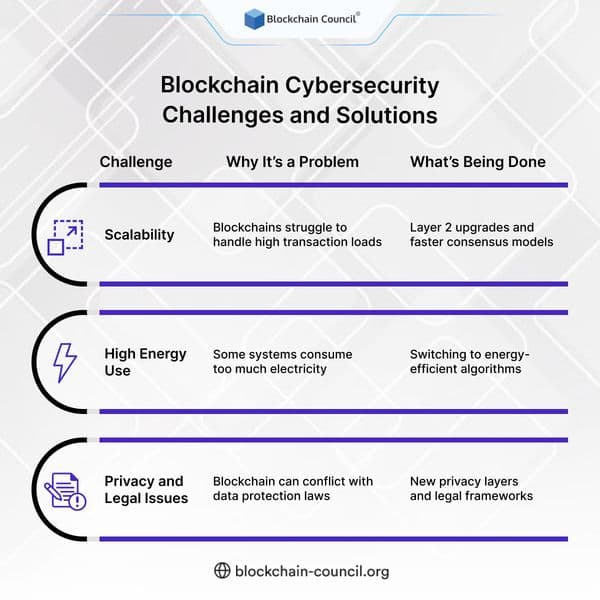
Infographics
Blockchain Cybersecurity Challenges and Solutions
Learn the top blockchain cybersecurity challenges, including key theft, 51% attacks, bridge hacks, and smart contract bugs, plus practical controls to reduce risk.
Infographics
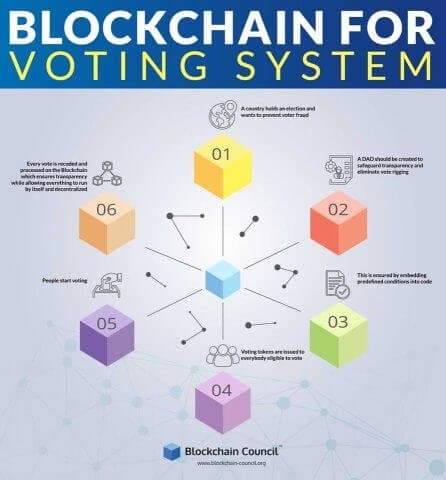
Blockchain For Voting System
The blockchain protocol is a means of logging and verifying records that is transparent and distributed among users. Usually, votes are recorded, managed, counted and checked by a central authority. Blockchain-enabled e-voting (BEV) would empower voters to do these tasks themselves, by allowing…
Infographics
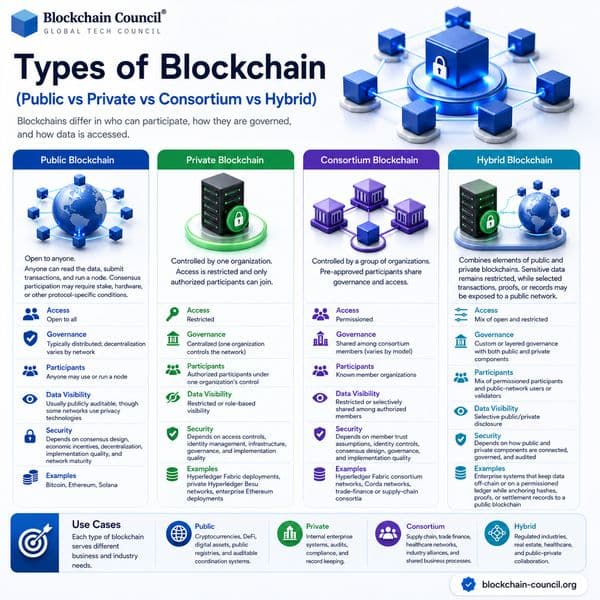
Types of Blockchain
Blockchain networks come in different forms, each designed to meet specific business and technical requirements. From fully decentralized public blockchains to permissioned private and consortium networks, understanding the different types of blockchain helps organizations choose the right solution for security, scalability, governance, and performance.
Trending Articles
AWS Career Roadmap
A step-by-step guide to building a successful career in Amazon Web Services cloud computing.

Top 5 DeFi Platforms
Explore the leading decentralized finance platforms and what makes each one unique in the evolving DeFi landscape.

Can DeFi 2.0 Bridge the Gap Between Traditional and Decentralized Finance?
The next generation of DeFi protocols aims to connect traditional banking with decentralized finance ecosystems.