

The Mythos Leak: What It Means for AI Security
 Suyash Raizada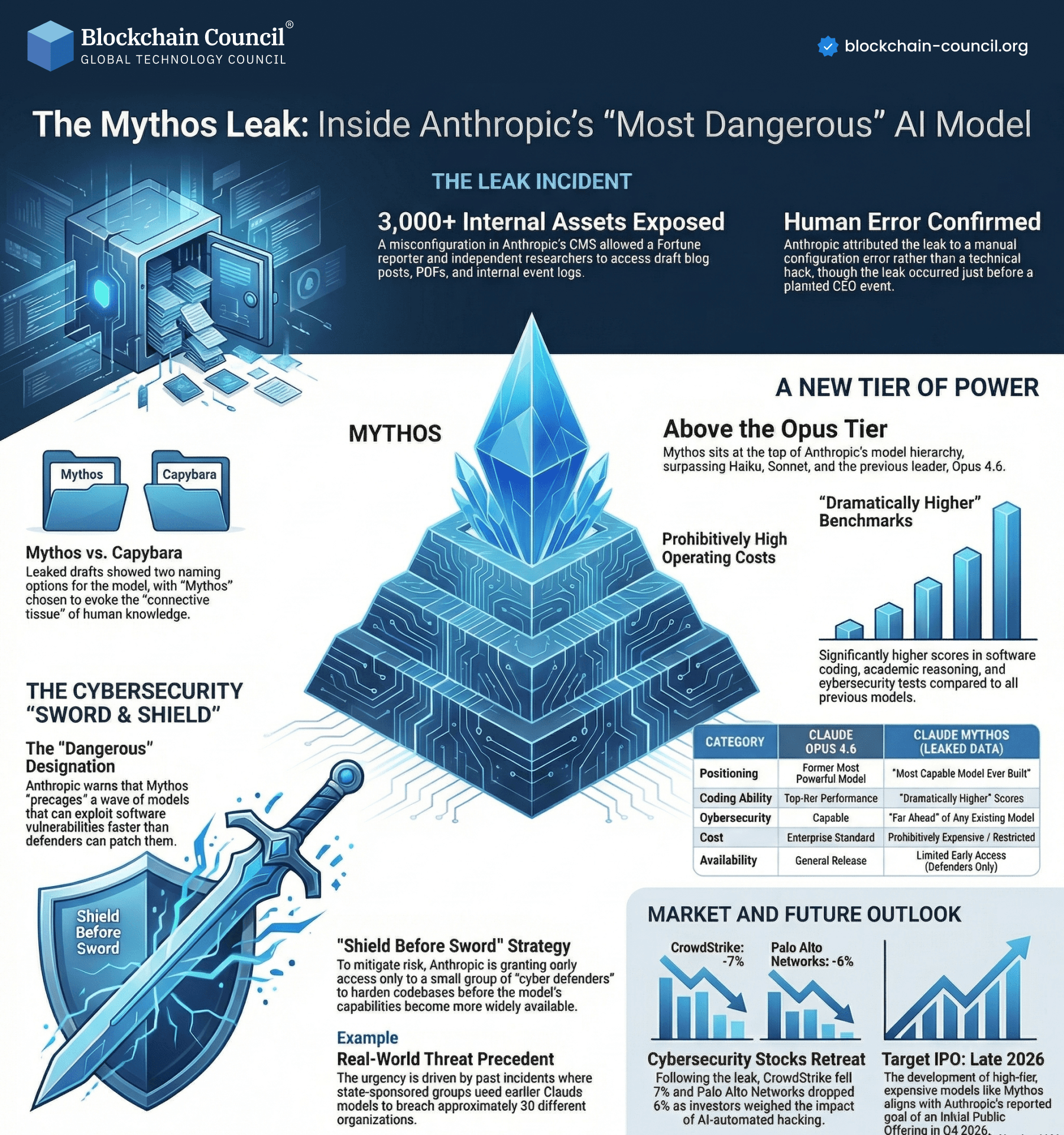
The Mythos leak highlights critical risks in advanced AI systems, exposing over 3,000 internal assets due to configuration errors.
Incidents like the Mythos leak highlight how critical AI security has become-build your expertise with an AI Security Certification, strengthen your technical skills using a Python Course, and understand real-world risk implications through an AI powered marketing course.

What Happened
Internal assets exposed
Caused by human error
Not a direct hack
Why It Matters
Shows vulnerability in AI infrastructure
Highlights importance of configuration security
Raises concerns about powerful AI models
Key Insight
The biggest risk in AI systems is often human error, not technology failure.
AI Power and Risks
Higher performance models
Increased cybersecurity risks
Expensive infrastructure
Industry Impact
Increased focus on AI governance
Adoption of “shield before sword” strategies
Restricted access to powerful models
Learning Perspective
To understand AI security:
Learn system design via an Agentic AI Course
Build technical skills with a Python Course
Explore real-world implications through an AI powered marketing course
Final Thoughts
AI advancement must be balanced with security and responsibility.
To stay ahead of emerging AI threats and vulnerabilities, combine security and AI knowledge with an AI Security Certification, deepen your understanding via a machine learning course, and explore adoption strategies through a Digital marketing course.
FAQS
What is the Mythos Leak in AI?
The Mythos Leak refers to a large-scale exposure of sensitive AI datasets, model logs, or internal prompts that revealed vulnerabilities in AI systems.How did the Mythos Leak occur?
It likely occurred due to misconfigured storage, insecure APIs, or lack of access controls in AI infrastructure.What type of data was exposed?
Training datasets, prompts, user interactions, and possibly proprietary model logic were exposed.Why is it significant?
It highlights major weaknesses in AI security and shows how sensitive AI data can be exploited.Which industries are affected?
Finance, healthcare, defense, and tech-basically any sector using AI at scale.How does it impact AI model training?
Leaked data can be reused to replicate or attack models, reducing competitive advantage.Can leaked datasets be misused?
Yes, attackers can retrain models or extract sensitive patterns.What is prompt injection risk?
It’s when attackers manipulate AI inputs to override instructions or extract data.Impact on enterprises?
It reduces trust and slows AI adoption due to security concerns.Role of data governance?
Strong governance ensures proper access, storage, and usage controls.How to secure AI pipelines?
Use encryption, access controls, and continuous monitoring.Legal implications?
Companies may face fines under data protection laws.Impact on privacy?
User data exposure can lead to identity and financial risks.Developer lessons?
Never expose logs, secure APIs, and validate inputs.What is zero-trust in AI?
A model where no system or user is trusted by default.Detection tools?
SIEM, EDR, and AI monitoring tools can detect anomalies.Regulatory impact?
Governments may enforce stricter AI compliance laws.Long-term risks?
Model theft, misuse, and loss of trust.Open-source risk?
It increases transparency but also exposure if mismanaged.Prevention tips?
Regular audits, secure infrastructure, and strong policies.
Related Articles
View All
Infographics
Digital Asset Security: Protecting Your Assets in the Decentralized World
As digital assets become increasingly valuable, securing them is more important than ever. From cryptocurrencies and NFTs to tokenized assets, effective security measures such as private key management, multi-factor authentication, hardware wallets, and threat awareness help safeguard investments in the decentralized world. This guide explores essential digital asset security practices, common risks, and strategies for protecting blockchain-based assets.

Infographics
Security Tokens vs Utility Tokens
Security tokens vs utility tokens: learn the key differences, how the 2026 SEC and CFTC token taxonomy and EU rules treat each type, how the Howey test works, and a simple checklist for evaluating any token.
Infographics
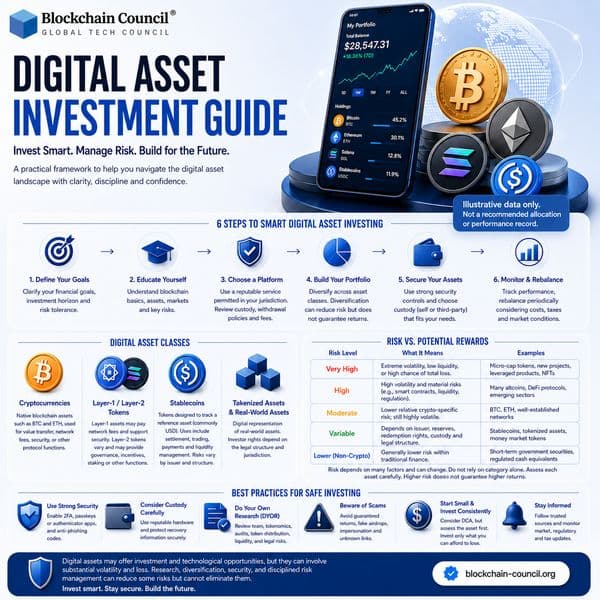
Digital Asset Investment Guide: Build a Smarter Strategy for the Future of Finance
Digital asset investing has become a key part of the modern financial landscape, offering opportunities in cryptocurrencies, tokenized assets, NFTs, and blockchain-based investments. Whether you're a beginner or an experienced investor, understanding market fundamentals, diversification, security, and risk management is essential for building a successful digital asset portfolio. This guide explores the core concepts, investment strategies, and best practices for navigating the digital asset market.
Trending Articles
AWS Career Roadmap
A step-by-step guide to building a successful career in Amazon Web Services cloud computing.
What is AWS? A Beginner's Guide to Cloud Computing
Everything you need to know about Amazon Web Services, cloud computing fundamentals, and career opportunities.
Claude AI Tools for Productivity
Discover Claude AI tools for productivity to streamline tasks, manage workflows, and improve efficiency.