

RealDID in Digital Ecosystems
 Michael Willson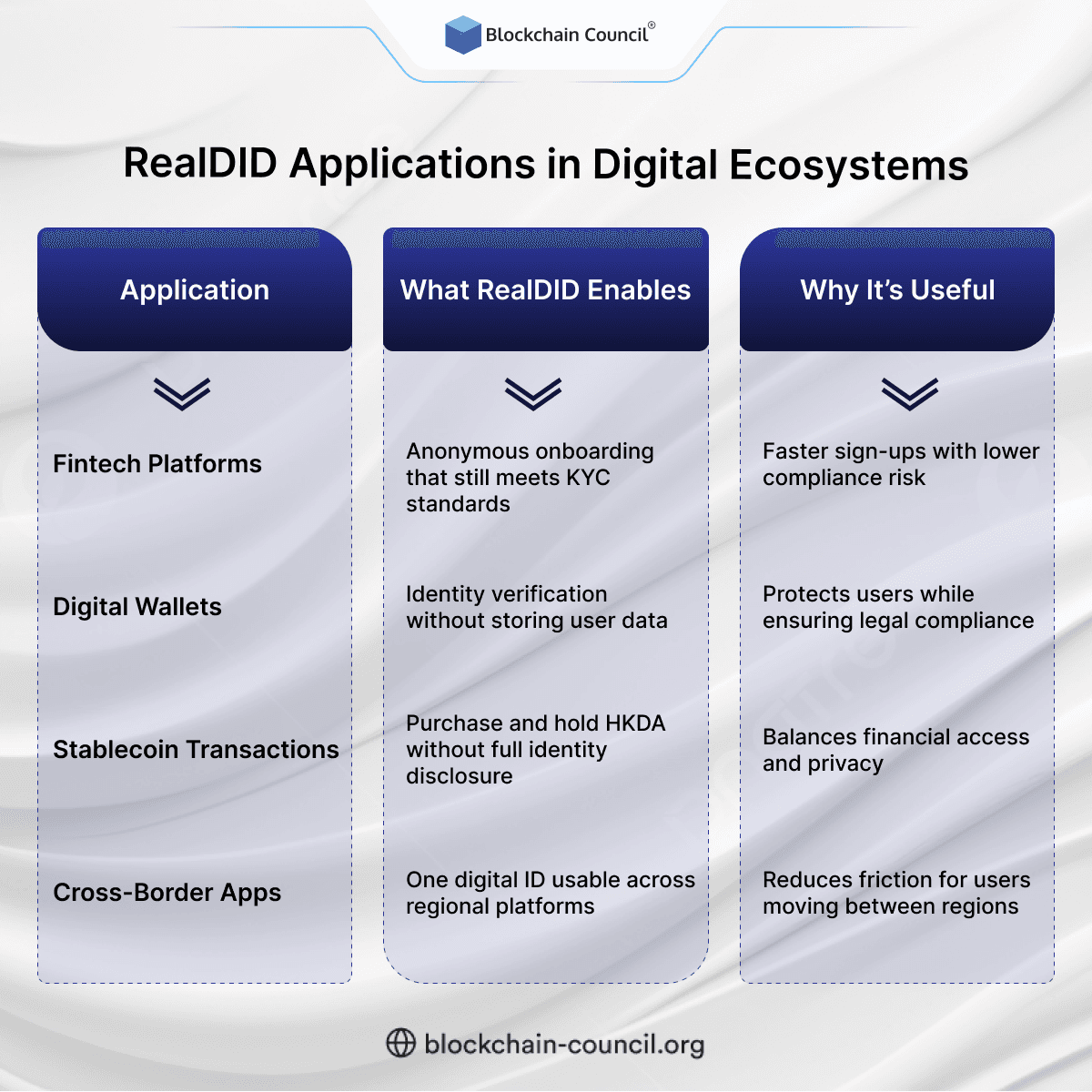
RealDID in digital ecosystems is emerging as a practical model for privacy-preserving identity verification at scale. Developed by China's Ministry of Public Security on the Blockchain-based Service Network (BSN), RealDID is a government-backed decentralized identity (DID) system. Its core value proposition is straightforward: enable secure verification and regulatory compliance without exposing sensitive personal data such as names or national ID numbers.
As decentralized identity and Self-Sovereign Identity (SSI) mature globally, RealDID demonstrates how government-backed DID can coexist with Web3 identity frameworks, reusable KYC processes, IoT device identity, and enterprise access control. The following is a use case-driven analysis of where RealDID and DID patterns fit across modern digital services.

Explore RealDID applications for secure identity verification and decentralized authentication by mastering identity systems as a Certified Blockchain Expert, enhancing implementation with a Python certification, and scaling identity solutions via a Digital marketing course.
What RealDID Is and How It Works
RealDID is a decentralized identity approach that relies on cryptographic proofs, typically using public-private key pairs, to let a user prove eligibility or identity attributes without revealing the underlying personal data. This aligns with core SSI concepts:
DIDs as unique identifiers controlled by users or entities
Verifiable credentials (VCs) for tamper-evident attestations (for example, age, residency, or professional accreditation)
Identity wallets for storing credentials and selectively disclosing attributes
SSI is increasingly recognized as a strong identity layer for Web3 because it reduces reliance on centralized databases and passwords, lowering breach risk while improving user control and supporting privacy-by-design compliance requirements.
Current State: Mainland Deployment and Hong Kong Pilot
RealDID is live in mainland China and is in a pilot phase in Hong Kong as of 2026. The Hong Kong expansion is designed to allow mainland users to access Hong Kong digital services through blockchain-based IDs without sharing sensitive personal data. One notable application area is stablecoin payments and financial services, where compliance checks can be satisfied while limiting unnecessary data disclosure.
This approach also helps businesses reduce long-term storage of personal data, which can simplify operational risk management under data protection obligations. Financial services stakeholders in Hong Kong have emphasized the role of digital identity in accelerating secure transactions and supporting broader digital transformation goals.
Use Cases Across Digital Ecosystems
1. Web3 Identity: Eligibility, Reputation, and Human Verification
Web3 has traditionally treated a wallet as an identity proxy, but wallets alone do not address compliance, uniqueness, or reputation requirements. DIDs and VCs add an identity layer that can be reused across decentralized applications and communities.
DAO access and governance: prove membership or eligibility, including one-person-one-vote patterns where uniqueness is a requirement.
DeFi onboarding: present reusable KYC credentials to access regulated liquidity pools without resubmitting documents.
NFT drops and auctions: verify human participation or uniqueness to reduce bot activity and improve fairness.
Reputation and attestations: use credentials to prove contributions, roles, or certifications within community trust frameworks.
Projects across the broader DID ecosystem, including credential-based wallet login tools, demonstrate how VCs can support membership, reputation, and eligibility checks without requiring platforms to collect more personal data than necessary.
2. KYC and Reusable Verification: Faster Onboarding with Less Exposure
Traditional KYC is repetitive, slow, and costly. Users must resubmit the same documents across multiple services, while providers accumulate sensitive datasets that become breach targets. DID-based models address these pain points by enabling reusable verification.
Reusable KYC: a user can present a credential already verified by a trusted issuer, eliminating repeated onboarding steps.
Selective disclosure: only the required attributes are shared (for example, confirming "over 18" rather than a full date of birth).
Cross-border access: credentials can support access to services across jurisdictions when appropriate governance frameworks are aligned.
In the RealDID context, the Hong Kong pilot is linked to financial platforms and stablecoin transactions where KYC requirements must be satisfied without excessive data sharing. Global platforms have similarly advanced reusable identity verification for financial services, while DID providers continue to build wallet-first verification flows for Web3 environments.
3. IoT Identity: Trusted Device Pairing and Lifecycle Access
IoT ecosystems require device identity that persists across manufacturers, networks, and service providers. Blockchain-based identity primitives help establish tamper-evident device identifiers and cryptographic proofs.
Secure device onboarding: pair a device to a system using cryptographic signatures rather than shared passwords or static credentials.
Service authorization: grant time-bound or role-bound access to maintenance providers, applications, or operators.
Anti-tamper verification: validate device provenance and configuration changes using signed proofs.
Enterprise blockchain research consistently highlights that tamper-resistant identity infrastructure can unify fragmented IoT identity and access workflows, particularly when devices must interoperate across multiple vendors and operational environments.
4. Enterprise Access Control: Lower Friction, Stronger Governance
Enterprises need identity systems that work across employees, partners, contractors, and customers, often spanning multiple regions and regulatory regimes. DID-based access control supports attribute-based authorization decisions while reducing unnecessary data collection.
Partner and vendor onboarding: verify business credentials, certifications, or authorized signatories without collecting full identity records.
Gated services: restrict access to regulated products, token sales, or enterprise portals using credential-based checks.
Compliance-friendly data minimization: verify eligibility without storing personally identifiable information across every system.
RealDID's cross-border direction is particularly relevant here, since enterprise access control depends on verifying specific facts rather than accumulating additional personally identifiable information.
Implementation Considerations for Teams
Adopting RealDID-style DID patterns requires alignment across technology and governance layers:
Credential issuance and trust: define who issues VCs, and what audit or assurance level each credential requires.
Interoperability: choose standards-based, ledger-agnostic designs so credentials can be reused across different ecosystems.
Privacy engineering: apply selective disclosure mechanisms and minimize correlation risk across services.
Security roadmap: evaluate biometrics for local authentication and monitor post-quantum cryptography readiness.
Build privacy-focused digital identity solutions using RealDID and decentralized frameworks by gaining expertise through a Blockchain Course, strengthening security using Cyber security certifications, and promoting Web3 identity platforms via an AI powered marketing course.
Why RealDID Matters for the Next Identity Layer
RealDID in digital ecosystems reflects a broader shift: identity is moving from centralized databases toward cryptographic proof and selective disclosure. With mainland deployment active and a Hong Kong pilot tied to digital services and compliant financial flows, RealDID illustrates how government-backed DID can support privacy-preserving access while reducing data exposure for both users and businesses.
Across Web3 identity, reusable KYC, IoT device management, and enterprise access control, the objective is consistent: verify what is necessary, share as little as possible, and treat compliance and user experience as compatible goals rather than competing ones.
FAQs
1. What is RealDID in digital ecosystems?
RealDID refers to decentralized digital identity systems that verify real-world identities securely. It uses blockchain to ensure authenticity and privacy. It is a key component of modern digital ecosystems.
2. How does RealDID work?
RealDID uses cryptographic verification and decentralized storage. Users control their identity data. This reduces reliance on centralized systems.
3. Why is RealDID important?
It enhances security and reduces identity fraud. Users maintain control over personal data. This builds trust in digital systems.
4. How does RealDID improve privacy?
RealDID allows selective data sharing without exposing full identity details. It uses encryption for protection. This ensures user privacy.
5. What industries use RealDID?
Industries like finance, healthcare, and government use RealDID. It helps in identity verification and compliance. Adoption is growing rapidly.
6. How does RealDID prevent identity theft?
It uses secure blockchain-based verification. Unauthorized access is difficult. This reduces identity fraud risks.
7. What is self-sovereign identity in RealDID?
Self-sovereign identity means users control their own data. They decide what information to share. This empowers individuals.
8. How does RealDID support digital transactions?
It enables secure identity verification for transactions. This reduces fraud and errors. It improves trust.
9. Can RealDID replace traditional identity systems?
It has the potential to replace centralized systems. However, adoption is still growing. Integration is ongoing.
10. What role does blockchain play in RealDID?
Blockchain ensures secure and tamper-proof identity records. It provides transparency and trust. This is essential for RealDID.
11. Is RealDID secure?
Yes, it uses advanced cryptography and decentralization. This makes it highly secure. Proper implementation is important.
12. How does RealDID improve user experience?
It simplifies identity verification processes. Users avoid repetitive documentation. This improves convenience.
13. What are the challenges of RealDID adoption?
Challenges include regulatory issues and integration complexity. User awareness is also limited. These factors slow adoption.
14. How does RealDID support compliance?
It provides verifiable identity records for audits. This helps meet regulatory requirements. It simplifies compliance processes.
15. Can RealDID be used globally?
Yes, it supports cross-border identity verification. It enables global digital interactions. This is beneficial for international systems.
16. What is the role of AI in RealDID?
AI enhances identity verification and fraud detection. It improves system accuracy. It supports scalability.
17. How does RealDID impact Web3?
RealDID is essential for secure Web3 identity systems. It enables decentralized authentication. This supports Web3 growth.
18. Are RealDID systems user-friendly?
Modern solutions focus on ease of use. Interfaces are becoming more intuitive. This improves adoption.
19. What is the future of RealDID?
RealDID will become a standard for digital identity. Adoption will increase across industries. It will shape digital ecosystems.
20. Why is RealDID important for digital ecosystems?
It ensures secure and trusted identity verification. It reduces fraud and improves efficiency. It is a foundation for digital transformation.
Related Articles
View All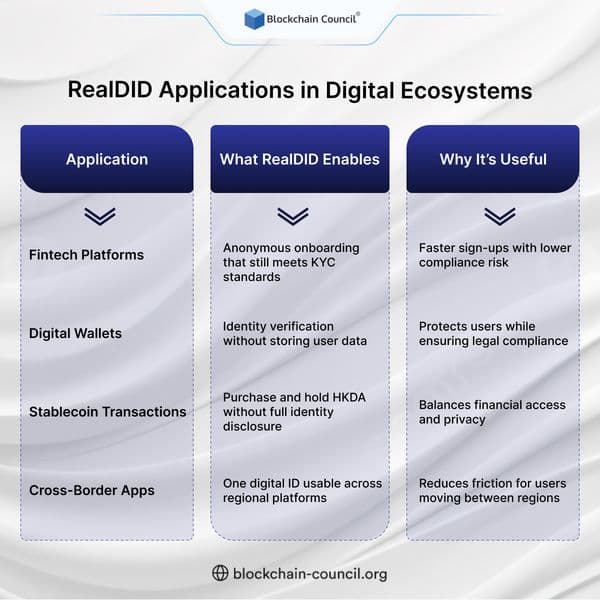
Infographics
RealDID Applications in Digital Ecosystems
Explore RealDID applications in digital ecosystems and how decentralized identity improves security, privacy, and user control.
Infographics
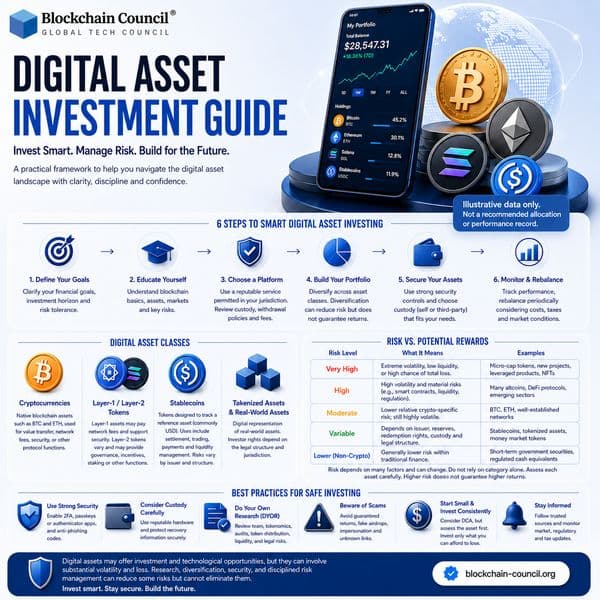
Digital Asset Investment Guide: Build a Smarter Strategy for the Future of Finance
Digital asset investing has become a key part of the modern financial landscape, offering opportunities in cryptocurrencies, tokenized assets, NFTs, and blockchain-based investments. Whether you're a beginner or an experienced investor, understanding market fundamentals, diversification, security, and risk management is essential for building a successful digital asset portfolio. This guide explores the core concepts, investment strategies, and best practices for navigating the digital asset market.

Infographics
Digital Asset Trading: A Complete Guide to Trading in the Digital Economy
Digital asset trading involves buying, selling, and exchanging cryptocurrencies, tokenized assets, NFTs, and other blockchain-based assets through centralized and decentralized trading platforms. As the digital economy expands, traders rely on market analysis, risk management, and advanced trading tools to navigate volatile markets. This guide explains the fundamentals of digital asset trading, key strategies, security considerations, and emerging trends shaping the future of digital finance.
Trending Articles
The Role of Blockchain in Ethical AI Development
How blockchain technology is being used to promote transparency and accountability in artificial intelligence systems.
AWS Career Roadmap
A step-by-step guide to building a successful career in Amazon Web Services cloud computing.

Top 5 DeFi Platforms
Explore the leading decentralized finance platforms and what makes each one unique in the evolving DeFi landscape.