

RealDID Applications in Digital Ecosystems
 Michael Willson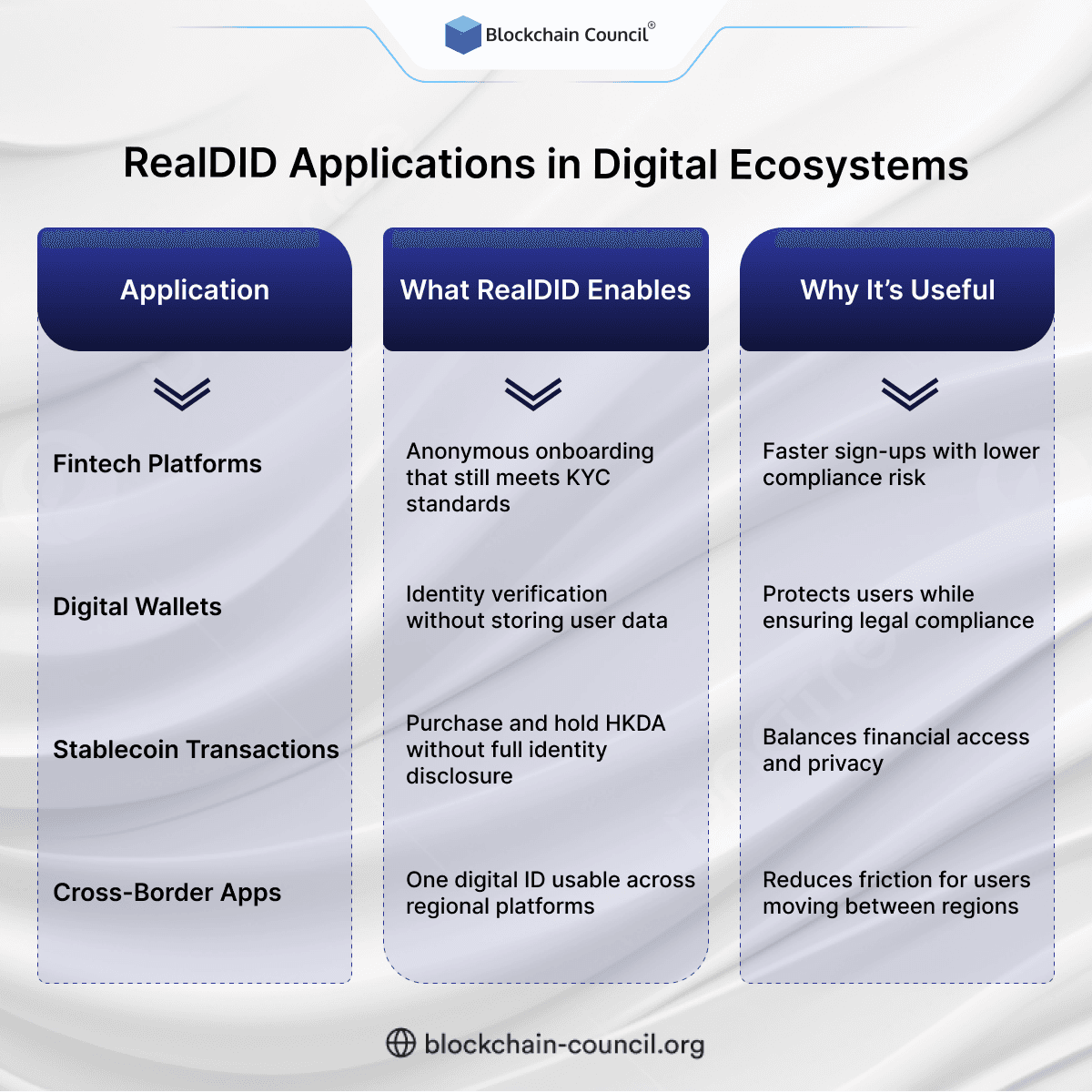
RealDID applications are emerging as a practical model for verifiable identity across Web3, IoT, and enterprise access control. As of 2026, RealDID is operational in mainland China and in a pilot phase in Hong Kong, reflecting a government-backed approach to decentralized identity that prioritizes privacy and user control while supporting regulated digital services.
At a technical level, RealDID uses cryptographic proofs, typically public-private key pairs, to let users prove identity attributes without exposing underlying personal data. This aligns with widely adopted Self-Sovereign Identity (SSI) building blocks: decentralized identifiers (DIDs) as user-controlled identifiers, verifiable credentials (VCs) as tamper-evident attestations, and identity wallets that enable selective disclosure.

Explore how RealDID enables secure, decentralized identity verification across digital ecosystems by mastering identity frameworks as a Certified Blockchain Expert, implementing authentication systems with a Python certification, and scaling identity solutions via a Digital marketing course.
What RealDID Enables in Modern Digital Ecosystems
RealDID is designed to verify only what is necessary, share as little as possible, and treat compliance and user experience as compatible goals. Its capabilities support identity verification without turning every login or onboarding event into a full data-sharing exercise.
Core RealDID Features
Real-name confirmation to verify the authenticity of personal data generated online
Data encryption flow to bind personal identity to data for secure cross-platform transmission
Privacy-protected login to allow anonymous registration while still meeting real-name management requirements
Custom business DID so enterprises can establish their own decentralized identifiers
Identity certificate services that provide verifiable attestations of identity attributes
A core operating principle is that citizens retain control over which information is disclosed, while enterprises can access only limited, necessary attributes through privacy-focused flows. This maps directly to privacy-by-design expectations and data minimization practices in enterprise governance.
RealDID Applications in Web3: Eligibility, Reputation, and Human Verification
Web3 commonly treats a wallet address as an identity proxy, but wallets alone do not solve uniqueness, compliance, or reputation. RealDID-based identity layers can provide reusable credentials that are presented across decentralized applications without repeatedly exposing personal data.
High-Impact Web3 Use Cases
DAO access and governance: prove membership or eligibility and support one-person-one-vote patterns where uniqueness is required
DeFi onboarding: present reusable KYC credentials to access regulated pools without resubmitting documents to every platform
NFT drops and auctions: verify human participation and uniqueness to reduce bot activity and improve fairness
Reusable KYC: Faster Onboarding with Selective Disclosure
Traditional KYC is repetitive, expensive, and slow, and it pushes sensitive documents into multiple databases that become breach targets. RealDID supports selective disclosure, where a user can prove a specific attribute without sharing full personal records. A service requiring age verification, for example, needs only a credential confirming over 18 rather than a complete date of birth and ID scan.
Reusable KYC further reduces friction by allowing users to present credentials already verified by trusted issuers. This is particularly relevant for cross-border service access when governance frameworks align. The Hong Kong pilot aims to let mainland users access Hong Kong digital services using blockchain-based IDs without sharing sensitive personal data, with reported target scenarios including stablecoin payments and regulated financial services.
RealDID Applications for IoT: Device Identity and Lifecycle Access
IoT security and governance frequently fail at the identity layer. Devices move across manufacturers, networks, and service providers, and shared secrets such as static passwords do not scale. Blockchain-based identity primitives can provide tamper-evident device identifiers and cryptographic proofs across the full device lifecycle.
IoT Identity Patterns Enabled by Verifiable Credentials
Secure device onboarding: pair devices using cryptographic signatures rather than shared passwords
Service authorization: grant time-bound or role-bound access to maintenance providers, applications, or operators
Anti-tamper verification: validate provenance and configuration changes using signed proofs
Enterprise Access Control: Lower Friction with Stronger Governance
Enterprises operating across regions and regulatory regimes need authorization that is attribute-based while minimizing unnecessary data collection. RealDID applications support credential-based checks that can reduce data sprawl and improve auditability.
Enterprise-Ready Scenarios
Partner and vendor onboarding: verify business credentials, certifications, or authorized signatories without collecting full identity records across every system
Gated services: restrict access to regulated products, token sales, or enterprise portals using credential-based eligibility checks
Compliance-aligned minimization: verify eligibility without storing personally identifiable information in each connected system
This approach reflects SSI's broader value proposition: fewer centralized password databases, reduced breach risk, and improved user control, while still satisfying compliance requirements when implemented with appropriate governance frameworks and trusted credential issuers.
Build privacy-first digital identity systems using RealDID and decentralized protocols by gaining expertise through a Blockchain Course, strengthening security through Cyber security certifications, and promoting Web3 identity platforms using an AI powered marketing course.
Outlook: Privacy-First Identity as Digital Infrastructure
RealDID's expansion reflects growing institutional interest in blockchain-based identity as core infrastructure for the digital economy and the circulation of national data assets. If the Hong Kong pilot succeeds, similar frameworks are expected to influence rollouts in other regions, with governments, financial institutions, and Web3 companies monitoring the results closely.
RealDID applications point toward a practical direction for verifiable identity: credentials that can be reused across ecosystems, privacy-preserving proofs that limit data exposure, and governance frameworks that treat compliance as an enabler rather than a constraint. For builders and enterprises, the actionable next step is designing credential schemas, issuer trust models, and wallet-based UX that can operate reliably across Web3, IoT, and enterprise access control environments.
FAQs
1. What are RealDID applications in digital ecosystems?
RealDID applications involve using decentralized identity systems for secure verification across platforms. They allow users to manage their identities digitally. This improves trust and efficiency in online interactions.
2. How is RealDID used in financial services?
RealDID enables secure identity verification for banking and fintech platforms. It reduces fraud and speeds up onboarding. This improves compliance with regulations.
3. Can RealDID be used in healthcare systems?
Yes, RealDID helps securely store and share patient data. It ensures privacy and accuracy. This improves healthcare delivery.
4. How does RealDID support e-commerce platforms?
RealDID verifies user identities and prevents fraud in transactions. It enhances trust between buyers and sellers. This improves customer experience.
5. What role does RealDID play in government services?
Governments use RealDID for digital identity verification and service access. It reduces paperwork and fraud. This improves efficiency.
6. How is RealDID used in education systems?
RealDID verifies academic credentials and certifications. It prevents fake degrees. This ensures authenticity in education.
7. Can RealDID improve digital payments?
Yes, it ensures secure identity verification during transactions. This reduces fraud risks. It enhances payment security.
8. What is the role of RealDID in Web3 platforms?
RealDID enables decentralized identity management in Web3. It allows users to control their data. This supports trustless systems.
9. How does RealDID enhance user privacy?
Users share only necessary information using encryption. Full identity details are not exposed. This ensures privacy.
10. Can RealDID be used in social media platforms?
Yes, it helps verify real users and reduce fake accounts. It improves trust and safety. This enhances platform integrity.
11. What is the role of blockchain in RealDID applications?
Blockchain stores identity data securely and immutably. It ensures transparency and trust. This is essential for RealDID systems.
12. How does RealDID support digital wallets?
It integrates identity verification into digital wallets. This simplifies transactions. It improves user convenience.
13. Can RealDID improve cybersecurity?
Yes, it reduces identity-based attacks and fraud. Secure verification enhances protection. It strengthens digital security.
14. How does RealDID benefit businesses?
Businesses gain secure customer verification and reduced fraud. It improves operational efficiency. This enhances trust.
15. What challenges exist in RealDID applications?
Challenges include regulatory compliance and integration complexity. User adoption is also a concern. These need to be addressed.
16. Can RealDID support cross-border identity verification?
Yes, it enables global identity verification. This supports international transactions. It improves accessibility.
17. How does RealDID improve onboarding processes?
It simplifies identity verification for new users. This reduces time and effort. It improves user experience.
18. What is the future of RealDID applications?
RealDID will expand across industries and platforms. Adoption will increase globally. It will shape digital ecosystems.
19. Can RealDID replace passwords?
Yes, it can reduce reliance on passwords through secure identity verification. This improves security. It simplifies access.
20. Why are RealDID applications important?
They enhance security, privacy, and efficiency in digital ecosystems. They reduce fraud and improve trust. They are essential for digital transformation.
Related Articles
View All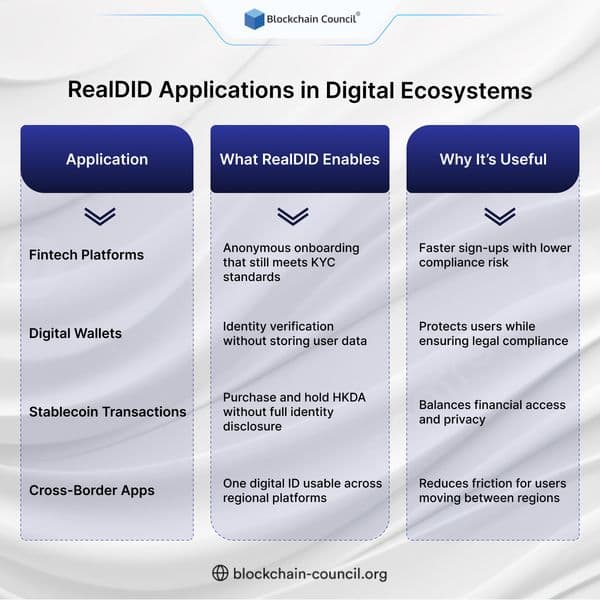
Infographics
RealDID in Digital Ecosystems
RealDID brings government-backed decentralized identity to Web3, reusable KYC, IoT, and enterprise access control with privacy-preserving verification.
Infographics
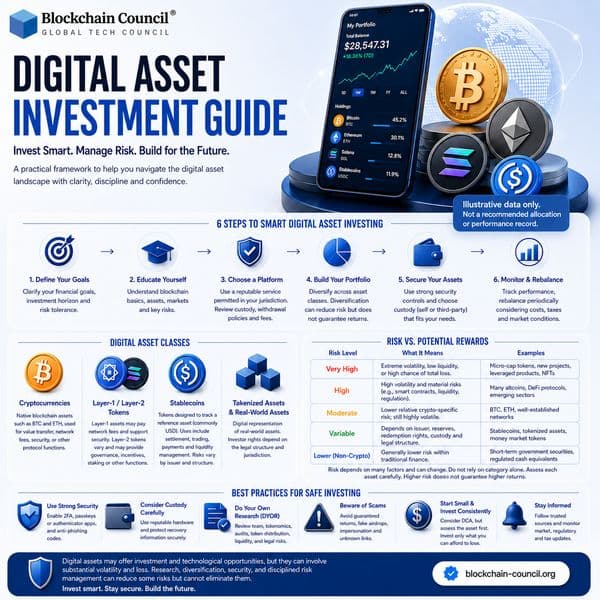
Digital Asset Investment Guide: Build a Smarter Strategy for the Future of Finance
Digital asset investing has become a key part of the modern financial landscape, offering opportunities in cryptocurrencies, tokenized assets, NFTs, and blockchain-based investments. Whether you're a beginner or an experienced investor, understanding market fundamentals, diversification, security, and risk management is essential for building a successful digital asset portfolio. This guide explores the core concepts, investment strategies, and best practices for navigating the digital asset market.

Infographics
Digital Asset Trading: A Complete Guide to Trading in the Digital Economy
Digital asset trading involves buying, selling, and exchanging cryptocurrencies, tokenized assets, NFTs, and other blockchain-based assets through centralized and decentralized trading platforms. As the digital economy expands, traders rely on market analysis, risk management, and advanced trading tools to navigate volatile markets. This guide explains the fundamentals of digital asset trading, key strategies, security considerations, and emerging trends shaping the future of digital finance.
Trending Articles

Can DeFi 2.0 Bridge the Gap Between Traditional and Decentralized Finance?
The next generation of DeFi protocols aims to connect traditional banking with decentralized finance ecosystems.
Claude AI Tools for Productivity
Discover Claude AI tools for productivity to streamline tasks, manage workflows, and improve efficiency.
How to Install Claude Code
Learn how to install Claude Code on macOS, Linux, and Windows using the native installer, plus verification, authentication, and troubleshooting tips.