

RealDID vs Traditional Identity Systems
 Michael Willson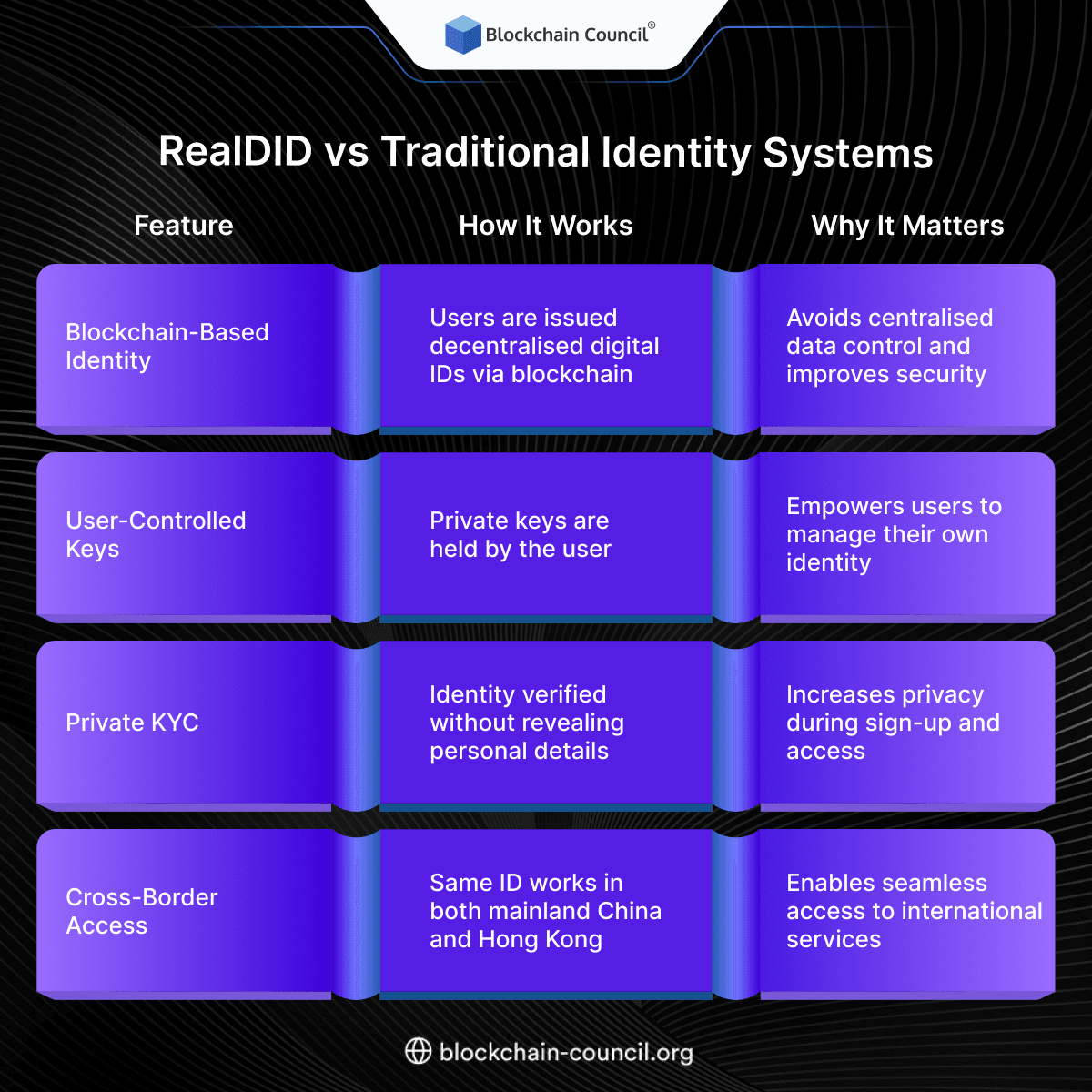
RealDID vs traditional identity systems is becoming a practical decision point for organizations facing AI-driven fraud, rising breach costs, and stricter privacy expectations. Traditional identity models still dominate day-to-day onboarding and access control, but decentralized identity approaches are gaining traction because they can verify eligibility while limiting personal data exposure. RealDID is a notable example: a government-backed decentralized identity (DID) system developed by China's Ministry of Public Security on the Blockchain-based Service Network (BSN), designed to support verification and regulatory alignment without repeatedly revealing sensitive identifiers like names or national ID numbers.
Compare RealDID and traditional identity systems by understanding decentralization, privacy, and control through a Certified Blockchain Expert, implementing identity solutions using a Python Course, and scaling adoption via a Digital marketing course.

What RealDID Is and Why It Matters
RealDID is a decentralized identity architecture that uses cryptography and reusable credentials to prove claims about a user. Instead of sending full identity profiles to each service provider, users present proofs tied to credentials issued by trusted parties. This aligns with the broader Self-Sovereign Identity (SSI) direction: verify what is necessary, share as little as possible, and make compliance compatible with user experience.
Core SSI Components Used in RealDID-Style Systems
Decentralized Identifiers (DIDs): unique identifiers controlled by the user rather than a single platform database.
Verifiable Credentials (VCs): tamper-evident attestations such as age eligibility, residency, or professional accreditation.
Identity wallets: user-held storage that supports selective disclosure of attributes.
Traditional Identity Systems: Strengths and Persistent Risks
Traditional identity systems are deeply integrated into global infrastructure. They rely on centralized registries, document checks, and well-established compliance workflows that regulators and institutions recognize. In practice, many environments have become hybrid: airports, for example, increasingly combine traditional credential recognition with digital verification through biometric e-gates or mobile passport workflows.
However, traditional models concentrate risk. Centralized databases become high-value targets, and physical IDs often lack strong protections such as encryption or built-in multi-factor authentication. A recurring issue is data duplication: individuals re-submit the same documents across multiple services, while each provider accumulates sensitive datasets that expand breach impact and compliance burden.
Security Trade-Offs: Cryptographic Proofs vs Centralized Controls
RealDID Security Model
RealDID-style decentralized identity systems use public-private key cryptography to prove identity attributes. This reduces dependence on passwords and large centralized data stores, which are common breach vectors. The security advantage for organizations is twofold: stronger authentication primitives and a reduced blast radius, since fewer systems need to store sensitive personal data when verification can be performed via credential proofs.
Traditional System Security Model
Traditional systems rely on regulatory oversight, standardized processes, and mature operational controls. That maturity helps with audits and interoperability, but it does not eliminate structural weaknesses. When sensitive information is stored centrally, attackers can target a single repository to extract records at scale. Centralization also increases insider risk and complicates containment when incidents occur.
Privacy Trade-Offs: Selective Disclosure vs Full-Profile Sharing
RealDID and Data Minimization
Selective disclosure is the defining privacy advantage in the RealDID vs traditional identity systems comparison. A user can prove they are over 18 without disclosing a full date of birth, or confirm eligibility without sharing a national identifier. Reusable credentials also reduce repeated KYC submissions, which limits unnecessary data spread across vendors and departments.
Traditional Privacy Challenges
Traditional models frequently require comprehensive data collection for routine access. Over time, organizations accumulate copies of IDs, proofs of address, and other sensitive documents across ticketing systems, CRMs, and third-party processors. State-managed programs can also face public concern when governance is opaque or when data collection expands beyond its original purpose. Trust depends heavily on transparency, clear limits on data use, and meaningful user agency.
Compliance Trade-Offs: Regulatory Maturity vs Compliance-Friendly Design
Traditional identity systems benefit from long-standing regulatory acceptance. Many compliance programs are designed around them, which reduces friction during audits and cross-institution recognition.
RealDID demonstrates a different path: government-backed DID can align with regulation while embracing privacy-by-design principles. For enterprises, a key compliance advantage is data minimization - organizations can verify eligibility without storing personally identifiable information in every application. This supports attribute-based authorization decisions and can reduce liability exposure tied to unnecessary data retention.
Where Each Approach Fits Best: Organizational Use Cases
RealDID-Style Decentralized Identity Use Cases
Reusable KYC: users present already-verified credentials, reducing repeated onboarding and limiting data exposure.
Enterprise access control: verify business credentials, authorized signatories, and certifications without collecting full identity records.
Web3 governance: support membership eligibility, one-person-one-vote patterns, and anti-bot participation controls using credential proofs.
Regulated DeFi onboarding: enable access to compliant pools using reusable credentials rather than repeated document submissions.
Traditional and Hybrid Identity Use Cases
High-coverage onboarding where universal accessibility matters, including users without digital wallets or consistent connectivity.
Legacy integrations where business processes and vendors are built around centralized identity repositories.
Hybrid travel and border workflows that combine traditional credentials with digital verification.
Decision Framework for Modern Organizations
Choosing between RealDID and traditional identity systems is rarely all-or-nothing. Many organizations are moving toward hybrid identity stacks that combine the reliability of established processes with the privacy and security advantages of credential-based verification.
Practical Questions to Ask
What is the minimum data required to authorize access or complete onboarding?
Where does sensitive data live today, and how many systems duplicate it?
Which regulations apply across jurisdictions, and where can data minimization reduce compliance friction?
What adoption barriers exist for customers and staff, including wallet usability and training requirements?
For teams building capability in this area, internal training and certification pathways covering blockchain, Web3, and cybersecurity can provide a structured foundation. Specialized learning tracks that address decentralized identity concepts - including DIDs, verifiable credentials, and secure key management - help organizations develop practical implementation expertise.
Evaluate the advantages of decentralized identity over centralized systems by mastering blockchain through a Blockchain Course, enhancing security via Cyber security certifications, and driving awareness with an AI powered marketing course.
Conclusion
RealDID vs traditional identity systems presents a clear set of trade-offs. Traditional identity offers familiarity and regulatory maturity, but centralization increases breach impact and encourages over-collection of personal data. RealDID-style decentralized identity improves privacy through selective disclosure and supports compliance-friendly data minimization, particularly for multi-jurisdiction enterprises and high-risk onboarding flows. For most organizations, the strongest near-term strategy is a phased, hybrid approach: retain what works operationally, reduce unnecessary data storage, and adopt credential-based verification where it meaningfully improves security, privacy, and compliance outcomes.
FAQs
1. What is the difference between RealDID and traditional identity systems?
RealDID is decentralized, while traditional systems are centralized. Users control their data in RealDID. Traditional systems rely on third-party authorities.
2. How does RealDID improve security compared to traditional systems?
RealDID uses blockchain and encryption for secure storage. Traditional systems are vulnerable to data breaches. This makes RealDID more secure.
3. Which system offers better privacy?
RealDID offers better privacy through selective data sharing. Traditional systems often store full data centrally. This increases exposure risk.
4. How does data control differ between the two?
RealDID gives users full control over their identity data. Traditional systems are controlled by organizations. This limits user control.
5. Are traditional identity systems still widely used?
Yes, traditional systems are still dominant globally. They are integrated into many processes. However, RealDID adoption is growing.
6. What are the main limitations of traditional identity systems?
They are prone to breaches and fraud. They require repeated verification. They lack transparency.
7. How does RealDID reduce identity fraud?
It uses secure verification and immutable records. This prevents tampering. It reduces fraud significantly.
8. Can RealDID integrate with existing systems?
Yes, integration is possible but requires technical effort. Hybrid systems are emerging. This helps transition gradually.
9. Which system is more cost-effective?
RealDID reduces costs through automation and reduced intermediaries. Traditional systems involve higher operational costs. Efficiency improves with RealDID.
10. How does user experience differ?
RealDID simplifies verification processes. Traditional systems require repeated documentation. This makes RealDID more user-friendly.
11. What role does blockchain play in RealDID?
Blockchain ensures secure and transparent identity management. It provides immutability. This is key to RealDID.
12. Are there regulatory challenges for RealDID?
Yes, regulations are still evolving. Compliance can be complex. This slows adoption.
13. Which system is better for Web3?
RealDID is ideal for Web3 due to decentralization. Traditional systems are not suitable. This supports Web3 growth.
14. Can RealDID replace traditional systems completely?
Not immediately, as adoption is still growing. Hybrid models are likely. Gradual transition is expected.
15. How does RealDID improve efficiency?
It automates identity verification processes. This reduces time and effort. It improves system efficiency.
16. What are the risks of RealDID?
Risks include technical complexity and adoption barriers. Mismanagement can affect security. Proper implementation is important.
17. Which system is more scalable?
RealDID is more scalable due to decentralized infrastructure. Traditional systems face limitations. This supports growth.
18. How does RealDID impact businesses?
It reduces fraud and improves customer trust. It simplifies operations. This benefits businesses.
19. What is the future of identity systems?
The future will include decentralized identity solutions. RealDID adoption will increase. It will reshape identity management.
20. Why is RealDID gaining popularity?
It offers better security, privacy, and control. It aligns with digital transformation trends. This drives adoption.
Related Articles
View AllInfographics
Key Features of Agentic AI Systems
Infographics
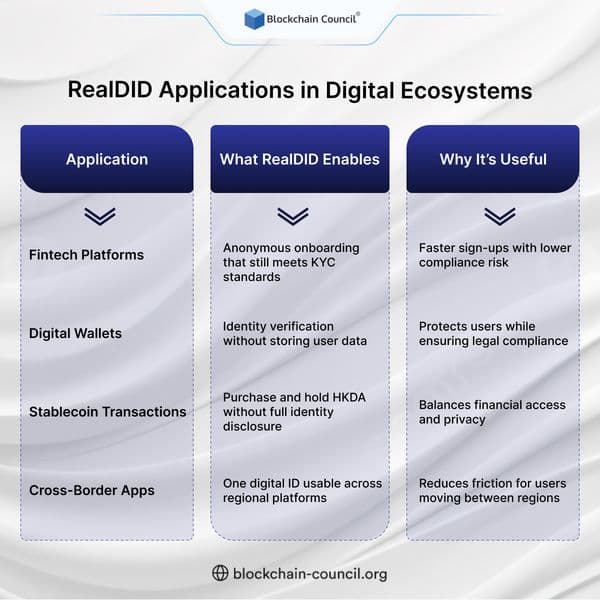
RealDID Applications in Digital Ecosystems
Explore RealDID applications in digital ecosystems and how decentralized identity improves security, privacy, and user control.
Infographics
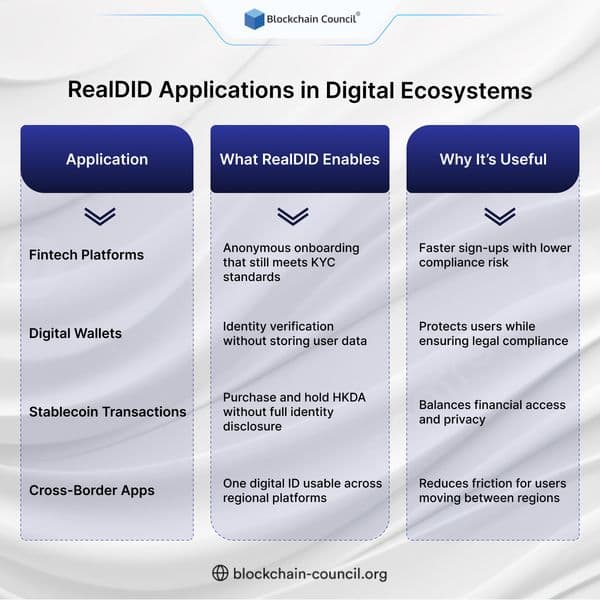
RealDID in Digital Ecosystems
RealDID brings government-backed decentralized identity to Web3, reusable KYC, IoT, and enterprise access control with privacy-preserving verification.
Trending Articles
AWS Career Roadmap
A step-by-step guide to building a successful career in Amazon Web Services cloud computing.

Top 5 DeFi Platforms
Explore the leading decentralized finance platforms and what makes each one unique in the evolving DeFi landscape.
How Blockchain Secures AI Data
Understand how blockchain technology is being applied to protect the integrity and security of AI training data.