

GPT 5.5 First Look: Efficiency, Power, and Creative Coding Benchmarks

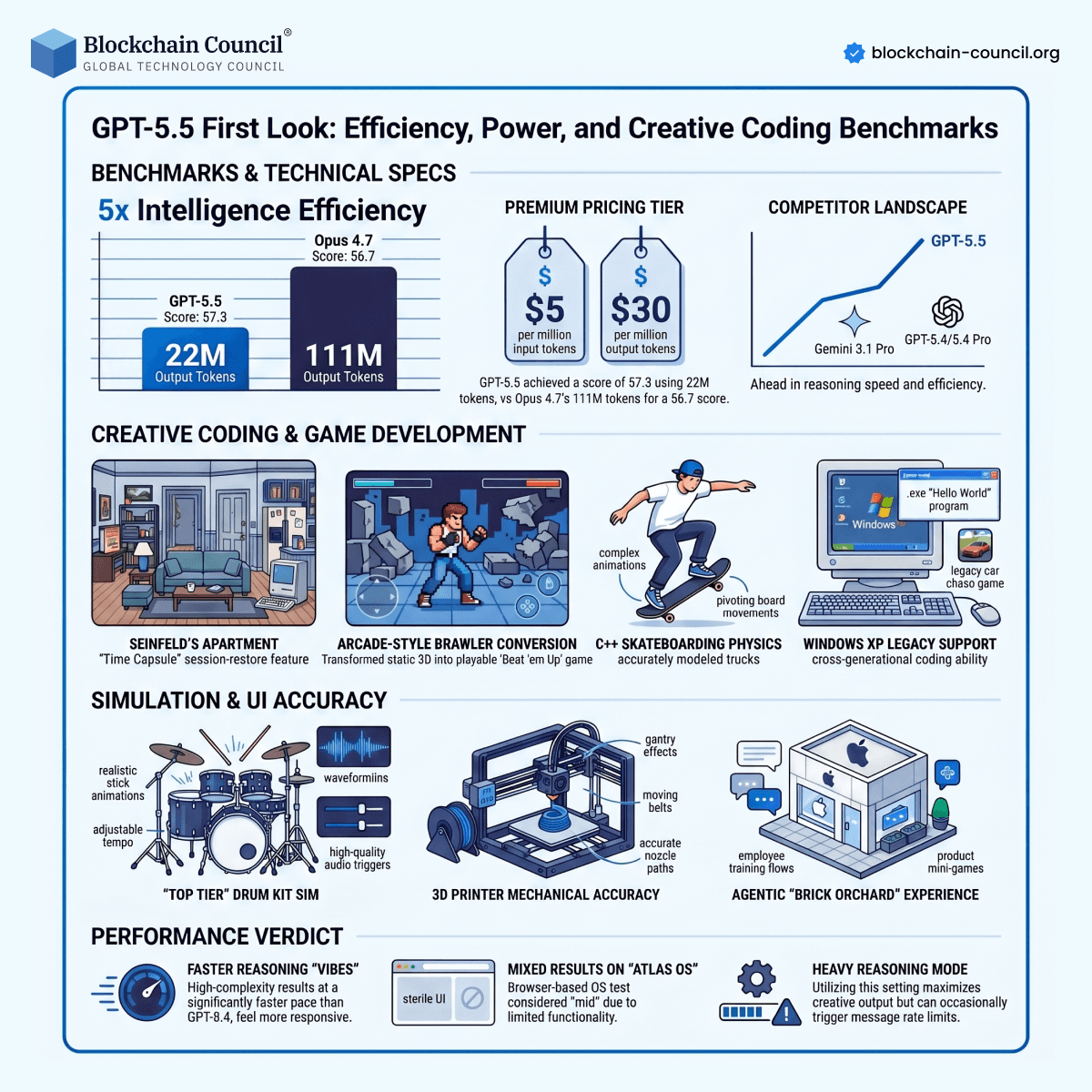
Artificial intelligence has entered a phase where incremental improvements matter more than flashy demos. The next generation of models, often referred to informally as GPT 5.5, represents a shift toward efficiency, reliability, and real-world performance. These systems are not just larger or faster. They are designed to be more practical, more accurate, and significantly more useful in professional environments.
To fully understand and leverage such systems, many professionals begin with structured learning paths like the ChatGPT Expert certification and the AI expert certification. These programs provide foundational knowledge of modern AI tools and their applications.

This article explores what defines a GPT 5.5 level system, focusing on efficiency, computational power, creative coding capabilities, and benchmark performance across industries.
What Is GPT 5.5 in Context
GPT 5.5 is not a formally announced product but rather a conceptual midpoint between major AI model generations. It reflects improvements in:
Efficiency and resource usage
Reasoning and accuracy
Multi step task execution
Integration with tools and workflows
Instead of being a dramatic leap, it represents refinement. Less spectacle, more usefulness.
Evolution Toward Efficient AI Models
Earlier models focused heavily on scale. More parameters, more data, more compute. That approach worked, but it came with costs.
Shift in Priorities
Modern AI development emphasizes:
Smarter architectures instead of just bigger models
Optimized inference for faster responses
Reduced energy consumption
Efficiency is no longer optional. It is a requirement.
Efficiency Improvements in GPT 5.5 Class Models
Reduced Computational Load
New architectures are designed to deliver high performance with lower computational requirements.
Example
A task that previously required large cloud resources can now run faster with optimized models.
Faster Response Times
Latency has been reduced significantly, enabling near real time interactions.
Impact
Better user experience
Improved workflow integration
Cost Efficiency
Lower computational demand translates into reduced operational costs, making AI more accessible.
Power and Capability Enhancements
Efficiency does not come at the cost of capability. In fact, modern models are becoming more powerful.
Improved Reasoning
AI systems can now handle complex reasoning tasks more effectively.
Example
Analyzing business strategies and providing structured recommendations.
Better Context Retention
Longer context windows allow AI to maintain coherence across extended interactions.
Multimodal Processing
Models can process and generate text, images, and other data types simultaneously.
Creative Coding Capabilities
One of the most significant advancements is in coding.
Code Generation
AI can generate functional code across multiple programming languages.
Example
Developers can describe a feature, and the AI generates the corresponding code.
Debugging and Optimization
AI assists in identifying errors and suggesting improvements.
Rapid Prototyping
Developers can quickly build and test applications using AI assistance.
Professionals looking to enhance these skills often turn to programs like the AI Powered coding expert Course, which focuses on practical AI applications in software development.
Creative Coding Benchmarks
Creative coding benchmarks evaluate how well AI can:
Generate innovative solutions
Adapt to new problems
Produce efficient and readable code
Observed Trends
Higher accuracy in code generation
Improved handling of edge cases
Better documentation and explanation
AI is moving from “helpful assistant” to “competent collaborator.”
Real World Use Cases
Software Development
AI accelerates development cycles by automating repetitive tasks.
Example
A startup reduces development time by using AI for backend code generation.
Marketing and Content Creation
AI tools generate content, analyze trends, and optimize campaigns.
Programs like the AI powered digital marketing course help professionals apply these capabilities effectively.
Business Operations
AI automates workflows, improving efficiency and reducing costs.
Data Analysis
AI processes large datasets and provides actionable insights.
Benchmarking AI Performance
Benchmarking evaluates AI performance across various tasks.
Accuracy Metrics
Measures correctness of outputs.
Speed Metrics
Evaluates response time and efficiency.
Task Completion
Assesses ability to complete multi step tasks.
Example
Comparing AI performance in coding challenges or data analysis tasks.
Challenges in AI Benchmarking
Benchmarking AI is not straightforward.
Limitations
Benchmarks may not reflect real world scenarios
Overfitting to test datasets
Rapid changes in model capabilities
So yes, benchmarks matter, but they are not the whole story.
Recent Developments in AI Models
Fine Tuning Techniques
Models can be customized for specific tasks.
Agent Based Systems
AI systems are becoming more autonomous and capable of executing workflows.
Improved Safety Measures
Efforts are being made to reduce harmful or inaccurate outputs.
Role of AI Skills in the Modern Era
Understanding AI tools is becoming essential.
Key Skills
Prompt engineering
Data analysis
Programming basics
These skills help professionals maximize AI capabilities.
Future of GPT Class Models
The future includes:
Greater efficiency
Enhanced reasoning
Deeper integration with tools
Increased specialization
AI will continue to evolve toward practical, reliable systems.
Conclusion
The concept of GPT 5.5 represents a shift in artificial intelligence toward efficiency, power, and real world usability. Instead of focusing solely on scale, modern models prioritize performance, reliability, and integration.
From creative coding to business automation, these systems are becoming essential tools across industries. Understanding their capabilities and limitations is key to leveraging their full potential.
The future of AI is not just about what it can do, but how effectively it can do it.
FAQs
1. What is GPT 5.5
GPT 5.5 is a conceptual term used to describe the next stage of AI model evolution, focusing on efficiency, reasoning, and real-world usability. It represents a transition from experimental AI tools to systems designed for consistent and practical outcomes. While not officially confirmed, it reflects the direction in which modern AI development is clearly heading.
2. How is GPT 5.5 different from earlier models
Unlike earlier models that prioritized scale and raw capability, GPT 5.5 emphasizes efficiency, accuracy, and task completion. It is designed to handle complex workflows more reliably and integrate better into real-world applications. This makes it significantly more useful for professionals rather than just impressive in demonstrations.
3. What is AI efficiency
AI efficiency refers to how effectively a model performs tasks while using minimal computational resources and time. It focuses on delivering high-quality outputs without excessive cost or energy consumption. This has become a major priority as AI adoption grows across industries.
4. What are creative coding benchmarks
Creative coding benchmarks measure how well AI can generate not just correct code, but innovative and efficient solutions. They evaluate adaptability, problem solving, and the ability to handle unfamiliar scenarios. These benchmarks are evolving to better reflect real-world development challenges.
5. Can AI replace programmers
AI can automate repetitive coding tasks and assist with debugging, but it cannot fully replace programmers. Human developers are still needed for designing systems, solving complex problems, and making critical decisions. In practice, AI acts more like a productivity tool than a replacement.
6. How does AI improve coding
AI improves coding by generating code snippets, identifying errors, and suggesting optimizations in real time. It reduces the time spent on routine tasks and helps developers focus on more complex aspects of projects. This leads to faster development cycles and improved efficiency.
7. What industries benefit from AI
Industries such as technology, healthcare, finance, and marketing benefit significantly from AI. It helps automate processes, analyze data, and improve decision making across these sectors. As adoption increases, its impact continues to expand into nearly every field.
8. What are the limitations of AI
AI still has limitations, including occasional inaccuracies, lack of true understanding, and dependence on high-quality data. It can produce confident but incorrect outputs, which require human validation. Despite improvements, oversight remains necessary.
9. What is multimodal AI
Multimodal AI refers to systems that can process and generate multiple types of data, such as text, images, and audio. This allows for more comprehensive understanding and richer outputs. It is a major step toward more versatile and capable AI systems.
10. How does AI handle complex tasks
AI handles complex tasks by breaking them into smaller steps, analyzing patterns, and applying learned knowledge to generate solutions. It processes large amounts of data quickly and can manage multi-step workflows. However, human guidance is often needed for best results.
11. What is AI benchmarking
AI benchmarking is the process of evaluating a model’s performance using standardized tests for accuracy, speed, and task completion. It helps compare different systems and track improvements over time. However, benchmarks do not always reflect real-world performance perfectly.
12. How can professionals learn AI
Professionals can learn AI through certifications, online courses, and hands-on experience with real tools. Continuous learning is important because the field evolves rapidly. Practical application is often more valuable than theoretical knowledge alone.
13. What is prompt engineering
Prompt engineering involves designing inputs that guide AI systems to produce accurate and relevant outputs. It requires understanding how models interpret language and refining prompts for better results. This skill has become increasingly important in working with AI.
14. What is the future of AI
The future of AI includes more efficient, specialized, and autonomous systems that integrate deeply into everyday workflows. AI will become less visible but more embedded in tools and platforms. Its role in productivity and decision making will continue to grow.
15. Can AI make decisions
AI can support decision making by analyzing data and providing insights, but it does not replace human judgment. Final decisions often require context, ethics, and experience that AI cannot fully replicate. It works best as a decision support system.
16. What is AI integration
AI integration refers to incorporating AI systems into existing tools, platforms, and workflows. This allows organizations to automate tasks and improve efficiency without completely replacing current systems. Successful integration is key to real-world AI adoption.
17. How reliable is modern AI
Modern AI is significantly more reliable than earlier versions, but it is not flawless. It performs well in structured tasks but may still produce errors in complex or ambiguous situations. Regular monitoring and validation are essential for accuracy.
18. What skills are needed for AI
Key skills include basic programming, data analysis, and an understanding of AI concepts and limitations. Prompt engineering and critical thinking are also increasingly important. Continuous learning helps professionals stay competitive in this field.
19. How does AI impact jobs
AI is transforming jobs by automating repetitive tasks and creating new roles that require technical and analytical skills. While some roles may change or disappear, new opportunities are emerging. Adaptability is essential in this evolving landscape.
20. Why is AI important
AI is important because it enhances efficiency, accelerates innovation, and improves decision making across industries. It enables organizations to process data and perform tasks at a scale that was not previously possible. Its influence will continue to shape the future of work and technology.
Related Articles
View All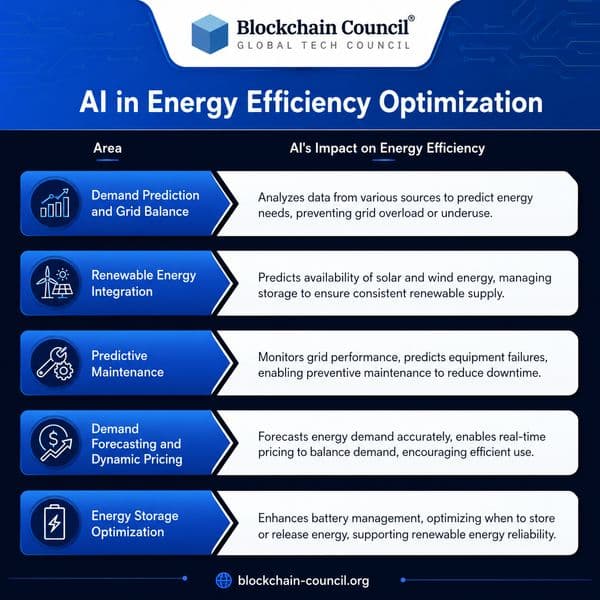
Infographics
AI in Energy Efficiency Optimization
AI improves energy efficiency by optimizing power usage, automating energy systems, and enhancing sustainability across industries and infrastructure.
Infographics
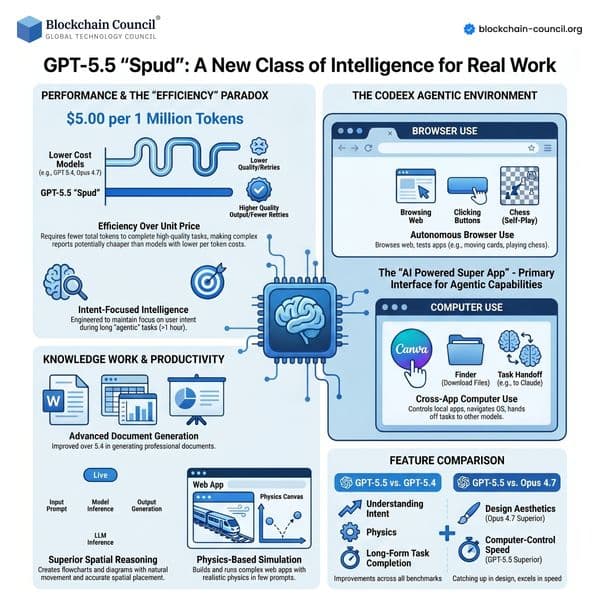
GPT 5.5 Spud: A New Intelligence for Real Work
GPT 5.5 Spud introduces a new level of AI intelligence focused on executing real-world tasks efficiently.

Infographics
Digital Asset Investment Guide: Build a Smarter Strategy for the Future of Finance
Digital asset investing has become a key part of the modern financial landscape, offering opportunities in cryptocurrencies, tokenized assets, NFTs, and blockchain-based investments. Whether you're a beginner or an experienced investor, understanding market fundamentals, diversification, security, and risk management is essential for building a successful digital asset portfolio. This guide explores the core concepts, investment strategies, and best practices for navigating the digital asset market.
Trending Articles

Top 5 DeFi Platforms
Explore the leading decentralized finance platforms and what makes each one unique in the evolving DeFi landscape.

Can DeFi 2.0 Bridge the Gap Between Traditional and Decentralized Finance?
The next generation of DeFi protocols aims to connect traditional banking with decentralized finance ecosystems.
Claude AI Tools for Productivity
Discover Claude AI tools for productivity to streamline tasks, manage workflows, and improve efficiency.