

GPT 5.5 Spud: A New Intelligence for Real Work

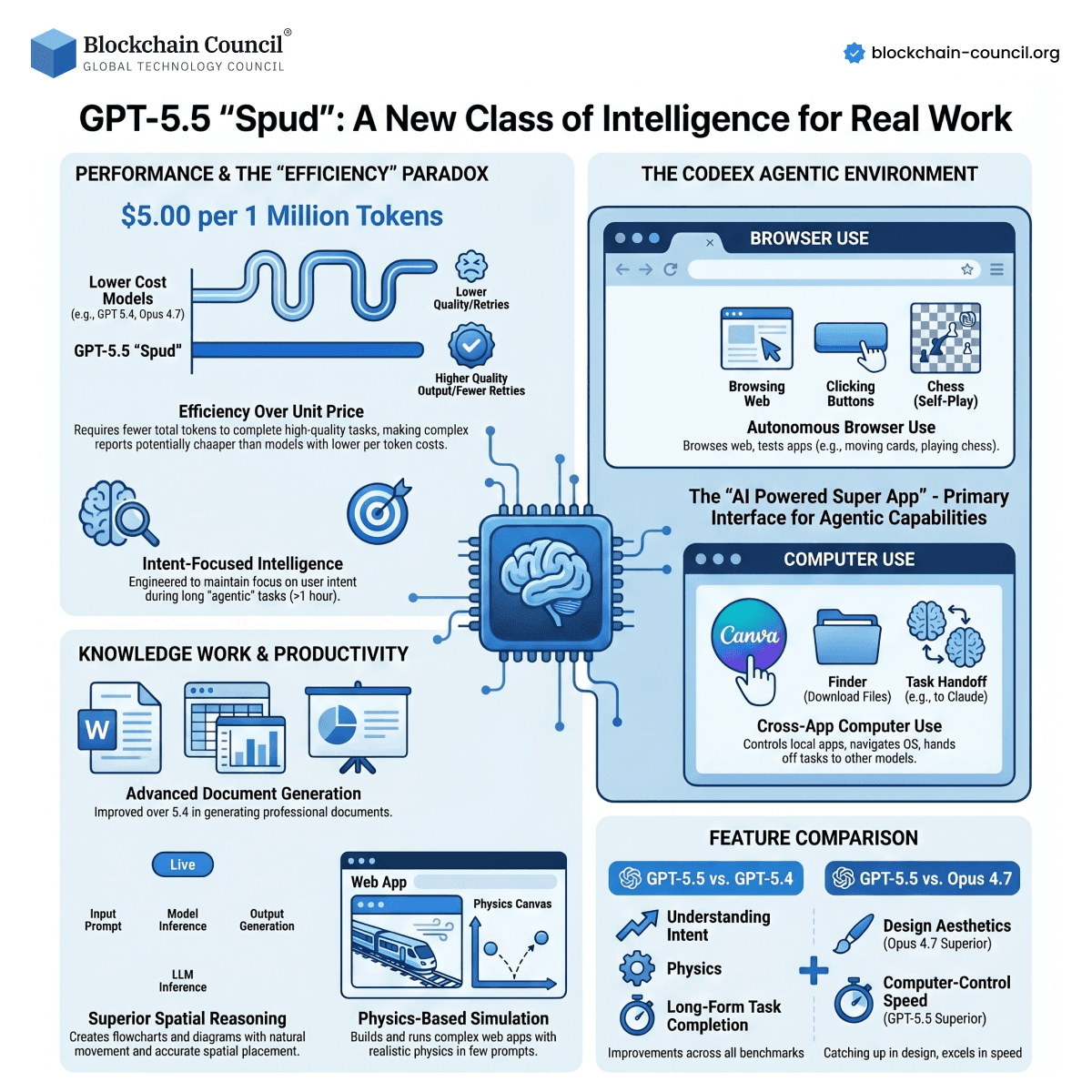
Artificial intelligence has moved rapidly from experimental tools to essential business infrastructure. The latest generation of large language models is no longer focused only on conversation or content generation. Instead, these systems are evolving into practical, reliable, and task oriented assistants capable of handling real work.
The concept often described as “GPT 5.5 Spud” reflects this shift toward more grounded, execution focused AI. Rather than chasing novelty, the emphasis is now on accuracy, reasoning, integration, and measurable productivity.

To understand and apply these systems effectively, professionals often begin with structured learning programs such as the ChatGPT Expert certification and the AI expert certification. These certifications provide practical knowledge of modern AI tools and their real world applications.
This article explores what defines this new generation of AI, its core capabilities, real world use cases, and the future of intelligent systems built for actual work.
What Does “A New Intelligence for Real Work” Mean
Earlier AI systems were impressive but inconsistent. They could generate text, answer questions, and assist with tasks, but reliability was often questionable.
The new generation focuses on:
Accuracy over creativity when needed
Task completion rather than just responses
Integration with tools and workflows
Consistency and reliability
In short, less “interesting chatbot” and more “competent digital coworker.”
Evolution of GPT Models
Understanding the shift requires a look at how AI models have evolved.
Early Models
Focused on basic text generation and pattern recognition.
Mid Generation Models
Improved reasoning and contextual understanding, but still prone to errors.
Current Direction
Systems are now designed to:
Execute multi step tasks
Integrate with external tools
Provide verifiable outputs
This evolution reflects a move from experimentation to practical deployment.
Core Capabilities of Next Generation AI Systems
1. Advanced Reasoning
Modern AI systems demonstrate improved logical reasoning and problem solving abilities.
Example
Instead of providing vague answers, the system can break down a business problem into actionable steps and suggest solutions.
2. Multi Step Task Execution
AI can now handle complex workflows involving multiple steps.
Example
Planning a marketing campaign, generating content, scheduling posts, and analyzing results.
3. Tool Integration
AI systems integrate with external tools such as:
Databases
APIs
Software platforms
This allows them to perform real actions rather than just provide suggestions.
4. Context Awareness
Modern AI maintains context over longer interactions, improving accuracy and relevance.
Example
A project management assistant remembers previous discussions and builds on them.
5. Reliability and Consistency
The focus is on reducing errors and improving output quality.
Example
Generating structured reports with minimal factual inaccuracies.
Real World Applications
Business Operations
AI systems automate repetitive tasks, allowing teams to focus on strategic work.
Example
Automating invoice processing and financial reporting.
Software Development
AI assists developers with code generation, debugging, and testing.
Professionals often enhance these skills through programs like the AI Powered coding expert Course.
Marketing and Content Creation
AI tools generate content, analyze audience behavior, and optimize campaigns.
Programs like the AI powered digital marketing course help professionals apply these capabilities effectively.
Customer Support
AI agents handle customer queries, reducing response times and improving satisfaction.
Healthcare
AI assists in diagnostics, data analysis, and patient management.
Key Advantages of This New AI Generation
Efficiency
Tasks that previously took hours can now be completed in minutes.
Scalability
AI systems can handle large volumes of work simultaneously.
Cost Reduction
Automation reduces operational costs over time.
Accessibility
Advanced tools are becoming available to a wider audience.
Challenges and Limitations
Accuracy Concerns
While improved, AI systems are not perfect and may still produce incorrect outputs.
Dependence on Data
Performance depends heavily on the quality of data used.
Ethical Considerations
Issues such as bias, privacy, and accountability remain important.
Integration Complexity
Implementing AI systems into existing workflows can be challenging.
Recent Developments in AI Systems
Multimodal Capabilities
AI can now process text, images, and audio together.
Autonomous Agents
Systems are becoming more independent in executing tasks.
Improved Fine Tuning
Customization allows AI to perform specific tasks more effectively.
Enterprise Adoption
Businesses are increasingly integrating AI into core operations.
How Businesses Are Using AI for Real Work
Example 1: E Commerce
AI manages inventory, predicts demand, and personalizes recommendations.
Example 2: Finance
AI detects fraud and automates financial analysis.
Example 3: Media
AI generates content and assists in editing and production.
Skills Required to Work with Modern AI
Prompt engineering
Data analysis
Basic programming
Understanding AI limitations
These skills help users maximize the benefits of AI systems.
Future of AI for Real Work
The future will likely include:
Greater autonomy
Improved accuracy
Deeper integration with workflows
More specialized AI systems
AI will continue to evolve as a practical tool rather than just a novelty.
Conclusion
The idea behind “GPT 5.5 Spud” represents a broader shift in artificial intelligence. The focus is no longer on impressive demonstrations but on delivering real value through reliable, efficient, and actionable systems.
As AI continues to mature, it will become an integral part of everyday work, transforming industries and redefining productivity. Understanding and adapting to these changes will be essential for professionals and businesses alike.
FAQs
1. What is GPT 5.5 Spud
GPT 5.5 Spud is not an officially confirmed model but represents the concept of advanced AI systems designed for real work. These systems focus on reliability, reasoning, and task execution. The term reflects the evolution of AI toward practical applications.
2. How is modern AI different from earlier models
Modern AI systems are more accurate, context aware, and capable of handling complex tasks. They integrate with tools and provide actionable outputs. This makes them more useful for real work.
3. What does real work mean in AI
Real work refers to practical tasks such as automation, data analysis, and workflow management. AI systems are now designed to perform these tasks efficiently. This marks a shift from experimental use.
4. Can AI replace human workers
AI can automate certain tasks but cannot fully replace human creativity and judgment. It is best used as a supportive tool. Collaboration between humans and AI is more effective.
5. What industries benefit from AI
Industries such as healthcare, finance, marketing, and technology benefit from AI. It improves efficiency and decision making. Its applications continue to expand.
6. How does AI improve productivity
AI automates repetitive tasks and provides quick insights, saving time and effort. This allows professionals to focus on strategic activities. Productivity increases significantly.
7. What are the risks of AI
Risks include inaccuracies, bias, and ethical concerns. Proper management and oversight are required. Understanding limitations is important.
8. What skills are needed for AI
Skills include prompt engineering, data analysis, and basic programming. Continuous learning is essential. These skills help professionals stay relevant.
9. How is AI used in marketing
AI is used to analyze customer data, create content, and optimize campaigns. It improves targeting and engagement. This enhances marketing effectiveness.
10. Can AI handle complex tasks
Yes, modern AI systems can handle multi step tasks and workflows. Their capabilities are improving rapidly. However, human oversight is still needed.
11. What is multimodal AI
Multimodal AI processes multiple types of data such as text and images. It enhances understanding and output quality. This technology is advancing quickly.
12. How reliable is modern AI
Modern AI is more reliable than earlier systems but not perfect. It requires validation and monitoring. Continuous improvements are being made.
13. What is AI integration
AI integration involves connecting AI systems with existing tools and workflows. This enhances functionality and efficiency. It is essential for real world use.
14. How do businesses adopt AI
Businesses adopt AI by identifying use cases, implementing tools, and training employees. A strategic approach ensures success. Adoption is increasing globally.
15. What is the future of AI
The future includes more advanced, autonomous, and specialized systems. AI will become more integrated into daily work. Its impact will continue to grow.
16. Can AI make decisions
AI can assist in decision making by analyzing data and providing insights. Final decisions often require human input. This ensures better outcomes.
17. What are AI agents
AI agents are systems that can act independently to achieve goals. They perform tasks and adapt to changes. They are becoming more common.
18. How does AI affect jobs
AI changes job roles by automating tasks and creating new opportunities. Workers need to adapt and learn new skills. This transition is ongoing.
19. Is AI expensive to implement
Costs vary depending on the system and scale. Initial investment may be high, but long term benefits often outweigh costs. Planning is important.
20. Why is AI important for the future
AI is important because it enhances efficiency, innovation, and decision making. It will shape industries and economies. Its role will continue to expand.
Related Articles
View All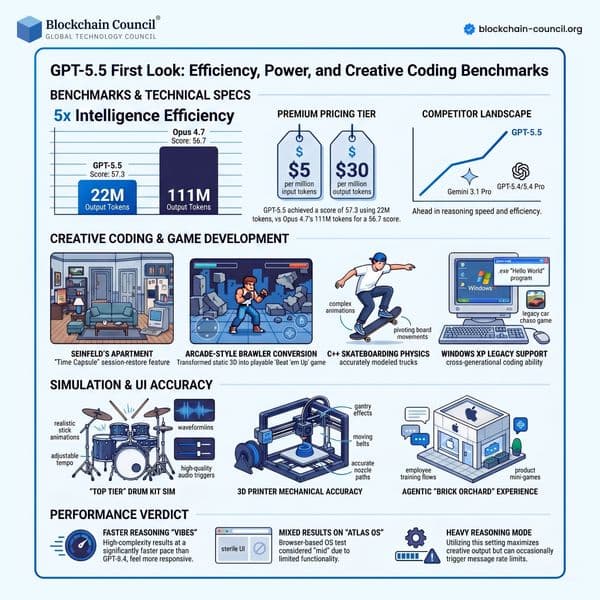
Infographics
GPT 5.5 First Look: Efficiency, Power, and Creative Coding Benchmarks
GPT 5.5 delivers improved efficiency, stronger performance, and better coding benchmarks compared to previous models.
Infographics
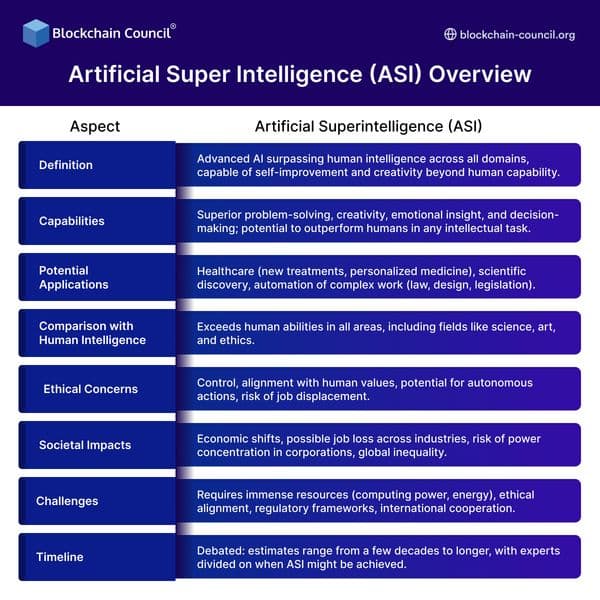
Artificial Super Intelligence (ASI) Overview
Artificial Super Intelligence (ASI) refers to a future AI that surpasses human intelligence across all domains, including creativity and decision-making.

Infographics
How Do Nodes Work In Corda Network?
How do nodes work in Corda network? Learn what a Corda node is, how the vault, messaging, doorman, network map, and notary fit together, and how a transaction moves between nodes, including Corda 5 changes.
Trending Articles

Top 5 DeFi Platforms
Explore the leading decentralized finance platforms and what makes each one unique in the evolving DeFi landscape.
What is AWS? A Beginner's Guide to Cloud Computing
Everything you need to know about Amazon Web Services, cloud computing fundamentals, and career opportunities.
Claude AI Tools for Productivity
Discover Claude AI tools for productivity to streamline tasks, manage workflows, and improve efficiency.